BCH4024 Douma Exam 4 - Lecture 3
 Call Kai
 Learn
Learn Practice Test
 Spaced Repetition
 Match
Match Flashcards
 Knowt Play
1/51

There's no tags or description
Looks like no tags are added yet.
52 Terms
Why are magnesium ions necessary for DNA Polymerase activity?
They stabilize the 3' hydroxyl nucleophile and the negative charges on the incoming triphosphate electrophile. This facilitates the nucleophilic attack on the alpha-phosphate.
What residues position the catalytic magnesium ions in DNA Polymerase?
Two aspartic acid residues.
What is released during nucleotide addition by DNA Polymerase?
Pyrophosphate (beta and gamma phosphates).
What direction does DNA synthesis occur in?
5' to 3' direction.
What is a primer in DNA replication?
A short DNA or RNA sequence with a 3' hydroxyl group for DNA Polymerase to extend.
Can DNA Polymerase initiate DNA synthesis de novo?
No, it requires a pre-existing 3' hydroxyl group.
What is the average E. coli mutation rate, and why is it impressive?
1 base pair in 10^9 - 10^10 base pairs. It's impressive because the E. coli genome is roughly 4.6 x 10^6 base pairs, meaning an error occurs only once per 1,000-10,000 replications.
What is pre-synthetic error control in DNA Polymerase?
The DNA Polymerase active site restricts base pairing to Watson-Crick-Franklin bp. It does this by ensuring correct base pairing through geometric fit before forming a phosphodiester bond.
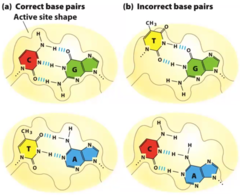
What is the error rate after pre-synthetic error control?
About one error per 10^4 to 10^5 nucleotides.
What are high-fidelity DNA polymerases?
They are DNA polymerases that have two active sites: 1) A catalytic site for DNA synthesis, and 2) a 3' -> 5' exonuclease site for removing mis-incorporated nucleotides.
What is proofreading activity in DNA Polymerase?
3' to 5' exonuclease activity that removes incorrectly added nucleotides.
What type of exonuclease activity does proofreading involve?
3' to 5' exonuclease activity.
Where does DNA replication begin?
At a specific DNA sequence called the origin of replication.
What is a replication bubble?
The locally separated region of DNA formed during replication initiation.
How many replication forks form at each origin?
Two replication forks, proceeding bidirectionally.
What is the function of Helicase during replication?
Separates parental DNA strands by breaking hydrogen bonds using ATP.
Which strand is synthesized continuously?
Leading strand.
Which strand is synthesized discontinuously?
Lagging strand.
What are the short DNA fragments on the lagging strand called?
Okazaki fragments.
Why is the lagging strand synthesized in fragments?
Because its 5' to 3' synthesis direction is opposite to the movement of the replication fork.
What problem arises ahead of the replication fork due to helicase activity?
Positive supercoiling (overwound DNA).
What problem arises behind the replication fork?
Negative supercoiling (underwound DNA).
What enzyme removes supercoils during replication?
Topoisomerases.
What does a topoisomerase do?
Cuts DNA strands to relieve supercoiling and then reseals the break.
Why is DNA replication initiation highly regulated?
Because once initiated, it cannot be reversed and must occur only once per cell cycle.
What is the name of the origin of replication in E. coli?
oriC.
What is the first protein to bind during replication initiation?
DNA A.
What DNA sites does DNA A bind to at the origin?
R and I sites (general binding sites for DNA A).
What is the DUE region?
DNA unwinding element; an AT-rich region where the initial strand separation occurs.
Why is the DUE region AT-rich?
AT base pairs have only two hydrogen bonds, making them easier to separate.
How does DNA A initiate strand separation?
DNA A molecules bind to R/I sites, oligomerize into a helical structure, and create torsional stress to pop open the DUE region.
What is the role of DNA C in replication initiation?
Loads the DNA B helicase onto single-stranded DNA using ATP.
What is the function of DNA B helicase?
Leads the replication fork by unwinding DNA strands.
Why are two DNA B helicases loaded during initiation?
Because replication proceeds bidirectionally with two replication forks.
How is re-initiation of replication prevented in prokaryotes?
Newly replicated origins are hemimethylated and sequestered at the plasma membrane.
What enzyme methylates adenines in GATC sequences?
Dam methylase.
What is the methylation state of newly replicated DNA?
Hemimethylated (one strand methylated, one unmethylated).
What does the cell do right after DNA replication to control the rate of replication in E. coli?
A special enzyme called DAM methylase adds a methyl group to adenine bases. During DNA replication, each new DNA molecule has one old strand (methylated) and one new strand (unmethylated). When the DNA is hemimethylated, special proteins recognize it and lock the oriC to the plasma membrane. This sequestering prevents the origin from firing again too soon; in other words, no second round of replication yet until the process of cell division is fully complete.
What are the two main DNA Polymerases involved in prokaryotic replication?
DNA Polymerase III and DNA Polymerase I.
Which polymerase is the main replicative polymerase in E. coli (i.e., the polymerase that synthesizes the entire genome)?
DNA Polymerase III.
What is the polymerization rate of DNA Polymerase I?
10-20 nucleotides per second.
What is the polymerization rate of DNA Polymerase III?
250-1000 nucleotides per second.
What is processivity in DNA replication?
The number of nucleotides added before the polymerase dissociates from DNA.
Which polymerase has higher processivity?
DNA Polymerase III (at least 500,000 nucleotides).
Which polymerases have proofreading (3' to 5' exonuclease) activity?
DNA Polymerase I and DNA Polymerase III.
Which polymerase is the only polymerase that has 5' to 3' exonuclease activity?
DNA Polymerase I.
What is a holoenzyme?
A core enzyme plus accessory subunits that assist in its function.
What is the DNA Polymerase III holoenzyme composed of?
Three DNA Pol III cores, a clamp loader, and sliding clamps.

What is the role of the clamp loader in the DNA polymerase III complex?
It serves as a scaffold for the DNA polymerase III complex. It helps assemble the beta-clamp onto DNA using ATP. It coordinates the replication fork by interacting with DNA B helicase through Tau subunits.
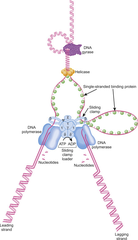
What is the sliding clamp in prokaryotic replication?
The Beta clamp; a donut-shaped protein that tethers DNA Pol III to DNA. It decreases the polymerase dissociation from DNA, increasing processivity.
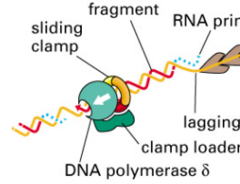
What loads the sliding clamp onto DNA?
The clamp loader.
What does the clamp loader also interact with?
DNA B helicase and DNA Polymerase III cores.