PSYC 336 - remaining content
 Studied by 2 people
 Call Kai
 Learn
Learn Practice Test
 Spaced Repetition
 Match
Match Flashcards
 Knowt Play
1/154

There's no tags or description
Looks like no tags are added yet.
Name | Mastery | Learn | Test | Matching | Spaced |
|---|
No study sessions yet.
155 Terms
kamide et al. (2003): findings
a visual world paradigm
shown different images of objects
tracked eye-gaze after hearing one of the sentences
ex. the man will ride the motorbike
more likely to look at the object before the word is uttered
they integrated information
can generate predictions about the most likely way to finish the sentence
kamide et al. (2003): japanese findings
visual world paradigm with different objects being shown
sentences included case markers
-ni for indirect object
-o for direct object
participants only looked to hamburger only if hearing “-ni”
event related brain potentials
brain responses that are directly linked to events
measured through EEG
N400
a negative voltage peak about 400ms
related to semantic processing
activated when listening to syntactically correct but semantically wrong sentences
delong et al. (2005) findings
participants read sentences with words presented as text one at at a time
ex. the day was breezy so the boy went outside to fly a kite/airplane
sentences with low predictability → greater N400
suprisal
inversely related to the statistical predictability of an event
low suprisal = something is very expected
high suprisal = something is not expected
correlated with size of N400
true or false:
high suprisal in sentences will cause more brain activation in left inferior frontal gyrus (IFG) and left anterior temporal lobe (ATL)
both of these regions are involved in processing syntactic structure
true
true or false:
“the horse raced past the barn and fell” will have higher suprisal than “the hose raced past the barn fell”
this is because the 1st sentence is something very expected and the 2nd sentence is something not very expected
higher suprisal is associated with higher expectedness
false
what is a crucial difference between using ERP analysis and eye tracking to evaluate subject's’ moment-by-moment experiences of spoken language?
ERP experiments allow researchers to test more abstract or complex language, whereas eye-tracking studies are limited to stimuli that can be easily represented in pictures
borovsky et al. (2012): findings
examined age, vocabulary size, and anticipatory looking time
3-10 year old children were slower to look than adults
children and adults with larger vocaulary sizes were faster in anticipatory looks
isabelle, 4, has the vocabulary of a 5-year-old. Sam, 5, has an average vocabulary for his age. In a study of language processing based on predictive eye movement, ____________.
the children would orient to relevant visual cues at similar speeds
example of subject relative clause
the senator who ______ spotted the reporter shouted.
example of object relative clause (more difficult to process than subject relative clause)
the senator who the reporter spotted ______ shouted.
memory failure account of object relative clauses
create more memory demands so they take a longer time to process than subject relative clauses
semantic similarity of the noun also creates burden
according to the memory failure account, which sentence will be harder to process?
A. the senator who the president summoned arrived.
B. the helicopter that the president summoned arrived.
A
faulty predictions/experience-based account of object relative clauses
parser predicts upcoming structure based on prior experience with language
subject relative clauses come up more frequently
based on _____ accounts, readers should exprience the greatest processing difficulty upon encountering ___ in the object relative clause of the sentence:
“the beauty queen who the judge disqualified broke into tears”
experience-based; “the judge”
reading span test
the subject reads a sequence of sentences
asked to write down the last word of the sentence
just & carpenter (1992): findings
participants completed reading span test
tracked processing time when reading object relative clauses and subject relative clauses
low-span participants were slower at reading object relative clauses
same as high-span but differences were more subtle
cognitive control
goal-directed cognitive processes responsible for directing attention and supervising behavioural repsonses to stimuli
stroop test findings when there’s damage to LIFG (left inferior frontal gyrus)
asked to name color of font than a word
ex. green vs. green
especially slow and error prone
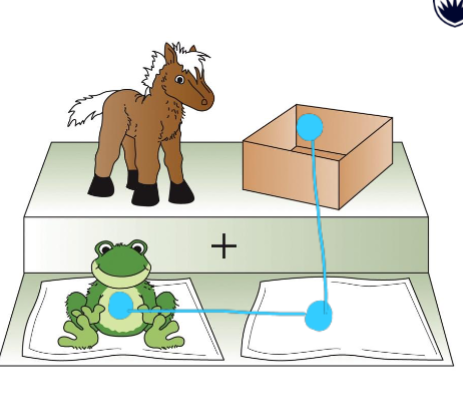
trueswell et al. (1999)- findings
“put the frog on the napkin in the box”
5 year olds only performed the right action less than 50% of the time
hard time processing the syntactic structure
suggests children have poor cognitive control
Hussey (2017) findings
participants trained with n-back test of either low or high conflict
high conflict n-back task:
better able to read garden path sentences
helpful for sentences involving cognitive control
low conflict n-back task
no improvement in reading garden path sentences
according to just and carpenter (1992), subjects who score poorly on the reading span test should __________.
have considerably more difficulty interpreting object relative clauses than subject relative clauses
kuhl et al. (2003) findings
examined whether babies can learn sound contrasts which occur outside their language
as well as learning through videos or audios
lost sensitivity to non-native contrasts by 10-12 months
social interaction enhances infants’ learning of non-native sound contrasts
social gating
learners are espcially attuned to information presentented in social context
why is social interaction helpful?
attention
rich set of social cues
highly receptive mindset
pedagogical stance
babies pay more attention since they believe they’re learning something
which finding would provide evidence to suggest social gating occurs in non-human animals
bird only learn songs from other birds, not from songs presented over speakers
sabbagh and baldwin (2001) findings
3 and 4 year old children interacted with either a knowledgeable or ignorant speaker
knowledeable speakers were reliable and able to identify correct objects
children learn more from the knowledgeable speaker
more likely to produce the word “blicket” by themselves
three mountain task - findings
children are asked to describe what they see in front of them and what the adult may see from the other side of the mountain
children under 7 cannot understand the other’s POV
theory of mind
ability to grasp nature of mental states and to recognize that different people may have different mental states under different conditions
rose scott (2017) findings
false belief task in which person B messes with the marbles of person A
infants looked longer to the inconsistent test trials
this is because they know something is wrong
deutsch and pechman (1982) findings
children are shown multiple objects
to unambiguously refer to just one object, child had to refer to at least two of its properties
age 3: 87% of descriptions failed to provide info
age 9: improved with age BUT still 22% ambiguous
if partner points out ambiguity, they are able to provide informative answers
what does it mean the objects are in common ground?
only one of the speakers can see it
what does it mean when the object is in privileged ground
both of the speakers can see it
consider the referential communication expriemnt by Deutsch and pechmann (1982). if subjects were shown a display that included a large pink block, a large blue block, and a small pink block.
a 3-year old would ____ say “the large pink block” and a nine-year old would ____ when referring to the large pink block.
almost never; sometimes say “the large block”
true or false:
if a referential communication task is made simple enough by reducing cognitive loads, even 2.5 year olds attempted to provide disambiguating information
true
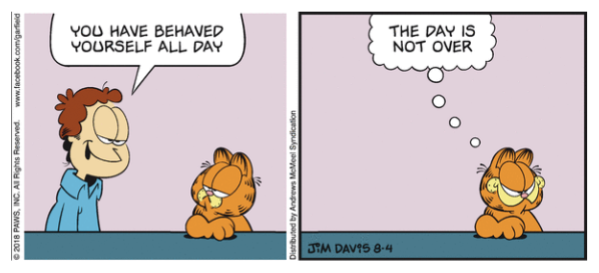
what are the “soft” and “hard” meanings of "“the day is not over”
hard: it is not midnight yet, this day has not ended
soft: i am going to do something bad before the end of today
implicature
conversational implicature
the part of the meaning that cannot be conveyed directly rhough the linguistic code
soft meaning
maxims of cooperative conversation
quality
relation
quantity
manner
maxim of quality
hearers assume that the speaker will make truthful statements
violations: obviously false statements taken as metaphorical or sarcastic
maxim of relation
hearers assume that the speaker’s utterances is relevant in the context of their converastion
maxim of quantity
hearers assume that the speaker will provide sufficient information without delving into unnecessary details
maxim of manner
hearers typically assume that speakers will use reasonably straight forward, unambiguous ways to communicate
ex. violation: “relocate my physical self to my place of employment”
scalar implicature
vague expressions are applied because stronger ones would be inaccurate
ex. some vs. all
a scalar implicature arises when the sentence ___ is understood to mean ____.
donna enjoys eating some vegetables; that donna does not enjoy eating all vegetables
noveck (2011) findings
true or false: “SOME girrafes have long necks”
adults tended to say that this statement is false
adopting pragmatic meaning of “some” → “not all”
most 7-11 year olds accepted this statement
adopting semantic meaning of “some”

stiller et. al (2015) findings
participants listen to the statement “my friend has glasses”
asked to point to the character
2,5-2.5 year olds randomly split between middle and rightmost characters
3.5 year olds and up chose the glasses-only character
bott and noveck (2004)
participants were asked to judge based on semantic or pragmatic meaning
“some girrafes have long necks”
those who were asked to judge based on pragmatic (underlying) meaning took longer to respond
made more errors when there was time pressure
de neys and schaeken (2007) findings
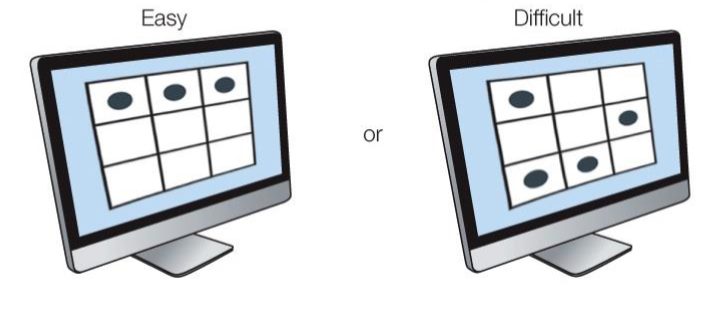
subjects saw a pattern of dots and were asked to memorize
dot pattern could be either easy or difficult to remember
participants were then asked to judge the truthfulness of sentence
afterwards, they had to reproduce dot pattern
participants were more likely to judge the sentence pragmatically when they were in the easy condition
limiting cognitive resources with hard conditions makes them less likely to judge on pragmatics
ferreira (2005) findings
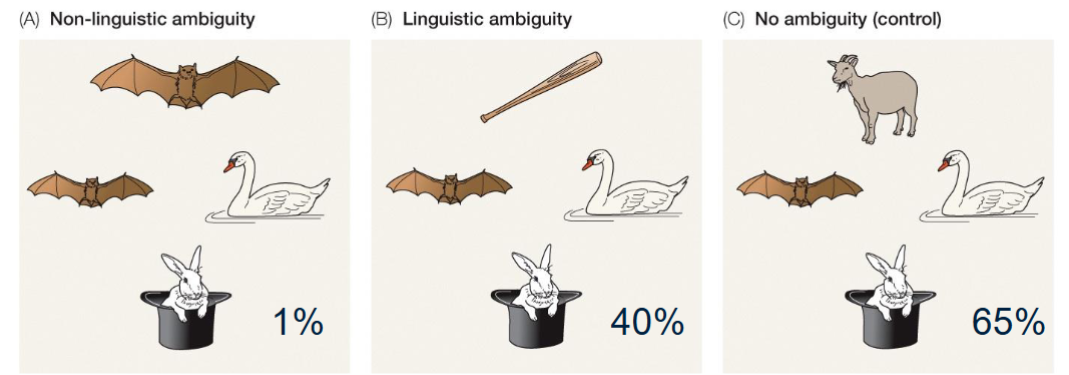
how likely do speakers use just the bare nouns (ex. ‘bat’ instead of ‘small bat’?)
they were more likely to use just the bare nouns when there is no ambiguity
no ambiguity>linguistic ambiguity>non-linguistic ambiguity
brown and dell (1987) findings
participants read short stories and retold the same stories to a listener
½ were with predictable instruments
½ stories were with unpredictable instruments
participants were more likely to mention instruments when they were unsual even when they saw the instrument in the picture
not sensitive to hearer’s comprehension demands
back channel responses
behavioural cues produced by a hearer that provide the speaker with information about the hearer’s degree of comprehension
which behaviour produces the strongest evidence for audience design in language production
a speaker provides more detail in referring to a person his conversational partner has never met in referring to a mutual friend
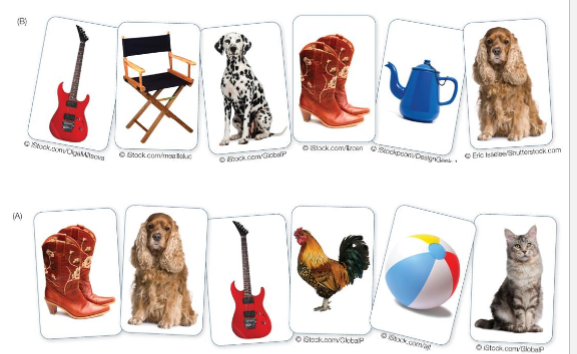
brennan and clark (1996) findings
the director instructed the other participant on how to arrange the card
two objects were of the same kind (ex. dogs)
what happens when this ambiguity is removed?
the director still uses the detailed expression
entered conceptual pact to describe the object in this way
reverts back to basic-level term when interacting with a new speaker
collaborative theorists account of conversations
conversation partners maintain a representation of common ground
have to track and update information about each other’s mental states, knowledge, and beliefs
relates to theory of mind
egocentric theorist perspective of conversations
priming plays an important role (previously used words/expressions are primed and more likely to be re-used)
minimizes the role of representing conversational partners’ mental states
describe collaborative and egocentric accounts for this prediction:
how quickly people make use of information about the common ground
collaborative: sensitive to partner’s mental states in the earliest moment of language production and comprehension
ego centric: only automatic processes (about the semantic meaning) influence early stage of language production and comprehension
describe collaborative and egocentric accounts for this prediction:
how much previousy used expression is linked to a specific partner
collaborative: conceptual pacts does not necessarily apply to a new conversation partner
egocentric: previously used expression will be re-used frequently with a new conversation partner
during a study, a participant hears their partner refer to a novel object as “thingy.” the participant is paired with a new partner, Jamie, who was not present during the first conversation. what is true?
a collaborative theorist would predict that the participant will have no special expectations about how jamie will refer to the novel object
cerebrum
higher cognitive function including language
corpus callosum
divides brain into two hemispheres
lateralization
certain cognitive functions or abilities to be specialized to one side of the brain
left hemisphere is dominant for language
true or false:
language deficits more common in right-hemisphere brain damage
false
wada test
quick-acting anesthetic injection to temporarily shut down one side of the brain
patient is asked to perform language tasks
if affected, suggests that patient is lateralized on anesthetized side
hemispherectomy
removing all of the cerebral cortex on one side of the brain
used to treat drug resistant epilepsy when seizures come from one damaged hemisphere
how will language develop with only one hemisphere?
brain plasticity allows for right hemisphere to take over tasks that the left hemisphere is typically responsible for
crowding hypothesis
crowding hypothesis
since right hemisphere takes over language functions, it will be less able to carry out non-verbal, visual-spatial skills
which of the following statements best reflects the effects of hemispherectomy on langauge lateralization and brain plasticity
in children, the remaining hemisphere can often reoganize to support langauge functions, illustrating neuroplasticity
true or false:
when the hemisphere gets decorticated on the left, there is less overall performance, particularly for syntax processing
true
paul broca examined patients name leborgne and lelong
findings
patients could either produce one word or only a few words
both had large areas of missing tissue in the inferior part of the left frontal lobes
which of the following statements accurately describes broca’s aphasia
speech is non-fluent, effortful, and often telegraphic while comprehensions is relatively preserved
carl wernicke’s findings
patients suffering could speak and hear, but had difficulty understanding both spoken and written langauge
lesions posterior portion of the brain
wernicke-lichtheim-geschwind (WLG) model of neural organization
3 cortical structures responsible for core processes in language production and comprehension
broca’s area
wernicke’s area
arcuate fasciculus
broca’s aphasia
chief underlying deficit appears to be in processes that plan and produces syntactically well-formed utterances
non-fluent effortful non-grammatical speech
central grammatical deficit
wernicke’s aphasia
chief underlying deficit appears to be in processes that map concepts to sound-codes
fluent, but non-sensical
little comprehension
conceptual representations and output planning mechanisms in broca’s area are still intact
phonological codes are not matched to concepts
conduction aphasia
damaged arcuate fasciculus
chief underlying deficit appears to be in communication between posterior language processing area and broca’s area
arcuate fasciculus
relays semantic and lexical information about words from wernicke’s area to broca’s area
limitations of WLG model: anatomical issues
broca’s aphasia results from damage extending far outside the broca’s area
wernicke’s aphasia symptoms and damage to wernicke’s area do not always go hand in hand
no agreement about location and size of areas
limitations of WLG model: it’s not a complete model of which brain regions are involved in language processing
brain damage outside the classical language areas also produce language and communication disorders
damage to the R hemisphere can also affect language processing
limitations of WLG model: symptoms seem to be driven by size of brain damage, not location
WLG emphasis location
why is the WLG model considered insufficient for fully explaining language processing
it assumes langauge is confined to just a few regions, ignoring distributed networks neuroplasticity
dichotic listening experiment findings:
when people hear two different syllable in each ear
usually report hearing right ear sound more clearly
right ear → sends sound to left hemisphere
left hemisphere → main area for language
individuals with lesions in the left temporal lobe have difficulty perceiving auditory signals in the R ear
semantic categorization task results
dichotic listening experiment
participants show a right ear advantage
left hemisphere is more efficient at detecting semantic categories
emotion categorization task
dichotic listening experiment
participants show a left ear advantage indicating that right hemisphere is more efficient at detecting emotional prosody
neuroimaging technique: EEG/ERP
measures charges in electrical voltage through electrodes placed on the scalp
excellent temporal resolution and low spatial resolution
studies cover the lifespan
sensitive to movement
noiseless
inexpensive
neuroimaging technique: MEG
uses magnetometers to measure magenetic field changes
excellent temporal and okay spatial resolution
studies on adults and young children
head tracking for movement calibration
noiseless
expensive
neuroimaging technique: fMRI (functional magnetic resonance imaging)
detects changes in blood oxygen levels and direction of blood flow in various areas of the brain
hemodynamic changes
low temporal resolution and excellent spatial resolution
studies on adults
extremely sensitive to movement
noise protectors needed
expensive and noninvasive
neuroimaging technique: fNIRS (functional near-infrared spectroscopy)
use near-infrared lights to measure hemodynamic changes
good temporal and spatial resolution
studies on infants in the first 2 years
sensitive to movement
noiseless
when hearing a semantically incorrect sentence, what will event related potentials reveal??
N400 spikes to reflect semantic processing
when hearing a syntactically incorrect sentence, what will event related potentials reveal??
P600: syntactic processing
spikes to reflect syntactic processing
BOLD: blood oxygenation level dependent
signals increased blood flow and cerebral blood volume
structural MRI
brain anatomical structure
diffusion tensor imaging (DTI)
white matter structures
dyslexia
deficits in word reading fluency, decoding, accuracy, and spelling
dysfunctions in the left-hemisphere reading system: inferior frontal, temporo-parietal, and occipito-temporal areas
fMRI results in dyslexia
less efficient connectivity between regions responsible for reading
greater reliance on right-hemisphere networks instead of typical left-hemisphere language areas during reading tasks
true or false:
speech disfluencies can be found throughout the phrases, the majority of them do not occur at the boundaries of clauses or long phrases
false
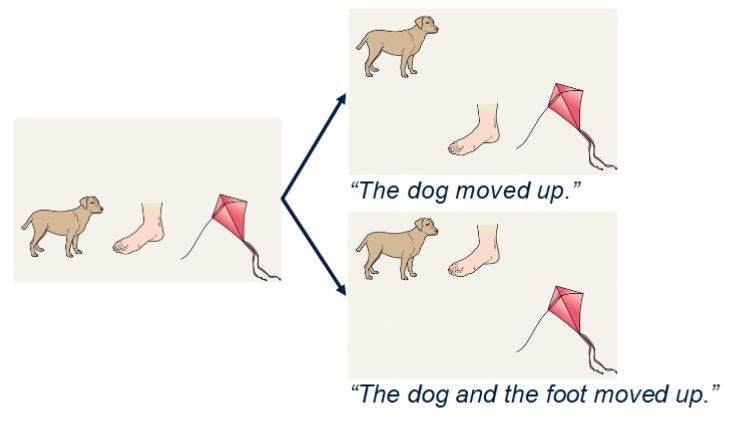
smith and wheeldon (1999) findings
participants were asked to describe what occured in the pictures
took longer to say" “the dog and the foot moved up”
sentences are more complex
which sentence will take longer to utter?
“the girl with brown hair fed the dog” than “the girl fed the dog with brown spots”
steps in speech production
conceptualization
formulation
lexical selection
sound representation
articulation