Chemistry of Life
 Call Kai
 Learn
Learn Practice Test
 Spaced Repetition
 Match
Match Flashcards
 Knowt Play
1/117

Earn XP
Description and Tags
Chemistry of Life, Water, proteins, carbohydrates, lipids
Name | Mastery | Learn | Test | Matching | Spaced | Call with Kai | Chat |
|---|
No analytics yet
Send a link to your students to track their progress
118 Terms
Polar Molecule
A molecule in which opposite ends have opposite charges, such as water where the oxygen atom holds a negative charge due to its greater affinity for electrons, leaving the two hydrogen atoms with a positive charge.

Hydrogen Bond
An attraction formed between polar molecules, such as when the positive charge of a hydrogen atom in one water molecule connects to the negative charge of an oxygen atom in another water molecule.
Cohesion
The property where water molecules stick to other water molecules via hydrogen bonds, giving water surface tension that allows insects like water striders to walk on its surface.
Adhesion
The property where water molecules stick to a substance other than water, such as silica in glass or xylem cell walls in plants.

Water Transport in Plants
The combined process where cohesion helps water stick to other water molecules while adhesion helps water stick to xylem cell walls to move upward against gravity as water evaporates from leaves.

Density of Ice
The physical property where solid ice floats in liquid water because its stable, ordered hydrogen bonds hold molecules further apart, making ice less dense than liquid water where hydrogen bonds constantly break and re-form.
Solution
A liquid mixture of two or more substances that are evenly mixed together.
Solvent
The dissolving agent of a solution in which a solute dissolves.
Solute
The substance that is dissolved in a solvent within a solution.
Aqueous Solution
A solution in which water serves as the dissolving agent (solvent).
Hydrophilic
Refers to a substance that has an affinity for water and combines with it easily, such as vinegar.
Hydrophobic
Refers to a substance that lacks an affinity for water and separates from it, such as oil.

pH Scale
A scale ranging from 0 to 14 that describes whether a solution is acidic (pH from 0 up to 7), neutral (pH of 7), or basic (pH above 7 to 14).
Acidic Solution
A solution with a pH from 0 up to 7 in which the concentration of hydrogen ions ([H+]) is greater than the concentration of hydroxide ions ([OH−]).
Basic Solution
A solution with a pH above 7 to 14 in which the concentration of hydrogen ions ([H+]) is lower than the concentration of hydroxide ions ([OH−]).

Neutral Solution
A solution with a pH of 7 where the concentration of hydrogen ions ([H+]) equals the concentration of hydroxide ions ([OH−]).
Buffer
A substance used to minimize changes in the concentrations of [H+] and [OH−] in a solution to maintain pH balance.

Acid Precipitation
Rain, snow, or fog formed when atmospheric pollutants like SO2 and NOx undergo complex oxidation reactions to form sulfuric acid (H2SO4) and nitric acid (HNO3).
Element
A fundamental form of matter that cannot be broken down into simpler substances and is organized on the periodic table based on atomic structure.
Compound
A substance consisting of two or more different elements combined in a fixed ratio, possessing chemical properties distinct from its constituent elements.
Essential Elements
The 25 elements required for human life, four of which—oxygen, carbon, hydrogen, and nitrogen—make up 96% of human body weight.
Trace Elements
Essential elements required by an organism in extremely small quantities (less than 0.01% of body weight), such as fluorine for teeth and bones or iodine for thyroid function.

Goiter
An enlargement of the thyroid gland caused by a deficiency in the trace element iodine.
Protons
Positively charged (+) subatomic particles located in the atomic nucleus that determine the identity of an element.
Neutrons
Subatomic particles with no electrical charge located inside the atomic nucleus that determine an atom's isotope.
Electrons
Negatively charged (−) subatomic particles that form a cloud outside the atomic nucleus and determine the chemical behavior of an atom.
Atomic Number
The total number of protons contained within the nucleus of an atom.
Mass Number
The total sum of protons and neutrons located inside the nucleus of an atom.

Atomic Mass
The total mass of an atom, which can be approximated by its mass number.
Isotopes
Atoms of the same element that have the same number of protons but differ in their number of neutrons.
Carbon-14 (14C)
An unstable, radioactive isotope of carbon containing 6 protons and 8 neutrons that decays, emitting energy used in PET scans to detect cancerous tissue.
Electron Shells
Energy levels around the atomic nucleus where electrons reside, with the first shell holding up to 2 electrons and the second and third shells holding up to 8 electrons each.

Valence Shell
The outermost electron shell of an atom, possessing the highest energy level and containing the electrons involved in forming chemical bonds.
Valence Electrons
Electrons located in the outermost shell (valence shell) of an atom that participate in chemical bonding.
Chemical Bond
An attraction between atoms created when atoms with incomplete valence shells share or transfer valence electrons to achieve stability.
Covalent Bond
The strongest chemical bond, formed when two atoms share a pair of valence electrons.
Nonpolar Covalent Bond
A type of covalent bond formed when two atoms share valence electrons equally.
Polar Covalent Bond
A covalent bond in which electrons are shared unequally due to differences in electronegativity, resulting in partial positive (δ+) and partial negative (δ−) charges.

Ionic Bond
A chemical bond formed when an electron is transferred from one atom to another, resulting in oppositely charged ions that attract each other.

Hydrogen Bond
A weak chemical attraction formed when a slightly positive end of one polar molecule (usually hydrogen) attracts the slightly negative end of another polar molecule.

Chemical Reaction
The process of making and breaking chemical bonds, converting starting materials (reactants) into resulting substances (products).

Organic Chemistry
The branch of chemistry devoted to the study of carbon-containing compounds.
Hydrocarbons
Organic molecules composed exclusively of carbon and hydrogen atoms.
Most cells are 70%-90% water; what does the rest mostly consist of?
Carbon-based compounds.
Oraganic Chemistry
the study of compounds that contain carbon.
What does carbon most frequently partners with?
Hydrogen, oxygen, nitrogen.
How can you tell that the compound is organic?
It contains carbon
What is the key word for Ionic bonds?
Electron transfer
What is defined as an "ion"?
An atom that has gained or lost one or more electrons, resulting in an electric charge.
What makes carbon so special?
Its ability to bond in a wide variety of shapes with so many elements, including itself.
Why is all life on earth carbon-based?
How many chemical bonds can carbon form?
Carbon can form four chemical bonds.
What does “catenation” mean?
The ability of carbon atoms to bond with each other to form long chains or complex structures.
What type of molecule is water?
Water is a polar molecule.
Water molecules make what type of bonds with other polar molecules?
Hydrogen bonds
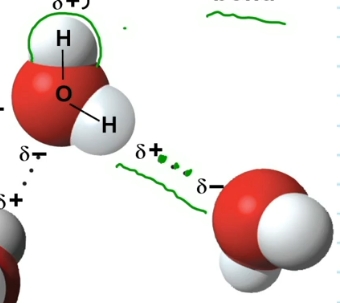
What do the three dots mean when shown on a hydrogen model?
It indicates that the hydrogen bond is very easily broken.
What is a hydrogen bond?
A hydrogen bond is a type of weak attraction that occurs between a hydrogen atom covalently bonded to an electronegative atom and another electronegative atom.
What is the difference between polar and nonpolar?
Polar bonds occur when there is an unequal sharing of electrons, resulting in a partial positive and negative charge, while nonpolar bonds involve equal sharing of electrons between atoms.
What are water’s properties when it comes to its structure?
Water's properties include cohesion and adhesion
What is water cohesion?
Water sticking to water
What is water adhesion?
Water sticking to other substances.
Adhesion and cohesion can transport water against what?
the force of gravity
Why does ice float in water?
Ice is less dense than liquid water due to the crystal structure formed by hydrogen bonds, causing it to float.
What is a solvent?
A dissolving agent
What are solutes?
Solutes are particles being disolved.
What is an example of a solute?
Salt
When you have a mixture of water plus solutes, what are we talking about?
aqueous solution.
What is another disolving agent?
acetone
What are those substances called that like to be mixed with water.
hydrophilic substances.
What are the substances called that do not like to be with water?
hydrophobic substances.
What is a ph scale?
A scale that measures the acidity or basicity of a solution, ranging from 0 to 14, with 7 being neutral.
Why is pure water a neutral?
Pure water has equal amounts of hydrogen and hydroxide ions, making it neutral.
What is acid precipitation referred to?
Rain, snow, or fog, which has a pH lower than 5.6
Element
A fundamental form of matter that cannot be broken down into simpler substances, represented by a unique chemical symbol such as H for hydrogen or Ca for calcium.
Compound
A substance consisting of two or more different elements combined in a fixed ratio, exhibiting characteristics distinct from those of its individual elements.
Essential Elements of Life
The four main elements—oxygen (65.0%), carbon (18.5%), hydrogen (9.5%), and nitrogen (3.3%)—that make up approximately 96% of the weight of the human body.

Trace Elements
Essential elements required by an organism in only very small amounts (less than 0.01% of body weight), such as fluorine (F), iodine (I), and iron (Fe).
Goiter
A condition resulting from an iodine (I) deficiency in the diet.

Subatomic Particles
The constituent particles of an atom, including uncharged neutrons, positively charged protons ([+]), and negatively charged electrons ([−]).
Atomic Nucleus
The dense central region of an atom composed of protons and neutrons.
Atomic Number
The specific number of protons contained in the nucleus of an atom.
Mass Number
The sum of the number of protons and neutrons in an atom's nucleus.
Atomic Mass
The total mass of an atom, which can be closely approximated by its mass number.
Isotopes
Atoms of the same element that share the same number of protons but differ in their number of neutrons.
Radioactive Isotope
An unstable isotope (such as 14C) whose nucleus spontaneously decays over time, releasing energy and radiation.
Valence Shell
The outermost electron shell of an atom.
Valence Electrons
Electrons residing in the outermost shell (valence shell) of an atom.
Chemical Bond
An interaction created when atoms with incomplete valence shells share or transfer valence electrons with other atoms.
Covalent Bond
A chemical bond formed by the sharing of a pair of valence electrons between two atoms.
Nonpolar Covalent Bond
A covalent bond where electrons are shared equally between two atoms of identical or similar electronegativity, such as in a hydrogen molecule (H2).
Polar Covalent Bond
A covalent bond where one atom is more electronegative than the other, resulting in unequal sharing of electrons and partial positive (δ+) or negative (δ−) charges.
Ion
A charged atom or molecule produced when an electron is completely transferred from one atom to another.
Ionic Bond
A chemical bond resulting from the attraction between oppositely charged ions created by an electron transfer.
Hydrogen Bond
A weak bond formed when the slightly positive end (δ+) of one polar molecule (usually hydrogen) attracts the negative end (δ−) of another polar molecule.

Chemical Reactions
Processes involving the making and breaking of chemical bonds to rearrange atoms.
Reactants
The starting materials in a chemical reaction.
Products
The resulting substances formed at the end of a chemical reaction.
Organic Chemistry
The branch of chemistry dedicated to the study of carbon-containing compounds.
Hydrocarbons
Organic molecules composed entirely of carbon and hydrogen atoms, which vary in length, branching, double bonds, and ring structures.
