College Bio Chpt. 3 &4
 Call Kai
 Learn
Learn Practice Test
 Spaced Repetition
 Match
Match Flashcards
 Knowt Play
1/23

There's no tags or description
Looks like no tags are added yet.
Name | Mastery | Learn | Test | Matching | Spaced | Call with Kai | Chat |
|---|
No analytics yet
Send a link to your students to track their progress
24 Terms
Carbon Atom
*has 6 electrons
*can form diverse molecules by bonding four other atoms
*acts as an intersection point from which a molecule can branch off in as many as 4 directions
*bond is covalent
How does valence work?
valence describes the combining power of an atom, measured by the # of chemical bonds it can form
Molecular Diversity
Ethan, propane, 1-Butene, 2-Butene, Butane, 2-Methylpropane, Cyclohexane, Benzene.
*these compounds only contain a connection of C and H. they are HYDROCARBONS (organic molecules consisting of only carbon and hydrogen)
*shapes are different
Isomers
structures that have the same number of atoms of the same elements, but different structures and therefore different properties
*3 types: structural isomers, cis-trans isomers, and enantiomers
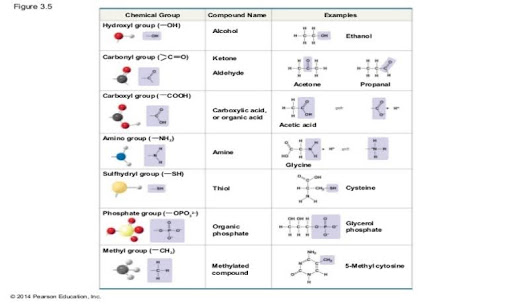
Important Biological Chem Groups
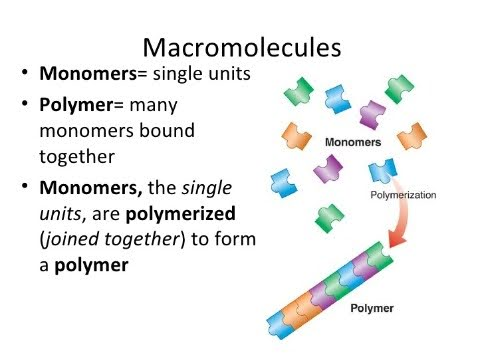
Macromolecules are Polymers built from Monomers
-macromolecules form when small building blocks (monomers) link together through dehydration synthesis (condensation) *cells join monomers with covalent bonds and release water as byproduct
-macromolecules are broken down through hydrolysis *a water molecule is added across the covalent bond holding the polymer together, which splits the bond, releases energy, and turns large chains into usable, bite-sized nutrient parts
Synthesis & Breakdown of Polymers
synthesis: polymers are created via the dehydration reaction
*monomers are connected covalently by the LOSS of a water molecule. Each monomer contributes part of the water molecule
OH = hydroxyl group
H = hydrogen
*breakdown of polymers: polymers are disassembled into monomers via hydrolysis (water breakage)
*covalent bond between monomers is broken by the addition of a water molecule
H attaches to one monomer
OH attaches to another
4 Main Macromolecules
*all macromolecules are polymers
A. carbohydrates
B. Lipids
C. Proteins
D. Nucleic Acids
A. Carbohydrates
*Includes sugars (saccharides)
*monomer = monosaccharides
*polymer = (disaccharides) and polysaccharides

Monosaccharides
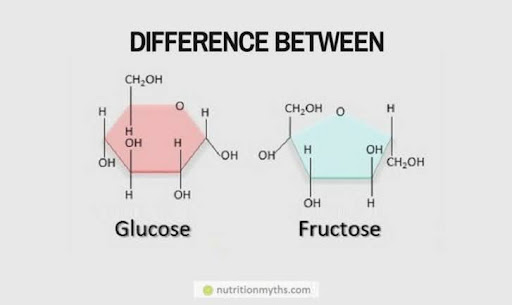
Glucose: C6H12O6
Function: serve as raw materials for creation of other molecules and extraction of energy (quick energy)
Trademarks: carbonyl groups C=O and multiple hydroxyl gps *-OH
Most stable form is in a ring
Glucose structure vs. structure (both monosaccharides)
Disaccharides & Glycosidic Linkage
disaccharides: 2 monosaccharides joined together
glycosidic linkage: bond between 2 monosaccharides that creates a covalent bond via dehydration reaction
*most popular = sucrose (table sugar)
glucose + fructose = sucrose
Beer: lactose, Milk: lactose
- Glycosidic Linkage bond holds monomers together in Carbohydrates
Polysaccharides
- polysaccharides: macromolecule (polymer) of sugar
*100’s to 1000’s of monomers brought together via glycosidic linkage
2 main types:
a. storage polysaccharides
b. structural polysaccharides
Storage polysaccharides
- storage sugar for later use
Plants: store STARCH (glucose chain)
Animals: store GLYCOGEN in liver and muscles; depleted much faster in humans (within a day)
Structural Polysaccharides
2 main types:
a. CELLULOSE: major component of plant walls that enclose the cell; gives a 3-D shape
*many enzymes cannot break this down
**humans: important part of the fiber in our diets
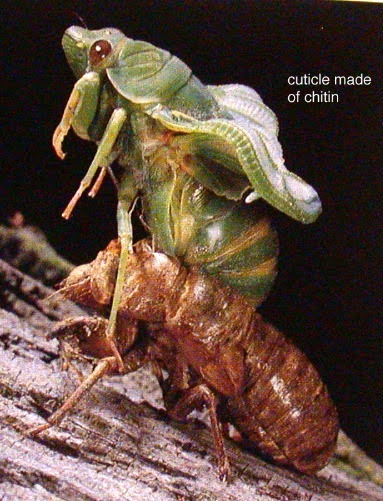
Chitin
carb polysaccharide used by arthropods (insects, spiders, crustaceans) to build their exoskeletons; also found in fungi to build their cell walls
B. Lipids
*long-term energy
includes fats, phospholipids, and steroids
bonds in lipids: ester linkage holds the head and tails together
Fats
- made up of a glycerol & a fatty acid
glycerol: C with a hydroxyl group
Fatty acid: 16-18 C atoms in length with a H attached (hydrocarbon chains)
Typically, there are 3 chains called a triacylglycerol (3 fatty acids to one glycerol)
2 Types of Fatty Acids
saturated: no double bonds between C; “hard fats”
unsaturated: one or more double bonds between C creating a kink; “liquid fats”
Phospholipids
- make up the cell membrane in a bilayer
*similar to a “fat molecule” because it has two fatty acids attached to a glycerol rather than 3
Head: hydrophyllic
Tail: hydrophobic
Steroids
- 4 fused C rings
Found in an animal cell membranes
Cholesterol: crucial steroid in animals; also makes up estrogen and testosterone
*synthesized in liver but also consumed by animals
C. Proteins
Instrumental in most everything and organism does; chemical reactions, defense, storage, cell communication, transport, support, etc.
Enzymes: proteins that act as CATALYSTS (speed up chemical reactions)
*10,000+ polymers made from 20 amino acids (monomers)
**biologically functional molecule made up of 1 or more polypeptides folded and coiled into 3-D structures
Polypeptide
*each has a unique linear sentence of amino acids (allows for creation of thousands of different amino acids)
N - terminus: free amino group
C - terminus: carboxyl end
Protein Structure & Function
*determined by its 3-D shape
There are 4 levels of protein structure:
Primary
Secondary
Teriary
Quaternary