EM 1 Intro to eye movements
 Call Kai
 Learn
Learn Practice Test
 Spaced Repetition
 Match
Match Flashcards
 Knowt Play
1/96

Earn XP
Description and Tags
Intro to eye movements
Name | Mastery | Learn | Test | Matching | Spaced | Call with Kai | Chat |
|---|
No analytics yet
Send a link to your students to track their progress
97 Terms
Why are accurate eye movements important in daily life?
Accurate monocular and binocular eye movements are essential for everyday visual tasks, allowing stable gaze, proper tracking, and coordinated vision during routine activities.
How can congenital or acquired eye movement disorders affect patients?
They can significantly impair daily functioning, making common tasks harder and reducing visual performance in activities that depend on precise gaze control.
Why is it important to recognize progressive acquired eye movement deficits?
Progressive acquired deficits may require urgent referral, as they can signal a serious underlying neurologic or ophthalmologic disorder.
What types of activities are commonly affected by eye movement disorders?
Eye movement disorders may impair reading, sports, and other visually demanding tasks that require accurate fixation, tracking, and coordination.
What are fixational eye movements, and when do they occur?
Fixational eye movements occur when attempting to hold gaze steady on a stationary object.
How is nystagmus related to fixational eye movements?
Nystagmus can be considered an abnormality of fixational eye movements.
What is the main purpose of the vestibulo-ocular reflex (VOR)?
The VOR stabilizes images on the retina during head movement by producing compensatory eye movements, which helps preserve visual clarity, object recognition, and localization.
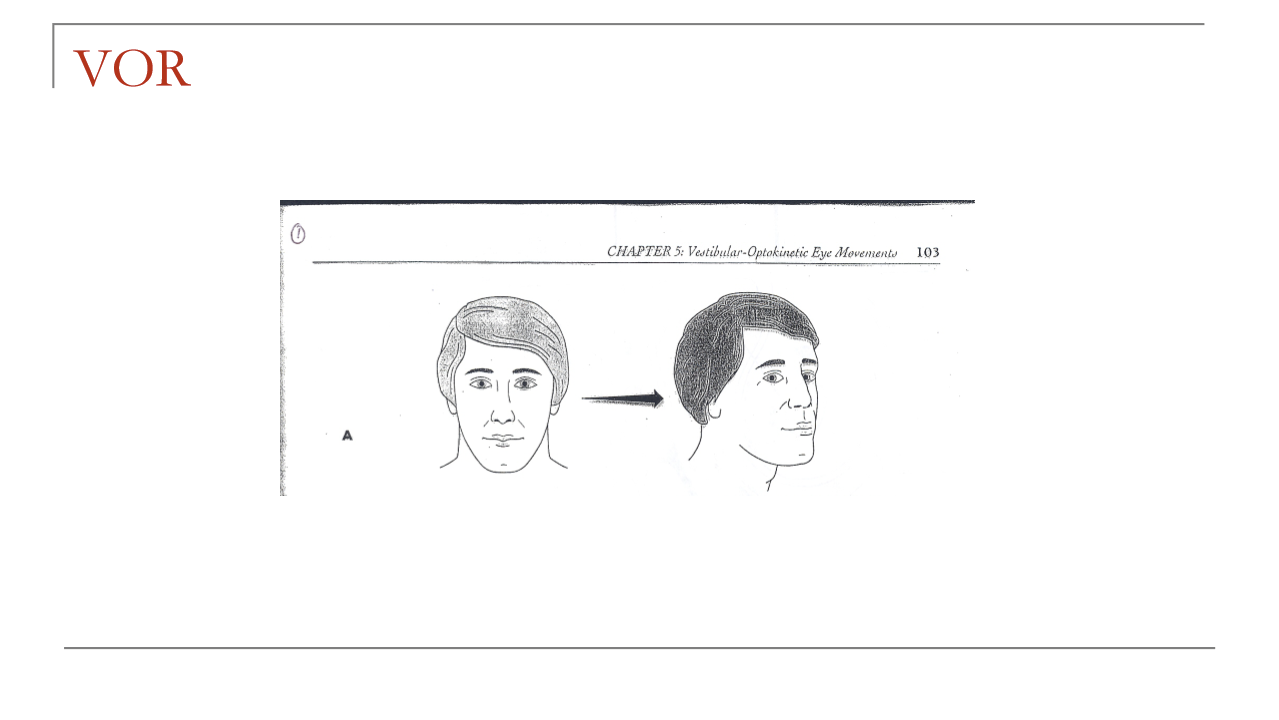
Why is the VOR necessary during head motion?
Without compensatory eye movement, head motion causes retinal slip, meaning images move across the retina and visual stability is lost.
What is retinal slip, and how is it prevented?
Retinal slip is movement of the visual image across the retina during head motion. It is prevented by gaze-holding/compensatory eye movements, especially the VOR.
What structure controls the VOR, and why is this clinically important?
The inner ear (vestibular system) controls the VOR. Therefore, inner ear disease or infection can impair gaze stabilization and cause eye movement problems.
What is the purpose of gaze-shifting eye movements such as saccades and pursuits?
They produce a purposeful change in gaze angle to either bring an object’s image onto the fovea or keep a moving target on the fovea.
Why must saccades and pursuits be highly accurate?
Vision is best at the foveola, which subtends only about ~70 minutes of arc, so gaze shifts must be very precise to place the image on the area of highest visual acuity.
Why do even animals with very large visual fields still make gaze-shifting eye movements?
Even animals with broad fields of view do not see equally well everywhere; they still have a region of relatively best vision (analogous to a fovea), so gaze shifting is needed to direct important targets to that area.
What are the key unit conversions for angular measurement in eye movement physiology?
1 degree = 60 minutes of arc (60′) and 1 minute of arc = 60 seconds of arc (60″).
What is the relationship between angle in radians, radius, and arc length?
θ (in radians) × r = arc length.
What are the key angular unit conversions used in eye movement/visual angle calculations?
1° = 60 minutes of arc (60′)
1 minute of arc = 60 seconds of arc (60″)
π radians = 180°
Approximately how many seconds of arc are in 1 radian?
1 radian ≈ 206,000 seconds of arc
(more exactly 206,264.8″)
How do you convert radians to seconds of arc?
1 rad × (180/π) × 60 × 60 ≈ 206,265″
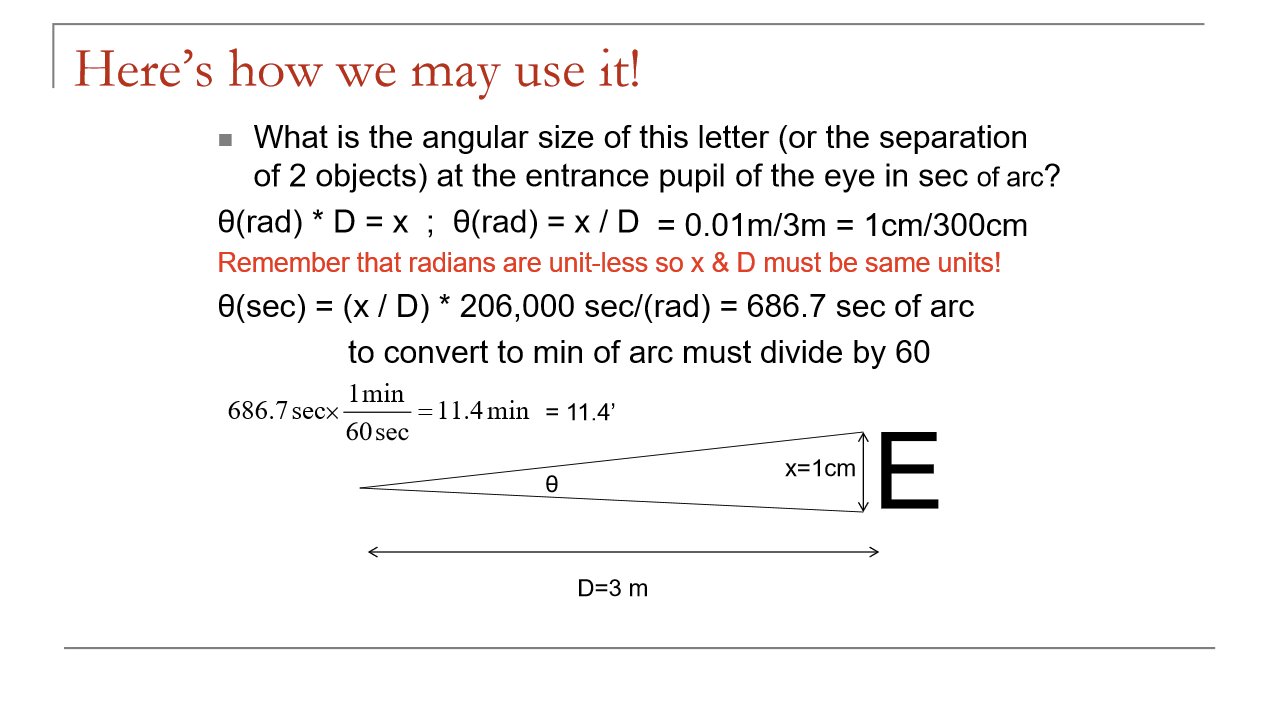
What is the formula relating visual angle, object size, and distance?
θ (rad) × D = x
so
θ (rad) = x / D
where x = object size and D = viewing distance.
What is the visual angle of a 1 cm letter viewed at 3 m?
Convert to same units: 1 cm / 300 cm = 0.00333 rad
Then:
0.00333 × 206,000 ≈ 686.7″
Convert to minutes:
686.7 / 60 ≈ 11.4′
So the letter subtends ~686.7 seconds of arc (11.4 minutes of arc).
What are vergence eye movements, and what is their main purpose?
Vergence movements are gaze-shifting movements that adjust the eyes for different viewing distances so that the object of regard is imaged on both foveas.
What are the major advantages of using two eyes in tandem?
Binocular vision provides better detection in low light and improved depth perception.
Why did vergence eye movements develop?
Because binocular vision is advantageous, eye movements developed to change gaze appropriately for near vs. far targets, allowing both eyes to stay aligned on the same object.
What is the key visual goal of vergence?
To place the image of the target on both foveas simultaneously, which supports single binocular vision and depth perception.
What are eye translations?
Translations are linear motions of the eye rather than angular rotations.
How does the effect of eye translation on the rotation needed to fixate an object change with distance?
The effect of eye translation on the eye rotation required for fixation decreases as the fixation point gets farther from the eye.
What is an example of an eye translation and its effect?
If both eyes translate nasally, the result is a decrease in interpupillary distance (PD).
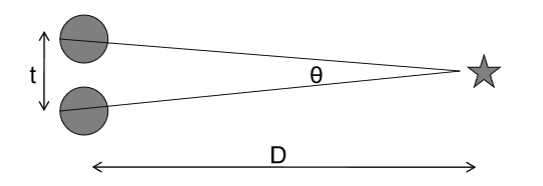
What angle must the eye rotate to maintain fixation if the eye translates a distance t toward or away from a target at distance D?
Use the approximation: θ × D = t, so
θ = t / D
(with θ in radians when t and D are in the same units).
Why is eye translation usually small in magnitude?
Eye translation is limited because the orbit restricts large globe movements, the bony orbit prevents large translations.
When does eye translation have minimal effect on fixation?
Translation has minimal effect when viewing distance (D) is large, because the required compensatory rotation θ = t/D becomes very small.
What is the term for monocular eye rotations?
Ductions = movements of one eye alone.
What are the 2 types of binocular eye rotations?
Conjugate movements = both eyes move in the same direction
Disjunctive movements = both eyes move in opposite directions
What is the term for binocular movements in which the eyes move in the same direction?
Versions = conjugate eye movements.
What is the term for binocular movements in which the eyes move in opposite directions?
Vergences = disjunctive eye movements.
What are the horizontal ductions/rotations about the vertical axis, and what are their normal directions/limits?
Abduction = eye rotates temporally; limit about 45°
Adduction = eye rotates nasally; limit about 50°
What are the vertical ductions/rotations about the horizontal axis, and what are their normal directions/limits?
Sursumduction (supraduction/elevation) = eye rotates upward; limit about 35°
Deorsumduction (infraduction/depression) = eye rotates downward; limit about 50°
What are the torsional ductions/rotations about the line of fixation, and how are they defined?
Intorsion = the 12 o’clock position rotates toward the nose
Extorsion = the 12 o’clock position rotates away from the nose
Match each duction to its axis of rotation.
Vertical axis → horizontal eye movements (abduction, adduction)
Horizontal axis → vertical eye movements (sursumduction, deorsumduction)
Anterior–posterior axis / line of fixation → torsional movements (intorsion, extorsion)
What are the horizontal versions/rotations about the vertical axis?
Dextroversion = rightward conjugate eye movement
Levoversion = leftward conjugate eye movement
What are the vertical versions/rotations about the horizontal axis?
Sursumversion = upward conjugate eye movement
Deorsumversion = downward conjugate eye movement
What are the torsional versions/rotations about anterior-posterior axis?
Dextrocycloversion = 12 o’clock position of both eyes rotates to the right
Levocycloversion = 12 o’clock position of both eyes rotates to the left
What are the main horizontal vergence movements?
Convergence = inward rotation of the eyes
Divergence = outward rotation of the eyes
What is the zero lateral vergence posture?
It is the state in which the lines of sight are parallel, such as when viewing an object at infinity.
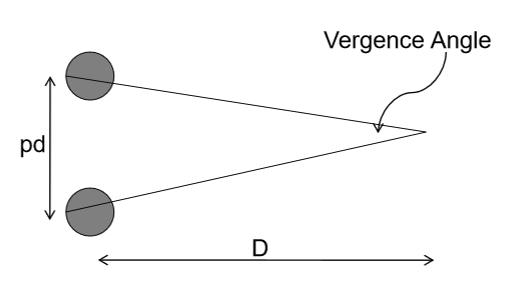
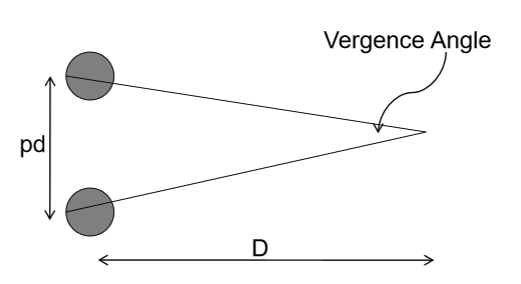
What is the vergence angle?
The vergence angle is the angle between the two lines of sight.
How is vergence angle calculated?
VergAng = pd/ D
If pd and D are in the same units, then the angle is in radians
If pd is in cm an D is in meters, then angle is in prism diopters (cm/m)
What is hypervergence?
Hypervergence describes a vertical vergence named for the eye that is higher.
Example: if the right eye goes up and the left eye goes down, this is a right hypervergence.
What is hypovergence?
Hypovergence describes the same vertical vergence pattern but is named for the eye that is lower.
Example: if the right eye goes up and the left eye goes down, this can also be called a left hypovergence.
How can the same vertical vergence movement be described in 2 ways?
A single vertical vergence can be named either by the eye that is higher (hypervergence) or by the eye that is lower (hypovergence).
Example: right eye up + left eye down = right hypervergence = left hypovergence.
What are torsional vergences, and what axis do they occur around?
Torsional vergences are disjunctive binocular movements involving rotation about the anterior-posterior axis (torsional axis), where the eyes rotate in opposite torsional directions.
What is incyclovergence?
Incyclovergence = both eyes rotate so that the 12 o’clock meridian moves toward the nose (torsion inward in each eye).
What is excyclovergence?
Excyclovergence = both eyes rotate so that the 12 o’clock meridian moves away from the nose (torsion outward in each eye).
How do torsional vergences differ from torsional versions (cycloversions)?
Vergence (cyclovergence) = eyes move in opposite torsional directions
Version (cycloversion) = eyes move in the same torsional direction
What is Hering’s Law of equal innervation?
During eye movements, equal neural input is sent to both eyes, resulting in equal magnitude of rotation in each eye.
How does Hering’s Law apply in normal (healthy) eye movements?
In normal physiology, most eye movements obey Hering’s Law, ensuring coordinated, symmetric movement of both eyes (with rare exceptions).
Does Hering’s Law apply to both conjugate and disjunctive movements?
Yes, Hering’s Law applies to both conjugate (versions) and disjunctive (vergences) eye movements.
What is the clinical significance of Hering’s Law?
It explains why the eyes move together in a coordinated manner, and helps in understanding patterns seen in strabismus and cranial nerve palsies (e.g., yoked muscle behavior).
What is the anatomical axis, and why is it not ideal for describing fixation?
The anatomical axis is the line joining the corneal pole and scleral pole. It is not ideal for fixation because the fovea is not located at the scleral pole, so it does not represent the true line of sight.
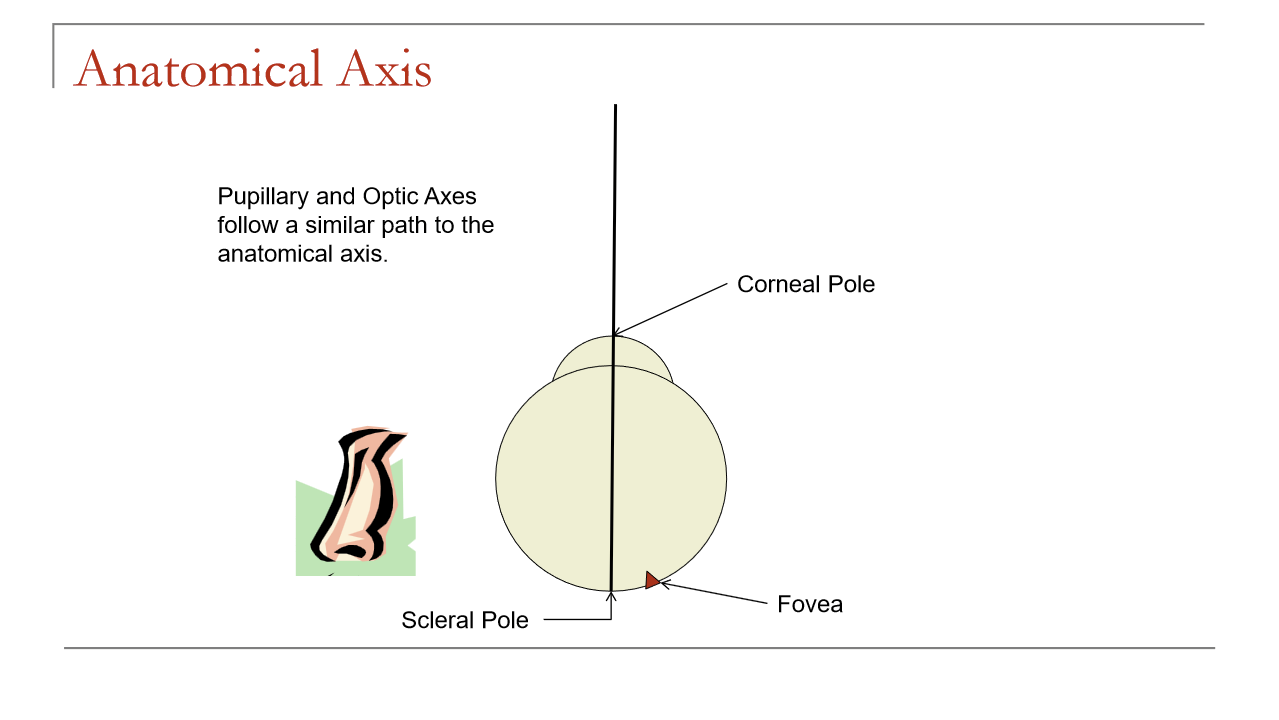
What is the pupillary axis, and how does it relate to fixation?
The pupillary axis passes through the center of the pupil, is normal to the cornea, and goes through the center of curvature of the cornea (~7.8 mm behind cornea). It is close to the anatomical axis and does not intersect the fovea, so it is not ideal for fixation.
What is the optic axis, and why is it of limited clinical use?
The optic axis connects the centers of curvature of the cornea and lens. It is close to the anatomical and pupillary axes and does not represent the true line of sight, making it less useful clinically.
What is the visual axis, and why is it the most important axis for fixation?
The visual axis runs from the fixated object → nodal points → fovea. It is the best representation of true fixation direction, as it passes through the fovea, the point of highest visual acuity.
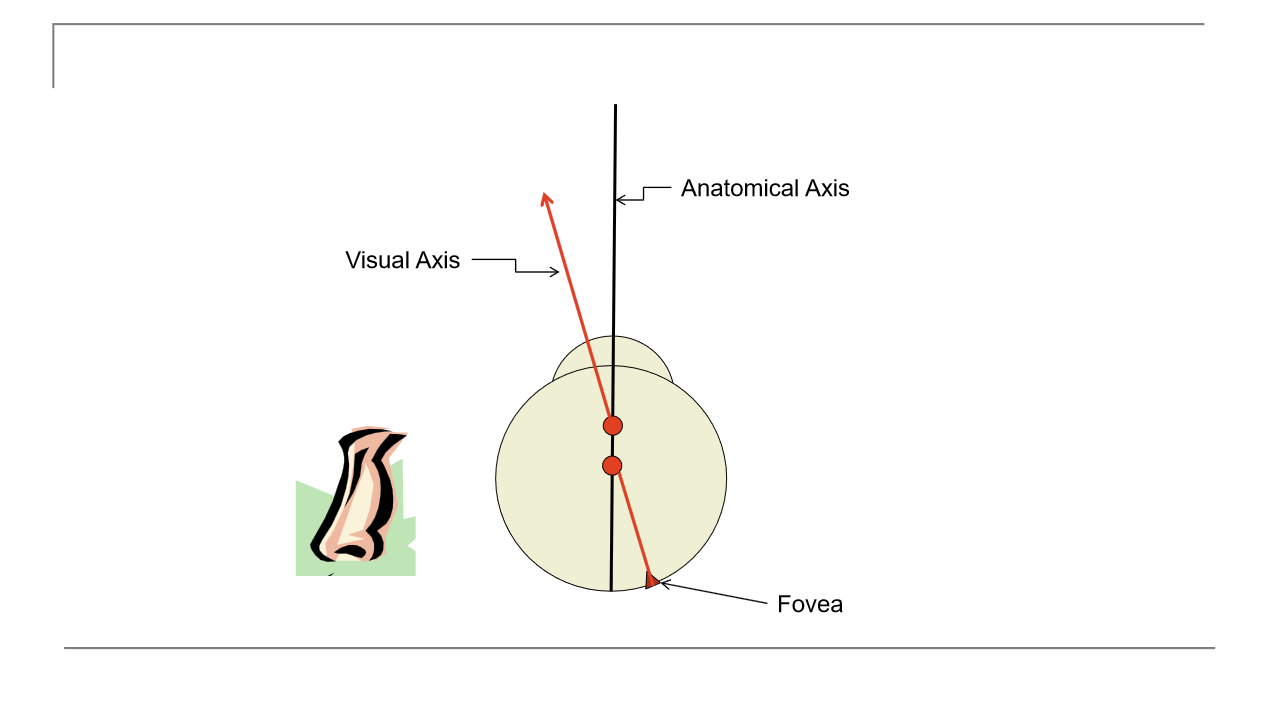
What is the line of sight, and what structures does it pass through?
The line of sight is the chief ray of the eye, running from the fixation point → center of the entrance pupil → center of the exit pupil → fovea.
What is the line of fixation, and how does it differ from the line of sight?
The line of fixation runs from the fixation point → center of rotation (COR) of the eye and stops there, unlike the line of sight which continues through the eye to the fovea.
Key difference: line of sight vs line of fixation
Line of sight = optical path (goes through pupil to fovea)
Line of fixation = geometric reference (ends at center of rotation)
What is the purpose of defining angles (λ, α, κ, γ) in eye movement physiology?
These angles are defined using different ocular axes to differentiate normal vs abnormal eye position, though they are not commonly used clinically.
What is angle lambda (λ)?
λ (lambda) = angle between the line of sight and the pupillary axis.
What is angle alpha (α)?
α (alpha) = angle between the optic axis and the visual axis.
What is angle kappa (κ)?
κ (kappa) = angle between the visual axis and the pupillary axis.
What is angle gamma (γ)?
γ (gamma) = angle between the optic axis and the line of fixation.
High-yield association: Which axes define each angle?
λ (lambda) = line of sight ↔ pupillary axis
α (alpha) = optic axis ↔ visual axis
κ (kappa) = visual axis ↔ pupillary axis
γ (gamma) = optic axis ↔ line of fixation
What is the center of rotation (COR) of the eye?
The COR is a point within the eye that has zero velocity relative to the orbit during eye movement, meaning the eye rotates around this fixed point.
What did Mueller propose about the center of rotation (COR) of the eye?
Mueller proposed that the eye behaves like a ball-and-socket joint, so the COR is located at the center of the eyeball.
What method did Volkmann use to study eye rotation?
Volkmann measured the line of sight at multiple gaze angles, aligned them, and extended them backward to find their intersection point.
What did Volkmann discover, and what is the sighting center?
He found that lines of sight intersect at a point about 13.5 mm behind the cornea, called the sighting center.
What are body centrode and space centrode in eye movement?
Body centrode = path of the COR relative to the eye
Space centrode = path of the COR relative to the orbit
DELETE
DELETE
What incorrect assumption did Volkmann and others make about eye rotation?
They assumed lines of sight intersect at the COR, which would simplify analysis, but this assumption is incorrect.
How did Fry determine the center of rotation (COR)?
Fry fit an arc to the caustic, then found the center of curvature of that arc, which represents the COR.
What did Fry conclude about the nature of the eye’s rotation?
The eye behaves as a ball-and-socket system with a unique (fixed) center of rotation.
Where is the center of rotation located for horizontal eye movements (Fry)?
Approximately 14.8 mm behind the corneal pole and about 0.79 mm nasal to the line of sight.
Where is the center of rotation located for vertical eye movements (Fry)?
Approximately 12.2 mm behind the corneal pole, located near the equator of the eye.
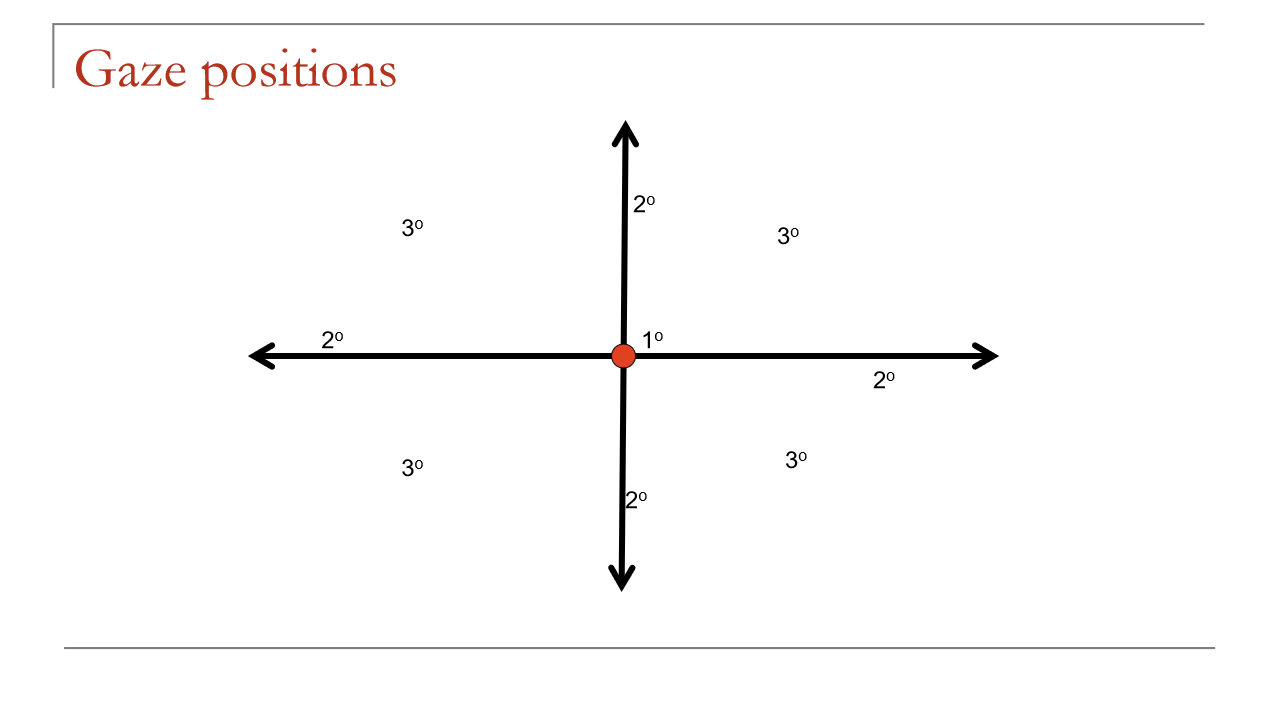
What are the primary, secondary, and tertiary positions of gaze?
Primary: straight ahead position
Secondary: points along the horizontal and vertical axes from primary position
Tertiary: all other positions
What is the Fick coordinate system, and what is the order of eye rotations?
A rectilinear system describing eye movement.
Order:
Horizontal movement first (rotation about vertical, head-fixed axis)
Then vertical movement (rotation about horizontal, eye-fixed axis)
Key axes in the Fick coordinate system
Vertical axis → head-fixed (does NOT move with eye) → controls horizontal movement
Horizontal axis → eye-fixed (moves with eye) → controls vertical movement
What real life counter part works with Fick coordinates?
Telescope and camera tripods. Our heads also follows fick coordinates.
In the Fick coordinate system, how are movements labeled and what do longitude vs latitude represent?
Horizontal movement (around vertical axis) → Longitude
Vertical movement (around horizontal axis) → Latitude
What is the key consequence of the eye-fixed horizontal axis in the Fick system?
Because the horizontal axis moves with the eye, iso-latitude lines (horizontal lines) appear curved on a tangent screen.
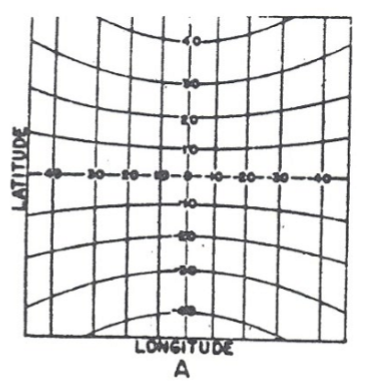
What is the Helmholtz coordinate system, and what is the order of rotations?
A rectilinear system where:
Vertical movement first (rotation about horizontal, head-fixed axis)
Then horizontal movement (rotation about vertical, eye-fixed axis)
Key axes in the Helmholtz coordinate system
Horizontal axis → head-fixed (does NOT move with eye) → controls vertical movement
Vertical axis → eye-fixed (moves with eye) → controls horizontal movement
In the Helmholtz coordinate system, what do azimuth and elevation represent?
Horizontal movement (around vertical axis) → Azimuth
Vertical movement (around horizontal axis) → Elevation
What is the key consequence of the eye-fixed vertical axis in the Helmholtz system?
Because the vertical axis moves with the eye, iso-azimuth lines (vertical lines) appear curved on a tangent screen.
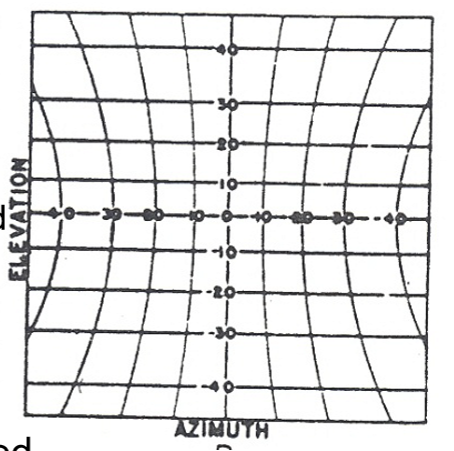
What is the Listing coordinate system, and how are positions described?
A polar coordinate system describing eye position using:
Axis angle (meridian) → direction of rotation axis
Eccentricity → angle from primary gaze to final position
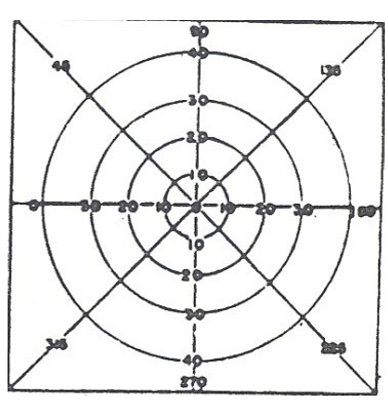
Why is the Listing system clinically relevant?
It matches the actual path of eye movement to tertiary positions
Uses polar coordinates, making it useful in perimetry (e.g., Goldman, tangent screen)
What is the difference between true torsion vs false torsion?
True torsion = rotation about the anterior–posterior axis (line of sight)
False torsion = apparent torsion that occurs when the eye moves to a tertiary position
How is false torsion related to Listing’s Law?
It matches torsion predicted by the Listing coordinate system
Can be defined as the difference between observed torsion and Listing-predicted torsion
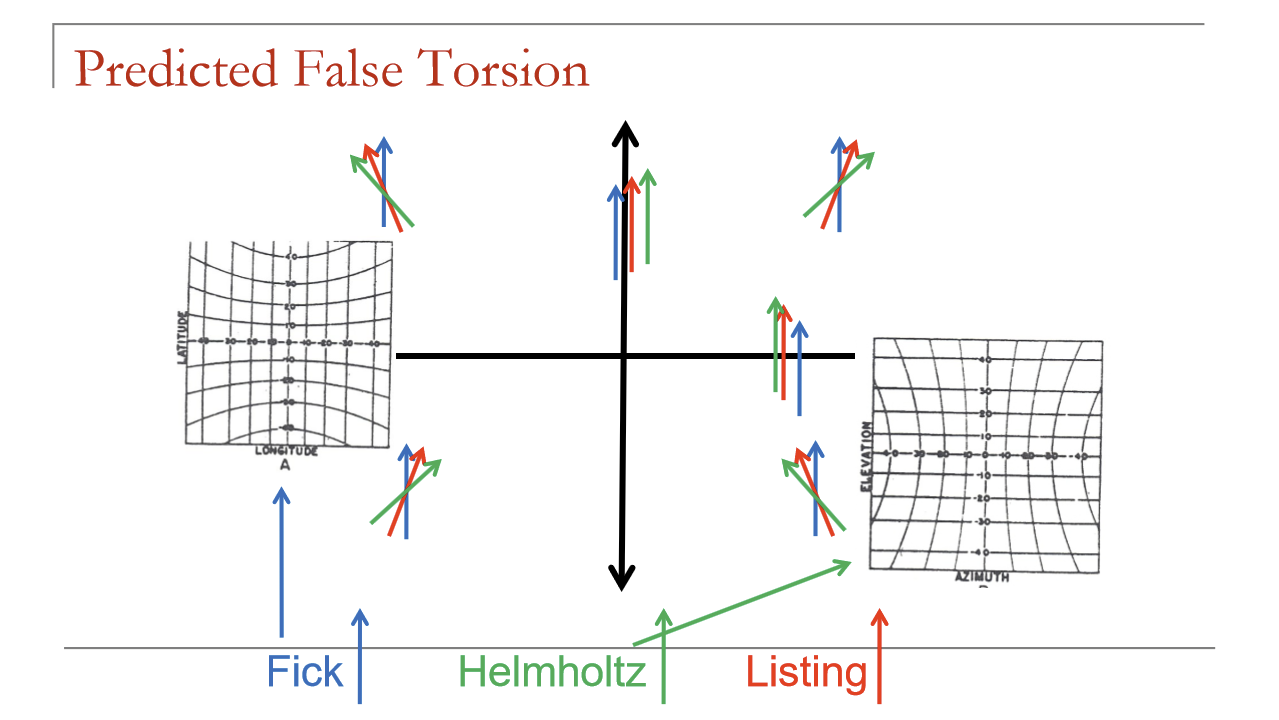
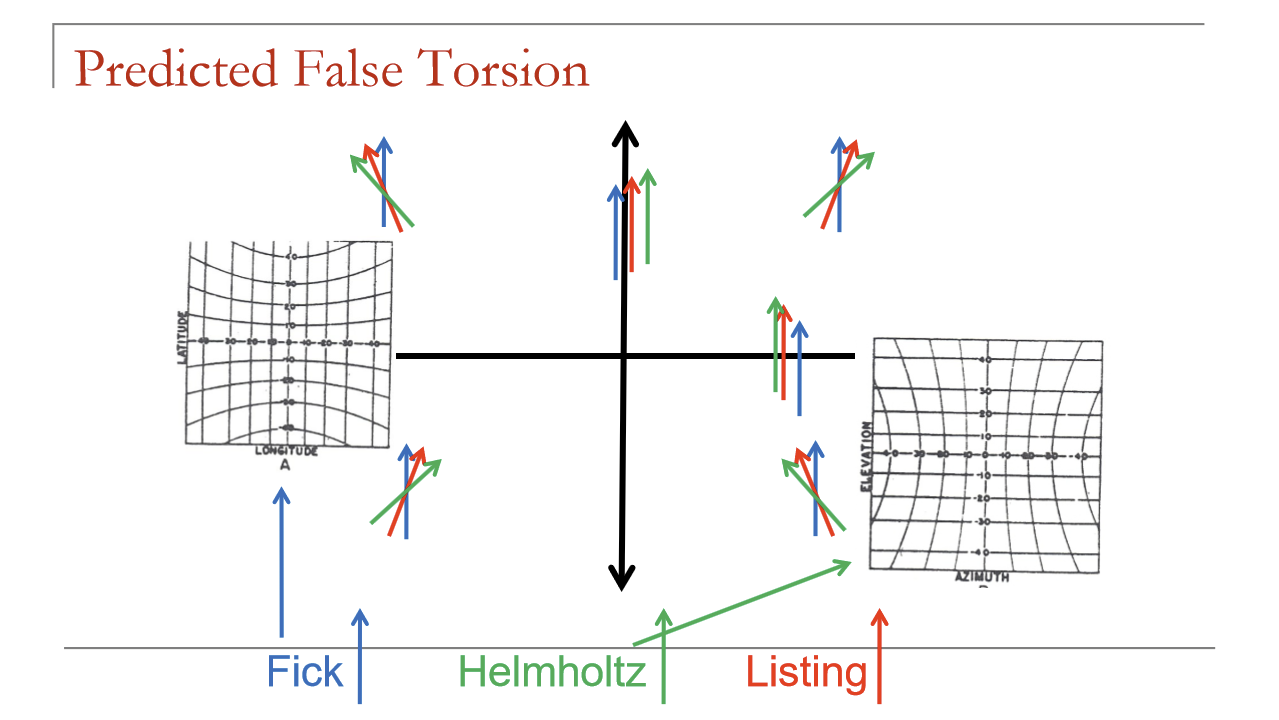
How do different coordinate systems predict false torsion?
Fick: No false torsion
Helmholtz: Most false torsion
Listing: Intermediate (closest to real eye behavior)
What is Donder’s Law?
For any given gaze position, the orientation of the eye (amount of torsion) is always the same, regardless of the path taken to reach that position.
How do Donder’s Law and Listing’s Law relate?
Donder’s Law → torsion is fixed for each gaze position
Listing’s Law → predicts how much torsion occurs for that position