Finding and Appraising the Evidence for Evidence-Based Veterinary Practice
 Studied by 0 people
 Call with Kai
 Learn
Learn Practice Test
 Spaced Repetition
 Match
Match Flashcards
 Knowt Play
1/15

There's no tags or description
Looks like no tags are added yet.
Name | Mastery | Learn | Test | Matching | Spaced | Call with Kai |
|---|
No study sessions yet.
16 Terms
What five topic areas can clinical questions be divided into?
• treatment
• prognosis and incidence
• aetiology or risk
• diagnosis
• prevalence
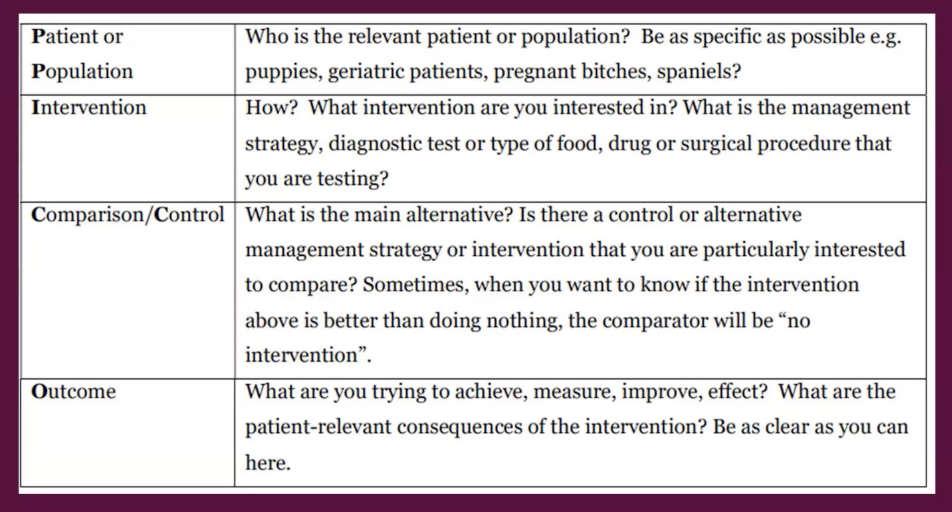
What does the PICO system stand for?
P - Patient: population and/or problem
I - Intervention: treatment, or thing of Interest: prognostic factor or exposure
C - Comparator: comparison or control
O - Outcome
Describe the questions you need to ask yourself when formatting a PICO question?
If including synonyms in your PICO search, how can you insert this into your search?
Using asterisks for synonyms
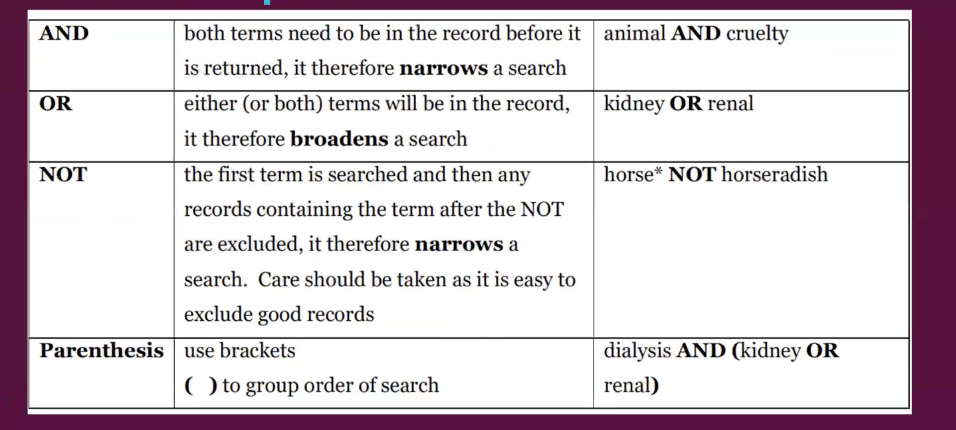
What are examples of Boolean operators?
A method of combining search terms
Helps to increase your search
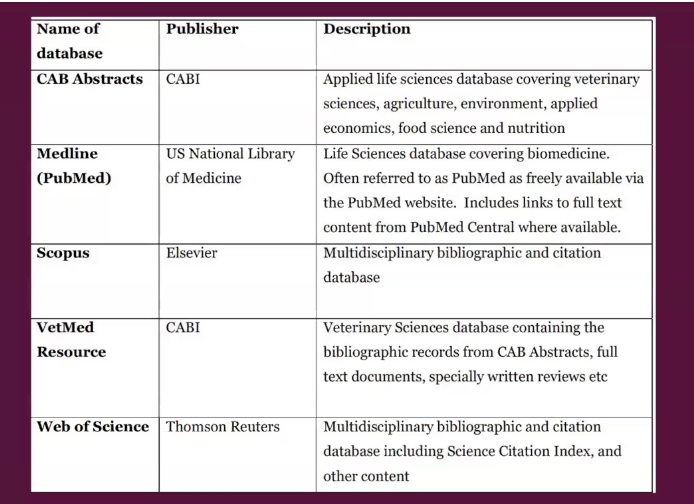
What are the main search engines that should be used when trying to source veterinary evidence and research?
Bibliographic Databases: (CAB extracts, VetMed resource, Medline/Pubmed, Scopus, Web of Science)
Secondary Resources: VetSRev, BestBETS for Vets, Veterinary Evidence
Provide a list of some of the most common data bases used in vet medicine.
What does the “best evidence” mean?
Asking questions about the evidence to determine if:
• It is relevant?
• It is reliable?
• It is recent?
When asking if the evidence is relevant, what considerations should be made?
• Does it answer all the parts of my question?
• Are the patients or participants in the study similar to my patients?
When asking if the evidence is reliable, what considerations should be made?
• Is the study design appropriate to answer the question?
• Has the study been well carried out?
• Have the results been accurately reported?
• What are the limitations of the study?
• Are there any sources of potential bias in the study?
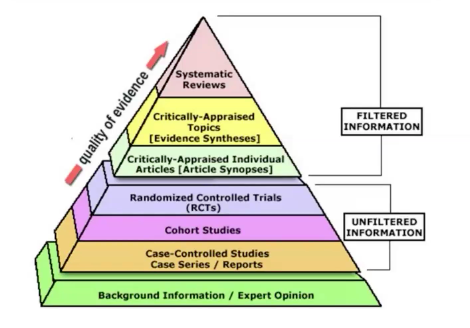
Describe the hierarchy of evidence.
**BUT a well thought out study carried out correctly might have stronger evidence even if not considered greater evidence on the pyramid.
What sort of information can be found in the Abstract?
• Why the research was carried out (objective)
• How the research was carried out (methods)
• What was found (results)
• Why the results are important (clinical significance)
How can you appraise a research paper?
Read the methods section and assess:
• Was the study observational or experimental? That is, were any of the animals treated differently as a result of being in the study, or did the researchers just make observations.
• Was the data for the study collected retrospectively (based on previous clinical records) or prospectively?
• Was there a control or comparator group?
• What type of data was collected and how was it analysed?
Read the results and look for:
• Is the data collection and analysis clearly described?
• Are the results clearly presented?
• Do the results meet the all the aims of the study?
• Where the animals in all groups comparable at the start of the study?
• Were all animals accounted for?
Look at the discussion and conclusions:
• Are the authors conclusions supported by the results?
• Have the authors considered the context and limitations of the study in drawing their conclusions?
• How do the findings add to or change current knowledge about the subject?
What are the five steps to follow when integrating evidence into practice?
Ask
Acquire
Appraise
Apply
Assess
What is evidence based practice?
Evidence-based practice involves applying the best and most relevant scientific evidence, integrated with clinical expertise, whilst taking into account each patient and owner's individual circumstances, when making clinical decisions.
What is contextualized care?
Contextualised care is a way of delivering veterinary care that acknowledges that there are different ways to approach the diagnosis and treatment of an animal, depending on the circumstances of the individual animal and their caregivers, and the context in which the care is delivered.