medchem exam 2 quantitative pharmacology
 Call Kai
 Learn
Learn Practice Test
 Spaced Repetition
 Match
Match Flashcards
 Knowt Play
1/56

Earn XP
Description and Tags
slide 9, class 11, april 2nd, all done
Name | Mastery | Learn | Test | Matching | Spaced | Call with Kai |
|---|
No analytics yet
Send a link to your students to track their progress
57 Terms
what properties to know to compare target ligands (1:2)
affinity for target (how strong does it bind), functional activity (potency ie at what concentration does it have an effect, efficacy ie how strong is the effect?)
How to quantify drug target interaction
Add drug concentration and then watch it increased and then plateau over time
Law of mass action
Velocity of a chemical reaction is proportional to the product of concentrations (or mass) of reactants
what is Kd
ligand affinity, how good ligand is interacting → dissociation constant (at equilibrium); shows at what [A] value you reach saturation
Kd unit
nanomolar
what do diff Kd numbers mean
The lower the Kd - the better it sits on the receptor, the less you need of it
The higher the Kd - the more you need for it to sit on the receptor (it is worse at it)
Can 100% ever be bound? why/why not?
interactions are reversible, usually can never bind 100%
why is it important to wait till equilibrium when doing these experiments
If not at equilibrium - incubate for shorter than it takes to each equilibrium
Highest one will be at equilibrium but lower values will not be
Underestimate affinity of ligand binding to receptor
if you test at equilibrium- much more likely to be accurate data!
what is the total receptor number
Bmax (or Rtotal)
association rate formula
= k+1 x [R] x [A]
Dissociation rate formula
= k-1 x [AR]
association and dissociation at equilibrium
they are equal - ie k+1 x [R] x [A] = k-1 x [AR]
what is the equilibrium dissociation constant equal to?
Affinity
Kd formula
k-1/k+1
= [A] x [R]/ [AR}
Bmax formula
[R] + [AR]
rearranged Bmax formula
[R] = Bmax - [AR]
Kd formula using Bmax
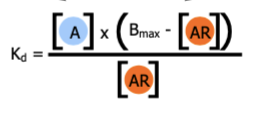
[AR] rearanged formula
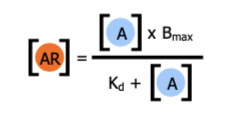
benefit of the [AR] rearranged formula?
relation between something you can measure [AR], something you know [A] and 2 parameters that you like to determine
KD[A meaning
[A] that occupies 50% of all receptors
what is it when [A] > > > > KD
[AR] = Bmax
what is it when [A] = KD
[AR] = ½ Bmax
fractional receptor occupancy (fAR)
= [A]/ KD + [A]
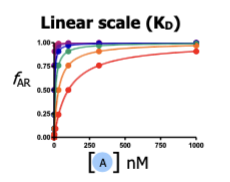
what are diff curves here
different compounds with different KD values
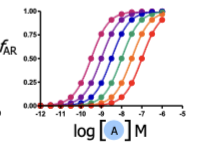
what is this?
fractional receptor occupancy but on a 10Log scale so they are S-curves instead
why is it helpful to use log scales here
S curves are easy to do curve fitting
when is f = 0.5 on log scales
At the inflection point

pKd = 9 (bc thats the one thats the smallest number since its 1 × 10⁻⁹§
how to make your ligand visible so you can measure things w/ it
but something radioactive on it which is detectable, can then measure how much of it is bound to the receptor as the rest is washed away (this method was used more in the past though)
displacement (competition) binding descr
indirect measure of affinity of unlabeled ligands, displace fixed [radioligand] from receptor by increasing concentrations of unlabeled ligand; eg with B present not all targets are accessible to A* the labelled ligand
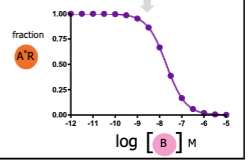
when would you get a graph like this
when doing competition of A* with B in increasing []s
way to compare ligands when doing competition binding
IC50 - inhibitory [] at 50%, measure of the potency of B to displace A*; BUT not the affinity of B (that is Kd(B))
what is the IC50 of B not equal to the affinity of B
IC40 value in binding experiments depends on experimental conditions and is not just a property of compound B; if you change the [A*] and eg make it higher, it is more difficult for unlabeled ligand B to displace → higher [B] are needed to fully occupy the target so the IC50 value shifts to the right
Ki value meaning
actual affinity
cheng-prusoff equation
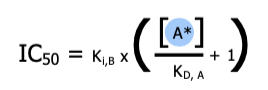
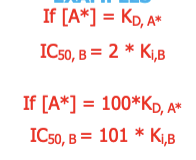
examples of cheng prusoff equation calc
what is the cheng-prusoff equation used to find
equation to derive an affinity parameter for a ligand that is independent of experimental condition, convert IC50 to Ki values
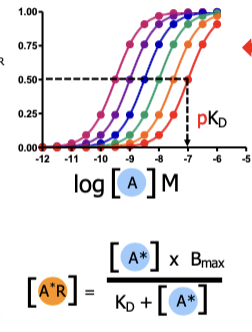
what is this a summary of?
direct binding - from A* + R <=> A*R
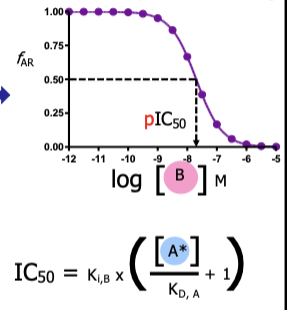
what is this a summary of
reversible competition binding, convert IC50 into Ki value
what can agonist binding to receptor lead to?
cellular response
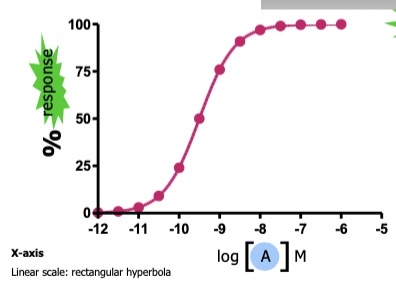
what is this
dosis-response curve
possible eg’s of a response that can happen after agonist binding (4) (that can be measured)
contraction muscle, frequency heart (cell), level of 2nd messengers, gene expression
agonist dosis response - potency descr
potency of agonist [A] to produce a given response
EC50 formula
[A] giving half a maximal response, -log EC50 also used
partial agonists descr
reduced maximal response at 100% occupancy, a partial agonist needs to occupy all receptors to produce its (low) maximal response
alpha formula
max response (partial agonist) / max response (full agonist)
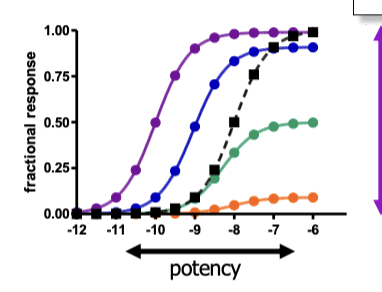
diff alphas for each line (top to bottom)
alpha = 1
alpha = 0.9
alpha = 0.5
alpha = 0.1
conformational sensors descr
can report on TM6 movement of GCPRs upon activation; can use bioluminescent emitter (BRET) when brought over emits red cause energy transfer to fluorophore
what do diff H3R agonist induce
different conformational states of the H3R sensor, although they all bind to the sensor
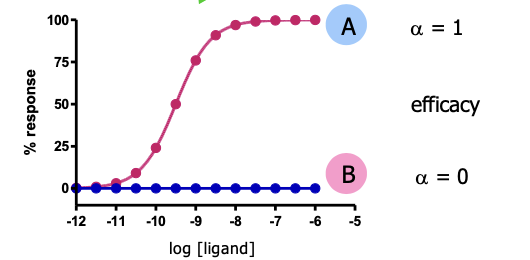
what are A and B here
A - agonist
B - antagonist
competitive antagonism descr
agonist dose response in presence of an antagonist - competition for common binding site, shift EC50 of agonist A, Emax still obtained if [A] is high enough and competes w/ B
how can you see competitive antagonism on a graph w/ diff conditions
increasing [antagonist] shift against DRC rightwards
parallel shifts if similar increase in [antagonist B] is tested
if graph increases in [B] in log-steps and half-log steps are shown
steps how to quantify strength of a blockade
determine EC50,A ([B] = 0) and EC50,A’ (with B present) for all tested [B]
determine dose ratio DR = EC50,A’/EC50,A for schild analysis
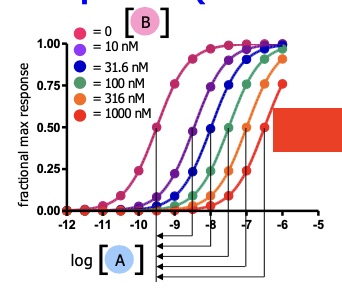
label red point
EC50,A’
what is affinity of antagonist [B'] expressed as?
Kd,b or pKd,b
what relationship do log([B]) and log(DR-1) have and result; what should the slop plot be for competitive antagonism?
linear relationship, if [B] increases 10-fold, DR also increases 10 fold; for competitive antagonist - slope = 1
what happens w/ insurmountable/non-competitive antagonism?
irreversible binding of B to receptor, less receptor available for A - reduced response by agonist A, agonist DRC in presence of irreversible antagonist, covalent bond formed, messenger blocked from binding site