Techniques and Applications Test 1
 Call Kai
 Learn
Learn Practice Test
 Spaced Repetition
 Match
Match Flashcards
 Knowt Play
1/172

There's no tags or description
Looks like no tags are added yet.
Name | Mastery | Learn | Test | Matching | Spaced | Call with Kai | Chat |
|---|
No analytics yet
Send a link to your students to track their progress
173 Terms
CQI (continuous quality improvement)
looks at why the system caused the person to make that mistake (or why something works)
decrease costs, increase customer satisfaction, ensure quality throughout the healthcare organization
What does QI do?
TJC (The joint commison)
independent, not for profit organization dedicated to improving the quality of care in healthcare settings
Accreditation is not required but desired by most
ACRO (american college of radiation oncology)
ACR (american college of radiology)
ASTRO (american society for radiation oncology)
APEx (accreditation program for excellence)
4 Rad Oncology accreditation agencies
quality
The totality of features and characteristics of a radiation therapy process that bear on its ability to satisfy stated or implied needs of the patient
QA (quality assurance)
what actions need to be taken to meet quality
TQM (total quality managment)
more customer service centered (what does this do for them?)
CQI
continuous quality improvement
QC (Quality control)
the tests/tasks you do
Quality indicators
the actual tolerances (#’s)
Who is on the QI team?
Physicians (oncologists), physicists, engineers, dosimetrists, radiation therapists, oncology nurses, support staff
research
strong scientific evidence demonstrates that performing the evidence based care process improves health outcomes (either directly or by reducing risk)
accuracy
measure should be capable of indicating whether the process has been delivered with sufficient effectiveness to make improved outcomes likely
Adverse effects
implementing the measure has little or no chance of inducing unintended consequences
TNM
Tumor, nodes, mets
PSA
Prostate specific antigen (lab value), higher levels when there is an issue
DRE
Digital rectal exam
consultation, simulation, RT planning, treatment, follow ups
Steps of radiation therapy
American association of physisicts in medicine
AAPM
SRS
stereotactic radiosurgery (more cranium)
SBRT
stereotactic body radiotherapy (rest of the body)
Megavolt vs Kilovolt
megavolt is used for treatment (shows grainy images) - compton
kilovolt is used for simulation and localization (shows structures better) - photoelectric
Homogenity results must be within how many HU (Housefield units)
5 HU
PSA
patient support assembly (the couch)
Co-60 monthly tolerance
2% monthly tolerance
Who does daily, monthly, and yearly QC tests
daily - therapists
monthly - physicists & dosimetrists
annual - physicists
optical devices
lasers, field defining lines
dose volume histogram
graphical summary used in rad therapy to show the dose delivered to a specific volume of tissue
DRR
digitally reconstructed radiograph
tumor localization
determining the extent of the tumor and the location of critical structures
Treatment verification
using diagnostic quality radiographs of each treatment field from the initial simulation procedure
(radiographs used to compare against port films)
conventional sim
designed to simulate the mechanical, geometrical, and optical conditions of various treatments units
IGRT
image guided radiographic therapy
isocenter
what everything rotates around
what is the only non divergent part of the beam
central axis
Monitor units (mu)
radiation output (dose)
100 cm
distance to maintain from source
SSD vs SAD
SSD (source to skin distance) - requires pt to be moved to maintain 100 cm
SAD (source to axis distance) - gantry can rotate and maintain 100 cm
IEC vs Varian
IEC - 0 degrees on top and 180 on bottom
Varian - 180 degrees on top and 0 on bottom
Field defining wires
define treatment field (biggest area possible is 40 × 40 at 100 cm)
Reticule
provides hash marks on field
ODI (Optical distance indicator)
light based ruler projected on pt’s skin
OFD (OID)
object to field distance
SFD
source to field distance
TFD
target to field distance
seperation
intrafield distance
6%
how many degrees of freedom for table movement
pitch
movement of couch in trendelenburg and reverse trendelenburg position
quality improvement
continuous study and improvement of the process of providing healthcare services
when are tattoos a good idea
when retreatment is needed
lead vs concrete vs borate polyethylene shielding
Lead doesn’t take up much space an can’t block neutron radiation
Concrete takes more space but blocks neutrons due to water in it
borated polyethylene is best shielding
conventional ct
using a simulator that was not 3-D (2-D)
virtual simulation
current method
can print out DRR’s
uses CT and computer software
bore size of CT machine for rad therapy
80-90 cm
5 mm
slice thickness can’t be more than 5 mm
pitch
“couch movement in longituinal per 360 degree rotation of the tube / half beam width”
how fast pt is translating through machine
interpolation
mathematical method that estimates unknown value that falls directly between 2 known pts
amount of detectors in conventional vs ct sim
1 detector in conventional
multiple in ct
amount of detectors per cm vs 1 degree in ct sim
1-8 detectors per cm
1-5 per 1 degree
pros and cons of spiral ct sim
pro - shorter scan time = less pt motion = reduces dose (slices can be taken of any part and any thickness)
cons - higher processing time, higher noise on image if pt moves, doesn’t reconstruct on z axis
respiratory gating
watching the tumor move while breathing
deformable fusion
when overlaping images don’t match (like PET and CT)
2 purposes of CT sim
target localization (and critical structures) allows skin marks to be given
ability to generate DRR’s
1 a week minumum
how often are port films taken
HU (hounsfield units) / CT numbers
attenuation rates or tissue density differences displayed as pixels of different shades of gray
range from +1000 to -1000
HU unit for air
-1000
HU units for water
0
HU units for CSF
15
HU units for blood
20H
HU units for gray matter
40
HU units for muscle
50
HU units for bone
650 - 700
patient positioning
weakest link in treatment
1-2 times
missing tumor can result in failure
10% or more reduction in dose =
could determine if pt is cured
3 types of immobilization devices
Patient positioning aids
simple immobilization devices
complex immobilization devices
immobilization device purpose
help set the pt up easier and to prevent movement
(need to last entire treatment otherwise have to re sim)
patient positioning aids
not custom
ex: head holder, prone pillow, arm board, sand bags
simple immobilization devices
helps restrict pt but won’t hold position for them
(doesn’t completely restrict movement)
ex: bite block, arm stretcher,
complex immobilization devices
custom
ex: alpha cradle, vac bag, aquaplast mask, aquaplast breast
when making complex immobilization devices check for…
bulky clothes because those change day to day, shoes, metal, that they aren’t chewing anything
ionizing vs non-ionizing
ionizing - x-rays
non-ionizing - MRI, ultrasound
lymphangiogram
injection of dye into vessels (usually between toes),
helps detect blocks/leaks in lymph vessels, find cancer, or diagnose conditions like lymphedema or lymphoma
Nuc med vs PET
uses different tracers and cameras
both help determine physiologyl
CT w/ PET
changed lung cancer treatment
Ipsilateral
on the same side
Contralateral
on the opposite side
median sagittal vs parasagittal
median sagittal = equal parts
parasagittal = unequal parts
4 types of body habitus
hypersthenic (5%)
sthenic (48-50%)
hyposthenic (35%)
asthenic (10-12%)
2 main body cavities
posterior/dorsal - can be divided further into cranial and spinal cavity
anterior/ventral - splits into thoracic cavity and abdominal/pelvic cavity divided by diaphragm
chondriac
cartilage
9 regions of abdomen

3 main functions of lymph nodes
1) Drains tissue spaces of interstitial fluid that escapes from blood capillaries and loose connective tissues, filters it, and returns it to the bloodstream
2) absorbs fats and transports them to the bloodstream
3) major role in the body’s defense/immunity
lymph node length
1-25 mm in length
afferent
adds lymph (more of these than efferent)
efferent
takes it away (less of these, larger in diameter than afferent)
lymphedema
excessive fluid
lymph node anatomy
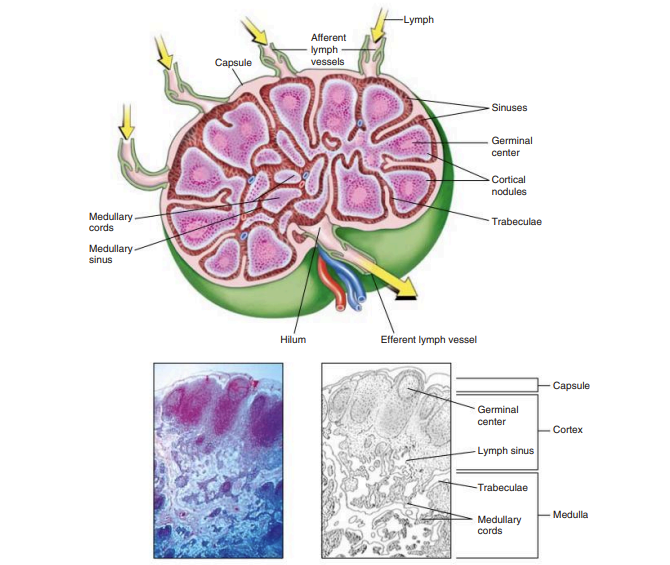
lymphatic flow
tissue fluid - lymph - lymphatic capillary - afferent lymphatic vessel - lymph node - efferent lymphatic vessel - lymphatic trunk - collecting duct - subclavian vein
spleen
largest lymph node in the body
filters all blood