PSYC2050 WEEK 5
 Call Kai
 Learn
Learn Practice Test
 Spaced Repetition
 Match
Match Flashcards
 Knowt Play
1/50

There's no tags or description
Looks like no tags are added yet.
Name | Mastery | Learn | Test | Matching | Spaced | Call with Kai | Chat |
|---|
No analytics yet
Send a link to your students to track their progress
51 Terms
CLASSICAL VS OPERANT CONDITIONING
Classical:
Ivan Pavlov
Leaning via association
Relies on the formation of reflexive associations between stimuli resulting in involuntary responses
Operant:
B.F. Skinner
Learning via reinforcement
Relies on the consequences of past actions influencing future behaviour, resulting in an increase or decrease of voluntary behaviour
OPERANT CONDITIONING PRINCIPLES
Consequences lead to changes in voluntary behaviours
A behaviour that results in a reward tends to be repeated or become more frequent
A behaviour that results in a punishment tends to be avoided or become less frequent
THE LAW OF EFFECT
The tendency to perform an action is increased if rewarded, weakened if not.
SKINNER BOX

SHAPING
Selectively reinforce behaviour that resembles the desired target behaviour.
SHAPING IN THE REAL WORLD
No experimenter/trainer
Real-world reinforcement (e.g., foraging)
Animals adapt behaviourally to environmental feedback
SUPERSTITIOUS BEHAVIOURS
Reflecting apparent belief that things they do cause the reward (when there is no real causation)
Random reinforcement can shape behaviour
Even if there is no true association between behaviour and outcome, we expect and try to find links.
Self-perpetuating: increased display of what was reinforced before -> increased chance of being rewarded again
Ex. Athletes' warm-up rituals, lucky clothes
ANIMAL TRAINING TECHNQIUES
Shaping
Reinforcing behaviour resembling target behaviour
Baiting
Using food to bait animal into target behaviour
Mimicking
Using reinforcement for animal to mimic target behaviour
Sculpting
Moving and sculpting animal to perform target behaviour
Instruction (language)
Using words to entice target behaviour
CHAINING
Many behaviours are made of smaller behaviours
Acquiring complex behaviour is easier if learned in chunks
It is often best to start with the last behaviour in the chain
Called backward chaining
The participant starts closer to the end goal
REINFORCERS AND PUNISHERS
Reinforcer = increases behaviour
Punisher = decreases behaviour
Positive = the animal/person receives something (add)
Negative = the animal/person loses something (subtract)

POSITIVE REINFORCEMENT
add something to increase a behaviour
Ex. Get a treat when doing something good
NEGATIVE REINFORCEMENT
removes something to increase a behaviour
Ex. Give night off from homework after good marks
POSITIVE PUNISHMENT
add something to decrease a behaviour
Ex. Anti-barking collar on a dog when doing something bad
NEGATIVE PUNISHMENT
removing something to decrease a behaviour
Ex. Lose your licence after speeding
BRIDGING
Combining two types of conditioning
Using a stimulus (CS) that has an acquired values via Pavlovian conditioning, as a positive reinforcer in operant conditioning
In animal training, it is useful to teach an association between a stimulus that can be delivered immediately, and a subsequent reward that can't be delivered immediately
Saying 'good'
Whistle
Clicker
It comes to signal arrival of the reward – effectively bridges the time between the behaviour and primary reinforcement
CATEGORISATION PROBLEMS
Some examples are hard to categorise between +/- reinforce/punishment
Directions are still useful for understanding how and why behaviours change over time
CONTINUOUS
Continuous (CRF) = every response
PARTIAL
Partial (PRF) = only some responses
RATIO
Delivered based on the number of times the subject performs the behaviour (frequency).
INTERVAL
Delivered based on the amount of time that has passed.
FIXED
The ratio or interval required is the same every time, it is consistent and predictable.
VARIABLE
The ratio or interval is indeterminant, it varies each time and is less predictable.
FIXED RATIO
Based on a definite number of responses.
Every nth action (ex. Every 10th coffee is free)
VARIABLE RATIO
Based on an indeterminate number of responses.
On average, every nth action (ex., gambling)
FIXED INTERVAL
Based on a definite period of time.
First behaviour after n seconds (ex. Pocket money each week if clean room)
VARIABLE INTERVAL
Based on an indeterminate period of time.
On average, the first behaviour after n seconds (ex., checking for new messages)
A child is allowed to go outside to play with friends as long as she checks in with her mother regularly. Her mother praises her every second time she checks in.
Fixed ratio
A pop quiz has to be completed in the lecture every three weeks.
Fixed interval
You have a chance of winning money on the pokies each time you press the button.
variable ratio
A factory worker is paid for each piece (assembling a certain number of units to receive money).
fixed ratio
Fly-fishing involves frequent casting and reeling back, what schedule is a fly-fisher on?
Variable ratio
A salesman is paid on commission for every 10th sale.
fixed ratio
An executive's contract specifies salary increases every 6 months.
fixed interval
A cleaner takes a break after each level of the building is cleaned.
fixed ratio
REINFORCEMENT SCHEDULES AND RESPONSE RATE
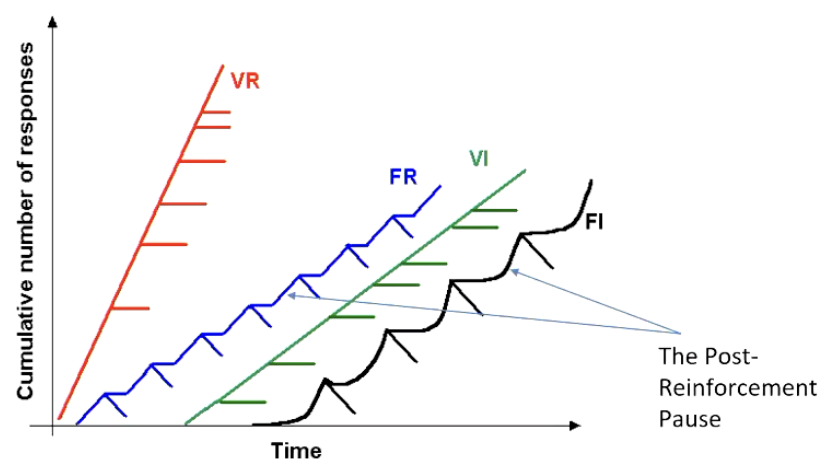
Ratio more effective than interval
You doing behaviour brings reward
Variable more effective than fixed
Unpredictability
Post-reinforcement pause
In fixed schedules
Demotivation as gaps between rewards
Variable ratio schedule most resistance to extinction
Teaches persistence
Ex. Gambling
CONTINUOUS VS PARTIAL
Continuous reinforcement is more effective for acquiring a new behaviour
Partial reinforcement is more resistant to extinction
PROBLEMS WITH PUNISHMENT
Reinforcement is more effective than punishment
Why?
Punishment isn't as permanent
Punishment reduces trust / increases aggression
Tells you what not to do, but doesn't show what you should do instead
WHEN IS PUNISHMENT EFFECTIVE?
Restricts escape from bad behaviour
Greater intensity = greater reduction in behaviour
Must have a continuous schedule
No delay in punishment
Must be delivered over short period of time
Can't have subsequent reinforcement
Reinforcing incompatibility
Watch out for side effects
REWARD VARIABLES
Other variables apart from schedule that affect conditioning:
Drive
How much the animal wants the reinforcer
Hungry vs not-hungry
Size
Animals learn faster if they get more food pellets
But... diminishing returns
Delay
Reinforced between when no delay
Temptation
Immediate reinforcement but delayed punishment
It can be hard to act in consideration of the delayed punishment
LAW OF DIMINISHING RETURNS
The effect of size is much stronger when you start with smaller sizes than initially starting off at a large size.

THE THREE TERM CONTINGENCY
The discriminative stimulus
What sets the occasion
The operant response
The behaviour
The outcome that follows
Reinforced/punished consequence
THE DISCRIMINATIVE STIMULUS
The discriminative stimulus serves to signal the occasion when a particular behaviour will be reinforced/punished.
Learning to discriminate the stimulus is key to operant conditioning
STIMULUS CONTROL - GENERALISATION
When a response is reinforced in the presence of one stimulus, there is a general tendency to respond in the presence of a new stimulus that has similar physical properties or has been associated with the stimulus
Loose degree of stimulus control
STIMULUS CONTROL - DISCRIMINATION
Degree to which different stimuli signal the occasion for a particular response
Precise degree of stimulus control
Taught using discrimination training procedures such as different reinforcement
Amy drove 120km/ph in a 100 zone every day until she received a speed ticket and fine of $500.
positive punishment
A person with a heroin addiction begins to feel withdrawal symptoms and injects another dose to rid the unpleasant feeling.
negative reinforcement
Rachel's lecturer compliments her writing ability and she decides to take other subjects in creative writing.
Positive punishment
Geoff is kicked of the swimming team for binge drinking.
negative punishment
Fiona buys her son a lolly so he stops his temper tantrum and it works.
Fiona = negative reinforcement
Son = positive reinforcement.
Melonie constantly complains about her lecturer, and her students are sick of hearing it and no longer provide sympathy.
negative punishment
Marty notices improvement in his fitness when he has to clime 6 flights of stairs every day, when his lift is fixed he still continues taking the stairs.
positive reinforcement