AP Physics 1 - Forces Study Guide
 Studied by 0 people
 Call Kai
 Learn
Learn Practice Test
 Spaced Repetition
 Match
Match Flashcards
 Knowt Play
1/72

Earn XP
Description and Tags
This doesn't have center of mass or springs. Please find other flashcards for those topics.
Name | Mastery | Learn | Test | Matching | Spaced |
|---|
No study sessions yet.
73 Terms
Inertia
Tendency of an object to maintain constant velocity.
Weight
Force of gravity acting on an object. In Newtons.
Mass
Amount of matter an object has. In kilograms.
Force
A push or a pull. In Newtons.
Net force
Vector sum of all forces acting on an object. In Newtons.
Static equilibrium
The state where an object is at rest because all the forces and torques acting on it are balanced, resulting in zero net force and zero net torque. F_net = 0. Example: Object at rest on level ground.
Kinetic equilibrium
F_net = 0; at constant velocity and 0 acceleration.
Normal force
Force perpendicular to the surface.
Static friction
Friction when object does not move against contact surface. Example: When you push a lunch table and it doesn’t move.
Kinetic friction
Friction when object moves against contact surface. Example: You go down a slide wearing jeans and they slow you down.
Coefficient of friction (μ)
μ = F_f/F_n → the ratio that tells how large friction is compared to how hard the surfaces are pressed together
μ_s vs μ_k
μ_s = static (prevents motion), μ_k = kinetic (while sliding)
Static friction formula
f_s ≤ μ_s N (≤ is mandatory)
Kinetic friction formula
f_k = μ_k N (always equal)
μ_k compared to μ_s
Smaller than μ_s
Object moving at constant speed on flat ground → how to find μ_k
μ_k = F_f/F_n
Object sliding at constant speed on incline with no other forces → value of μ
μ = tan θ (the angle θ is the incline angle)
Normal force for any object on an incline
F_n = mg cos θ (cos of the incline angle, not sin)
Static friction direction
Opposite the way it would move if no friction
Kinetic friction direction
Opposite the actual sliding direction
Action/reaction force pairs
Two forces that are always equal in size, always opposite in direction, and act on two different objects. They happen at the exact same time and are of the same exact type. Newton’s 3rd Law: No force exists alone. Example: you push on a wall, so the forces are you to wall and wall to you. There are two forces. Not only one.
Terminal velocity
Free fall when force of air resistance equals force of gravity.
Newton’s First Law
No change in speed (a=0) only if F_net = 0
Newton’s Second Law
When a ≠ 0, F_net = ma.
Newton’s Third Law
Forces exist in action/reaction pairs.
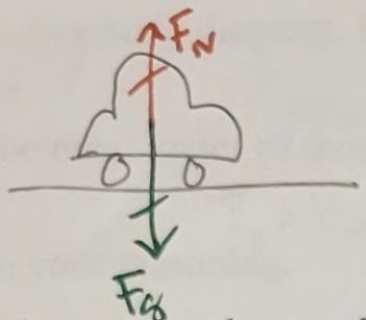
Draw free body diagram of parked car on level ground.
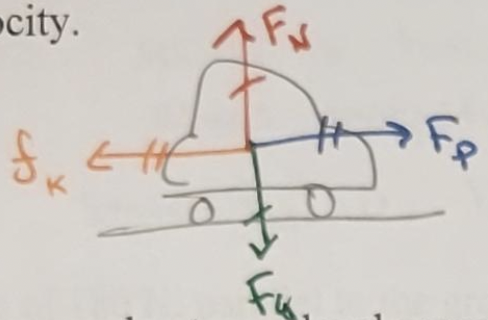
Draw free body diagram of driving car on level ground at constant velocity.
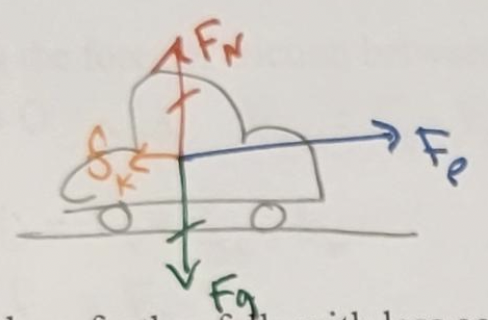
Draw free body diagram of car accelerating on level ground.
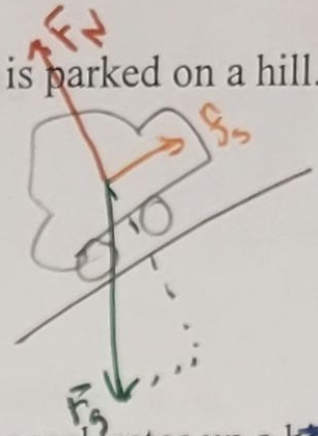
Draw free body diagram of car parked on a hill.
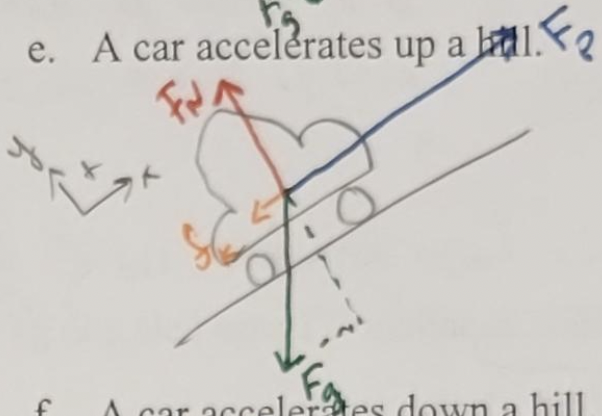
Draw free body diagram of car accelerating up a hill.
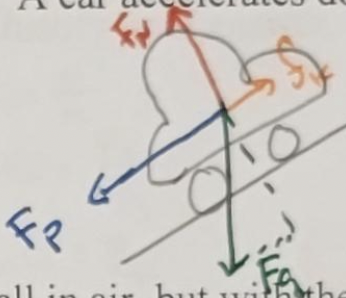
Draw free body diagram of a car accelerating down a hill.
Why does a feather fall slower than a bowling ball in air, but same speed in vacuum?
In air: feather has large air resistance relative to weight → net force smaller → smaller acceleration.
In vacuum: no air resistance → only gravity → F = mg = ma → a = g for both (mass cancels).
Action-reaction forces (3rd law pair) are equal/opposite — why don’t they cancel?
You push wall (forward on wall), wall pushes you (backward on you) → forces don’t cancel because they’re on separate bodies. One force is on you (you push the wall) and one force is on the wall (the wall pushes you) so they’re different systems.
Find mass when given F_net and a (acceleration)
Fₙₑₜ = ma → m = Fₙₑₜ / a (MAKE SURE TO DRAW A FREE-BODY DIAGRAM AND SHOW ALL YOUR STEPS INCLUDING HOW YOU GOT “m = Fₙₑₜ / a”!!!)
Find acceleration when there are multiple horizontal forces (push + friction)
F_netx = Fₐ − f = ma → a = (Fₐ − f) / m
Object sliding down ramp at constant speed → what does that tell you?
F_net parallel = 0 and F_net perpendicular = 0. Component of weight down ramp exactly equals friction (or pulling force)
Force applied at angle θ above horizontal, constant speed on level ground → normal force
F_net = mg − F sinθ
Object moving at constant velocity (any situation) → net force
F_net = 0 in every direction
F_netx
sum of forces in x-direction (horizontal)
F_nety
sum of forces in y-direction (vertical)