818 Exam 2 Concepts
 Call Kai
 Learn
Learn Practice Test
 Spaced Repetition
 Match
Match Flashcards
 Knowt Play
1/96

There's no tags or description
Looks like no tags are added yet.
Name | Mastery | Learn | Test | Matching | Spaced | Call with Kai | Chat |
|---|
No analytics yet
Send a link to your students to track their progress
97 Terms
T/F: solid drugs always have to be in solution (solubilized) before they can diffuse across membranes and be absorbed
TRUE
T/F: the small intestine has a large surface area and is the site for maximal absorption of most drugs and nutrients
TRUE (rate limiting step = permeability)
T/F: pH alters the solubility and dissolution rate of poorly water soluble and ionizable drugs
TRUE
if the pH is 2 units ______ the pka of an acid, then it is _____ % charged
above; 99%
if the pH is 2 units ______ the pka of an base, then it is _____ % charged
below; 99%
what are 3 physical aspects of the GI tract that are key determinants in drug absorption?
1) surface area -> smaller the SA, the less absorption
2) fluids (pH & bile salts)
3) gastric emptying
gastric emptying rate is influenced by:
1) fluid content
2) solid content
3) fatty acid content
T/F: delayed gastric emptying can either be beneficial or detrimental
TRUE
what are 2 detrimental effects of delayed gastric emptying?
1) increased drug-nutrient interactions
2) greater potential for acid or enzymatic degradation
what are the 2 beneficial effects of delayed gastric emptying?
1) poorly or slowly water soluble drugs will have a greater time for complete dissolution and absorption
2) more time allowed for compounds that require a specialized absorption process
what mechanism are the majority of drugs absorbed from the GI tract?
passive diffusion
the rate of drug transport across a membrane is described by ....
Ficks Law
what are some components of Ficks law?
1) Dm = diffusion coefficient
2) Am = membrane absorbing surface area
3) Pm/Aq = drug partition coefficient
4) Cut-Cblood = concentration gradient of drug
5) Xm = thickness of membrane
passive diffusion: what are 3 things the rate of drug absorption is proportional to?
1) lipid solubility
2) surface area
3) concentration gradient between the site of absorption and the plasma
passive diffusion: what is something that the rate of drug absorption is inversely proportional to?
thickness of the biological membrane
what can Ficks law be simplified to?
rate of membrane diffusion = P x Cgut
- permeability coefficient
- concentration of drug in the gut
what is the DRIVING FORCE for passive diffusion across biological membranes?
the concentration gradient between the site of absorption and the plasma
Two other molecular and physiochemical considerations for drug absorption
1) molecular weight - larger molecules have a lower ability to diffuse effectively
2) Log P (oil/water coefficient) - need a balance of hydrophobicity/hydrophilicity
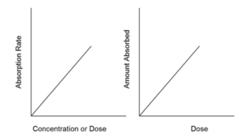
for passive diffusion the absorption rate and the amount absorbed are proportional to dose/concentration (assuming good permeability) because drugs can pass freely through the membranes
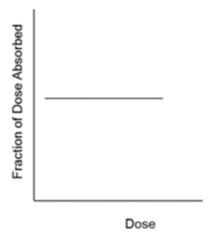
T/F: the fraction of dose absorbed will increase as the dose of the drug increases for passive diffusion
FALSE this explains why most drugs exhibit first order kinetics because the fraction of dose absorbed (Ka) remains constant regardless of dose
for first order kinetics, elimination rate (K) is _______ of drug concentration
DEPENDENT
Recap: for first order kinetics, what is INDEPENDENT of changes in drug dose?
Cl, V, T 1/2
Carrier mediated transport
can move lipid insoluble drugs (hydrophilic) and ions across membranes via facilitated disunion (no energy) or active transport (energy)
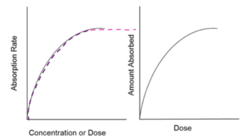
Carrier mediated transport systems are ______
saturable as there is a finite number of carrier molecules (will eventually plateau as the drug concentration increases)
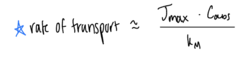
carrier mediated transport: at low concentrations of drug, the rate of transport is ______ to the drug concentration
proportional; exhibits first order kinetics; concentration at absorption site (Cabs) << Km (binding affinity to the transporter)

carrier mediated transport: at high concentrations of drug, the rate of transport is ______ to the drug concentration
independent (will plateau); exhibits zero order kinetics; Cabs >> Km
6 characteristics of active transport systems
1) require energy
2) hold structural specificity for substrate
3) site specificity
4) able to move drugs against concentration gradient
5) saturable
6) subject to competitive inhibition by structurally similar compounds
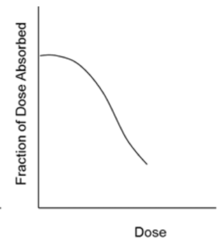
this describes a carrier mediated/active transport process because as drug concentrations get higher, the process becomes saturated so the fraction of dose absorbed will decrease
T/F: basic drugs undergo faster dissolution in the acid of the stomach, making them ready to be absorbed once entering the small intestine
TRUE because at an acidic pH, bases will be 99% ionized which helps dissolution
T/F: food (especially fatty food) will increase/delay gastric emptying time
TRUE
what is dose dumping?
a PK phenomenon when the drug is released too quickly from its dosage form in the body -> occurs when a controlled release or extended release formulation releases faster then intended (from breaking/chewing/crushing tablet, food/alcohol in stomach (delays gastric emptying time), or pH changes)
T/F: there is no active transport systems in the large intestine
TRUE
T/F: rectal administration of drugs bypasses first pass hepatic metabolism
TRUE
what are 5 major rate limiting steps of absorption?
1) disintegration -> tablet breakage into granules or particles
2) dissolution
3) permeability
4) blood flow/perfusion
5) gastric emptying
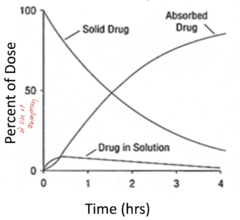
what rate limiting absorption is this graph describing?
dissolution rate-limited absorption
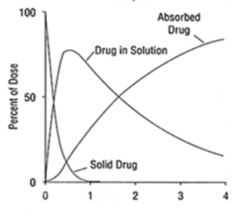
what rate limiting absorption is this graph describing?
permeability rate-limited absorption
what are ways to help dissolution?
1) micronization - increases surface area for the dissolution of poorly water soluble drugs
2) presence of food in GI tract - increases time in GI tract (delays gastric emptying)
3) adequate aqueous solubility
what is a way to get around permeability issues?
formulation as a prodrug
Kinetics of drug absorption: absorption phase
the rate of drug absorption (ka) is GREATER than the rate of drug elimination (k) -> although K is always occuring whenever drug is present in the plasma
Kinetics of drug absorption: at peak concentration (Cmax), the rate of drug absorption is _____ to the rate of drug elimination
TRUE
the larger the Ka, the _____ the rate of absorption
faster
T/F: takes ~5 Ka T/12 for the drug to be fully absorbed
TRUE
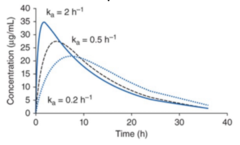
the larger the Ka and the smaller the K, the _____ the Cmax
larger
Tmax
the time to reach Cmax -> reflects the rate of drug absorption (Ka)
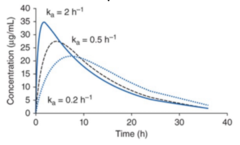
the larger the Ka, the _______ the Tmax
shorter (Cmax is reached faster)
T/F: the terminal slope of the extravascular concentration vs time graph is dependent on the SLOWEST step (either absorption or elimination)
TRUE
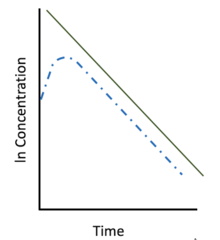
depicts standard kinetics following an IV (solid line) and oral (dashed line) administration -> occurs when the rate of Ka is larger than K
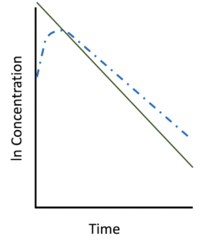
Flip flop kinetics
when Ka is smaller than K
is the slope of Ka steeper or shallower than K?
steeper and its the slope of the residual line
an increase in bioavailability will have a proportional relationship to which two parameters?
1) Cmax
2) AUC
an increase in CL will have an inversely proportional relationship to which four parameters?
1) T 1/2
2) Cmax
3) AUC
3) Tmax
an increase in Vd will have a proportional relationship to which two parameters?
1) T/12
2) Tmax
an increase in Vd will have an inversely proportional relationship to which parameter?
Cmax
Ka has a(n) _________ relationship to Tmax and a(n) _________ relationship to Cmax
inversely proportional; proportional
multiple dosing regimen: Cmax
peak plasma concentration -> occurs at time zero
multiple dosing regimen: Cmin
trough concentration -> occurs at the dosing interval (tau)
For a single IV bolus, Cmax = ?
Co (dose/V)
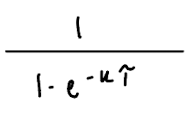
drug accumulation ratio -> reflects how much drug is accumulated with repeated dosing
what are two things that influence drug accumulation?
elimination T 1/2 and dosing interval (tau)
T/F: if the dosing interval is > 5 T 1/2 of the drug, then virtually no accumulation will occur since ~97% of the drug is eliminated by the time it is dosed again
TRUE
for multiple dosing, after steady-state conditions are achieved, the mathematical function of (1-e-nkτ) becomes equal to what value?
1 -> the growth function no longer is in the equation since e^-nkt =0 so 1-0 = 1
T/F: for multiple dosing, the average steady state concentration is the same as the arithmic mean of the trough and peak concentrations
FALSE
T/F: volume of distribution will affect the average steady state concentration
FALSE only dose/doing rate and clearance will
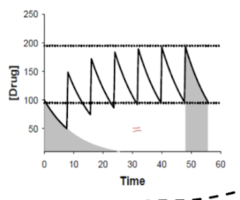
T/F: at steady state, the AUC over the dosing interval (tau) is identical to AUC 0->infinity for a single dose
TRUE
fluctuation
reflects the difference between the peak and trough concentrations within a dosing interval (the amount REMOVED during a dosing interval)
the larger the tau, the ________ the fluctuation
greater
the larger the Ka, the ______ the fluctuation
greater
as a general rule, the dosing interval is usually about equal to the drugs ______, with adjustments made based on convenience factor
half life
with a decreased rate of elimination (smaller K), more or less drug will accumulate?
more -> since the T 1/2 will increase which will mean it will take longer to reach Css
T/F: if you shorten the tau, the drug will accumulate more (larger Css) and have smaller fluctuations, but it will still take the same amount of time to reach Css
TRUE
Does Ka affect the C average at steady state (Cave)?
NO
for oral drugs with rapid drug absorption (large Ka's), they have a similar relationship to ______
IV bolus administration as most of the drug will reach systemic circulation without alot being administered -> can use the IV bolus equations
for multiple dose IV infusions, a decrease in dose will have a(n) _________ relationship to Cmin and Cmax
proportional relationship (will also decrease)
for multiple dose IV infusions, an increase in infusion time will _____ Cmax and _____ Cmin
decrease; increase
what are 4 advantages of non-compartmental analysis (NCA)?
1) fewer, simpler equations
2) does not rely upon assumptions about body compartments
3) most widely accepted method of analyzing drug concentration-time data
4) requires only pen, log graph paper, and calculator
what are 3 disadvantages of NCA?
1) inability to visualize or predict plasma concentration vs time profiles
2) based on only observational data -> cannot overcome/predict missing data
3) doesn't allow for predicting concentrations in certain compartments (aka anywhere else in the body)
2 requirements for NCA
1) need to calculate AUC from concentration time data
2) need to determine terminal deposition T 1/2 and rate constant
AUMC
area under the first order moment curve -> always lager than AUC
MRT is the time required for ______ of an IV dose to be eliminated
63.2% ; proportionally related to T 1/2
T/F: MRT for an oral formulation is longer than MRT for an IV formulation
TRUE since the oral also has to account for absorption time
T/F: NCA can be used to compare rates of drug absorption for different products of the same active ingredients since the MRTiv for that drug will be the same
TRUE
the smaller the MAT, the _____ rate of absorption of that formulation
faster
rate of drug absorption is depicted by _____ & ______ while extent of drug absorption is depicted by _______
Tmax & Cmax; AUC
if a drug is absorbed more quickly, will the MAT and MRTni be a greater or lower value?
lower
if a drug is absorbed to a greater extent, will it have a lower or higher AUC and F?
higher
what is apparent volume of distribution at steady state (Vdss)
relates the amount of drug in the body at steady state during constant IV infusion and the resulting steady state plasma drug concentration
Vd, steady state IV bolus equation
CL X MRTiv = IV dose/(AUMC/AUC)
two compartment characteristics are the result of ....
a slower distribution of the drug into some of the tissues in the body
T/F: one compartment model assumes instantaneous equilibrium between blood and tissues
TRUE
what determines the # of compartments that are included in a model?
how many distinct rates of drug distribution
microconstants
K12 -> represents the distribution out of the central compartment into the peripheral compartment
K21 -> represents distribution from the peripheral compartment back to the central compartment
T/F: drug elimination from the central compartment out of the body is irreversible
TRUE and is denoted by K10
what is the driving force for movement of drug out of the central compartment and into the peripheral compartment?
drug concentration in the central compartment
what are 5 key assumptions of two compartment models
1) all processes are first order
2) the system is NOT saturable aka exhibits linear kinetics
3) the drug follows passive diffusion
4) the drug is being monitored in the central compartment
5) the organ responsible for the removal of the drug is also in the central compartment
what are the macro constants?
a = distribution rate constant
b = elimination rate constant
A = intercept of slope associated with the alpha phase (y-intercept)
B = the intercept of the slop associated with the beta phase (y-intercept)
what is Co in a two compartment model?
Co = A + B
rank the values for Vss, Vc, and Vb (Varea)
Vb=Varea > Vss > Vc