Cell Biology Ch. 3
 Call Kai
 Learn
Learn Practice Test
 Spaced Repetition
 Match
Match Flashcards
 Knowt Play
1/78

There's no tags or description
Looks like no tags are added yet.
Name | Mastery | Learn | Test | Matching | Spaced | Call with Kai | Chat |
|---|
No analytics yet
Send a link to your students to track their progress
79 Terms
nine major classes of proteins
enzymes, structural, motility, regulatory, transport, signaling, receptor, defensive, storage
2 structural classes of proteins
globular and fibrous
how many amino acids used in protein synthesis and biologically relevant? are there more than that existing?
20 / yes
explain and draw basic structure of amino acid
carboxyl group, amino group, hydrogen, and side chain R group attached to alpha carbon

different for each amino acid and gives each amino acid its distinctive properties.
R group
what is glycine R group and how does that make it different from other AA
just hydrogen / not enantiomeric
are amino acids for proteins d or l
l
where are hydrophobic amino acids found
interior of proteins when the proteins are in an aqueous environment or in cell membrane
where are hydrophilic amino acids found and why
surface of proteins in solution to maximize interactions with water and other polar or charged substances
function of enzyme proteins
catalysts, increasing rate of chemical reaction
function of structural proteins
physical support and shape
function of motility proteins
contraction and movement
function of regulatory proteins
control and coordinate cell function
function of transport proteins
move substances into and out of cells
function of signaling proteins
communication between cells, made by cell and sent to cell surface
function of receptor proteins
enable cells to respond to signaling proteins and chemical stimuli from environment
function of defensive proteins
protect against disease
function of storage proteins
reservoirs of AA
what are the 3 types of R groups and subsection
hydrophobic, polar uncharged, polar charged (acidic negative charge, basic positive charge)
what is found in R group of nonpolar amino acids
hydrocarbons
what is found in polar uncharged amino acid R groups
lot of O, N, and SH
what is found in acidic polar charged amino acid R groups
negative charged terminal carboxyl
what is found in basic polar charged amino acid R groups
positive amine
each amino acid has what names
name, 3 letter abbreviation, 1 letter abbreviation
single chain of amino acids
polypeptide
two or more polypeptide chains that have a function
protein
t or f: all polypeptides are proteins
f (all proteins are made of polypeptides but not all polypeptides are proteins)
protein that consists of a single, polypeptide chain
monomeric protein
protein that consists of more than one polypeptide chain
multimeric protein
composed of 2 polypeptide chains is (__). 3 is (___). 4 is (__)
dimer / trimer / tetramer
single chain of a multimeric protein
subunit
describe a peptide bond and what kind of reaction it is
covalent bond between the C of a carboxyl group of one amino acid and the nitrogen of the amino group of the next amino acid / dehydration synthesis condensation
what do the n- and c-terminus ends of polypeptide have
n-terminus has unbound amine group. c-terminus has unbound carboxyl group
how is sequence of polypeptide read and synthesized
both N to C
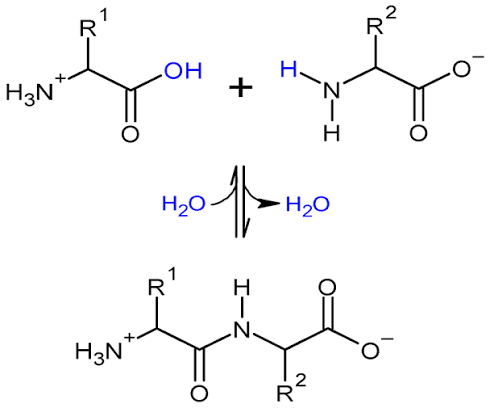
describe what is happening. what are the starting molecules and what do they form? what kind of bond is formed? what kind of reaction?
2 amino acids forming a polypeptide / peptide bond / dehydration synthesis or condensation
final folded, functional shape of a protein is (__) which is NOT (__) and can be manipulated to regulate protein (__).
conformation / static / function
t or f: amino acids of protein held together by polar covalent bonds, but the folded shape of protein help together by noncovalent bonds and interactions (and covalent disulfide)
t
core structure of polypeptide is the (__) and (__) project out in alternating arrangement
polypeptide backbone / R groups
noncovalent bonds form between (__) of protein. disulfide bonds form between (__) by (__) reaction
R groups, R groups and backbone, and just backbone / cysteine R groups terminal SH / redox
if the wild type was ASN and the mutation GLY on number 232, how would you write the amino acid
ASN232GLY
what is the primary structure? kind of bonds and interactions involved?
amino acid sequence / covalent peptide bonds
what is the secondary structure? kind of bonds and interactions involved?
folding into alpha helix, beta sheets, and random coils / hydrogen bonds between NH and CO groups of peptide bonds in backbone
what is the tertiary structure? kind of bonds and interactions involved?
3-D folding of single polypeptide chain / disulfide bonds, all types of noncovalent bonds
what is the quaternary structure? what kind of bonds and interactions invovled?
multiple polypeptides forming multimeric protein / disulfide bonds and all types of noncovalent bonds
how is primary structure determined
order of nucleotides in DNA determines order of nucleotides in mRNA which in turn gives amino acid sequence
what is at the N-terminus
NH3+
t or f: R groups participate in the bonding of secondary structure
f
explain the backbone model of protein structure
traces backbone
describe the wire model of protein structure
outlines R groups with backbone
describe the ribbon model of protein structure
has arrows and coils that highlight secondary structure beta sheets and alpha helices
describe the space-filling model of protein structure
shows 3-D shape, distance, and size. good for finding binding sites
what are the 4 protein structure models
backbone, ribbon, wire, and space-filling
what does the arrow of beta sheets mean in ribbon model
arrow points to C-terminus
alpha helices are (__) structure. (__) bonds between (__) and (__) groups about (__) carbons away. only between atoms of (__). what do amino acid R groups look like
spiral / hydrogen / carboxyl / amino / 4 / polypeptide backbone / project out from spiralled backbone
beta sheets are (__) structure. (__) bonds between atoms of (__). made up of (__) that are connected by (__). what do R groups look like?
pleated sheet / hydrogen / polypeptide backbone / strands / random coils / alternating above and below sheet
t or f: the secondary/tertiary structure may lump beta sheets together and be in a different order than the primary structure even if the primary structure is not continuous beta sheet
t
what are the two beta sheet forms
parallel (strands fun in same direction) and antiparallel (strands run in opposite directions)
small secondary structures with common shape and function
motif
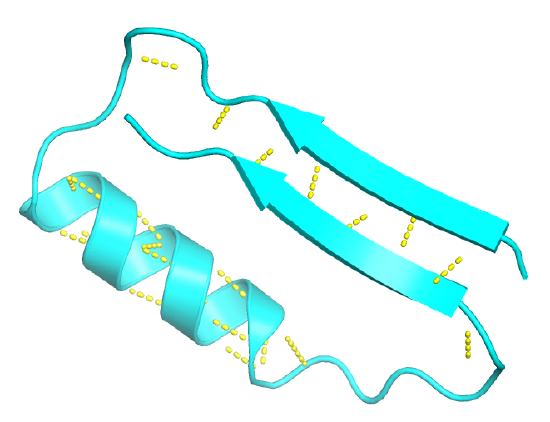
identify the motif
beta-alpha-beta
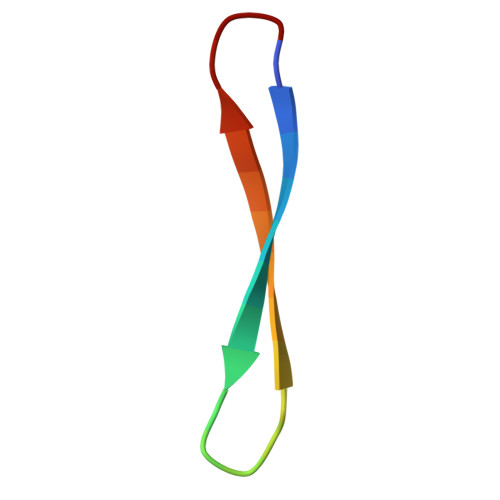
identify the motif
hairpin loop

identify the motif
helix-turn-helix

identify the motif
coiled coils

identify the motif
leucine zipper
which motif is commonly found binding to DNA
leucine zipper
tertiary structure contains bonds between atoms of
R groups and polypeptide backbone
structures in single polypeptide chain, discrete, locally folded unit of tertiary structure folding and functioning independently
protein domains
domains act (__) with specific (__). what useful experiments can you do?
modularly / jobs / can take off DNA binding domain to see if still binds to DNA. then could but DNA binding domain on non binding molecule to see if will bind to DNA
t or f: all proteins achieve quarternary structure
f
t or f: some proteins function as a single polypeptide chain
t
individual peptide of quaternary protein
subunit
subunits can be either (__) like in (__) or (__) like in (__)
identical / p53 / different / hemoglobin
are subunits of quaternary structure functional in isolation
no