Lecture 3: Skeletal Considerations in Movement
 Call Kai
 Learn
Learn Practice Test
 Spaced Repetition
 Match
Match Flashcards
 Knowt Play
1/52

There's no tags or description
Looks like no tags are added yet.
Name | Mastery | Learn | Test | Matching | Spaced | Call with Kai | Chat |
|---|
No analytics yet
Send a link to your students to track their progress
53 Terms
Term: Loading
Application of a force to a body/object
Term: Skeletal Loading
Force applied on the skeletal system
How are tissues loaded?
From internal and external forces
Term: External Forces
Gravity and contact forces
Term: Internal Forces
Generated within the body
What are some internal forces?
Muscles: They are the main internal force because they actively do so
CT: They passively transfer forces to the skeletal system from us moving our body
Forces from tendons, ligaments, and joint capsules push and pull on skeletal system
What are the types of loading?
Compression: 2 forces press the bone together
can be top-to-bottom or side-to-side
Tension: Pulls or stretches bone apart
can be top-to-bottom or side-to-side
Shear: (perpendicular) Force that causes bone to have translation in opposite directions
can be top-to-bottom, side-to-side, or front-to-back
can also be the friction between two bones
Torsional: Twisting force that causes a bone to rotate with respect to each other (opposite direction)
Bending: Within the bone, applied to an area with no direct support
Term: Tissue deformation
A change in the shape of the tissue (bone, muscle, tendons, ligaments, and fascia)
Tissue deformation: does the tissue have resistance? what type of force does it result from?
To some degree, all tissues can resist changes in their shape (some more than others), and TD may result from external and internal forces.
From: muscles, ligaments, and tendons can cause other tissues to change shape.
How is change in shape graphed and mechanically represented?
Through a curve called: The Stress-Strain curve
SSC - Term: Stress (σ)
Measured as
Any force applied to a structure
F per unit area
N/m2 (or psi)
σ = F/A
SSC - Stress Example
The monkey is the F (stress) being applied to the structure, pulling it.
F = weight of the monkey (10lbs)
The monkey is applying the F on a smaller area (0.1in2 ), so the psi is high (100psi)
SSC - Force over a smaller/larger area = how much σ
Smaller = more σ
Larger = less σ
SSC - Term: Strain (ε)
measured as
The (resulting) deformation caused by applied stress.
ε = Δ L / L₀ (change in length divided by original length)
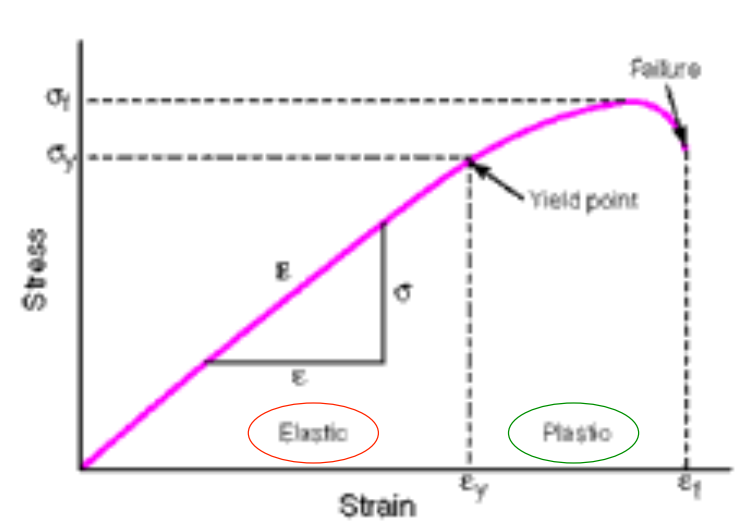
SSC:
What happens when a stress is removed from the elastic region?
What happens when a stress is removed from the plastic region?
When σ is removed from the material’s elastic region so is the strain. So, the material goes back to its original shape/length
When σ is removed from the material’s plastic region, the strain remains. The material’s shape/length is permanently changed (deformed).
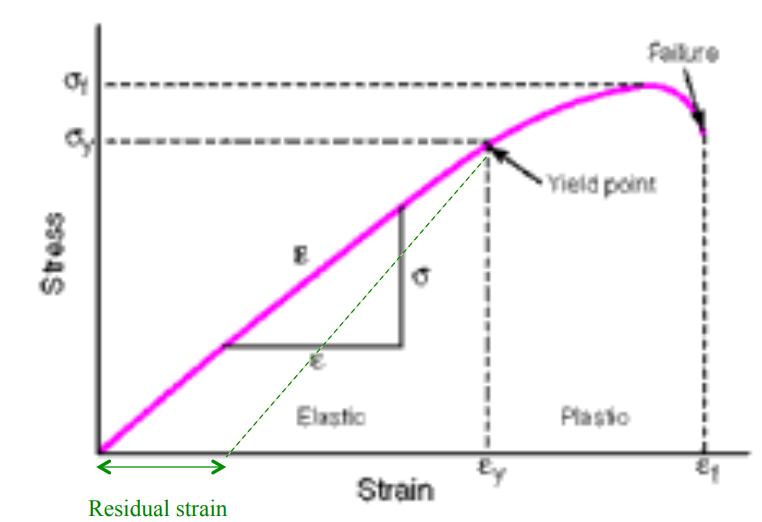
SSC - Term: Residual Strain
What happens to the slope?
A σ was removed, but the material permanently starts with a strain.
The slope of σ permanently changes because low amounts of σ will cause higher ε in the material than before.
Ex) Residual Strain - pulling a tendon, ligament, etc.
The material heals but not to how well it was before. Therefore the person is more likely to keep reinjuring it because the same loads hurt it more easily.
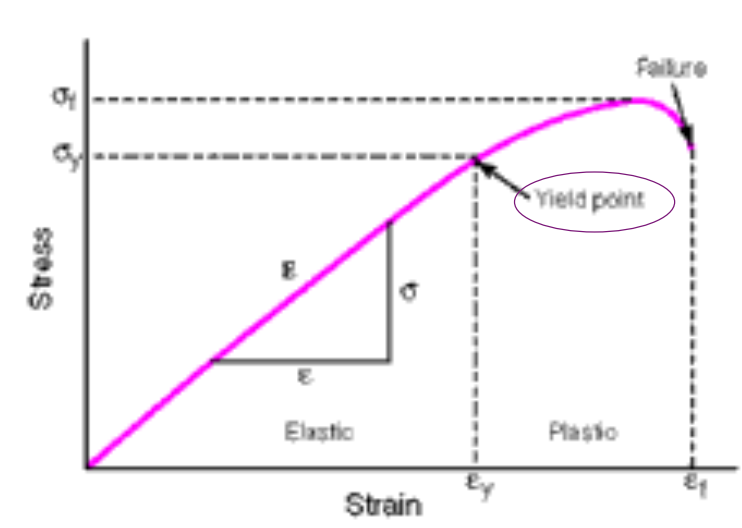
What is the transition between the elastic and plastic region?
The yield point is the marker of change. It is the point of which a body structure can handle the load safely.
Once the YP is reached and stress goes into the plastic region, it is now an unsafe load.

What is the failure point?
The end of the plastic region. It is the point where the material completely disintegrates underneath the load.
When a muscle completely tears or the bone fully breaks.
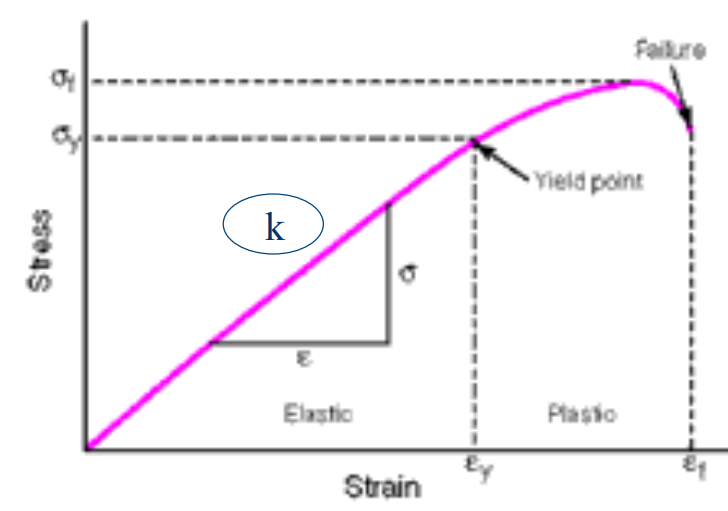
What is the elastic modulus?
What does it tell us?
How is it represented?
The slope of the line, the ratio between stress and strain.
Tells us how stiff the material is
Represented with the variable K
K= σ / ε

What is K representing
Ductile material: can handle a high level of stress with low amount of strain
Brittle material: Fairly even ration (1-to-1 relationship)
Weak material: Has a K that is lesser than 1
Bone: Only a little amount of stress causes a large strain.
How is the materials’ strength represented in the graph?
Material strength is represented by how much area is underneath the curve (K)
the area representing the energy storage
How can the failure point be reached?
1) A single traumatic event
2) Or an accumulation of microfractures building up to failure
going into the plastic region repeatedly, slowly changing the residual strain of the material
Term: Anisotropic
Yield strength depends on the direction the load is applied
The materials’ strength is not equal is all directions of load application.
There is a different stress-strain curve depending on the plane and direction of load.

What materials in our body are anisotropic?
Tendons, muscles, ligaments, and bones
How strong is a bone in a….
Compression load type
Tension load type
Shear load type
Strong SSC
Medium SSC
Weakest SSC

Why is bone the strongest in a compression load type?
We are bipedal and gravity is always pushing us down. As Newton’s Third Law states, When we push down on something we get an equal and opposite reaction back; because of this we are always receiving a compression force which the bone has evolved to become stronger.
Term - Viscoelastic
The rate and duration of loading affects the strain (curves) of the material.
When is a material viscoelastic?
When the material has a different SSC based on how fast the load is coming into it.

Viscoelastic
Fast Loading
Slow Loading
FL: can have a high rate of strain or some materials have a low amount
SL: can have a low rate of strain or some materials have a high amount
All depends whether the material responds better to slow or fast loads

Which materials in our body are viscoelastic?
Bones, ligaments, and tendons

How do we categorize material?
Flexible, Strong
Stiff, Strong
Flexible, Weak
Stiff, Weak
Categorizing material: Where does bone fall under?
Flexible and weak.
Weak because in the grand scheme of things (universe) it is not very strong
When can loading be good?
The bone adapts to loading, getting stronger through exercise.
What do high rates of loading cause?
How?
High loading rates may exceed the yield point more quickly than the bone can adapt, increasing risk of injury.
The muscle applying high compression and tension can cause an injury
External forces such as collisions with an object or a human at higher rates or amounts.
What is the mechanical perspective of loading bones?
Physical activity causes loading by using muscles and body weight. This mechanical stress is needed for bones to grow and strengthen.
This has to be done safely and slowly so the person can slightly move from the elastic to plastic region to allow growth.
Loading → Deposition→ Increases bone density
What types of injury can loads cause? How do we prevent injury?
Fracture bones, dislocate joints, disrupt muscles, and CT
To prevent injury or damage from tissue deformation the body must be able to absorb energy from both internal and external forces (loads)
It is more advantageous for the body to absorb force over?
Why?
Larger aspects of the body rather than smaller ones, and to spread the absorption rate over a greater period of time
σ = F/A
By spreading the F over a larger SA, there is a decreased σ, dissipating it, and reducing the likelihood of injury.
Stronger and healthier tissues have a better SSC
and are more likely to withstand excessive mechanical loading, resulting in the ability to have excessive tissue deformation without reaching the plastic region.
The skeletal system is made up of….
It makes up how much of BW?
Bones, ligaments, cartilage, and other joint structures
20%
Health of the skeletal system is influenced by?
Nutrition health
Genetics
physical activity
Postural habits
What are the functions of the skeletal system?
Leverage
Support
most critical for movement
Protection
Storage
Blood-cell formation
What type of machines does the skeletal system represent?
Series of simple machines (pulleys, levers) with machine like functions such as magnifying force and/or enhancing speed + ROMT
Term: Morphology
Difference in the shape and structural arrangement of bones and characteristics of the articulation connecting the bone
shape of bones and joints are unique in each person
Anatomy of Bones
Bones are a living tissue because…
Osteocytes
Osseous

What does Osseous tissue do?
Affects the mechanics of the bone. It is what allows it to be flexible and weak.
the ability to compress but also go back to OG shape afterwards
What are the type of bones

What is Wolff’s Law?
Bone adapts to level of imposed stress/loads
overload principle
WL: Phase of Bone Remodeling - Reabsorption
The response to decreased stress (e.g. Disuse, demobilized, microgravity environment). As a result osteoclasts dominated and reabsorb the bone not used (even healthy)
WL: Phase of Bone Remodeling - Deposition
The response to increased stress (e.g. weight bearing exercise, no longer immobilized, etc.). As a result osteoblasts dominate and deposit new bone.
What do bones require to grow and strengthen? How does it work?
Require loading → microfractures → absorption/deposition→ increased density
To grow bones we need to load it into its plastic region so microfractures can occur. Then the bone remodeling begins, osteoclasts taking fractured old bone and osteoblasts depositing new. This increases bone density, therefore bone strength.
What is osteoporosis? What does it increase? What is it related to?
When reabsorption exceeds deposition to the point of very low bone density (clinically). This increases the risk of fracture as the elastic region decreases and the plastic region increases.
Related to genetics, hormonal factors, nutritional imbalances, and lack of exercise.
What are stress fractures? Who does it happen to? What does it result from?
Reabsorption is faster than deposition. It happens to young adults and athletes.
It results from repetitive muscle forces pulling on the bone leading to muscle fatigue and reduced shock absorption.
muscle cant take the load so now its transferred to the bone.
Accounts for 10% of injuries in athletes