MSE 182 Quiz #1 (ALL) - Fall 2026
 Call Kai
 Learn
Learn Practice Test
 Spaced Repetition
 Match
Match Flashcards
 Knowt Play
1/51

Earn XP
Description and Tags
The need-to-know terms/things for the test (excluding skills, like learn how to using/identifying Miller indices and shit; also a nanometer is a tenth of an angstrom (Å) (e.i. 10nm = 1Å))
Name | Mastery | Learn | Test | Matching | Spaced | Call with Kai | Chat |
|---|
No analytics yet
Send a link to your students to track their progress
52 Terms
define MATERIAL
a (usually) solid substance composed of at least one type of atom or molecule
what is a METAL composed of?
one or more metallic elements, but MAY contain small (
what are some properties of METALS?
GOOD conductor or heat and electricity; dense; stiff; fracture resistent
what is a CERAMIC composed of?
both metallic AND nonmetallic elements, forming a STRONG bond
what are some properties of CERAMICS?
POOR conductor of heat and electricity; dense; stiff; strong
what is a POLYMER composed of?
organic nonmetals and organic, carbon-based compounds, forming a REPEATING CHAIN of bonds. (...)_n
what are some properties of POLYMERS?
non-reactive; low melting point; light weight; insulating; can be BOTH stiff or pliable
what causes IONIC bonding?
the near complete transfer of valence electrons from the "paws"itively charged "cat"ion to the negatively charged anion
what causes COVALENT bonding?
the sharing of electrons between involved atoms/elements
what causes METALLIC bonding?
the electrostatic attractions between a lattice of positively charged metal cations and delocalized electrons
what causes MIXED bonding?
when the difference in electronegativity between involved atoms isn't great enough to be ionic but isn't small enough to be covalent (e.i. 1 ≤ ΔEN < 2)
which bonds are PRIMARY BONDS?
ionic; covalent; metallic; mixed
what causes LONDON DISPERSION bonding?
the brief formation of instantaneous dipoles, creating negatively and positively charged ends of a molecule which can be attracted to another molecule's dipole
what causes HYDROGEN BONDING?
the extremely strong dipole moments formed by the dramatic difference in electronegativity between H and N, O, or F, attracting other molecules with N-H, O-H, or F-H bonds (its more complex than that but wtv)
what causes DIPOLE-DIPOLE "bonding"?
differences in electronegativity within a molecule create dipole moments which attract other molecules' dipoles
which bonds are SECONDARY BONDS?
london dispersion; hydrogen bond; dipole-dipole
what is the PERCENT IONIC CHARACTER formula?

why do crystals form?
to reach the lowest energy state, atoms will arrange themselves at regular distances from each other to reach equilibrium
what is the BASIS of a crystal lattice?
the repeating motif on each lattice site
What is a CLOSE PACK DIRECTION within a crystal structure?
the direction in which atoms are directing touching each other; the direction of highest atomic density
What are the three common crystal structures that must be memorized?
simple cubic (SC)
face-centered cubic (FCC)
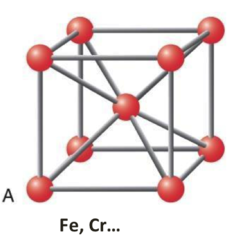
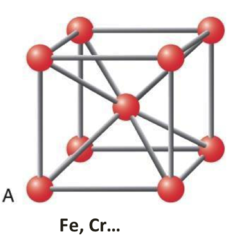
body-centered cubic (BCC)
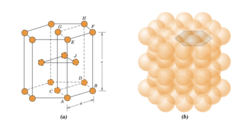
[hexagonal close pocked (HCP)]
what is COORDINATION NUMBER?
the number of atoms equally closest/nearest-neighbored to a reference atom
In the CUBIC CRYSTAL SYSTEM, what are the AXIAL relationships? (between a, b, and c)
a = b = c

In the CUBIC CRYSTAL SYSTEM, what are the INTERAXIAL relationships? (between α, β, and γ)
α = β = γ = 90°

In the HEXAGONAL CRYSTAL SYSTEM, what are the AXIAL relationships? (between a, b, and c)
a = b ≠ c

In the HEXAGONAL CRYSTAL SYSTEM, what are the INTERAXIAL relationships? (between α, β, and γ)
α = β = 90°; γ = 120°
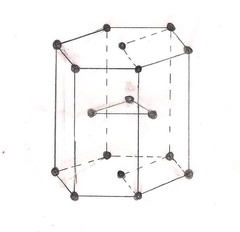
In the TETRAGONAL CRYSTAL SYSTEM, what are the AXIAL relationships? (between a, b, and c)
a = b ≠ c

In the TETRAGONAL CRYSTAL SYSTEM, what are the INTERAXIAL relationships? (between α, β, and γ)
α = β = γ = 90°

In the RHOMBOHEDRAL/TRIGONAL CRYSTAL SYSTEM, what are the AXIAL relationships? (between a, b, and c)
a = b = c
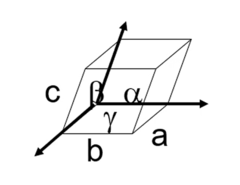
In the RHOMBOHEDRAL/TRIGONAL SYSTEM, what are the INTERAXIAL relationships? (between α, β, and γ)
α = β = γ ≠ 90°

In the ORTHORHOMBIC CRYSTAL SYSTEM, what are the AXIAL relationships? (between a, b, and c)
a ≠ b ≠ c

In the ORTHORHOMBIC SYSTEM, what are the INTERAXIAL relationships? (between α, β, and γ)
α = β = γ = 90°

In the MONOCLINIC CRYSTAL SYSTEM, what are the AXIAL relationships? (between a, b, and c)
a ≠ b ≠ c
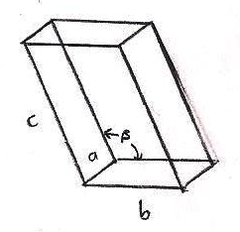
In the MONOCLINIC SYSTEM, what are the INTERAXIAL relationships? (between α, β, and γ)
α = γ = 90° ≠ β
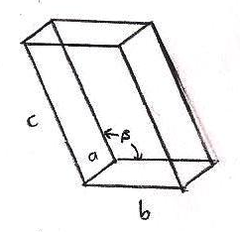
In the TRICLINIC CRYSTAL SYSTEM, what are the AXIAL relationships? (between a, b, and c)
a ≠ b ≠ c

In the TRICLINIC SYSTEM, what are the INTERAXIAL relationships? (between α, β, and γ)
α ≠ β ≠ γ ≠ 90°

What's the SC (simple cubic) coordination number?
6

What's the FCC coordination number?
12

What's the BCC coordination number?
8
What's the HCP coordination number?
12
How many atoms are in a single SC (simple cubic) unit cell?
1 atoms

How many atoms are in a single FCC unit cell?
4 atoms

How many atoms are in a single BCC unit cell?
2 atoms
How many atoms are in a single HCP unit cell?
6 atoms

How are the POINT COORDINATES represented?
formatted as "q r s", and are always positive
How are the DIRECTIONS represented?
formatted as "[u v w]", and are always integers
How are the PLANES represented?
formatted as "(h k l)", and are always integers
How are a FAMILY of DIRECTIONS represented?
with "〈u v w〉"
How are a FAMILY of PLANES represented?
with " {h k l} "
What value of ΔE (change in electronegativity) between bonded atoms in an IONIC compound?
ΔEN > 2
What value of ΔE (change in electronegativity) between bonded atoms in an COVALENT compound?
ΔEN < 1
What value of ΔE (change in electronegativity) between bonded atoms in an MIXED BINDING compound?
1 < ΔEN < 2