IS 2
 Call Kai
 Learn
Learn Practice Test
 Spaced Repetition
 Match
Match Flashcards
 Knowt Play
1/51

There's no tags or description
Looks like no tags are added yet.
Name | Mastery | Learn | Test | Matching | Spaced | Call with Kai | Chat |
|---|
No analytics yet
Send a link to your students to track their progress
52 Terms
Cord factor; Sulfatides
______________ is a glycoprotein found in mycobacterial cell walls that allow them to cluster together and form granulomas, while ___________ are glycolipids that help them prevent phagolysosome fusion to survive in macrophages.
Upper; Cough, Hemoptysis, and Night Sweats
REactivated TB typically infects the _________ lobe of the lung, and it classically presents with __________, ____________, and ______________.
Pott’s Disease
When TB infects the skeletal system (specifically the vertebrae), it is known as ___________________.
Meningitis or Tuberculoma
When TB infects the CNS, it can cause either ______________ or a ______________, which is a cavitary lesion in the brain.
RNA polymerase inhibitor; CYP450 Induction
Within the RIPE treatment protocol for TB, Rifampin is an ____________________. It’s major side effect is __________________, which can mess with a lot of other medications the patient is taking.
Mycolic Acid Synthesis Inhibitor; B6 Deficiency
Within the RIPE treatment protocol for TB, Isoniazid is a ____________________. It’s major side effect is __________________, which is why we supplement patients with Pyridoxine.
Hyperuricemia and Gout
Within the RIPE treatment protocol for TB, Pyrazinamide’s MOA is unknown, but it’s major side effect is __________________.
Arabinosyltransferase inhibitor, Optic Neuropathy
Within the RIPE treatment protocol for TB, Ethambutol is an ____________________, which is responsible for producing arabinogalactan (another component required for the cell wall). It’s major side effect is __________________.
More
Isoniazid is (more/less) hepatotoxic than Rifampin.
Mycobacterium avium complex (MAC)
_______________________________ is a mycobacterial illness that typically only infects patients with a hx some kind of underlying lung disease (like COPD or bronchiectasis).
Mycobacterium marinum
The classic presentation for _____________________ infections is an aquarium worker with a hand infection following a bite/scratch from a fish.
Histoplasmosis
The classic presentation for ________________ infection is inhalation of bird/bat droppings (often while spelunking) in the Mississippi/Ohio River Valley.
Histoplasmosis
On histology, ______________ presents as macrophages with small, intracellular oval bodies.
Blastomycosis
The classic presentation for ________________ infection is inhalation of soil in the Great Lakes and Ohio River Valley. It will present with patchy, alveolar infiltrates (“haziness”) in the lungs and warty plaques/ulcers.
Blastomycosis
On histology, ______________ presents as yeast with single, broad-based bud.
Coccidiomycosis
The classic presentation for ________________ infection is inhalation of dust in the California and Southwestern US. It will present with acute pneumonia and erythema nodosum in immunocompetent patients.
Coccidiomycosis
On histology, ______________ presents as spherules containing endospores, and these spherules are LARGER than RBC’s.
Paracoccidiomycosis
The classic presentation for ________________ infection is inhalation of respiratory droplets in Brazil and South America. It will present with cervical lymphadenopathy and mucocutaneous ulcers in the mouth.
Paracoccidiomycosis
On histology, ______________ presents as “Captain’s Wheel” yeast, which are MUCH LARGER than RBC’s.
Dermatophytes
_______________ are the causative agent of tinea infections, and they are also known as “Ringworm” even though they aren’t worms.
Sporotrichosis
The classic presentation for ________________ is ascending nodules on the arm following a scratch/puncture wound from a rose thorn. This is also known as “Rose-Gardner’s Disease.”
Sporotrichosis
On histology, ______________ presents as “Cigar-Shaped” yeast.
<200; Nystatin
Candidal esophagitis is an AIDS-Defining illness, as it only occurs when the CD4+ T-cell count is _________. Treatment is __________.
Aspergillus
On histology, ______________ presents as acute-angle septate hyphae.
Necrosis of the paranasal sinuses
One of the most severe presentations of angioinvasive aspergillosis infection in immunocompromised patients is _________________________.
Cryptococcus neoformans
The classic presentation for ________________ infection is inhalation of pigeon droppings in soil. It is the most common fungal cause of meningitis. Patients with late-stage infections will have “Soap Bubble Lesions” in the gray matter of the brain on imaging.
Cryptococcus neoformans
______________________ is definitively diagnosed with an India-Ink stain, which highlights the thickness of the polysaccharide capsule it has.
Mucor
On histology, ________ presents Non-septate hyphae with WIDE-ANGLE (90º) branching.
Mucor
___________ is known for invading the cribriform plate in the skull to get into the brain and proliferate until it causes tissue necrosis.
Mucormycosis
One of the most common predisposing risk factors for _______________ is DKA because it proliferates in environments with excess glucose and ketones.
Pneumocystis jirovecii
On histology, _______________ presents as disc-shaped yeast cells.
Pneumocystis jirovecii; <200
The classic presentation for ________________ infection is diffuse, interstitial pneumonia that has a “Ground-Glass Appearance” on CXR. This is an AIDS-Defining illness that only occurs at CD4+ T-cell counts __________.
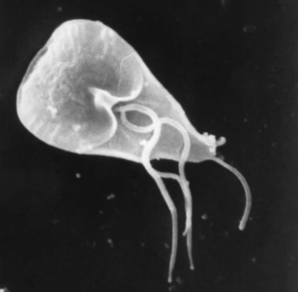
Giardia lamblia
The classic history for __________________ infection is a camper/hiker that drank unfiltered water from a river/stream. The most common presentation is foul-smelling steatorrhea.
Entamoeba histolytica
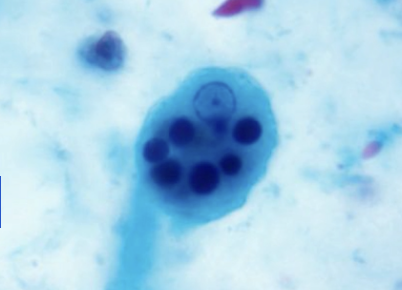
The classic presentation for __________________ infection is amoebic liver abscesses with an “anchovy paste consistency.” These could also be “flask-shaped” ulcerations in the colon leading to bloody diarrhea.
Entamoeba histolytica
On histology, _______________ presents as trophozoites that contain endocytosed RBCs.
Cryptosporidium
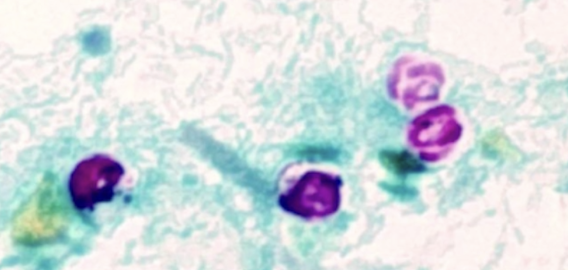
The classic presentation for __________________ infection is mild diarrhea, following ingestion of contaminated water, but it can cause severe watery diarrhea in immunocompromised patients.
Cryptosporidium
On histology, _________________ are characterized by being partially acid-fast cysts that contain FOUR motile sporozoites.
Toxoplasma gondii
The classic history for _________________ infection is exposure to cat feces, and it can lead to multiple ring-enhancing lesions on brain CT if the patient is immunocompromised.
Bactrim; <100
Toxoplasma gondii infection is an AIDS-Defining illness, and prophylaxis with __________ should be given when CD4+ T-cell counts are _________.
Trypanosoma brucei
___________________ infection is transmitted via the Tsetse fly and causes African Sleeping Sickness. In the hematologic stage, Sleeping Sickness is characterized by intermittent, spiking fevers. In the CNS stage, it is characterized by daytime drowsiness.
Trypanosoma cruzi
___________________ infection is transmitted via the Triatomine bug (Kissing Bug) and causes Chagas Disease.
Fever and Chagoma
Acute Chagas Disease is associated with symptoms of _______ and a ___________ (a swollen skin lesion near the eye).
Cardiac and GI
Chronic Determinate Chagas Disease is when the trypomastigote infects the ________ and/or _____ systems.
Babesiosis; Maltese Cross
___________________ infection is transmitted via the Ixodes tick and causes hemolytic anemia, hemoglobinuria, and irregularly cycling fevers. The classic finding on blood smear is the “_______________” sign in RBC’s.
Plasmodium; Schuffner Dots
___________________ infection is transmitted via the Anopheles mosquito and causes fever and hemolytic anemia. The classic finding on blood smear with Giemsa stain is the “_______________” in RBC’s.
Leishmania donovani
_____________________ infection causes VISCERAL LEISHMANIASIS (aka “Black Fever”). This is fever with hyperpigmented skin lesions.
Leishmania braziliensis
_____________________ infection causes CUTANEOUS & MUCOCUTANEOUS LEISHMANIASIS. This presents with a “wet,” ulcerated lesion at the site of a bite with a sand fly.
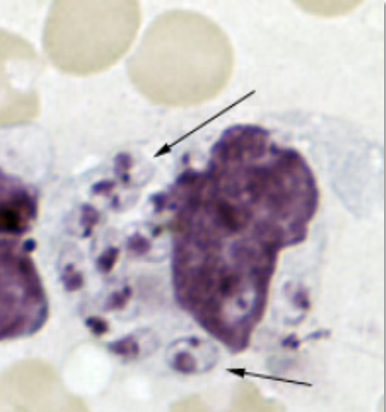
Leishmaniasis braziliensis
_______________________ would show up as intracellular amastigotes inside of macrophages on blood smear.
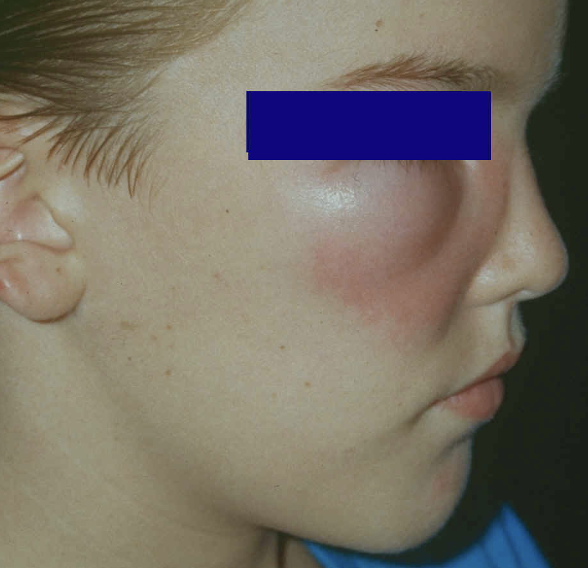
Loa loa
The classic history for a patient with a __________ infection is someone from Central/West Africa with Calabar Swellings wherever the worm migrates. You may also be able to see the worm moving across the eye.
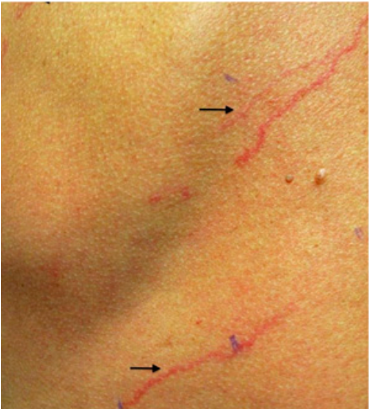
Strongyloides stercoralis
____________________ infection classically presents with a Larva currens rash.
Ascaris lubricoides
___________________ infection classically presents with Loeffler syndrome (wheezing) in the acute phase, and may lead to intestinal obstruction of the ileocecal valve.