6.2 - Heat treatment of steel (quenching & tempering)
 Call Kai
 Learn
Learn Practice Test
 Spaced Repetition
 Match
Match Flashcards
 Knowt Play
1/7

There's no tags or description
Looks like no tags are added yet.
Name | Mastery | Learn | Test | Matching | Spaced | Call with Kai | Chat |
|---|
No analytics yet
Send a link to your students to track their progress
8 Terms
Why do we want to harden metals?
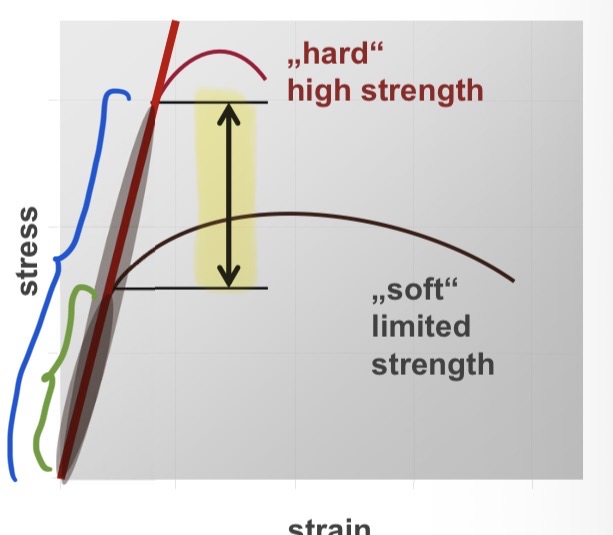
In general, materials are only technically usable as long as no plastic deformation occurs (permanent, irreversible deformation)
→ usable in elastic region
small for softer materials
Large for harder materials
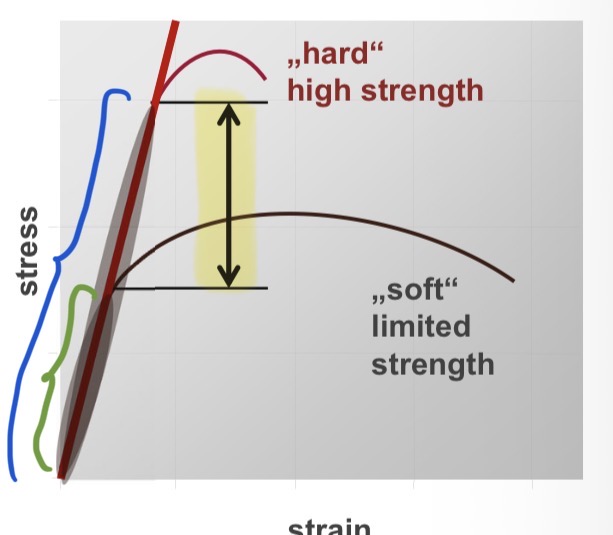
What’s the elastic region in the stress-strain diagram?
Draw the stress-strain curve for both soft and hard materials
The linear region of the stress-strain curve is the elastic region
What are the stages of the hardening process?
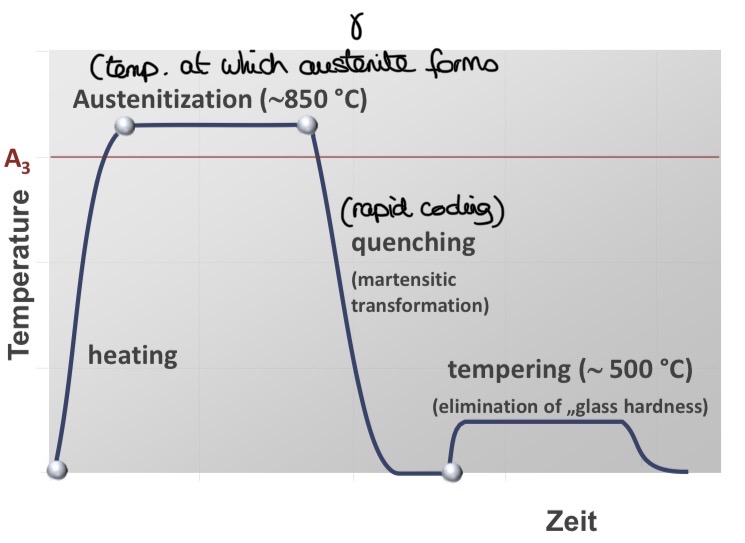
Quenching (hardening) & tempering (reheating at temperatures up to 650°C)
Describe the full process of heat treatment to harden steel.
Draw a simple diagram to illustrate it.
Austenitisation: heating up to ~850°C to get austenite (homogeneous) microstructure → necessary for the subsequent (next, upcoming) hardening
Quenching: rapid cooling → austenite transforms into martensite hard & brittle)
Tempering: slight reheating up to ~500°C → reduces brittleness & residual stresses while retaining hardness
What are the purposes/effects of tempering?
improve deformation capacity
Reduce residual stresses while retaining hardness
Reduce brittleness & risk of cracking
What is the transformation process of austenite into martensite called?
When does it happen in the heat treatment process flow?
Martensitic transformation
→ occurs during quenching
Explain how the martensitic transformation arises during the heat treatment process.
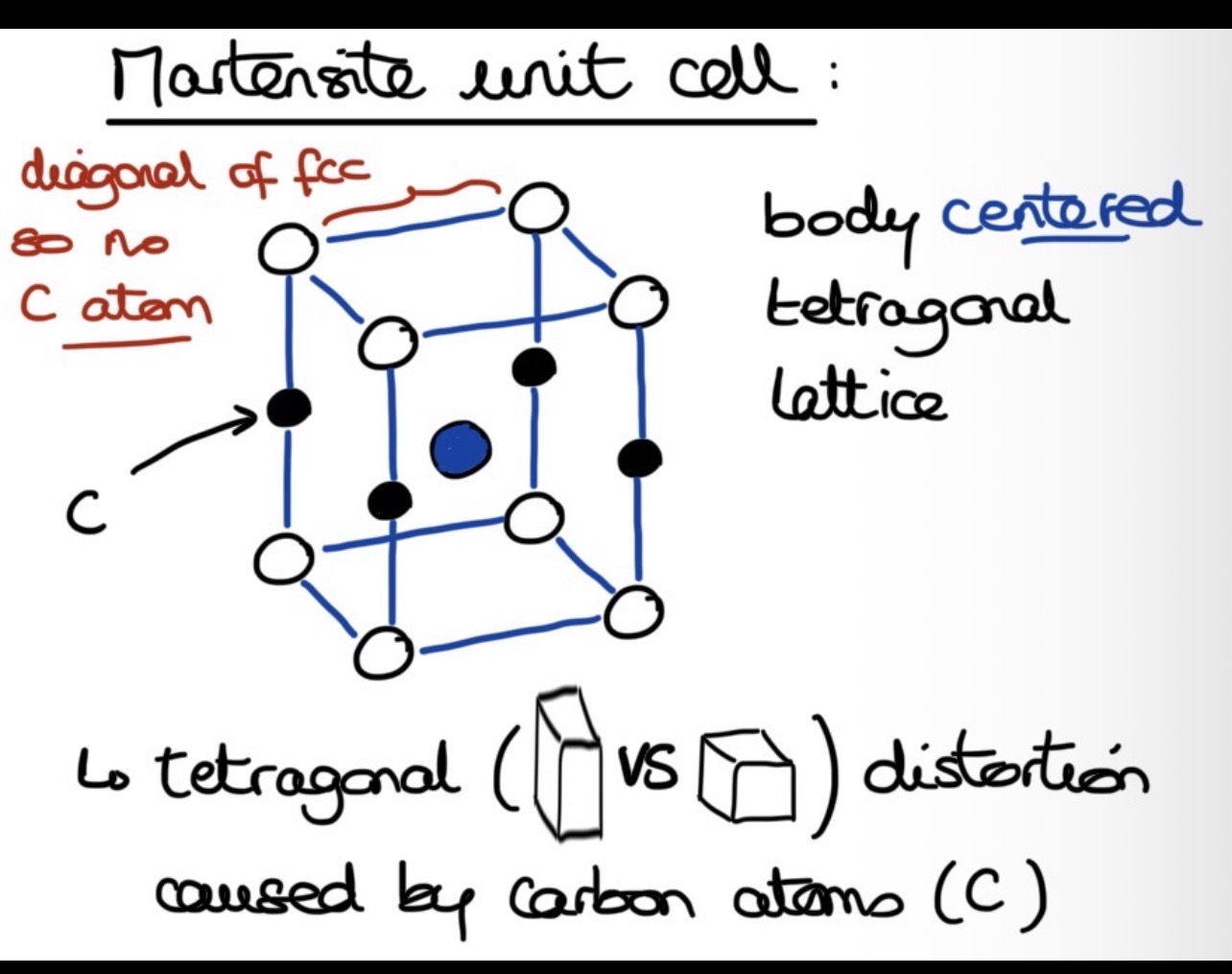
Draw the martensite unit cell
Austenite microstructure
Austenite has a FCC structure
Interstitial sites:
- between the atoms at the corners of each face
- in the center of the austenite unit cell (fcc)
Carbon atoms randomly occupy interstitial sites (they’re not all necessarily occupied!)
Martensite microstructure
BCT: body centered tetragonal (not cubic!)
Shorter side = ½ of the diagonal of the face of the FCC
Longer side = side of the face of the FCC
Centered atom = atom at the center of the face of the FCC
Carbon atoms between the atoms in the longer sides → they cause the distortion of the unit cell (not cubic)
Austenite → martensite
Quenching
as temperature decreases, FCC austenite lattice becomes metastable → “wants” to transform into a more stable structure
Bain mechanism / distortion
1 axis of the cube of the FCC elongates
The 2 other axes shrink
→ form the BCT structure
iron atoms slightly shift but don’t move far → no diffusion, no precipitation of a new phase
Adaptation mechanism (local atomic adjustments)
As the axis of the FCC elongated/shrunk, iron and carbon atoms slightly moved
→ carbon atoms stabilise the BCT structure & create internal stresses
How does the martensitic transformation increase the strength of steel?
Higher distortion of the lattice due to the supersaturation of carbon (the steel holds more carbon than it would at equilibrium) → forces between iron and carbon atoms make the axis elongate or shrink even more
As carbon increase inner tensions within the lattice, it is harder for dislocation to move through
the boundaries between martensite grains form and are also obstacles for dislocation movements