A) Diseases of nasal cavity and paranasal sinuses
 Call Kai
 Learn
Learn Practice Test
 Spaced Repetition
 Match
Match Flashcards
 Knowt Play
1/78

There's no tags or description
Looks like no tags are added yet.
Name | Mastery | Learn | Test | Matching | Spaced | Call with Kai | Chat |
|---|
No analytics yet
Send a link to your students to track their progress
79 Terms

cyclops
Chondrodysplasia
Choanal Atresia
enumerate the anomalies in respi system
anomalies
Rare and often merely part of a more extensive craniofacial deformity
Cyclops
Component of generalized malformation
Chondrodysplasia
Lack of communication
between the nasal cavity
and pharynx
Choanal Atresia
Bronchoaspiration and
aspiration pneumonia are
common sequelae
CONGESTION OF NASAL MUCOSA
lesion commonly found at necropsy and presumably associated with the circulatory failure preceding death.
HYPEREMIA OF NASAL MUCOSA
inflammation,whether caused by irritation
EX. regurgitated feed, viral infections,secondary bacterialinfections, toxemia, allergy, or trauma.
epistaxis and hemoptysis
2 types of hemorrhages in Disorders of the Nasal Cavity and Paranasal Sinuses
EPISTAXIS HEMORRHAGE
local trauma, can originate from erosions of submucosal vessels by inflammation, neoplasms, in horse - exercise-induced pulmonary hemorrhage

HEMOPTYSIS HEMORRHAGE
presence of blood in sputum or saliva thru coughing or spitting and is result of pneumonia, lung abscesses, ulcerative bronchitis, pulmonary thromboembolisms or hemorrhage, and pulmonary neoplasia
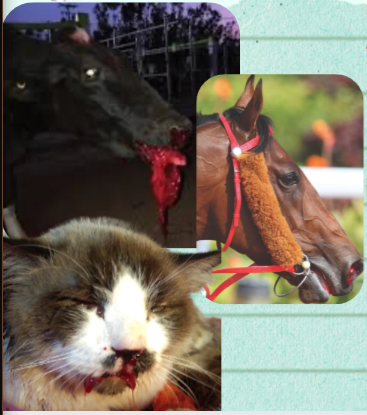

SEROUS RHINITIS
Mild inflammation: hyperemia and increased production of clear fluid from serous glands in the nasal submucosa.
Mild irritants or cold air and occurs during the early stages of viral infections, common cold in humans, upper respiratory infections in animals, or mild allergic reactions.
FIBRINOUS RHINITIS
What nasal cavity inflammation condition features plasma fibrinogen coagulating into a yellow, tan, or gray rubbery mat over the mucosa?
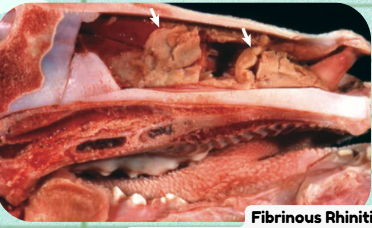
Increased vascular permeability
FIBRINOUS RHINITIS
What vascular change allows plasma fibrinogen to enter the exudate and coagulate into fibrin?
pseudomembrane
FIBRINOUS RHINITIS
yellow, tan, or gray rubbery mat forming a distinct film of exudate is known as what?
Aspergillosis
FIBRINOUS RHINITIS
What specific fungal infection can cause a severe fibrinonecrotic rhinitis?
diphtheritic or fibrinonecrotic rhinitis
FIBRINOUS RHINITIS
When the exudate membrane is difficult to remove because it is attached to an ulcerated mucosa, what are the two terms used for the condition?
GRANULOMATOUS RHINITIS
What nasal cavity inflammation condition is characterized by an infiltration of activated macrophages, forming chronic polypoid nodules that block the nasal passages?

1. Activated macrophages (predominant)
2. few lymphocytes
3. plasma cells
GRANULOMATOUS RHINITIS
List the three specific inflammatory cell types that infiltrate the nasal mucosa and submucosa in Granulomatous Rhinitis:
polypoid nodules, blocking nasal passages.
GRANULOMATOUS RHINITIS
In chronic states, what structural lesions form, and what mechanical effect do they have on the airway?
fungi
tuberculosis
systemic mycosis
undetermined cases.
Granulomatous Rhinitis is linked to chronic allergic inflammation or infections from what four specific organisms/disease categories?
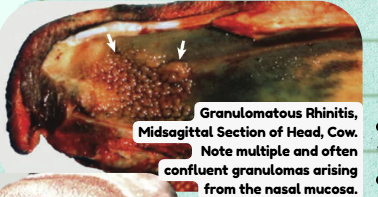
multiple and often confluent granulomas
GRANULOMATOUS RHINITIS
In the midsagittal head section of the cow, what specific pattern do the granulomas take as they arise from the nasal mucosa?
Rhinosporidium seeberi causing a polypoid granulomatous mass
GRANULOMATOUS RHINITIS
What specific organism is identified as causing the mass shown on the dog's nose, and what kind of mass is it?
SINUSITIS
What paranasal sinus inflammation condition often follows rhinitis, improper dehorning, or tooth infections, and can chronically spread to the brain?

improper dehorning or tooth infections.
Sinusitis frequently occurs alongside rhinitis or follows injuries to the nasal and surrounding bones. What are the two classic examples of such predisposing injuries/infections?
serous
catarrhal
fibrinous (rare)
purulent
granulomatous
List the 5 types of exudate used to classify Sinusitis, noting which one is specifically rare:
mucocele or empyema.
SINUSITIS
Because sinuses have poor drainage, accumulating exudate can lead to which two specific secondary conditions?
meningitis or encephalitis.
SINUSITIS
Chronic sinusitis may spread to adjacent bones or the meninges and brain. What two severe intracranial complications can this cause?
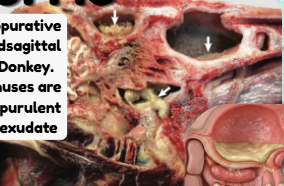
Fibrinosuppurative Sinusitis; paranasal sinuses are filled with fibrinopurulent exudate
SINUSITIS
Describe the condition and exudate type shown in the midsagittal head section of the donkey:
PROGRESSIVE ETHMOIDAL HEMATOMA
What species-specific circulatory condition of the nasal cavity occurs in older horses, causing chronic, progressive, and often unilateral nasal bleeding?

older horses
PROGRESSIVE ETHMOIDAL HEMATOMA
In what general age profile of equine patients does Progressive Ethmoidal Hematoma occur?
chronic, progressive, often unilateral nasal bleeding.
PROGRESSIVE ETHMOIDAL HEMATOMA
Describe the classic clinical bleeding pattern associated with this condition:
1. single
2. soft
3. tumor-like
4. pedunculated
5. expansive
PROGRESSIVE ETHMOIDAL HEMATOMA
Give the 5 classic gross/endoscopic descriptors for the physical structure of an ethmoidal hematoma:
dark red mass arising from the mucosa of the ethmoidal conchae
PROGRESSIVE ETHMOIDAL HEMATOMA
What color is the mass, and exactly where does it arise from anatomically?
1. Equine Viral Rhinopneumonitis (E. HerpesVirus 1 & 4)
2. Equine Influenza (H7N7 A/equi-1, H3N8 A/equi-2)
3. Equine Adenovirus
4. Equine Picornavirus
5. Equine Parainfluenza
RIAPP
Viral Infections
List the 5 viral causes of nasal cavity/paranasal sinus diseases in horses:
BoHV-1 (Bovine Herpesvirus 1)
Viral Infections
What viral agent causes Infectious Bovine Rhinotracheitis (IBR) and acts synergistically with Mannheimia hemolytica?
Thick plaques of fibrinonecrotic exudate covering the nasal, pharyngeal, laryngeal, and tracheal mucosae.
Viral Infections
Describe the gross lesions shown in the IBR case photos:

Canine Distemper Virus, CAV1 (Infectious Canine Hepatitis), and CAV2 (Infectious Tracheobronchitis/Canine Cough)
Viral Infections
Name the viruses in the Canine Infectious Respiratory Disease (CIRD) Group:
Suid Herpesvirus 2
Viral Infections
What virus causes Inclusion Body Rhinitis in pigs?
Feline Viral Rhinotracheitis (FeHV-1)
Feline Calicivirus (FCV)
Viral Infections
List the two primary viral pathogens for feline upper respiratory infections:
Streptococcus equi = Strangles
Fatal hematogenous dissemination = Bastard Strangles
Bacterial Infections
Match Streptococcus equi and its fatal hematogenous disseminated form to their diagnostic names:
Bacterial Infections
Burkholderia pseudomallei (Pseudomonas pseudomallei)
Bacterial Infections
What organism causes Melioidosis (Pseudoglanders)?
Bordetella bronchiseptica,
Escherichia coli, and
Pasteurella multocida
Bacterial Infections
What are the three most common bacterial isolates for nasal cavity disease in dogs?
Chlamydophila felis
Bacterial Infections
What specific bacterial organism is highlighted for cats?
1. Bordetella bronchiseptica
2. Pasteurella multocida
3. Haemophilus parasuis
Bacterial Infections
What three bacterial organisms work together to cause Atrophic Rhinitis in pigs?
Rhinosporidium seeberi; forms an exophytic, large pedunculated granulomatous mass containing numerous sporangia (encapsulated cysts filled with endospores).
Parasitic Infections
What pathogen causes Rhinosporidiosis in a mule/horse, and what does it look like histologically?
Oestrus ovis
Parasitic Infections
What parasite causes nasal larvae/bots in the frontal sinus and nasal passages of ruminants?
irritation, inflammation, and obstruction of airways.
Parasitic Infections
What do Oestrus ovis larvae physically cause while spending most of their larval stages in the airway?
Linguatula serrata
Parasitic Infections
What specific parasite is highlighted under the Dogs column for nasal cavity infections?
CANINE NASAL ASPERGILLOSIS
What specific mycotic infection condition in dogs is primarily caused by Aspergillus spp. or Penicillium spp., resulting in severe destructive and exudative rhinitis/sinusitis?

Damage from chronic granulomatous inflammation, with a yellow-green, granular mycotic exudate in the posterior nasal cavity.
CANINE NASAL ASPERGILLOSIS
Describe the damage and exudate characteristics seen in the nasal conchae of a dog with chronic nasal aspergillosis:
Severe destructive and exudative rhinitis and sinusitis with gray-white mycotic membranes.
CANINE NASAL ASPERGILLOSIS
What do longitudinal head sections of affected dogs classically show regarding the nasal membranes?
numerous fungal hyphae.
CANINE NASAL ASPERGILLOSIS
What does the thick fibrinopurulent exudate contain in abundance under microscopic examination?
FELINE CRYPTOCOCCOSIS
What systemic mycotic infection condition in cats presents with swelling in the nose bridge ("Roman nose"), facial skin ulcers, and respiratory or neurological signs?
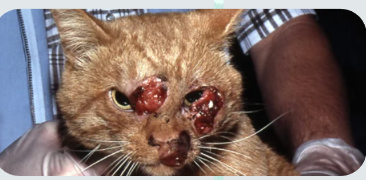
Cryptococcus neoformans
Cryptococcus gattii
FELINE CRYPTOCOCCOSIS
Name the two specific fungal species responsible for feline cryptococcosis:
Status: Immunosuppressed
Exposure: Inhaling and ingesting spores from pigeon or bird droppings + the environment.
FELINE CRYPTOCOCCOSIS
While not all animals exposed develop the disease, what primary status predisposes them, and how are the spores encountered?
Lesions range from small nasal granulomas to large masses of mucopurulent exudate filling the nasal cavity and paranasal sinuses.
FELINE CRYPTOCOCCOSIS
Describe the anatomical spectrum of lesions seen within the nasal pathways in Feline Cryptococcosis:
Respiratory signs, sneezing, congestion, nasal discharge
FELINE CRYPTOCOCCOSIS
List the 4 primary respiratory signs associated with this condition:
1. skin ulcers
2. eye changes
3. seizures
4. eye bulging
5. swelling in the nose bridge
FELINE CRYPTOCOCCOSIS
Beyond the respiratory tract, list the 5 other diverse clinical manifestations that can develop:
NASAL NEOPLASMS
What broad neoplasia category of the upper respiratory tract is primarily malignant, observed mostly in medium-to-large breed dogs, and frequently masquerades as infectious rhinitis?
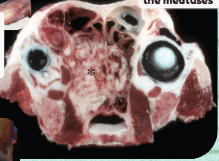
False (Majority of nasal neoplasms are Malignant)
NASAL NEOPLASMS
True or False: The vast majority of nasal neoplasms in veterinary medicine are benign.
1. Collie
2. Airedale Terrier
3. Basset Hound
4. German Shepherd
CABG
Nasal neoplasms are primarily observed in dogs, especially medium to large breeds. List the 4 specific breeds highlighted on the slide:
Cats and horses
NASAL NEOPLASMS
Which two domestic species are explicitly mentioned as being less commonly affected by nasal neoplasms?
Because they become secondarily infected by bacteria.
NASAL NEOPLASMS
Why do nasal tumors often produce clinical signs identical to infectious rhinitis (such as catarrhal or mucopurulent discharge)?
Nasal passages and sinuses
NASAL NEOPLASMS
What are the main sites of occurrence for nasal neoplasms in Dogs, listed by frequency?
Tip of the nose and nasal passages
NASAL NEOPLASMS
What are the main sites of occurrence for nasal neoplasms in Cats, listed by frequency?
Maxillary sinus and nasal passages
NASAL NEOPLASMS
What are the main sites of occurrence for nasal neoplasms in Horses, listed by frequency?
ENZOOTIC (ETHMOIDAL) NASAL TUMORS
What specific viral-induced neoplasia of the upper respiratory tract is caused by betaretroviruses, occurs in small ruminants, and is characteristically locally invasive but non-metastatic?

betaretroviruses
ENZOOTIC (ETHMOIDAL) NASAL TUMORS
What specific viral family/genus is the causative agent of Enzootic Nasal Tumors?
y inoculation of cell-free tumor filtrates.
ENZOOTIC (ETHMOIDAL) NASAL TUMORS
How has this tumor been successfully transmitted to susceptible animals in experimental settings?
Typically invasive but do not metastasize
ENZOOTIC (ETHMOIDAL) NASAL TUMORS
Describe the classic dual metastatic/invasive behavior pattern of Enzootic Nasal Tumors:
NASAL POLYPS AND NASAL CYSTS RESEMBLING NEOPLASMS
What category of nonneoplastic exophytic masses resemble neoplasms, frequently occur in horses and cats, and often follow chronic upper respiratory inflammation?
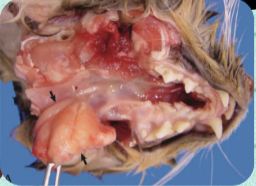
the ethmoidal region.
NASAL POLYPS AND NASAL CYSTS RESEMBLING NEOPLASMS
Where do polyps typically develop in Horses?
nasopharynx and Eustachian tubes.
NASAL POLYPS AND NASAL CYSTS RESEMBLING NEOPLASMS
Where do polyps typically develop in Cats?
chronic rhinitis or sinusitis.
NASAL POLYPS AND NASAL CYSTS RESEMBLING NEOPLASMS
While the exact cause remains unclear, polyps often follow what two chronic conditions?
Lymphatic obstruction due to inflammation
NASAL POLYPS AND NASAL CYSTS RESEMBLING NEOPLASMS
What specific vascular/fluid tissue complication has been suggested as a primary factor in polyp formation?
firm, pedunculated nodules of varying sizes, protruding from the nasal mucosa into the nasal passages or nasopharynx.
NASAL POLYPS AND NASAL CYSTS RESEMBLING NEOPLASMS
Describe the basic tactile feel, shape, and protruding behavior of these polyps:
smooth
ulcerated
secondarily infected
hemorrhagic
NASAL POLYPS AND NASAL CYSTS RESEMBLING NEOPLASMS
List the four potential surface characteristics described for nasal polyps: