CMB- Protein Structure & function
 Call Kai
 Learn
Learn Practice Test
 Spaced Repetition
 Match
Match Flashcards
 Knowt Play
1/94

There's no tags or description
Looks like no tags are added yet.
Name | Mastery | Learn | Test | Matching | Spaced | Call with Kai | Chat |
|---|
No analytics yet
Send a link to your students to track their progress
95 Terms
H2N
Amino group
COOH
Carboxyl group
Amino Acids
Building blocks of proteins. Common structure: an amino group and a carboxyl group connected to the alpha carbon and a side chain (R group).
20
How many common maino acids are there ?
R groups
Amino Acids are classified into 4 groups based on their _____
Basic Side Chains, Acidic Side Chains, Uncharged Polar Side Chains, and Nonpolar side chains
What are the four families of Amino Acids?
Polar Amino Acids, positive
Basic Side chains are ______ Amino Acids and are _______
Arginine, Lysine, Histidine
What are the 3 Basic Side Chains?
Basic, Arg, R
Arginine is a ____ side chain and can be abbreviated as ___ or _
Basic, Lys, K
Lysine is a ____ side chain and can be abbreviated as ___ or _
Basic, His, H
Histidine is a ____ side chain and can be abbreviated as ___ or _
Polar amino acids, negative
Acidic Side chains are ______ Amino Acids and are _______
Aspartic acid, Glutamic acid
What are the two acidic side chains?
Acidic, Asp, D
Aspartic acid is ____ side chain and can be abbreviated as ___ or _
Acidic, Glu, E
Glutamic acid is a ____ side chain and can be abbreviated as ___ or _
Polar, uncharged polar
Uncharged Polar side chain are ____ Amino Acids and are ______
Asparagine, Glutamine, Serine, Threonine, and Tyrosine
What are the 5 Uncharged polar side chains?
Uncharged polar, Asn, N
Asparagine is a ____ side chain and can be abbreviated as ___ or _
Uncharged Polar, Gln, Q
Gutamine is a ____ side chain and can be abbreviated as ___ or _
Polar uncharged, Ser, S
Serine is a ____ side chain and can be abbreviated as ___ or _
uncharged polar, Thr, T
Threonine is a ____ side chain and can be abbreviated as ___ or _
Uncharged polar, Tyr, Y
Tyrosine is a ____ side chain and can be abbreviated as ___ or _
Nonpolar, Nonpolar
Nonpolar side chains are _____ Amino acids that are______
Alanine, Glycine, Valine, Leucine, Isoleucine, Proline, Phenylalanine, Methionine, Tryptophan and Cysteine.
What are the 10 nonpolar side chains?
Nonpolar, Ala, A
Alanine is a ____ side chain and can be abbreviated as ___ or _
Nonpolar, Gly, G
Glycine is a ____ side chain and can be abbreviated as ___ or _
Nonpolar, Val, V
Valine is a ____ side chain and can be abbreviated as ___ or _
Leu, L, nonpolar
Leucine is a ____ side chain and can be abbreviated as ___ or _
Nonpolar, Ile,I
Isoleucine is a ____ side chain and can be abbreviated as ___ or _
Nonpolar, Pro, P
Proline is a ____ side chain and can be abbreviated as ___ or _
Nonpolar, Phe, F
Phenylalanine is a ____ side chain and can be abbreviated as ___ or _
Nonpolar, Met, M
Methionine is a ____ side chain and can be abbreviated as ___ or _
Nonpolar, Trp, W
Tryptophan is a ____ side chain and can be abbreviated as ___ or _
Nonpolar, Cys, C
Cysteine is a ____ side chain and can be abbreviated as ___ or _
hydrophilic
Polar Amino Acids are ______
Hydrophobic
Nonpolar Amino Acids are
Peptide Bonds
The bonds between amino acids are formed by dehydration (polymerization)
Hydrogen Bonds, Ionic bonding, Van der Waals attraction, hydrophobic force, and covalent bonds between sulfurs in cystine.
What are the four internal forces that determine protein structure?
The forces between amino acids
What determines the 3D structure of a protein?
Hydrogen Bonding

Covalent bonding between sulfurs in cysteine

Ionic Bonding

Van Der Waals attraction

Hydrophobic exclusion

Primary Structure 1o
Amino acid sequence
Secondary Structure 2o
α helix and β helix
α helix
Hydrogen bonds in the backbone elements between the 1st and 4th amino acids
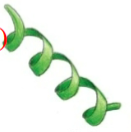
β helix
Hydrogen bonds in the backbone elements are parallel and anti-parallel

Motif or Super 2o
Multiple 2nd structures but in one domain

Tertiary Structure 3o
Final folded shape of a polypeptide (or protein), usually a molecule made up of multiple domains.
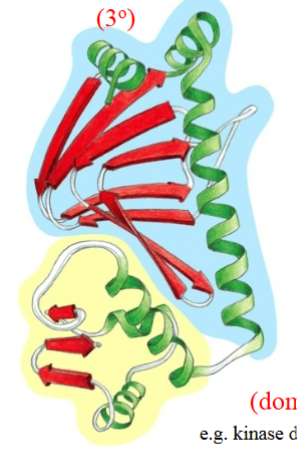
Domain
A segment of a polypeptide chain that can fold independently into a compact, stable structure usually has a special function.
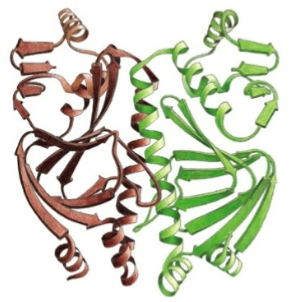
Quaternary Structure 4o
Combination of multiple protein units
3-D configuration
Protein function is determined by its _________
Denatured protein
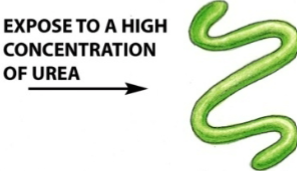
Renaturing
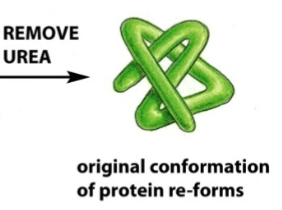
Molecular Chaperones
Assist protein folding in the cell
prion protein
Special misfolded proteins can cause Scrapie in sheep, mad cow disease, and Creutzfeldt-Jakob disease in humans.
Hetrodimer

homodimer

Protein Aggregate

Enzymes, structural proteins, motor proteins, receptors, signal transduction and special functions.
What are the 6 functions of intracellular proteins?
Catalase
Example(s) of Intracellular Proteins Function: Enzyme
Actin filament and sceptrin
Example(s) of Intracellular Proteins Function: Structural Proteins
Myosin, kinesin, dynein
Example(s) of Intracellular Proteins Function: Motor Proteins
hormone receptors
Example(s) of Intracellular Proteins Function: Receptors
Kinase
Example(s) of Intracellular Proteins Function: Signal transduction
DNA binding protiens
Example(s) of Intracellular Proteins Function: Special functions
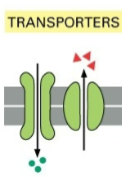
Transporters, anchors, receptors, enzymes, and recognition
What are the 5 functions of membrane proteins?
ion channels
Example(s) of Membrane Proteins Function: Transporters
Integrins
Example(s) of Membrane Proteins Function: anchors

growth factor receptors
Example(s) of Membrane Proteins Function: receptors

adenylyl cyclase
Example(s) of Membrane Proteins Function: Enzymes

glycoproteins
Example(s) of Membrane Proteins Function: Recognition
Structural proteins, enzymes, growth factor, and immune response
What are the four functions of extracellular proteins?
collagen
Example(s) of Extracellular Proteins Function: Structural Proteins
lysozyme
Example(s) of Extracellular Proteins Function: Enzyme
Fibroblast growth factor (FGF)
Example(s) of Extracellular Proteins Function: Growth Factor
Antibodies
Example(s) of Extracellular Proteins Function: Immune Response
lysozyme & polysaccharide
Enzyme & Substrate
Growth factor & growth factor receptor
ligand & receptor
antigen
antibody
Antibody (immunoglobulin (Ig))
Tetramer composed of two heavy and two light chains. They form a unique Y shape by many intra- and intermolecular S-S disulfide bonds. The variable domain binds a specific antigen.
Homogenization
The mechanical procedure allows the plasma membranes of cells to be ruptured and cell contents to be released.
Breaking cells with high-frequency sounds (ultrasound), using mild detergents to make holes in the plasma membrane, forcing cells through a small hole using high pressure, and shearing/grinding cells by plunger i a tight-fit tube.
What are the four common ways of Homogenization?
Homogenate or extract
The resulting thick “soup” from homogenization contains large and small molecules.

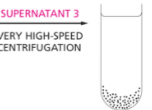
Differential Centrifugation
Repeated centrifugation at progressively higher speeds will fractionate cell homogenates into their components. Does so based on size and density. Bigger components form a pellet at the bottom. Smaller components remain in the suspension.
Supernatant
In Differential centrifugation, the smaller components of the cell remain in the suspension above.
whole cells, Nuclei, cytoskeltons
What fractionates at a low-speed centrifugation?

mitochondria, lysosomes, and peroxisomes
What fractionates at a medium-speed centrifugation?
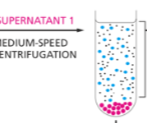
Microsomes and other small vesicles
What fractionates at a high-speed centrifugation?
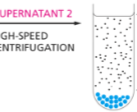
ribosomes, viruses and large macromolecules
What fractionates at very high-speed centrifugation?
Column chromatography
A way of separating proteins. A mixture of proteins in a solution is applied to a column filled with a permeable solid matrix. Then a large amount of solvent is pumped through the column. Based on how it reacts to the matric proteins will bind to certain chemical groups.
Ion exchange chromatography
Columns packed with small beads carrying either postive of negativle charges. Proteins of opposite charges are attracted to the beads.

Gel-Filtration Chromatography
The matrix is full of porous beads. Proteins that are small enough to enter the holes in the beads travel more slowly through the column.

Affinity Chromatography
A chromatography that separates proteins by the binding capacity to the packed protein.
