Lecture 4 - Chemical Treatments of Rangelands
 Call Kai
 Learn
Learn Practice Test
 Spaced Repetition
 Match
Match Flashcards
 Knowt Play
1/54

There's no tags or description
Looks like no tags are added yet.
Name | Mastery | Learn | Test | Matching | Spaced | Call with Kai | Chat |
|---|
No analytics yet
Send a link to your students to track their progress
55 Terms
Advantages for Chemical Control:
1. Can be Inexpensive
2. Application not limited by terrain
3. Easily ranges from individual plant treatment to area-wide treatment
4. Can be very selective
5. Maintains other vegetation cover
6. Low soil disturbance
Disadvantages for Chemical Control:
1. Some pest plants are not well controlled by chemicals
2. No seedbed preparation (may make seeding difficult)
3. May kill desirable plants
4. May increase toxicity of some poisonous plants
5. May be hazardous to applicator/wildlife/public
6. Not all health hazards may be known
7. Social Stigma
_______: Any chemical used to kill or control plants
Herbicide
______: Active ingredient is in a liquid carrier
examples:
Solution
Emulsion
Suspension/Flowables
Liquid Formulation
_______: Active ingredient is on the surface of a solid carrier
examples:
Wettable Powder
Dry Flowable
Granules/Pellets
Dry Formulation
_______: Applied before the target weed germinates and emerges, they act on the roots or shoots of newly germinated seeds.
Pre-emergent Herbicide
______: Applied to the foliage of the target weed after it has emerged from the soil.
Post-emergent Herbicide
_______: Causes local injury only to plant parts directly contacted
Contact Herbicide
_______: Applied to one part of a plant but is spread by the plant throughout the plant
Translocated (Systemic) Herbicide
_______: An herbicide that kills or damages only a particular species or group of species, with little or no injury to other species
Selective Herbicide
Nonselective Herbicide
________: An herbicide which kills or injures all plant species to which it is applied
________: An herbicide that kills or damages plants when applied to the soil
Soil-active Herbicide
Herbicide efficacy depends on:
Surface Contact
Penetration
Translocation
Disruption of Vital Function
Active plant growth/photosynthesizing
Ultimately, these are reliant on:
Active plant growth/photosynthesizing
Environmental conditions
Classifying Rangeland Herbicides
Application Method
Selectivity (type of plant affected)
Mode of action
Soil Residual Activity
Toxicity
Chemical Family
Application Targets:
Foliage
Soil
Both
Stem
Selectivity:
Selective
Non-selective (general)
Partially selective
Modes of Action:
Target critical chemical and physiological systems in plants
Important Modes of Action:
Synthetic Auxin
Photosystem II Inhibition
ESPS Synthase Inhibition
Membrane Disruptor
________: uncontrolled, unsustainable growth… the plant literally grows to death (2,4-D)
Synthetic Auxin
Photosystem II Inhibition
_______: stops photosynthesis by binding to plastiquinone enzyme and blocking electron transport (atrazine)
EPSP Synthase Inhibition
_____: blocks an enzyme (epsp) that synthesizes amino acids (glyphosate)
Membrane Disruptor
_______: takes an electron from the ps I electron chain, thereby stopping photosynthesis (paraquat)
Methods of Herbicide Application:
Foliage Spray
Individual Stem/Trunk Treatment
Soil Application
Advantages of Boom Application
More even distribution of spray
Less drift/wind problems
Advantages of Boomless Application
Less expensive equipment
Easier maneuvering
Convenient for brush, fence, rough terrain
Less nozzle stoppage
Advantages of Ground Application
Better over small acreages
No landing strip required!
Less drifting in fog or wind
Lower equipment costs
Safer for applicator
Advantages of Aerial Application
Faster Coverage
Possible over wet or rough terrain
Lower cost per acre on larger acres
No soil disturbance
Better coverage of tall, dense brush
Advantages of Fixed Wing Application
Greater lifting power in thin, warm air
Greater payload
Cheaper on large projects
More available
Advantages of Helicopter Application
No landing strip required
Less troubled by trees/snags and steep terrain
Slower airspeed and maneuverability results in greater accuracy
_______: Trunk base spray
Frill/Notch/Girdle Spray
Streamline Spray
Cut-stump Spray
Trunk Injection
Stem/Trunk Treatments
_______: Soil Injection
Stem/Base Placement
Pattern (bands/grids) Placement
Soil Application
Advantages of Soil Active Herbicides
Reduced (no?) drift
No foliage interception
Controlled release possible
Easier handling and application
Generally pre-mixed
Often has longer residual activity
Disadvantages of Soil Active Herbicides
More expensive to make, package and ship
May be less effective than the same liquid chemical
More expensive per unit of killing power
May be moved by surface winds or water movement
Needs rainfall to activate
Environmental Conditions that Influence Herbicide Effectiveness:
1. Temperature
2. Precipitation/Rainfall
3. Humidity
4. Wind
5. Light
6. Soil Moisture
7. Other Soil Factors (texture, OM content, etc)
______: the herbicidal preparation by the manufacturer, including the kind, chemical and physical form, and concentration of the toxicant, along with other ingredients
Formulation AKA Commercial Product
_______: The chemical agent that causes the toxic effect on plants
Toxicant
_________: The substance that with which the commercial product is mixed for more effective application– may be liquid, solid or gas
Carrier
_______: The commercial product, carrier, and surfactant mixed together and ready to be sprayed
Spray mix
________: A spray mixture in which the toxicant is mixed in ionic form with the carrier
Solution
________: A spray mixture in which the liquid toxicant is dispersed as globules in a liquid carrier (oil in water)
Emulsion
________: A spray mixture in which the toxicant in aqueous form is dispensed in an oil carrier (requires special application equipment)
Invert Emulsion
_________: A spray mixture in which the solid, finely particulate toxicant is dispersed in a liquid carrier
Suspension
________: An addition to the spray mix (or commercial product) that increases the spreading, wetting, sticking, solubility, etc of the mix
Surfactant
________: The part of the commercial product or spray mix that directly causes the herbicidal effects
Active Ingredient (A.I.)
_________: The amount of active ingredient, expressed in terms of the parent acid
Acid Equivalent (a.e.)
Herbicide Rate Prescriptions Come in 3 forms:
Lbs a.i/a.e. per acre
Lbs a.i/a.e. per 100gal
Weight/volume of commercial product per plant or acre
_______: The oral dosage that kills 50% of test animals, expressed as mg/kg of body wt.
LD50
_______: “No Observable Effect Limit” or “No Observable Adverse Effect Limit” = the highest level that causes no adverse effect in the most sensitive animal species tested.
NOEL / NOAEL
______: “Margin of Safety” = NOEL/Dose…
MOS is considered high risk when <100
MOS
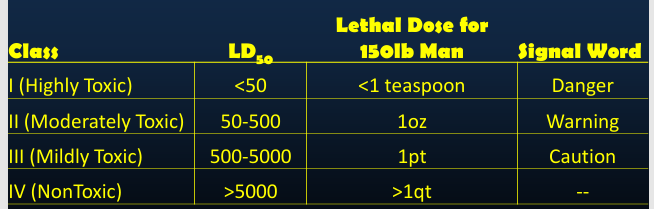
________: Indicates the relative toxicity of a chemical
Toxicity Class
Federal Insecticide, Fungicide, and Rodenticide Act
Original law passed in 1947
Gave authority for regulating pesticides to Department of Ag
Revised law passed in 1972
Moved regulatory authority to EPA
Amendments in 1988 and 1996
Requires that pesticides be REGISTERED and sold under an approved LABEL
FIRFA
Registration Categories
1. General Use (anyone can purchase and use)
2. Restricted Use (Requires application by a certified applicator)
Dangerous to the Environment
Dangerous to the Applicator
3. Experimental Use
Allow manufacturers to field test pesticides under experimental use permits
4. Emergency Use
__________: Administered by Texas Department of Agriculture
“Private Applicator” or “Commercial Applicator” licenses
Allows purchase and use of “restricted” herbicides
Herbicide Applicator’s License
Herbicide Labels
1. Define active ingredients and concentrations
2. Include Toxicity Signal Words
3. Describe Registration restrictions
4. Precautionary Statement/Handling
5. Physical and Chemical hazards for storage
6. Environmental Hazards
7. Directions and Rates for Use
8. Storage and Disposal Precautions
Herbicide Label - Questions to Ask
1. What is the active ingredient and concentration?
2. What is the Toxicity Class?
3. Are there any Registration restrictions?
4. What precautions are required for Handling?
5. What are the Physical and Chemical hazards for storage?
6. What are the Environmental Hazards?
7. What/Where are the Directions and Rates for Use?
8. What are the Storage and Disposal Precautions?