Electrical Systems Exam 1
 Call Kai
 Learn
Learn Practice Test
 Spaced Repetition
 Match
Match Flashcards
 Knowt Play
1/46

Earn XP
Description and Tags
AGM 4600 Exam 1 Material (9/9/2026)
Name | Mastery | Learn | Test | Matching | Spaced | Call with Kai | Chat |
|---|
No analytics yet
Send a link to your students to track their progress
47 Terms
Voltage (V)
The electrical PRESSURE that pushes charge through a circuit.
Current (I)
The movement of electric charge.
Volts (V)
Measurement of Voltage
Amperes (amps)
Measurement of current
Resistance (R)
The opposition to current flow.
Ohm’s Law Equation
V = I * R
Required Parts for Basic Electrical Circuits
Voltage Source, Conducting Path, Load, Closed Path for Current Flow.
Conventional Flow
Defined historically as a positive charge moving from positive to negative. How many diagrams show the direction of flow.
Electron Flow
Electrons move away from the negative terminal and are drawn toward the positive terminal. Actual motion of electrons.
Why does filament in a lightbulb glow?
Resistance that limits current and creates extreme heat.
A Basic Circuit (Series) Drawing

Parallel Circuit Drawing
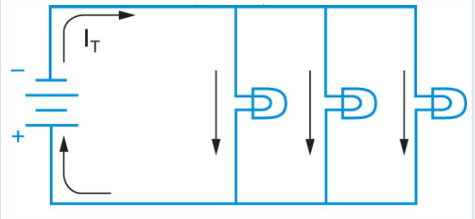
Series-Parallel Drawing

Equation to Calculate Total Resistance in Series
Rt = R1 + R2 + R3 + …
Equation to Calculate Total Resistance in Parallel
1/Rt = 1/R1 + 1/R2 + 1/R3 + …
Current Equation for Parallel Circuits
It = I1 + I2 + I3 + …
Reducing Series-Parallel Circuit
1) Find the parallel section.
2) Replace it with one resistor.
3) Add the series resistance.
Kirchhoff’s Current Law
At any point in a circuit, the total current entering equals the total current leaving.
Kirchhoff’s Voltage Law
The algebraic sum of all the potential differences in a closed loop is equal to zero.
Power
The rate of doing work.
Energy
Power multiplied by time.
Watts (W)
The measurement of Power
Watt-Hours (Wh) or Kilowatt-Hours (kWh)
The measurement for energy.
Formula for Power
P = V * I
Formula for Energy
E = P * t
What does a power rating mean?
How much power a resistor or load can safely dissipate.
Electric Charge
A property that can move through conductors.
Direct Current (DC)
Voltage stays constant in polarity. (ex. batteries)
Alternating Current (AC)
Direction of voltage reverses repeatedly. (ex. Utility power systems)
Single Phase Power
One repeating AC waveform supplies the load. Common in homes and light commercial spaces.
Three-Phase Power
Three AC waveforms are offset by 120 electrical degrees. Common in commercial and industrial facilities.
Service Entrance
Conductors and equipment from the utility connection to the service equipment.
Service Equipment
Equipment at the service point that includes the first disconnecting means.
Meter Base
The location where the utility measures electrical energy used by the building.
Panelboard
The enclosure that holds breakers and distributes power to branch circuits.
Feeder
Conductors between the service equipment and another panel or disconnect.
Branch Circuit
Conductors from a panel to lights, receptacles, or equipment loads.
Circuit Breaker
Opens automatically when current stays too high for too long or when a fault occurs. Can be reset.
Fuse
Melts open once the current exceeds its limit. Must be replaced.
Ground Fault Current Interrupter (GFCI)
Compares hot and neutral current. When the difference is large enough, it opens the circuit to reduce shock risk.
Arc Fault Circuit Interrupters (AFCI)
Constantly monitors the electrical current and waveform patterns on a circuit. When it detects a spark, it instantly trips to cut power and prevent electrical fires.
Outlet
Any point where power is provided to a load, device, or receptacle.
Receptacle
The part of an outlet that accepts a plug.
Branch Circuit
Conductors that run from the panel to outlets and loads.
Service Equipment
The first disconnecting means for the building service.
Feeder
Conductors that carry power from service equipment to another panel.
Panelboard
The cabinet that holds breakers and distributes power to circuits.