Match: Anatomy & Physiology: Homeostasis, Feedback Mechanisms, and Body Organization
 Call Kai
 Learn
Learn Practice Test
 Spaced Repetition
 Match
Match Flashcards
 Knowt Play
1/27

There's no tags or description
Looks like no tags are added yet.
Name | Mastery | Learn | Test | Matching | Spaced | Call with Kai | Chat |
|---|
No analytics yet
Send a link to your students to track their progress
28 Terms
What are the two sciences that complement each other in the study of the body?
Anatomy and Physiology
Define Anatomy.
The scientific discipline that investigates the body's structure.
Define Physiology.
The scientific investigation of the processes or functions of living things.

What is the chemical level of organization?
Interaction of atoms.

What is the cell level of organization?
The structural and functional unit of life.
What is the tissue level of organization?
A group of similar cells and the materials surrounding them.
What is the organ level of organization?
One or more tissues functioning together.

What is the organ system level of organization?
A group of organs functioning together.

What is the organism level of organization?
Any living thing.
What is the microbiome?
The microorganisms in the body or parts of the body, such as the gut microbiome.
List the six characteristics of life.
1. Organization 2. Metabolism 3. Responsiveness 4. Growth 5. Development 6. Reproduction
What is homeostasis?
The process through which a nearly stable internal environment is maintained in the body.

What is the significance of water in the internal environment?
Cells contain water and live in water, which is crucial for maintaining homeostasis.
Who are the two key figures associated with the concept of homeostasis?
Walter Bradford Cannon and Claude Bernard.
What is a set point in the context of homeostasis?
The ideal normal value of a variable around which values fluctuate.
What are the two types of feedback systems in homeostasis?
Negative feedback and positive feedback.
What is the role of a receptor in a feedback system?
To monitor the value of some variable.
What is the function of the control center in a feedback system?
To establish the set point.
What does the effector do in a feedback system?
It can change the value of the variable.
What is a stimulus in the context of feedback systems?
A deviation from the set point detected by the receptor.
What is the response in a feedback system?
The action produced by the effector.
What is an example of a negative feedback mechanism?
Body temperature regulation.
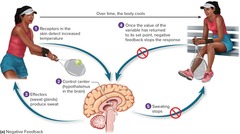
What happens during a positive feedback mechanism?
A deviation occurs, and the response makes the deviation greater.
Give an example of normal positive feedback.
Childbirth and blood coagulation.

What is a harmful example of positive feedback?
After hemorrhage, increased heart rate leads to decreased ability to pump blood.
Why is maintaining blood pressure around a set point important?
To ensure adequate blood flow and function of organs.

What is differentiation in the context of the characteristics of life?
The change from general to specific in cell types.
What is morphogenesis?
The change in shape of tissues and organs.