Economics Preliminary Year 11
 Call Kai
 Learn
Learn Practice Test
 Spaced Repetition
 Match
Match Flashcards
 Knowt Play
1/84

There's no tags or description
Looks like no tags are added yet.
Name | Mastery | Learn | Test | Matching | Spaced | Call with Kai | Chat |
|---|
No analytics yet
Send a link to your students to track their progress
85 Terms
Economic Problem
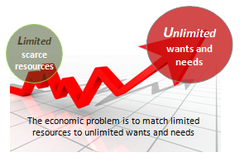
Focuses on how a society can satisfy the unlimited wants of individuals with the limited resources available.
Individual Wants
Are the wants of each person according to their preferences and income, such as the types of food, clothing and shelter they prefer and can afford to buy with their income.
Collective Wants
Are the wants of the whole community. What is desired will depend on the preferences of the community as a whole, and not only those of the individual person. Collective wants are usually provided by the government.
Basic Wants
Are needs that all individuals must satisfy to some degree to survive, such as food, water, clothing and shelter. Without these basic wants being satisfied, individuals might not survive in their environment or at the very least experience a very low standard of living, or live in poverty.
Recurring Wants
Are those wants that must be continually satisfied, or satisfied at regular intervals, such as food and water so that people can survive.
Substitute Goods
Are those wants that are interchangeable, such as a consumer wanting to buy a second hand car instead of a new car because it is within the consumer's budget or income.
Complementary Goods
Refer to those wants which are derived from other wants such as cars and petrol, knives and forks, computers and laser printers. These goods are all complementary in use.
Luxury Goods
Are the desires for goods and services which satisfy needs in excess of basic goods and services needed for survival, such as the desire for holidays, computers, entertainment and cars.
Resources
Refers to the factors of production in economics. The factors of production are bought and sold in factor markets and are used in the production process to produce goods and services to satisfy the needs and wants of consumers
Return for Land (Natural)
Rent
Return for Labour
Income
Return for Capital
Interest
Return for Enterprise
Profit
Scarcity
implies that people must make a choice. Either forgo something to gain something else.
Questions that needs to be answered due to Scarcity
What Goods need to be produced?
How much needs to be Produced?
How are the Goods/Services to be produced?
How are these goods and services to be distributed among the population?
Current Living Standards
A society that places a higher value on current living standards and consumer goods production might allocate more resources to the production of food, clothing, houses, cars and other luxurious, and less on capital goods production such as building new factories, shops, offices and farms.
Future Living Standards
A society that places a higher value on future living standards, might allocate more resources to investment in capital goods production in the present, rather than consumer goods production.
Opportunity Cost
Whenever we satisfy one want, we are giving up the opportunity to satisfy an alternative want.

Production Possibility Frontier (PPF) or Curve (PPC)
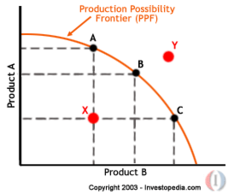
Is a graphical representation of all the possible combinations of the production of two goods or services (or two types of goods or services) that the economy can produce at any given time.
4 Assumptions made with the PPF
1. Two Goods: the economy produces only two goods
2. Fixed Resources: the quantity of resources available remains unchanged
3. Fixed Technology: the state of technology is constant
4. Technical Efficiency: all resources are fully employed
Impacts on the PPF
New Technology
Technological Improvement
New/More Resources
Decline in Resources
Unemployment
Consumer Goods and Services
Are items produced for the immediate satisfaction of individual and community needs and wants.
Capital Goods
Are items that have not been produced for immediate consumption but will be used for the production of other goods.
Economic Factors Underlying Individuals
Spending and Saving
Work and Education
Retirement, Voting and Particpation
Economic Factors Underlying Businesses
Pricing and Production
Resource use and Industrial Relations
Economic Factors Underlying Governments
Resource Allocation and Stabilising Activity
Taxation and Regulators of Economic Activity
Gross Domestic Product (GDP)
Is the total value of finished goods and services produced in an economy, in a given time period.
Market Economy
Does not attempt to distribute output equally; rather to reward households and firms for their contribution to the production process in the form of income (Y).
Individuals do not all receive the same level of wages. Workers' income levels are influenced by how much they work, their skills and expertise, educational qualifications and their bargaining power in wage negotiations with employers.
Free Market Economy
Is an economic system in which investment in and ownership of the means of production, distribution, and exchange of wealth is made and maintained chiefly by private individuals or corporations, especially as contrasted to cooperatively or state-owned means of wealth.
Mixed Market Economy
Is an economic system that features characteristics of both capitalism and socialism. It allows a level of private economic freedom in the use of capital, but also allows for governments to interfere in economic activities in order to achieve social aims.
Command Economy
Is a system where the government determines what goods should be produced, how much should be produced and the price at which the goods will be offered for sale. The command economy is a key feature of any communist society.
Business Cycle
Displays the fluctuations of economic growth over a period of time. Overall, there is usually an overall upward trend in an economy's output.
Household Sector
Consists of all individuals in the economy who earn an income by selling productive resources to firms.
With the income earnt, households purchase goods and services from the firms sector to satisfy their needs and wants and improve or maintain their standard of living and quality of life.
Firms Sector
Consists of all private businesses which produce and distribute goods and services to consumers.
Firms buy productive resources (labour, land) from the household sector and then make income payments (wages, rent, interest profits, etc.) in return for the use of these resources.
Finance Sector
Consists of all financial institutions (banks and non-bank financial intermediaries) who engage in the borrowing and lending of money and the sale and purchase of financial assets and services to firms and households.
Financial institutions attempt to maximise profits by charging a higher rate of interest to borrowers than they pay to the public for depositing funds.
Government Sector
Consists of all economic activities of local, state, territory and federal governments in Australia. Governments raise revenue through taxes, rates, feeds and charges, and the profits of public trading enterprises (PTEs). This revenue is used to provide collective goods and services to the community such as law and order, defence, education, health, social security and community services.
Overseas Sector
Consists of the exporters and importers of goods and services from the rest of the world. Trade flows refer to exports of goods (e.g. iron ore and natural gas) and services (e.g. education and tourism) sold by Australian firms to foreigners, and imports of goods (e.g. food and machinery) and services (e.g. freight and insurance) purchased by Australian residents from foreigners.
Circular Flow of Income
A model that describes how economic activity occurs between the different groups in an economy. Saving, taxation and spending on imports represent 'leakages' from the circular flow. Investment, government spending and export revenue represent 'injections' into the circular flow.
Equilibrium
Leakages = Injections
Consumer Sovereignty:
Refers to how the pattern of consumer spending determines the pattern of production and resource allocation.
Effects of Consumer Sovereignty
Marketing + Deceptive & Misleading Conduct + Planned Obsolesce + Anti-Competitive behaviour
Average propensity to consume (APC)
Refers to the proportion of an individual's income that is spent on consumption rather than on savings.
APC = C/Y
Average propensity to save (APS)
Refers to the proportion of an individual's income that is saved rather than spent on consumption
APS = S/Y
Factors Influencing Spending & Saving
-Cultural factors
-Personality factors
-Confidence and future expectations - economic outlook
-Any specific future spending plans - e.g. real estate purchase
-Tax policies - lower tax rates for superannuation contributions
-Availability of credit - spending increases if credit is available
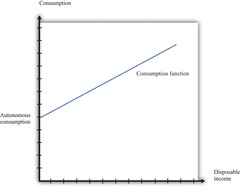
Consumption Function
The relationship between consumption spending and disposable income
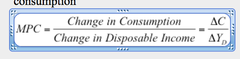
Marginal Propensity to Consume (MPC)
Is the proportion of each extra dollar of income that goes to consumption.
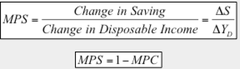
Marginal Propensity to Save (MPS)
Is the proportion of each additional dollar of household income that is used for saving.
Factors Affecting Individuals Consumer Choice
Level of Income
Price of Good itself
Price of Substitute/Complementary Goods
Consumer taste/preference
Expected Future Pricing
Advertising
Social Welfare Payments
Assistance to the Aged
Family Payments
Disability Support Payment
Unemployment Benefit
Business/Firm
Is an organisation involved in using entrepreneurial skills to combine factors of production to produce a good or service for sale. Their size, behaviour and performance influence overall productive capacity.
Industry
Is the collection of firms involved in making a similar range of items that usually compete with each other
Goals of a Firm
Maximising Profit
Meeting Shareholder Expectations
Increasing Market Share
Maximising Growth
Satisfying Behaviour
Production
Refers to the total amount of goods and services produced. We can increase production by increasing the amount of resources we use, or working those resources for a longer period of time.
Productivity
The ratio of the quantity and quality of units produced to the labour per unit of time
Benefits of Productivity
- Able to satisfy more wants
- Increase in the living standards
- Less wastage of our scarce resources
- Lower production costs and higher profits for the business firm
- A lower inflation rate
- Higher incomes
- Improved international competitiveness of our industries
Achieving Productivity
- Division (Specialisation) of Labour
- Specialisation of Natural Resources (Location of Industry)
- Specialisation of Capital (Large Scale Production)
Internal Economies of Scale
Are the cost saving advantages that result from a firm expanding its scale of operations. This occurs when the average costs per- unit of production fall as the size of output grows. This occurs when a firm's output level is below the technical optimum.
Internal Diseconomies of Scale
Are the cost disadvantages (specifically, the increase in marginal costs per unit) faced by a firm as a result of the firm expanding its scale of operations beyond a certain point. The firm's output level is above the technical optimum.
External Economies of scale
Are the advantages that accrue to a firm because of the growth of the industry in which the firm is operating, and are not the result of the firm changing its own scale of operations.
External Diseconomies of scale
External diseconomies of scale
Are the advantages faced by a firm because of the growth of the industry in which the firm is operating, and are not the result of a firm changing its own sale of operations.
Demand
Can be defined as the quantity of a particular good or service that consumers are willing and able to purchase at various price levels at a given point in time.
Law of Demand
States that, all else being equal, as the price of a product increases, quantity demanded falls; likewise, as the price of a product decreases, quantity demanded increases.
Individual Demand
Refers to the demand of each individual consumer for a particular good or service
Market Demand
Refers to the demand by all consumers for a particular good or service.
Demand Curve
A graph of the relationship between the price of a good and the quantity demanded.

Factors Affecting Market Demand
- Prices of other goods and services
- Expected Future Prices:
- Consumer Incomes:
- The size and age distribution of the population:
Price Elasticity of Demand
Measures the responsiveness of quantity demanded to a change in price.

Elastic Demand
A situation in which consumer demand is sensitive to changes in price
Inelastic Demand
A situation in which an increase or a decrease in price will not significantly affect demand for the product
Unit Elasticity
Demand or supply for which the elasticity coefficient is equal to 1; means that the percentage change in the quantity demanded or quantity supplied is equal to the percentage change in price.
Total Outlay Method
A way to calculate the price elasticity of demand by looking at the effect of changes in price on the revenue earned by the producer. If price and revenue move in the same direction, demand is inelastic; If price and revenue move in the a different direction, demand is elastic; and if revenue remains unchanged in response to a price change, demand is unit elastic
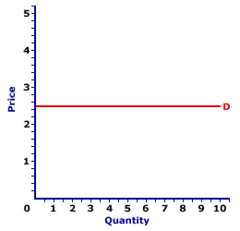
Perfect Elasticity
horizontal or flat, any price change results in zero or an infinite quantity demanded/supplied
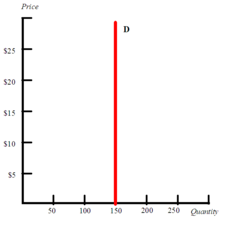
Perfect Inelasticity
the demand curve is a vertical straight line; quantity demanded remains the same regardless of price
Factors Affecting Elasticity of Demand
- Whether the good is a luxury or a necessity
- Whether the good has any close substitutes
- The expenditure on the product as a proportion of income
- The length of time subsequent to a price change
- Whether a good is habit-forming (addictive) or not
Supply
The amount of goods and services that producers are able and willing to sell at various prices during a specified time period
Market Supply
Refers to the sum of all individual firm supplies of a good or service.
Assumptions of Supply
- Has the resources and technology to produce
- It can profit from producing it
- Plans to produce it and sell it
Law of Supply
States that, all else equal (Certeris Paribus), an increase in price results in an increase in quantity supplied. In other words, there is a direct relationship between price and quantity: quantities respond in the same direction as price changes.
Factors Affecting Market Supply
Price of goods itself
Price of Other Goods
Expected Future Prices
State of Technology
Change in Cost of Factors of Production
Quantity of good Available
Climatic Condition
Contraction of Supply
When a decrease in the price of a good or service causes a decrease in quantity supplied. It is shown by a downward movement along the supply curve
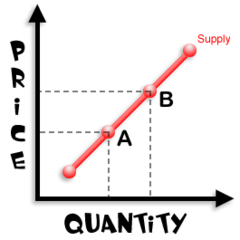
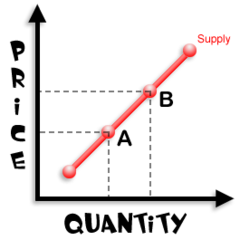
Expansion of Supply
When an increase in the price of a good or service causes an increase in quantity supplied. It is shown by an upward movement along the supply curve
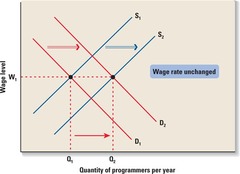
Increase in Supply
Products become cheaper for firms to produces. This would encourage them to supply more quantity at the same price, or same amount for a cheaper price. The supply curve shifts to the right. This is due to: utility costs decrease, company taxes decrease, wages decrease, exchange rate increases (cheaper to buy capital from overseas), and lower interest rates.
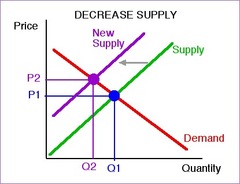
Decrease in Supply
Products become more expensive for firms to produce. This would encourage them to supply less quantity at the same price, or same amount for a higher price. The supply curve shifts to the left. This is due to: utility costs increase, company taxes increase, wages increase, exchange rate decreases (more expensive to buy capital from overseas), and higher interest rates.
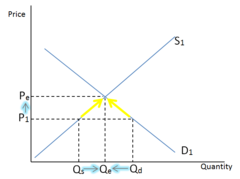
Market Equilibrium
Is the situation where, at a certain price level, the quantity supplied and the quantity demanded of a particular good are equal.

Price Mechanism
Is the process by which the forces of supply and demand interact to determine the market price at which goods and services are sold and the quantity produced. In a market economy, the price mechanism attempts to solve the economic problem in product markets for goods and services.