Module 1 Chp 2 Forces and Shape + Chp 3 + Chp 4 + Chp 5
 Call Kai
 Learn
Learn Practice Test
 Spaced Repetition
 Match
Match Flashcards
 Knowt Play
1/58

There's no tags or description
Looks like no tags are added yet.
Name | Mastery | Learn | Test | Matching | Spaced | Call with Kai | Chat |
|---|
No analytics yet
Send a link to your students to track their progress
59 Terms
Define "drag."
Objects experience friction when they move through a liquid or a gas.
What does weight equal ??
Weight only equal to gravitational force
Define "upthrust."
The upward force from a liquid/gas that makes some things float.
Define “weight.”
The gravitational force on an object
Define “tension.”
The force in a stretched material
OBJQ
Define "friction."
The force that opposes the motion of one material sliding past another
Define “thrust.”
The forward force from an engine
Define “air resistance.”
An object moving through air experience a force that opposes its movement
What is a balanced force?
When resultant force = 0, so a = 0
What are 2 scenarios that a = 0?
If an object is originally at rest, it will continue at rest
If object move with certain velocity, will move with same constant velocity, so a = 0rest.
What is Newton’s first law?
-There is no net external force acting on an object; if an object is initially at rest, it will continue to rest. If an object moves with a certain velocity, it will continue moving with the same constant velocity. So there is not acceleration.
Explain the relationship between thrust and drag.
Thrust>Drag (Speeding up)
Thrust<Drag (Slow down)
What is Newton Second Law
he resultant force acting on an object is equal to the product of mass and acceleration of the object
F = ma
F = resultant force
m = mass
a = acceleration
Downward arrow reaction or action?
action
Upward arrow reaction or action?
Normal reaction
When does an action-reaction pair occur?
It occurs when 2 objects interact with each other. (not only on single object)
What is Newton’s Third Law?
Whenever 2 objects interact to each other, the force exerted by the first on the second is equal in magnitude and opposite in direction to the force exerted by the second on the first. This is an action-reaction pair.
When does free fall occur?
When there is no air resistance
What are the other names for free fall? And its symbol
Acceleration due to gravity
Acceleration of free fall
Symbol = g
What is the upward and downward reaction with gravity and speed?
Upward→against gravity→speed decrease
Downward→same direction with gravity→speed increase
What are free fall equations?
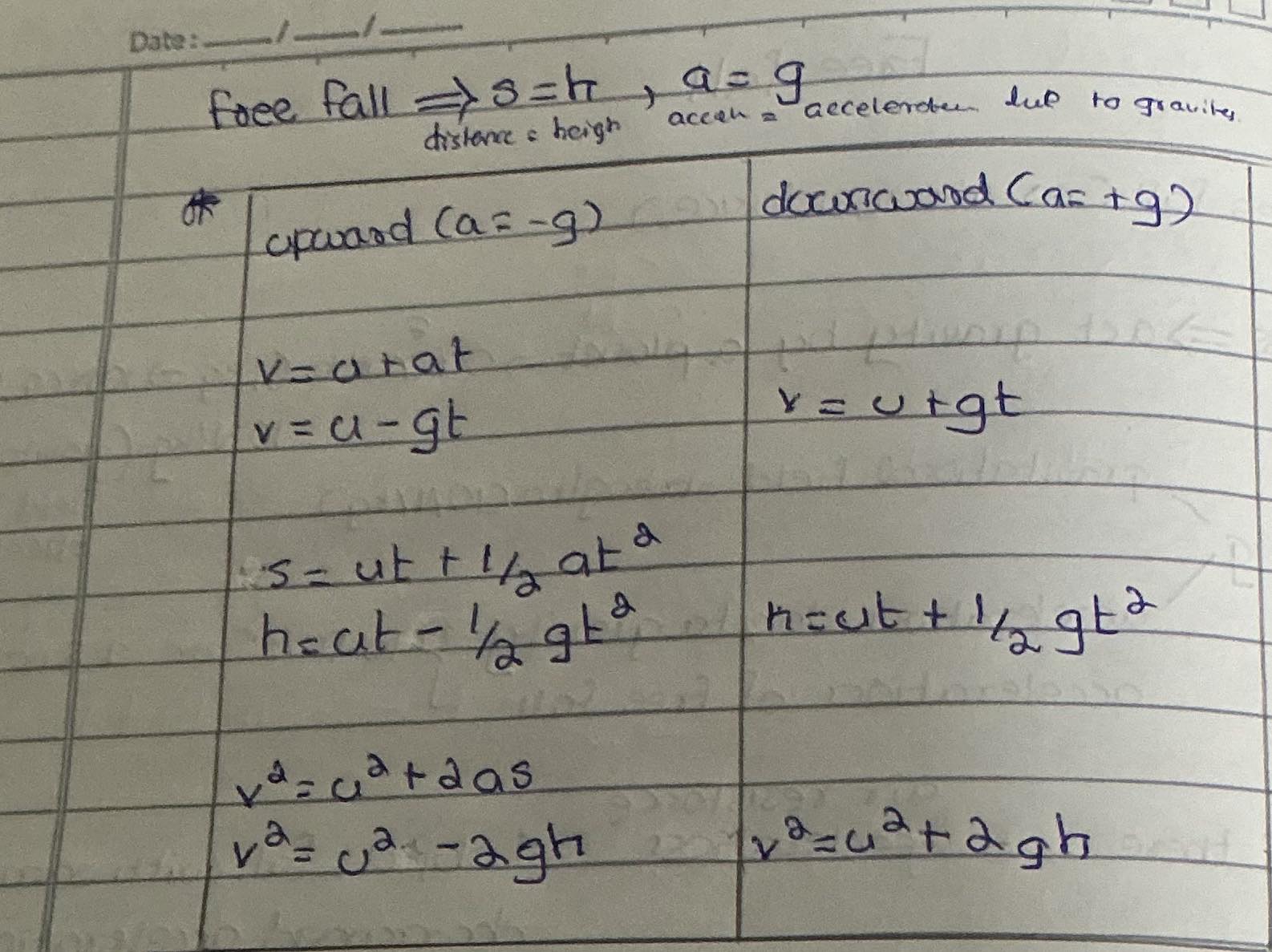
What are the relationships between the same mass and different force and the same force and different masses?
Same mass
F1 > F2
a1 > a2
accelration (a) directly proportional to F (force)
Same force
m1 < m2
a1 > a2
acceleration (a) inversly proportional to mass.
Weight equation?
W = mg
Weight = mass x gravitational field strength
OBJQ
What are weight, location, gravitational field strength, and mass relation?
Weight depends on mass and gravitational field strength. Different location→different value of gravitational field strength. Greater the mass of location (Planets)→larger gravitational field strength
What is Earth's gravitational field strength?
10 N/kg (9.8 N/kg)
Which apparatus can we use to measure mass?
Mass=Electric balance or digital balance
Force, weight = spring balance or newton meter
OBJQ
Why does weight change but mass doesn’t when location changes?
Since w=mg, mass doesn’t depend on location, but weight does: gravitational field strength ‘g’ can change according to the location. Therefore, the weight of a body may change when its location changes.
OBJQ
What factors does air resistance depend on?
Speed→The faster they move, the greater the drag force opposing their motion becomes
Shape→ Streamlined smooth surface experience less air resistance. Larger surface area, the more air resistance it experiences.
What forces does that object failing through air experience?
Weight, and drag
Explain the falling-through-air experience.
At first, it has weight only and no air resistance.
The resultant force is downward, so it has acceleration.
There is air resistance. Air resistance increases with increasing speed, and the resultant force becomes decreased. Acceleration also decreases.
Eventually air resistance is equal to its weight and 2 forces are balanced and the resultant force becomes zero.
There it falls with terminal velocity (Constant velocity)
Explain the process after the parachute happens.
After the parachute opened, air resistance greatly increased.
Air resistance greater than weight.
Then air resistance decreases with the decreasing speed.
Eventually, air resistance is equal to its weight, 2 forces are balanced, and the resultant force becomes zero.
So parachutists fall with low terminal velocity.
OBJR + FAQ
What is thinking distance/reaction time?
When a driver suddenly sees an object blocking the way ahead, it takes time for him or her to respond to the new situation before any action, such as braking. It is called reaction time.
OBJQ + FAQ
What does thinking distance depend on?
(i) Driver’s condition (use of alcohol or drug)
(ii) Tiredness of the driver
(iii) Poor visibility (fog)
(iv) Speed of car
OBJQ + FAQ
What does breaking distance depend on?
(i) Road’s condition (let friction due to wet or icy)
(ii) Tier’s condition (not enough to grip the road’s surface)
(iii) Speed of car
OBJR
What is stopping distance?
Thinking distance + Breaking distance
FAQ
Define elastic behavior.
When applied force is removed from an object, the ability to return to its original form is called "elastic behavior" or "elastic object."
What is an extension equation?
Extension = new length - original length
x or e = L - L₀
What is the original length equation?
Original length = new length - extension
L₀ = L - x or e
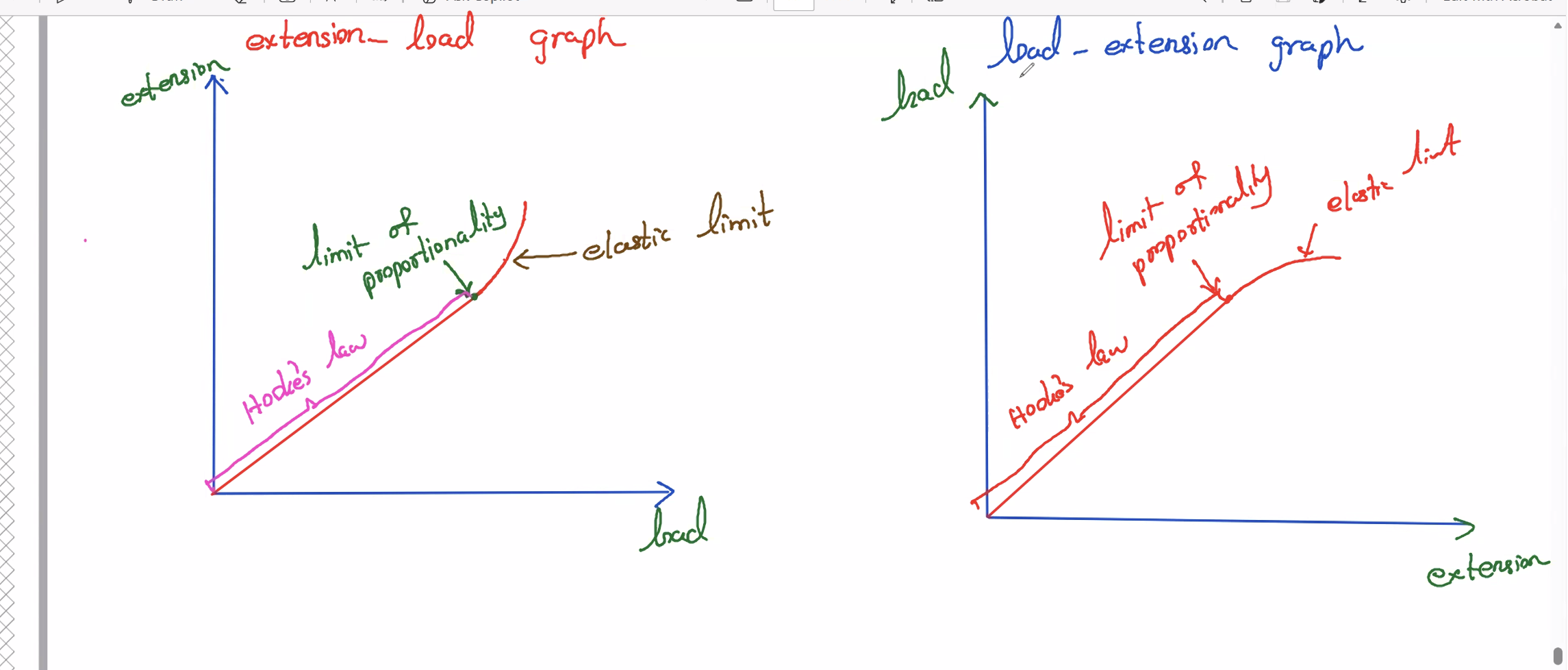
What is Hooke’s Law?
As long as the elastic limit of object is not exceeded, the extension is directly proportional to its applied force
2 equations of Hooke’s Law?
F = kx
k = F/x (in normal calculation and load-extension graph)
k = 1/gradient (extention-load graph)
F = applied force
k = spring constant, Hooke’s constant
x = extension
How to prove that a graph obeys Hooke’s Law?
-The graph is a straight line & passing through the origin.
Why does a curve happen in the graph of the extension-load graph?
When a student doesn’t check whether the spring goes back to its original length or not.
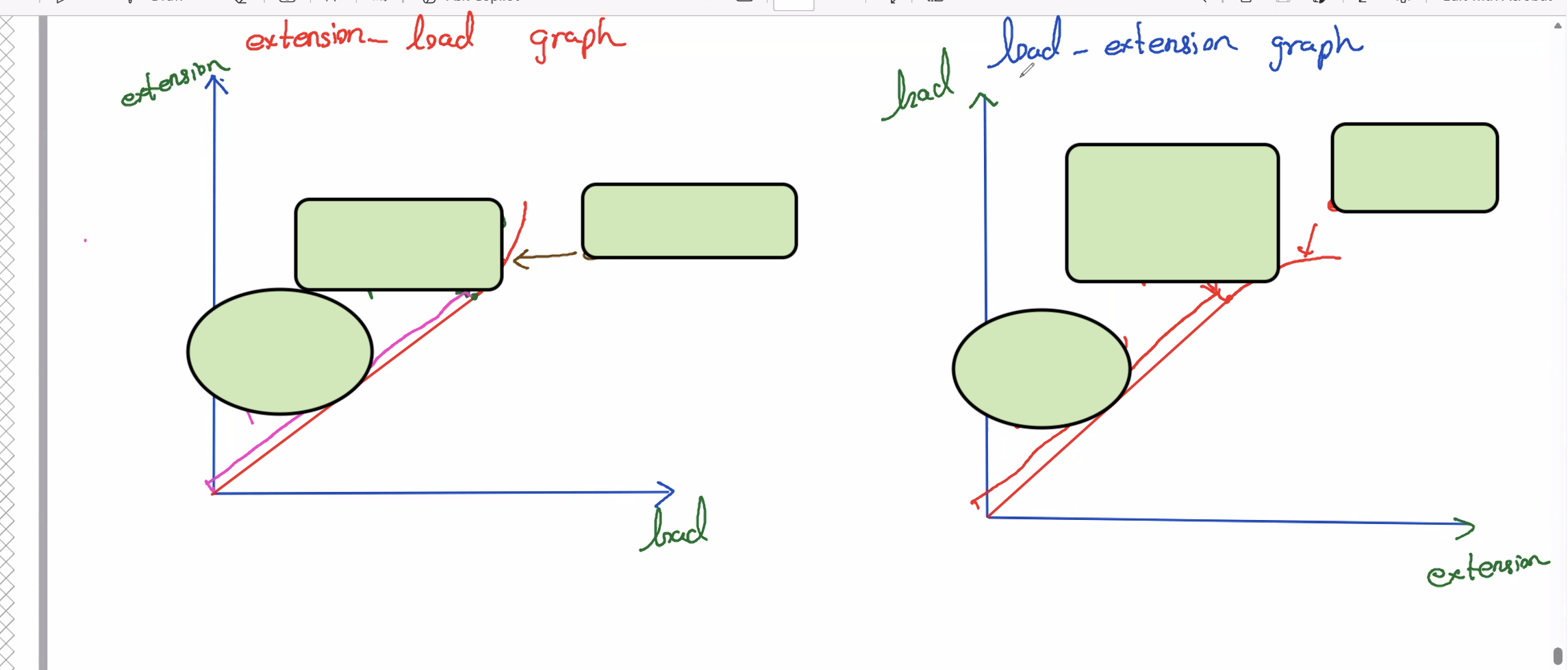
Label which part follow Hooke’s law, elastic limit and limit of proportionality
FAQ
What is a moment of force?
Turning effect of force about a pivot.
OBJQ
Equations of a moment?
moment = force x perpendicular distance from pivot
Moment = f d sin θ
What are directions of moment?
Clockwise and Anti-clockwise
How to prove an object is balanced in a seesaw?
Total anti-clockwise moment = total clockwise moment
What is the principle of moments?
If an object is in equilibrium, total clockwise moment is equal to total anti-clockwise moment
FAQ
What are the conditions for equilibrium?
Total anti-clockwise moment = total clockwise moment (or) Resultant moment = 0
Total upward force = total downward force (or)
The resultant force = 0
What is the relation between arrow length and speed of the object?
Same arrow => constant speed/steady speed
Air.r arrow shorter weight arrow => speed up
Air.r arrow longer than weight arrow => slow down
State the relation between the same moment (resultant moment) and distance from the pivot.
For the same amount of moment, the smaller distance from the pivot (closer to the pivot) will cause greater force
State the relation between weight (N) and distance
To balance
Greater force (N) must have less distance (further from the pivot).
A smaller force (N) must have more distance (closer to the pivot).
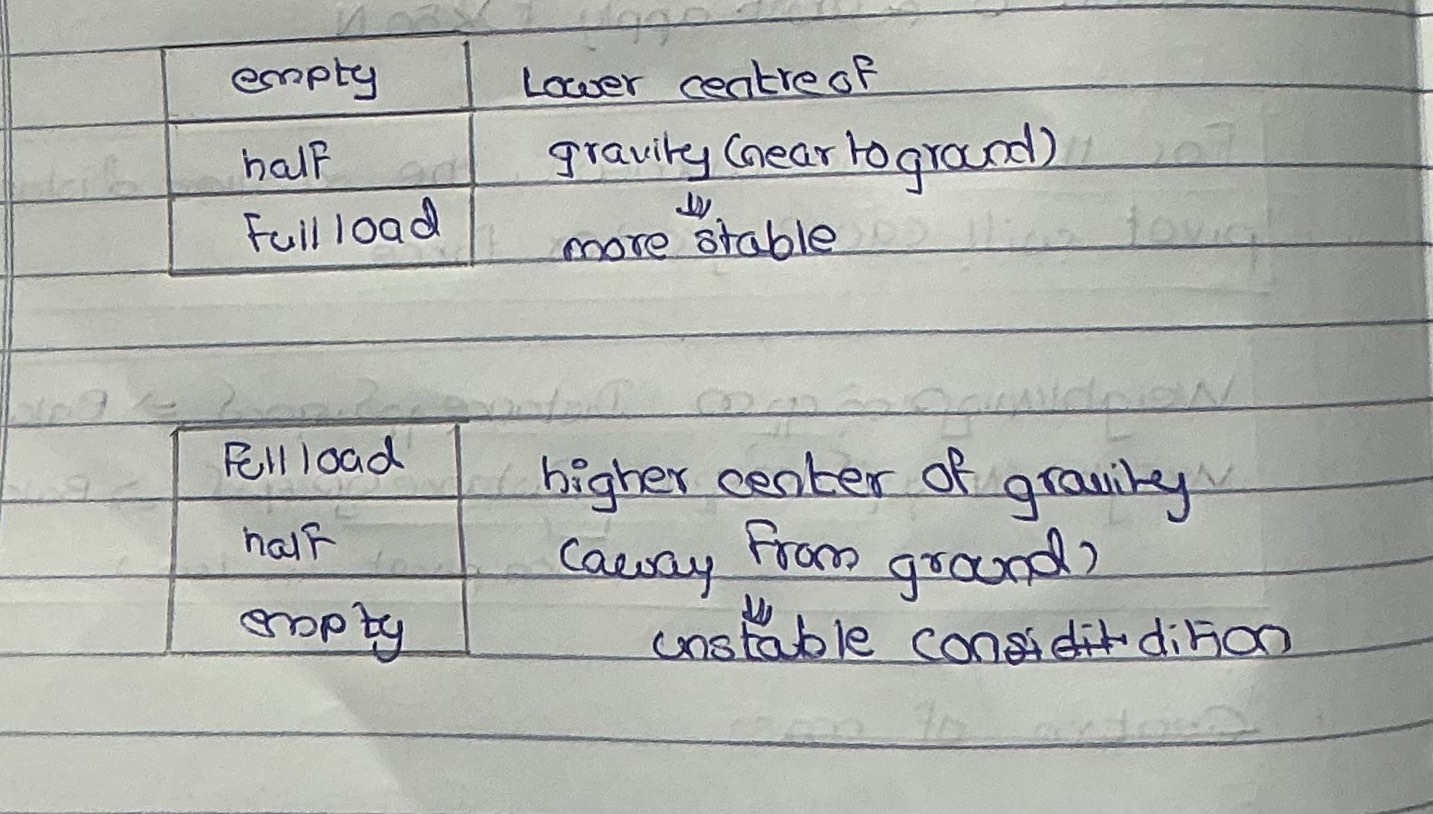
Define 'centre of mass/gravity'.
There is a point of an object through which all of the weight of the object seems to act.
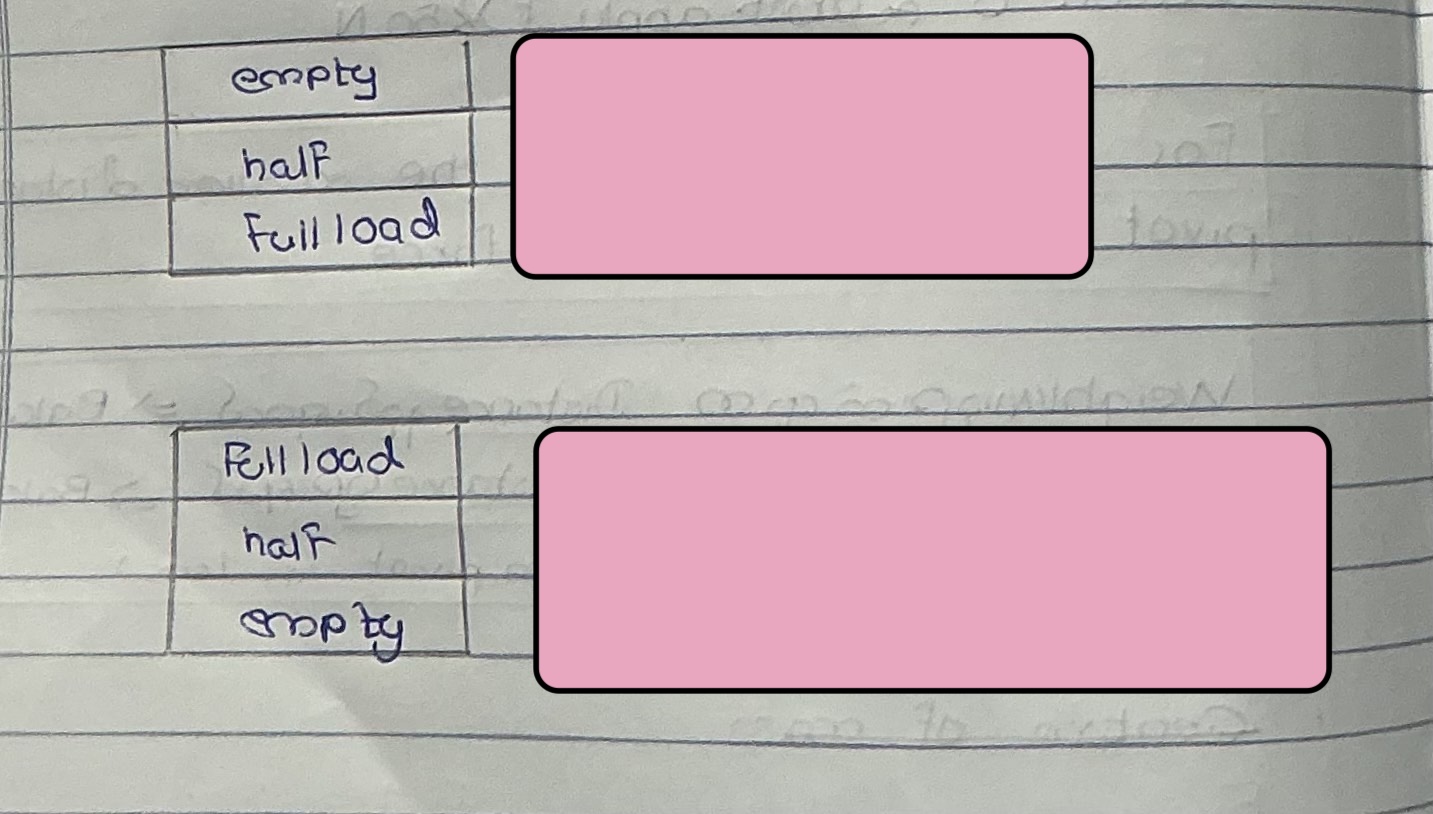
Explain in terms of a centre of mass/gravity and arrangement of load.
OBJQ
Define momentum?
Momentum is the product of mass and velocity of an object
OBJQ
Write down momentum equations
Momentum = mass x velocity
P = mv
p=momentum
m=mass
v=velocity
What is the SI unit of momentum?
kgm/s
Write down the impulse in terms of force and momentum in term of force and momentum.
Impulse = resultant force x time (in terms of force)
Impulse = change in momentum (in terms of momentum)
Resultant force x time = change in momentum
F x t = (mv-mu) or (mu-mv)
OBJQ
Write the resultant force formula in terms of momentum.
Resultant force = change in momentum/time
F = Δp/t
F = m(v-u)/t or F = m(u-v)/t