ISU MATE Mod1 2026
 Call Kai
 Learn
Learn Practice Test
 Spaced Repetition
 Match
Match Flashcards
 Knowt Play
1/26

There's no tags or description
Looks like no tags are added yet.
Name | Mastery | Learn | Test | Matching | Spaced | Call with Kai | Chat |
|---|
No analytics yet
Send a link to your students to track their progress
27 Terms
Bonding Forces
Forces that attract atoms and repel atoms from each other when trying to form a bond
Potential Energy
potential energy PE between the two atoms for both attraction and repulsion as a function of separation distance r are given by EA and ER
Coulombs Law
The force F between two charged particles as a function the magnitude of the two charges and r, the distance between them.
Attraction Force
The force of attraction FA between two oppositely charged particles as a function of distance r between them
Force & Potential Energy for Repulsion
The repulsive force FR and associated potential energy ER are electrostatic & QM in nature. As a function of distance r between the two ions

Covalent Bonding
The attractive force is between ion cores and the valence electrons that are located or “localized” in the shared orbitals
Directional attraction, dictated by shapes of orbitals
Metallic Bonding
The attractive force is between ion cores and the valence electrons that are “delocalized” in the “sea” of electrons
Non-directional attraction, dictated by attraction to “sea”
Ionic Bonding
Attractive forces are electrostatic
Non-directional attraction, limited by like charge repulsion
Amorphous Materials
Materials that don’t exhibit crystallinity

Single Crystals
Materials made up of one single crystal. All the atoms in the bulk material are perfectly periodic. Single crystals are rare or human-made
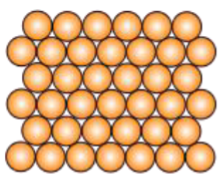
Polycrystalline
An assemblage of single crystals also known as grains.
Each with different orientations relative to each other and separated by grain boundaries

Atomic Structure
The “little” picture of structure. Describes How the atoms are arranged in crystals or grains
Lattice
An array of positions or points in space. A geometric framework on which to “hang” or “position” atoms
Unit Cell
The smallest repeat unit which defines a lattice

Lattice Parameters
Unit cell dimensions give by a, b and c
Cubic Bravais Lattices
There are 3 cubic Bravais lattices in the cubic crystal system defined as having all 90 degree angles and equal side lengths

Basis
A simple geometric “recipe” for placing atoms on, or about, a lattice point
Polymorphism
A material that can exist in more than one form or structure

Elastic Lattice Energy
The energy required to separate an ionic crystal into its constituent ions
SC

FCC
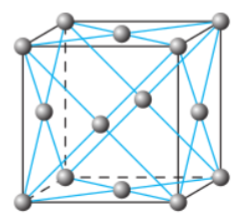
BCC
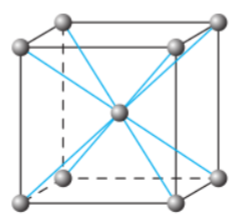
HCP

Induced Dipole Bonds
Weakest, asymmetrical bonds
Thermal fluctuations cause temporary electrical asymmetry in non-polar atoms & molecules. These can induce similar polarizations in adjacent atoms.
Polar Molecule-Induced Dipole Bonds
Charge asymmetry in polar molecules can induce dipoles in non-polar molecules
Permanent Dipole Bonds
Hydrogen bond, strongest bond
Polar-to-polar molecule bonding
Van der Waals Bonds
Several types of secondary bonds exist.
All are weak compared to primary bonding
Each is the result of attraction due to partial charge electric dipoles that exists between all atoms or molecules.