learning and cognition
 Call Kai
 Learn
Learn Practice Test
 Spaced Repetition
 Match
Match Flashcards
 Knowt Play
1/19

There's no tags or description
Looks like no tags are added yet.
Name | Mastery | Learn | Test | Matching | Spaced | Call with Kai | Chat |
|---|
No analytics yet
Send a link to your students to track their progress
20 Terms
classical conditioning
unconditioned stimulus (US)- biology predetermined knowledge
conditioned stimulus (CS)- does not produce any biologically predetermined reaction
Unconditioned response (UR) reflex response to unconditioned stimulus
conditioned response (CR)- learned response
innate behaviours
are triggered and regulated by a genetic programme. they are rigid and cannot be changes
learned behaviours
acquired during life, they make organism better adapted to its environment ex. classical and operant conditioning and cognitive learning
pavlov’ss dogs
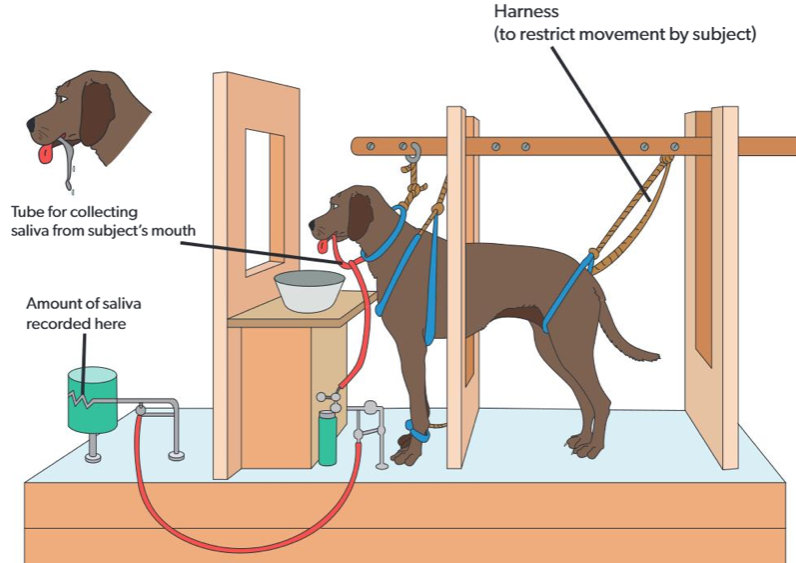
classical conditioning- if you repeatedly present the meat (US) and the bell (CS) several times, you will be able to remove the meet and the dog will salivate at the sound of the bell (CR).
dogs digestive track was surgically modified so that saliva, instead of going down into the stomach, was redirected to a measuring device
Little Albert
classical conditioning- proved that in fear conditioning even one repetition may be enough
a nine year old was conditioned with frightening loud sounds to respond with fear and crying to objects such as a white rat or hat
even after years the child was still terrified of white stuff
Operant conditioning
learning process with an association is made between a behaviour and its consequence such as reward or punishment
reinforcement- increase the behaviour (positive-reward, negative- unpleasant stimulus removed)
punishment- decrease the behaviour (positive-negative consequence, negative-attractive factor removed)
Skinner box
operant conditioning- kept pigeons in a cage that had a food-dispenser giving food at regular intervals.
the bird behaved as if there was a causal relationship between its behaviour and the presentation of food although the relationship was lacking
radical behaviourism
belief that the most complex human behaviour could be reduced to operant conditioning and therefore potentially controlled
cognitive schema
generalised mental representation of some aspect of reality, this mental representation can be a stereotype-”firefighters” you see generalized image in your head
person with anorexia has distorted body image due to their mental representation of their body
they can be viewed as something that makes us biased however they make i tpossible for us to efficiently process information we encounter every day
rats in tolman’s study
rats believes to create a kind of internal map of the maze, which allowed them to acquire a sense of direction to find food more easily on subsequent trials
teleogical behaviourism
implies the existence of some kind of purposeful behaviour
schema theory
cognitive schemas influence the way we interpret information,
creates a lens through which we perceive reality,
maintains that schemas develop from experience in two processes: acomodation and assimilation,
according to this theory schemas are resistant to change
cannot be observed directly in behaviour
there are two types of schema: script and self-schema
script
schema of events
ex. mental representation of typical course of action in performing an activity
turner
text presented
recall after 20 minutes
participants added information from their own schema
self-schema
ones schema about themselves, depressed people might believe that they are failing at everything but objectively that is not the case; cognitive behavioural. therapy has demonstrated significant results in the treatment of depression
Piaget
children when they grow construct schemas that help them understand the world
accomomdation
adjusting the existing schema to enble better fit with environment, it will occur when we adjust after learning new information
assimilation
fitting the environment into existing schema, it may involve distorting information or ignoring some aspects , once this schema is formed it is hard to fit in the world into existing schema, only when we fail to do so we will resort to accomodation
ex. a person prejusticed against certain group when meets a nice representative decides that they are rare exeption
systematic processing
processing information based on schema, it saves time and energy while providing accurate enough approximation of reality, it is open to debate whether it is good
ex. tiger is a stripy predator that can eat you for dinner you know to run when you see one
Treyens