Chapter 1: Foundations of Epidemiology
 Call Kai
 Learn
Learn Practice Test
 Spaced Repetition
 Match
Match Flashcards
 Knowt Play
1/61

There's no tags or description
Looks like no tags are added yet.
Name | Mastery | Learn | Test | Matching | Spaced | Call with Kai | Chat |
|---|
No analytics yet
Send a link to your students to track their progress
62 Terms
Active carrier
Individual who has been exposed to and harbors a pathogen for a while, even if the person has recovered from the disease
Active primary prevention
Individuals change their behavior by exercising more, stopping smoking, etc
Airborne transmission
Droplets, dust particles carry the pathogen in the air and can be breathed in by susceptible hosts causing infection; happens when sneezing, coughing, talking
Biological transmission
When a pathogen goes through its life cycle within the host/vector before being transmitted. Happens in malaria, where female mosquitoes collected blood feeds and promote the development of the Plasmodium parasite in the mosquito
Carrier
Individuals that contain, spread, and or harbor an infectious organism
Case
Person in a population that has a specific disease, disorder, injury, or condition. If a person does not fully fit the case definition, that person is not a case even if they have similar symptoms
Case definition
Standard set of criteria that diagnoses a person with a health problem; symptoms. Ensures reliable diagnosis, regardless of when, where, and who the diagnosis occurs.
Case severity
How harsh the illness is. Can be measured by its average length of a hospital stay, how disabling or debilitating the illness is, the likelihood of recovery, how long the person is ill, and how much care the person needs.
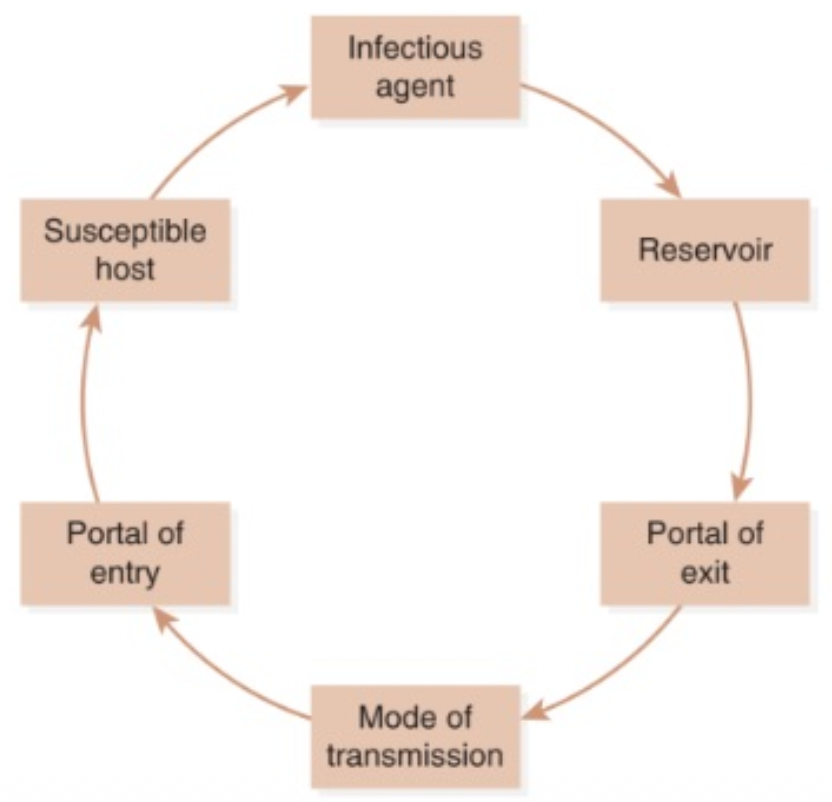
Chain of infection
Process linked by an infectious agent, reservoir, portal of exit, mode of transmission, portal of entry, and susceptible host
Common-source epidemic
Epidemic where the disease comes from a specific source. Results in cases occurring more rapidly during the initial phase compared to host-to-host. Removing the common sources makes epidemics end fast.
Control
Aims to prevent further spread of a disease in areas where an outbreak currently exists
Convalescent carrier
Individual who harbors a pathogen and is in the recovery phase, but is still infectious
Determinants
Factors that CAUSE a health outcome.
Direct transmission
Uninterrupted and immediate transfer of an infectious agent from one person to another. Requires physical contact between an infected host and a susceptible person.
Distribution
Frequency and pattern of health-related states or events
Effectiveness
The ability of a program to produce benefits among those who are offered the program. Basically are people actually interested in the program
Efficacy
The ability of a program to produce desired results among those in the program compared to those not. Basically does the treatment work
Endemic
Constant presence of a disease in a population, but with predictable behavior. Examples: flu with weather pattern, chicken pox with age pattern, malaria with location pattern. Many pandemics become endemic.
Epidemic
A larger than usual occurrence of a disease in a specified population during a given period
Epidemiology
Study of the distribution and determinants of health-related states or events and the prevention and control of health problems in human population. Data from the shared characteristics can be used to identify groups that are at risk for a disease/disability.
Fomite
An inanimate object such as a piece of clothing or door handle that has an infectious agent on it and is capable of spreading the agent. Common in hospital settings with stethoscopes, IV drip tubes, etc. Sterilization is helpful.
Frequency
Number of health-related states/events and their relationship to the size of the population
Health
A state of complete physical, mental, and social wellbeing, not just the absence of weakness or disease
Health-related states
Anything that affects the well-being of a population, including diseases, events, conditions, and behaviors
Healthy (Passive) carrier
Individual who has been exposed to and harbors a pathogen but is asymptomatic; typhoid Mary
Incubatory carrier
Individual who has been exposed to and harbors a pathogen, is in the beginning phase of the disease, showing symptoms, and can transmit the disease to others
Index case
The first case brought to the attention of the epidemiologist
Indirect transmission
When an infectious agent is transferred through an intermediate player; includes air, water, food etc. Some epidemiologists consider droplets direct transmission but technically its indirect since the drop transfers the pathogen
Intermittent carrier
Individual who has been exposed to and harbors a pathogen and who can spread the disease in different places or at different intervals.
Mechanical transmissison
When a pathogen spreads using a host (e.g., fly, flea, louse, and rat) as a mechanism for a ride for nourishment, or as part of a physical transfer process.
Mixed epidemic
When people affected by a common-source spread the disease, resulting in a propagated outbreak.
Outbreak
An epidemic that is geographically and time constrained
Pandemic
A large epidemic that spreads across regions, countries, and continents
Passive carrier
Passive primary prevention
Individuals don’t need to change their behavior because their environment provides protection through drinking water being fluoridated or foods being modified so they have more vitamins . Happens before infection
Pathogen
Disease-causing agent such as a virus, bacteria, fungus, or parasite
Pathogenicity
The state of being pathogenic
Pattern
Who, where, and when health-related state/events typically occur
Person
Aspects of disease, disability, injury, and death on the individual level
Place
Where the health-related states//events are more or less likely to occur
Population
A group of people sharing one or more characteristics (social, economic, family, work, geography)
Portal of entry
Where the pathogen or disease-causing agent enters
the host body
Portal of exit
Where the pathogen or disease-causing agent leaves
the original host body
Prevention
Primary Case
The first disease case in the population
Primary prevention
Preventing the disease/disorder before it happens. Includes health education, protection, vaccines, etc
Propogated epidemic
When infections are transmitted from person to person, host-to-host. Cases rise and fall more slowly compared to common-source epidemics
Public health surveillance
Ongoing systematic collection, analysis, interpretation, and dissemination (presentation) of health data. Data can come from demographics, symptoms, health outcomes, hospital records, death certificates
Rehabillitation
Attempt to restore an afflicted person to a useful, productive, and satisfying lifestyle. Its purpose is to promote the highest quality of life possible, given the extent of the disease/disability
Reservoir
the habitat (living or nonliving) in or on which an infectious agent lives, grows, multiplies, and depends for its survival in nature. Can be humans, animals, or certain environmental conditions or substances (poop)
Risk factor
A behavior, environmental exposure, or inherent human characteristic that increases the chance of a person developing an adverse health outcome
Secondary case
A person infected because of contact with a primary case
Secondary prevention
Focuses on health screening and early detection to increase the likelihood of curing.Early treatment blocks the progression of the disease and prevent injuries from developing into more serious things
Suspect case
Person who has all the signs and symptoms of a disease or condition, but hasn’t been diagnosed yet
Tertiary prevention
Limits disability by providing rehabilitation when a disease/injury/disorder has already occurred and caused damage. Decreases likelihood of sick individuals becoming sicker and dependent on healthcare institutions.
Time
Measurable period in which a process, behavior, or condition occurs
Vector
An invertebrate animal (tick, mosquito, mite, fly) that transmits infections by transferring infectious agents from one host to another; does not cause the disease itself, but it is part of the infectious process
Vector-borne transmission
Malaria, lyme disease
Vehicle
An inanimate object that may carry and spread an infectious agent
Vehicle-born transmission
Cholera
Zoonosis
An infectious organism in vertebrate animals. can be transmitted to humans through direct contact, a fomite, or a vector. Includes rabies
Public health
The science of promoting health and extending life on the population level. Deals with threats to health in the population (a group of people sharing one or more characteristics)