NMS Lecture 3 - Action Potential
 Call Kai
 Learn
Learn Practice Test
 Spaced Repetition
 Match
Match Flashcards
 Knowt Play
1/26

There's no tags or description
Looks like no tags are added yet.
Name | Mastery | Learn | Test | Matching | Spaced | Call with Kai | Chat |
|---|
No analytics yet
Send a link to your students to track their progress
27 Terms
What determines the resting membrane potential
The relative permeability of the membrane to K+ and Na+
How is the RMP disrupted
A specific stimuli causes the ion selective channels to open
What is the physical stimuli in the stretch reflex
Patellar tendon tap
When a stimuli activates the cell, permeability of what ion increases initially
Sodium
2 main types of ion channels (other than leak channels)
1. Voltage-gated ion channels - open at a specific membrane voltage
2. Ligand-gated ion channels - involved in neurotransmitter release and synaptic transmission
Action potential
Large change of membrane potential from the resting membrane potential of -70mV to + 30mV, approaching the equilibrium potential Na+ (+55mV)
Time of action potential
2 to 3 milliseconds
How is afferent neuron activated in stretch reflex
Muscle stretch results in increased opening of specialized Na+ receptors. Na+ enters efferent fiber and depolarizes the afferent neuron
Threshold potential (-55mV)
Minimum membrane potential that must be reached for voltage-gated sodium channels to open, firing the action potential
How does potential reach the threshold potential
Sodium entering through pores
What channels are open/closed at RMP
Leak channels are open, passively moving Na+ and K+. Voltage-gated ion channels are closed
At threshold potential which channel opens
Voltage-gated sodium ion channel opens up, sodium rushes into cell, increasing potential to +30mV
At +30 mV, which channels open/close
Voltage-gated sodium ion channel closes, votage-gated potasium ion channel opens, potassium rushes into the cell, decreasing potential.
Absolute refractory period
Time during which an excitable membrane cannot generate an action potential in response to any stimulus
What causes the absolute refractory period
Inactivation of voltage-gated sodium channels
Relative refractory period
Time during which an excitable membrane will generate an action potential only with a stimulus greater than the usual strength
Stage 1 of action potential
Resting membrane potential. Voltage-gated ion channels are clsoed
Stage 2 of action potential
Stimulus causes depolarization to threshold potential. Sodium moves into cell via pores
Stage 3 of action potential
Depolarization - Voltage-gated sodium channels open. Sodium rushes into the cell, depolarizing the cell to +30mV
Stage 4 of action potential
Repolarization - Voltage gated potassium channels open, sodium channels close. Potassium rushes into the cell, repolarizing the cell
Stage 5 of action potential
Hyperpolarization - Voltage gated potassium channels are open, sodium channels are completely closed. Cell moves closer to equilibrium potential of potassium (-90mV).
Stage 6 of action potential
Resting membrane potential - All voltage- gated channels are closed
How does membrane conductance change throughout the action potential
Sodium conductance increases during the depolarization stages, but decreases during repolarization. Potassium conductance decreases during depolarization, but increases during repolarization
The movement of an action potential along a neuron is related to ________
The relative permeabilities of Na+ and K+
Steps of action potential transmission
1. Axon at RMP
2. Activation of stretch receptor opens voltage-gated Na+ channels
3. Local depolarization of membrane causes adjacent voltage-gated Na+ channels to activated
4. New action potential generated in adjacent membrane
5. Action potential only travels in one direction due to refractory period
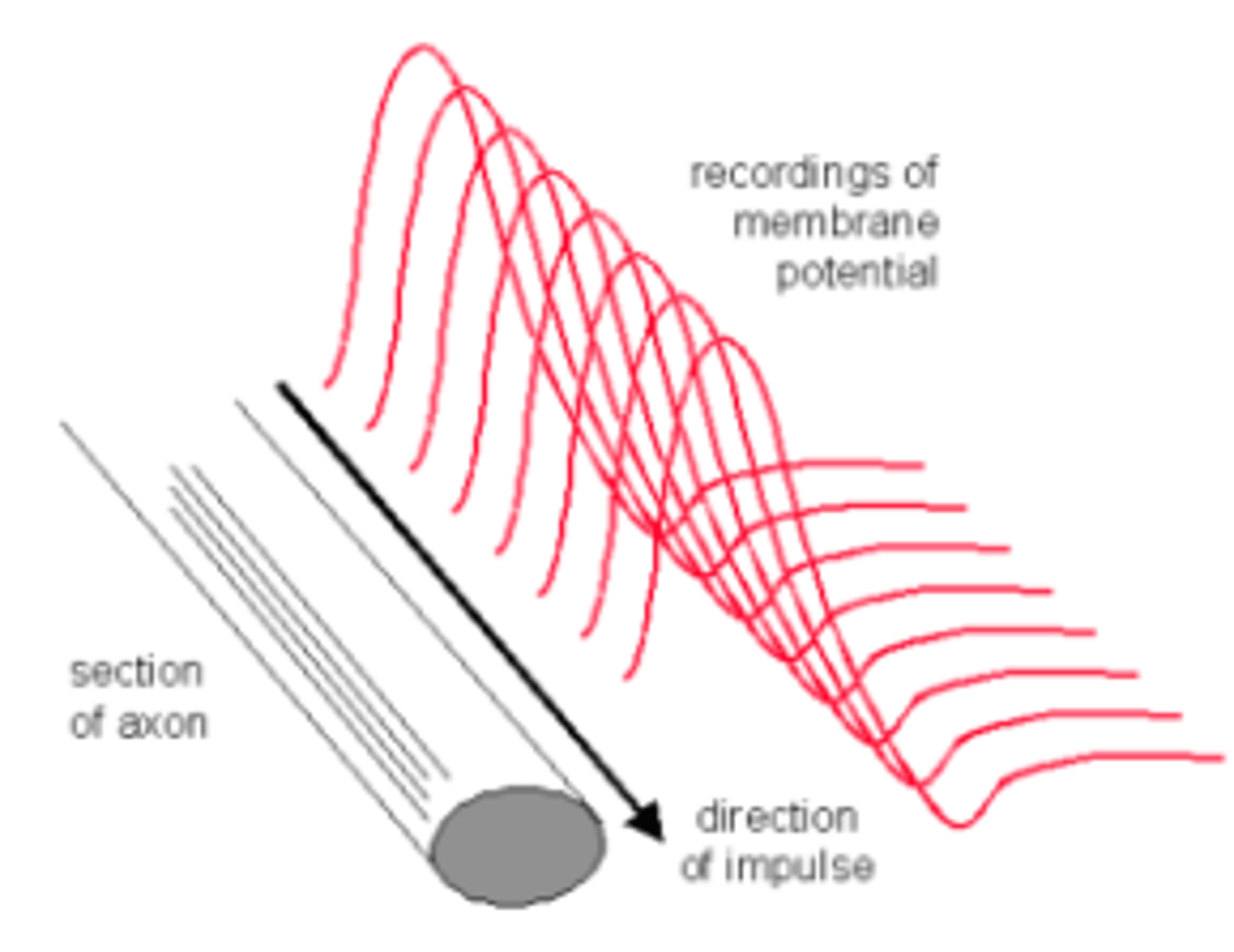
Why does action potential propagation only occur in one direction?
Refractory period limits which cells can be stimulated
Electrotonic conduction
Spread of current inside axon, proceeding in only one direction.