Wrong - Behavioral
 Call Kai
 Learn
Learn Practice Test
 Spaced Repetition
 Match
Match Flashcards
 Knowt Play
1/168

There's no tags or description
Looks like no tags are added yet.
Name | Mastery | Learn | Test | Matching | Spaced | Call with Kai | Chat |
|---|
No analytics yet
Send a link to your students to track their progress
169 Terms
Nativist Linguistic Hypothesis
Language is an innate behaviour wired into the brain. As long as language is introduced at the critical time, it is biologically predetermined
Opponent Process Color Hypothesis
Color information from cones is determined in pair sets: black/white, red/green, blue/yellow. These pairs overlap with other pairs but not with each other (ie won’t see red and green at same time from same thing)
Young-Helmhotz Color Theory
All colors we see are result of combined activity of 3 photoreceptors: Short wavelengths (blue), medium (green), long (red)
Sapir-Whorf Linguistic Relativity Hypothesis
Language influences cognition and perception
Fovea
Highest density of cones
Optic disc
Where optic nerve exits and artery that supplies blood to retina enters. This is a blind spot, no photoreceptors
Parvo Pathway
Retina → Lower(ventral) LGN → V1 → Ventral Brain Region
Parvo Pathway Function
“What” - Perception of Fine Detail: form and color
Magno Pathway
Retina → Upper(dorsal) LGN → V1 → Dorsal Brain Region
Magno Pathway Function
“Where” - Perception of Course Detail: Motion and Depth
Elaboration Likelihood Model (Central Route)
Processing of persuasive messages:
Central Route:
High Elaboration
Use logic, facts and lasting reason to persuade
Use when audience is motivated and able
Leads to deeper persuasion
Elaboration Likelihood Model (Peripheral Route)
Processing of persuasive messages:
Peripheral Route:
Low Elaboration
Use superficial cues or associations to persuade
Use when audience is unmotivated or distracted
Leads to shallow persuasion
McDonaldization of Society
Increase in efficiency/standardization/automation but decrease in individuality/quality/skill
Malthusian Theory of Population Growth
Human population growth is exponential and outpaces resource growth which is arithmetic
Thus, population growth experiences checks to keep it down:
Preventative Checks:
Voluntary reduction of births
Positive Checks:
Involuntary increase in death
Intersectionality
How different social identities combine to affect a persons life, treatment, behaviour
Ethnography
Qualitative study of human social phenomena in their own communities
Content Analysis
Qualitative technique used to examine text and images involved in human communication
Sick Role Theory
The rights and responsibilities of a sick person:
2 Rights:
Exempt from social norms
Not blamed for their illness
2 Responsibilities:
Must try to get better
Must seek help and follow that help to get better
Medicalization
Everyday normal human behaviours are treated as medical issues
False Consciousness
Members of exploited classes fall into the status quo and believe the misleading views of the upper class rather than being aware of the class disparities
Forgetting Curve
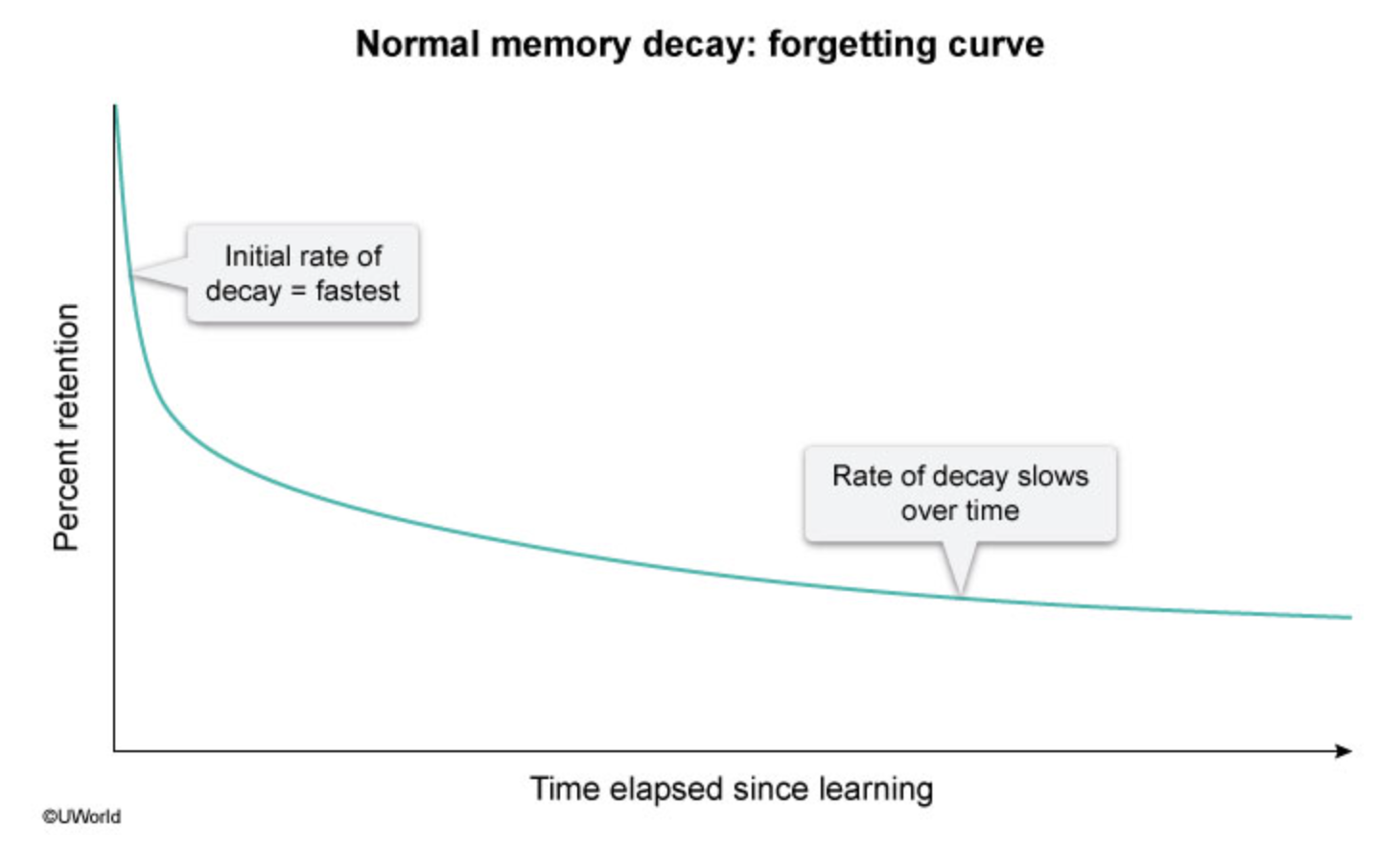
Crystallized Intelligence
Solving problems with using experience or previous information
Practical Intelligence
Solve issues that arise in everyday life
Fluid Intelligence
Ability to reason abstractly and solve new problems
Impression management techniques
Presenting a curated version of yourself on the outside consciously or unconsciously
Symbolic interactionism
Microsocial theory that says human behavior and society are shaped by the subjective meanings individuals assign to objects, events, and behaviors.
Conflict theory
Society is in a perpetual state of conflict driven by competition for limited resources, power, and status
Social constructionism
A sociological theory that posits reality and knowledge are created through human interaction rather than existing objectively.
Sensory memory
Initial stage of memory briefly retaining environmental data using ones senses
Iconic - Visual
Echonic - Auditory
Working memory
Memory used to temporarily hold and manipulate information required for complex tasks, mental scratchpad.
Central Executive: Coordinates attention and directs data to the other systems.
Phonological Loop: Handles verbal and auditory information.
Visuospatial Sketchpad: Handles visual and spatial information.
Episodic Buffer: Integrates information between working memory and long-term memory
Randomized control trial
Randomly assign participants into two or more groups, control or experimental. Minimizes bias
Case control study
Compare a group with the illness to a group without it and see the differences to determine the cause of the illness. Correlation between exposure and outcome?
Cohort study
Follow a group of people to see what happens to them after some have been treated with experimental and some are controls.
Cross sectional
Observational research method that collects population data at one moment in time
Inclusive fitness theory
Organism not only protects its own reproductive fitness but also by helping genetic relatives (ie family) who share same genes.
Perceptual organization
The brain's process of grouping and structuring raw sensory data (like shapes, colors, or sounds) into coherent, meaningful objects and patterns.
Combination of top down and bottom up processing
Priming
Exposure to one stimulus affects exposure to another stimulus
Social capital
Strength of ones social network and the value it can bring
Privilege
Opportunities one is provided
Ascribed status
Portion of SES adopted in life assumed involuntarily such as gender, race and age.
Achieved status
Portion of SES voluntarily earned and achieved for such as education.
Somatic symptom disorder
Persistent and excessive concern and looking for medical attention over minor physical symptoms that are not supported by medical evaluation.
Behaviorism
Focuses on role of the environment shapes human behaviour, specifically punishment and reinforcement. (Focus on result, not cognition of result)
Auto communication
Message sender is also message receiver
Evolutionary Game Theory
Relative Success of Particular Strategies
Availability Heuristic
Tendency to judge how common or likely something is based on how easily it is recalled or how recently it occured.
Evolutionary Emotional Theory
Emotions evolved to adapt to the environment
Cognitive appraisal theory
Cognitive appraisal occurs first → Then emotion → Then physiological response
Schachster-Singer Theory
Physiological Appraisal → Cognitive Appraisal → Emotional Response
James-Lange Theory
Physiological Appraisal → Emotional Response
Lazarus theory of emotion
Cognitive appraisal → Emotional + Physiological response
Mirror Neurons
Neurons that fire when individual both observes and performs a behavior
Vicarious emotions
When observer intuits the feelings another may be experiencing.
Cannon-Bard Theory
Physiological Appraisal and Emotional Response happen at same time
Mead theory of identity development
Social factors affect development
Preparatory
Imitation, no sense of self
Play
“I” starts to form when children understand themselves as individuals
Role taking
Beginnings of “me”, how others perceive them
Game
Further developing of “me”
Become aware of position/role relative to others
Hawthorne Effect
Acting differently than normal because you’re being watched
Activity Approach to Aging
Remain physically and socially active to improve the lives of the elderly
Continuity Approach to Aging
Attempt to retain habits and behaviours from youth
Disengagement Approach to Aging
Withdraw from social relationships and society withdraws from them
Life Course Approach to Aging
Holistic approach considering all factors
Demographic Transition Population Model
Stage 1: Death and birth rate high
Stage 2: Industrialization: Death rate drops
Stage 3: Urbanization: Birth rates decline due to contraception
Stage 4: Birth rate low and death rate low, pop growth slow
Stage 5: Birth rate too low, pop decrease
Exchange-Rational Choice
People make choices in interactions with people to maximize gain and minimize loss.
Gambling is what kind of conditioning principal
Variable interval
Social Facilitation
How does an audience affect performance? More dominant response will be present, if good then even better, if bad then even worse.
Maslow’s Hierarchy of Needs
Physiological Needs
Safety Needs
Love and Belongingness Needs
Esteem Needs: Self-esteem/Desire for reputation or respect
Growth → Self-actualization needs
Groupthink
Agreeing with the group to maintain harmony within the group despite disagreeing with the decision
Group polarization
Differences in opinion get magnified
Dyadic groups
Consist of 2 people
Social Networks
Observable pattern of social relationships amongst groups or indivudals
ABC model of attitude
Affective: Emotional reaction of attitude
Behavioural: How we behave and act towards a subject
Cognitive: What we think via our ideas, assumptions and beliefs
Differential association theory
How people either conform to society or become deviant based on interactions with others
Labeling theory
Identities and behaviours shaped by how people label you
Strain theory
How people become deviant without the means to achieve cultural goals
Control theory
How level of control determines whether people engage in deviant behaviours
Superior Colliculus
Reflex response to visual stimuli
Inferior Colliculus
Reflex response to auditory stimuli
Substantia nigra
Part of basal ganglia for movement control
Ventral tegmental area
Part of mesolimbic reward pathway
Ainsworth Secure Attachment
Baby explores while caretaker in the room
Baby upset when caretaker leaves
Baby soothed when caretaker returns
Ainsworth Insecure-Avoidant Attachment
Baby explores without checking in on caretaker
Show little distress when caregiver leaves
Ignore and avoid caretaker upon return
Ainsworth Ambivalent Attachment
Cling to caregiver
Highly distressed when caregiver leaves
Seek comfort and push caretaker away at the same time upon return
Ainsworth Disorganized Attachment
Contradictory or erratic behaviours
Trauma/fearful environement
Cocaine effect on prenatal brain
Adds stress, increased glucose metabolism
Instinctual drift
Animal replaces conditioned habits with innate food based instincts
Social Reproduction
Passing on social status to new kid
Partial report technique
Measures capacity and duration of sensory memory
Recall partial amounts of information that were presented
Operational span testing
Measures working memory capacity and executive attention
Remember sequences of letters while solving math problems
Psychophysical discrimination testing
Measure ability to differentiate between two stimuli, JND
Flashbulb memory
Remember what you are doing when receiving emotionally arousing news
Motivational state in conditioning
Deprive subject of desirable stimulus for some portion of time
Collective vs Group Behaviour
Collective behaviour is about deviance: fads, mass hysteria, riots
Collective behaviour is short term, open membership
Group behaviour is long term, more defined social norms
Riot vs Mob
Riots act defiantly about social injustices
Mobs focus on specific individuals or groups of individuals
Escape vs Avoidance Learning
Escape learning is terminating a stimulus while its happening (negative reinforcement; take away a punishment)
Leave a dentist appointment during cavity drilling, while experiencing pain
Avoidance learning is learning to terminate a stimulus before it happens.
Leave a dentist appointment when told about a cavity, before experiencing pain
Perceived behavioural control vs Self-efficacy vs self-esteem vs self-image vs self-concept
Perceived behavioural control: How well we think we can change our behaviour
Self-efficacy: Belief in ability to achieve a goal
Self-esteem: Respect and regard for oneself
Self-worth: Belief that you are worth being loved
Self-image: How we perceive ourselves
Self-concept: How we percieve, interpret, and evaluate ourselves.
Cooley vs Mead Theory of Identity
Cooley: Looking glass self, change our self-concept based on how we think other people see us, regardless if true or not
Mead: More focused on using societal norms on general to base ourselves
Prejudice vs Bias Vs Stereotypes vs Discrimination
Prejudice is a negative feeling toward a person as a result of belonging to a social group
Bias: Cognitive decision-making that influences our judgment
Stereotypes: Generalized cognitions about a group, not good or bad, or that we actually believe them.
Discrimination: Taking a specifc action against an individual based on their social groupspecific
Game theory vs evolutionary game theory
Game theory: Mathematical analysis of how two actors make decisions of uncertainty without knowing how other player will act.
Evolutionary game theory applies this theory to evolution in terms of social behaviour and resource availability.
Communism vs Socialism
Communism: NO private property , everything owned by government.
Socialism: Everyone makes their own income and can afford their own things but are also taxed by government to buy thing that benefit all of society .
Gender role vs gender norm vs gender schema vs gender script
Gender role: Specific sets of behaviour expected from somebody of a specific gender
Women stay home while men work
Gender norms: General behaviours expected from somebody of a specific gender
Women should be soft spoken, while men should be assertive
Gender schemas: Unconcious frameworks when we interpet things about gender
A masculine person believes that self-help as a concept is feminine and does not go to therapy
Gender script: Super specific context of behaviors expected of a gender
Man should open door for women, pay for the bill etc.
Quasi-experiment vs observational study
Quasi-experimental studies: Independant variables cannot be changed and thus cannot be randomized.
The experiment on gender is a quasi-experiment because the independent variable is gender,
Gender cannot be randomly assigned.
Observational studies: No variables manipulated, just watched