5.1 - 5.4 - Aerobic respiration
 Call Kai
 Learn
Learn Practice Test
 Spaced Repetition
 Match
Match Flashcards
 Knowt Play
1/27

There's no tags or description
Looks like no tags are added yet.
Name | Mastery | Learn | Test | Matching | Spaced | Call with Kai | Chat |
|---|
No analytics yet
Send a link to your students to track their progress
28 Terms
What does cellular respiration release?
Energy in the form of ATP → source for metabolic reactions
Respiration also generates heat
What are the 4 different stages in aerobic respiration?
Glycolysis
Link reaction
Krebs cycle
Oxidative phosphorylation (electron transport chain)
Where does glycolysis take place?
In the cytoplasm
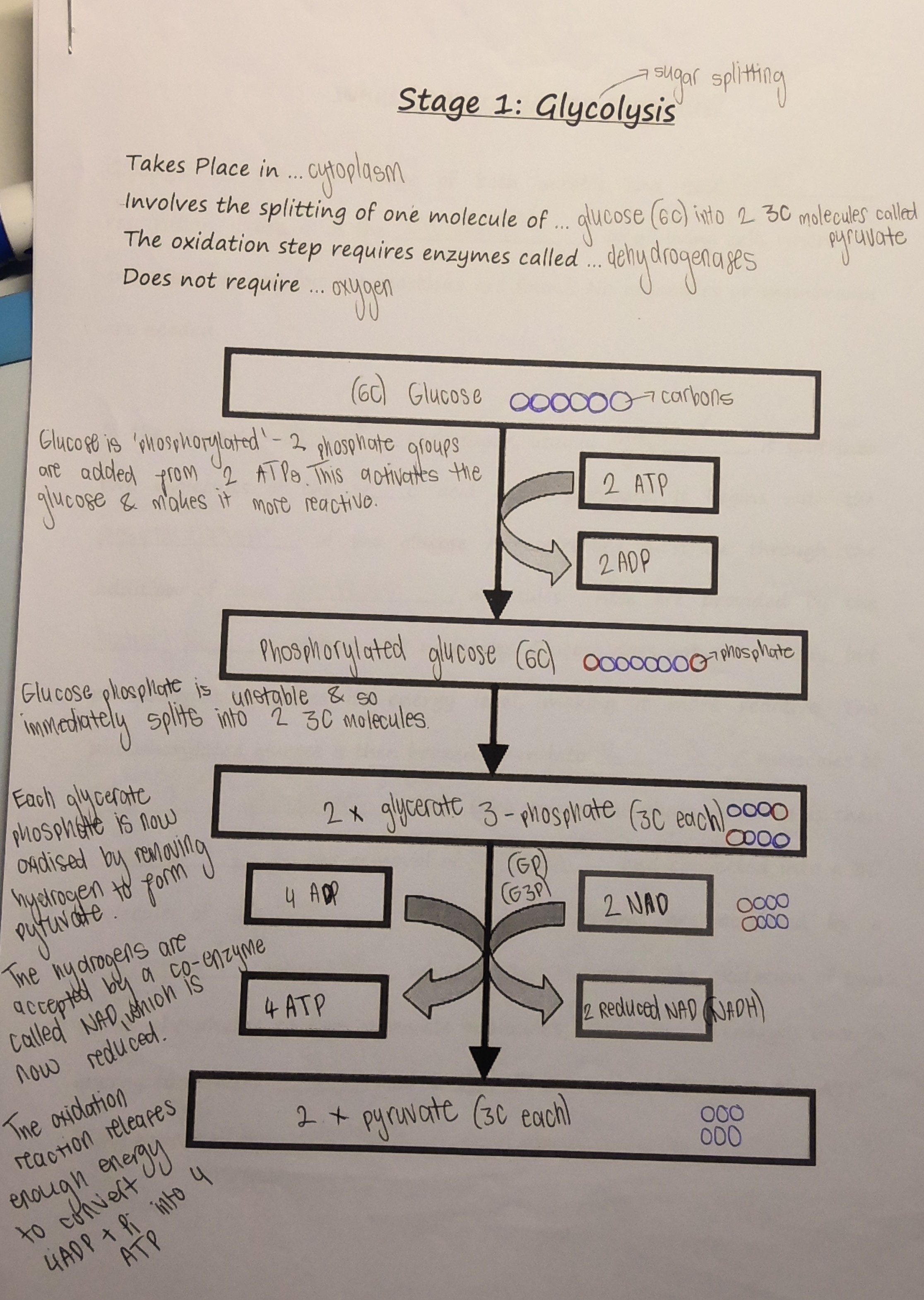
Outline what happens during glycolysis
Glucose is phosphorylated, meaning 2 phosphate groups are added from 2 ATP molecules (2 ATP → 2 ADP). This activates the glucose, making it more reactive
Phosphorylated glucose is unstable & immediately splits into 2 3C molecules of glycerate phosphate (GP)
Each GP is oxidised by removing hydrogen to form pyruvate (3C)
The hydrogens are accepted by the NAD co-enzyme, which is now reduced (2 NAD → 2 NADH)
The oxidation reaction releases enough energy to convert 4 ADP into 4 ATP
What are the products of glycolysis?
Net gain of 2 ATP
2 x pyruvate
2 x NADH
Does glycolysis require oxygen?
No
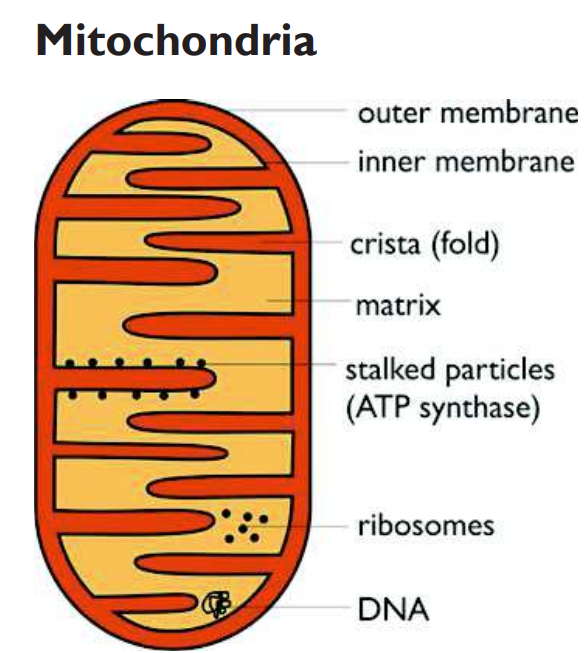
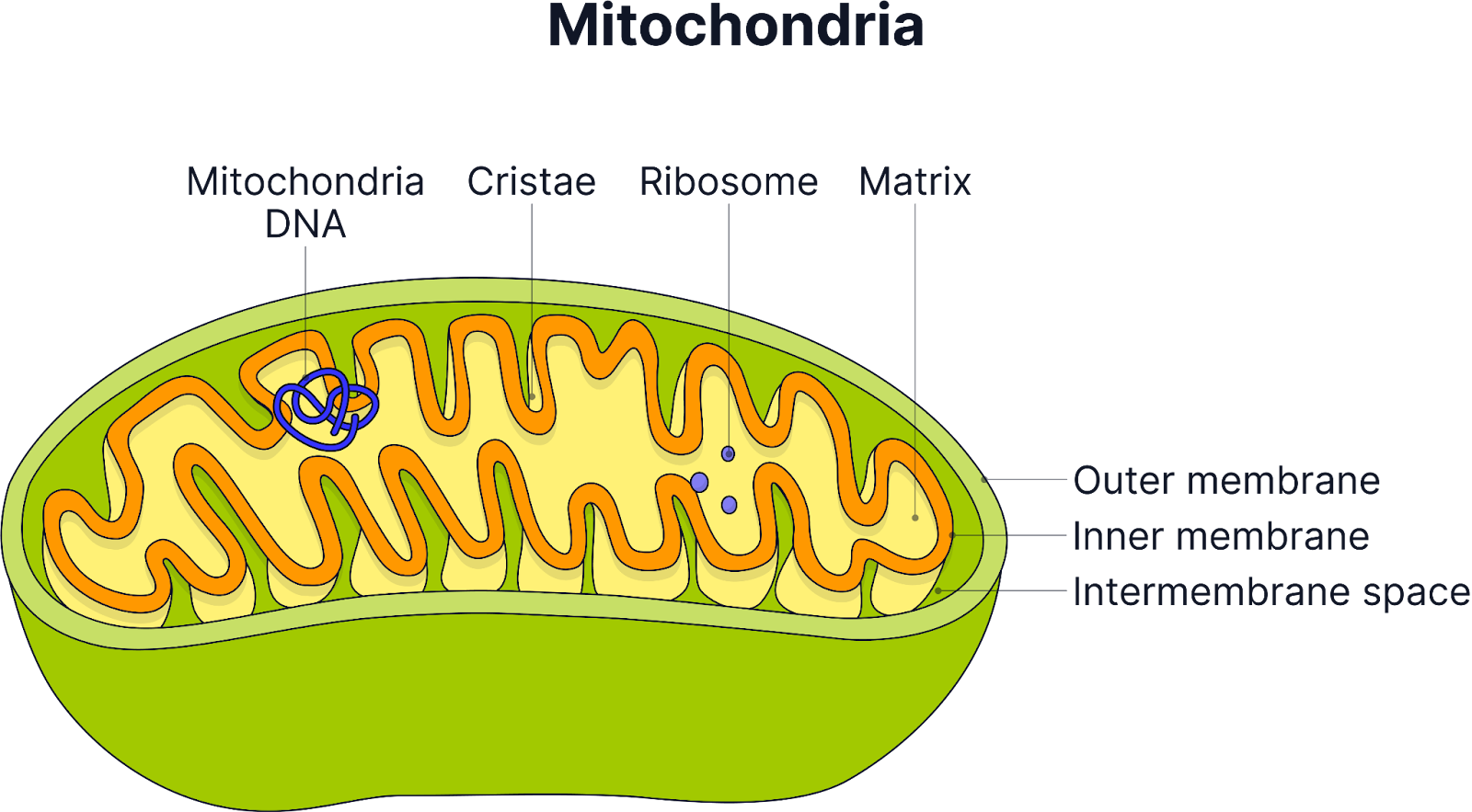
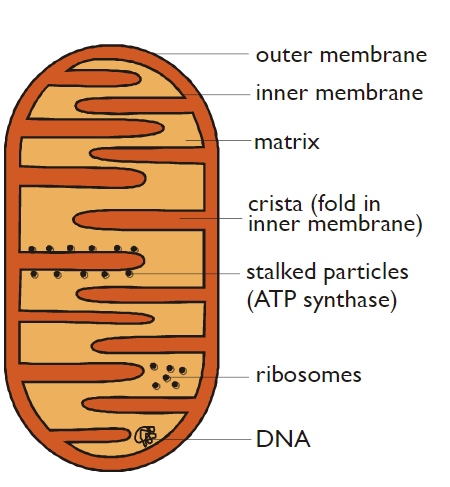
What is the structure & function of the mitochondria?
Site of aerobic respiration & ATP synthesis:
double membrane → inner membrane is highly folded into cristae (large surface area)
fluid-filled matrix → contains mitochondrial DNA
inner membrane is studded with stalked particles → ATP synthase enzymes
Where does the Link reaction & Krebs cycle take place?
In the mitochondrial matrix
What is the Link reaction?
The reaction that links glycolysis & the Krebs cycle
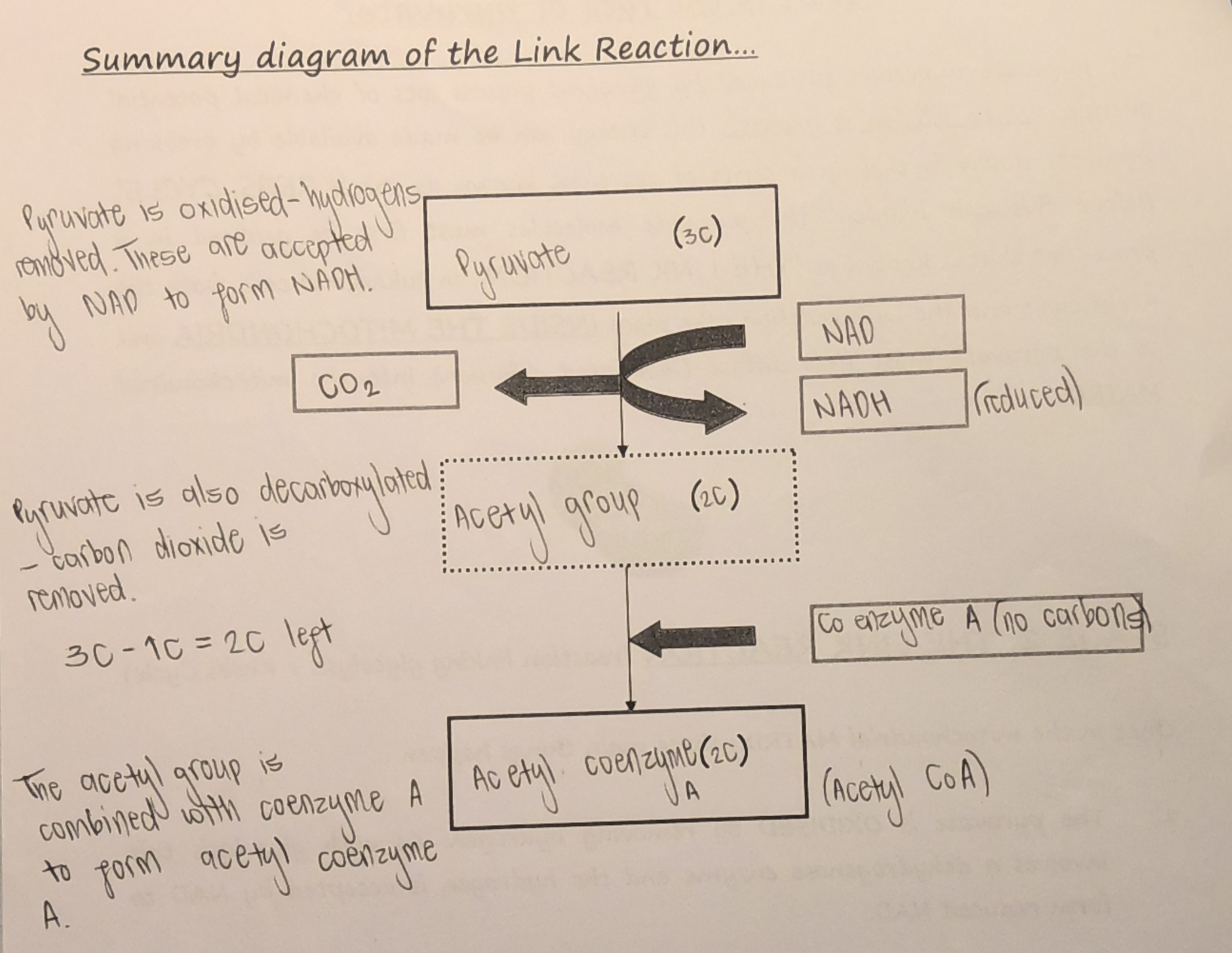
Outline what happens during the Link reaction
Pyruvate is oxidised by removing hydrogen (involves dehydrogenase enzyme) & hydrogen is accepted by NAD to form NADH
Pyruvate is decarboxylated (molecule of CO2 is removed) to form a 2C compound called an acetyl group
This combines with coenzyme A to produce acetyl coenzyme A (acetyl CoA)
What are the products of the Link reaction per glucose molecule?
2 x Acetyl CoA
2 x CO₂
2 x NADH
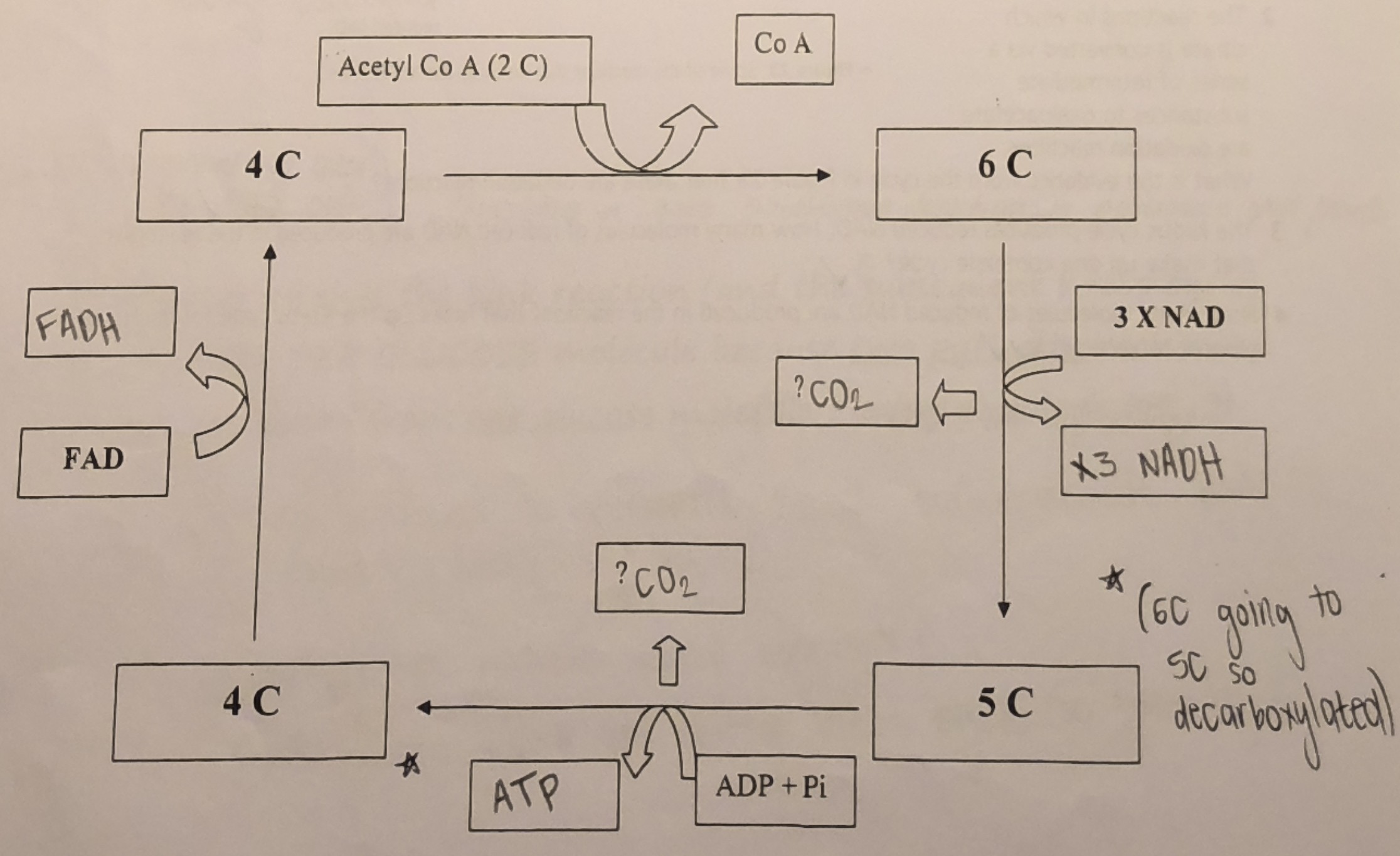
Outline what happens during the Krebs cycle
The 2C acetyl coenzyme A from the Link reaction combines with a 4C compound to make a 6C compound which enters the Krebs cycle (regenerates coenzyme A to be used again in Link reaction)
The 6C compound is oxidised (hydrogens removed) & hydrogens are passed to coenzymes NAD & FAD, forming 3 x NADH & 1 x FADH
The 6C compound is decarboxylated twice (leads to release of x2 CO2 molecules) & the 4C compound is regenerated, allowing Krebs cycle to continue
A single molecule of ATP is produced from ADP + Pi through substrate phosphorylation
What are the products of the Krebs cycle per cycle?
3 x NADH
1 x FADH
1 x ATP
2 x CO₂
What are the products of the Krebs Cycle per glucose molecule?
6 x NADH
2 x FADH
2 x ATP
4 x CO₂
What happens after the Krebs cycle?
Carbon dioxide (from Link reaction & Krebs cycle) diffuses out of mitochondrial matrix & cell
NADH & FADH carry their hydrogen atoms to the cristae of the inner mitochondrial membrane
Hydrogens are offloaded to specific carriers (i.e. ETC), where oxidative phosphorylation occurs
What is the electron transport chain?
A series of electron-carrying molecules along which electrons are transferred in a series of redox reactions, driving the production of ATP
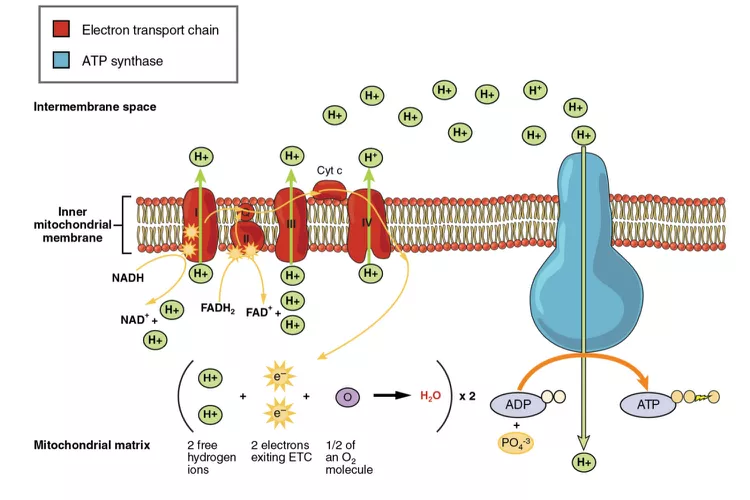
Outline what happens during oxidative phosphorylation (i.e. electron transport chain)
Hydrogen atoms from NADH & FADH are split into H+ & e-, with electrons passed along a series of electron carriers via redox reactions, each at a lower energy level, releasing energy
This energy pumps H+ ions from the matrix into the intermembrane space, creating a proton, pH & electrochemical gradient
Protons diffuse back into the matrix through ATP synthase, forming ATP via a condensation reaction between ADP & Pi
At the end of the chain, electrons combine with protons & oxygen to form water (oxygen acts as the terminal electron acceptor)
What would happen without oxygen as the terminal electron acceptor in the electron transport chain?
Without oxygen as the terminal electron acceptor, electrons cannot pass along the ETC
NADH & FADH cannot be oxidised, so NAD & FAD are not regenerated & the Krebs cycle stops
No proton gradient is formed, so ATP synthase cannot produce ATP → oxidative phosphorylation stops
Only glycolysis continues (producing 2 ATP per glucose)
What is chemiosmosis?
The process that links the movement of electrons down the ETC & the production of ATP using a hydrogen ion gradient
What is oxidative phosphorylation?
An oxygen-dependent process in the ETC where ADP is phosphorylated to make ATP
What is the definition of reduction?
Gain of electrons (by addition of hydrogen or loss of oxygen)
What is the definition of oxidation?
Loss of electrons (by addition of oxygen or removal of hydrogen)
What is the definition of a hydrogen acceptor?
A molecule which receives hydrogen & becomes reduced
What is the definition of NAD?
A coenzyme that acts as a hydrogen acceptor
What is the definition of dehydrogenases?
Enzymes that remove hydrogen (carry out oxidation)
What is the definition of stalked particles?
The structures where ATP production happens on the inner mitochondrial membrane
What is the definition of cytochromes?
Members of the ETC → protein pigments with an ion group
What is the definition of cytochrome oxidase?
An enzyme in the ETC which receives electrons from the cytochromes & is reduced as the cytochromes are oxidised