2 .1 - Manufacturing of Solid Dosage Forms
 Call Kai
 Learn
Learn Practice Test
 Spaced Repetition
 Match
Match Flashcards
 Knowt Play
1/100

Earn XP
Description and Tags
Proverbs 16:3
Name | Mastery | Learn | Test | Matching | Spaced | Call with Kai | Chat |
|---|
No analytics yet
Send a link to your students to track their progress
101 Terms
Dispensing
↓
Milling
↓
Mixing
↓
Granulation
↓
Tableting
↓
Coating
Tablet Manufacturing Process [6]
Dispensing
↓
Milling
↓
Mixing
↓
Granulation
↓
Filling
↓
Sealing
Hard Gelatin Capsules (HGC) Manufacturing Process [6]
c. Dispensing
[Unit Operations]
First step in any manufacturing process, involves weighing and measuring
a. Milling
b. Granulation
c. Dispensing
d. Compression
b. Accuracy of weight → uniform dose
[Unit Operations]
Objective of dispensing
a. Uniform particle size
b. Accuracy of weight → uniform dose
c. Easier and more uniform mixing
d. Improved flow properties
Hand scooping and weighing
Weighing with material lifting assistance
Automated dispensaries
[Unit Operations]
Methods of Dispensing [3]
Weighing accuracy
Dust control (dust collecting assistance
Lot control of each ingredient
Material movement (WH —> DA → PA)
[Unit Operations]
Issues in dispensing [4]
c. Milling
[Unit Operations]
Particle size reduction
a. Granulation
b. Dispensing
c. Milling
d. Compression
e. All of the above
Sizing
Crushing
Grinding
Pulverization
[Unit Operations]
Milling is also known as _______
a. Sizing
b. Crushing
c. Grinding
d. Pulverization
e. All of the above
f. Two of the above
c. Cutting
[Methods and Equipment for Milling]
Milling method wherein material is cut by means of sharp blades
a. Compression
b. Impact
c. Cutting
d. Attrition
c. Cutter Mill
Type of Mill that cuts particles using knives
a. Hammer Mill
b. Roller Mill
c. Cutter Mill
d. Ball Mill
c. Cutter Mill
[Methods and Equipment for Milling]
Type of Mill for fibrous materials
a. Hammer Mill
b. Roller Mill
c. Cutter Mill
d. Ball Mill
b. Compression
[Methods and Equipment for Milling]
Milling method wherein material is crushed by application of pressure
a. Attrition
b. Compression
c. Impact
d. Combined
b. End Runner Mill
[Methods and Equipment for Milling]
Compression mill wherein mortar rotates
a. Edge Runner Mill
b. End Runner Mill
a. . Edge Runner Mill
[Methods and Equipment for Milling]
Compression mill with 2 rotating wheels
a. Edge Runner Mill
b. End Runner Mill
d. Impact
[Methods and Equipment for Milling]
Milling method wherein material is hit by an object or it strikes a stationary phase
a. Attrition
b. Combined
c. Compression
d. Impact
b. Hammer Mill
[Methods and Equipment for Milling]
Impact mill with 4 or more hammers hinged on a shaft
a. Ball Mill
b. Hammer Mill
c. Roller Mill
d. Cutter Mill
a. Attrition
[Methods and Equipment for Milling]
Milling method wherein material is crushed in between rubbing surfaces
a. Attrition
b. Impact
c. Compression
d. Combined
c. Roller Mill
[Methods and Equipment for Milling]
Attrition mill with 2 metal cylindrical rolls rotating
a. Hammer Mill
b. End Runner Mill
c. Roller Mill
d. Ball Mill
d. Combined
[Methods and Equipment for Milling]
Milling method that utilizes both impact and attrition methods
a. Cutting
b. Compression
c. Attrition
d. Combined
b. Ball Mill
[Methods and Equipment for Milling]
Combined mill that is a hollow cylinder containing balls
a. Fluid Energy Mill
b. Ball Mill
c. Roller Mill
d. Hammer Mill
c. Fluid Energy Mill
[Methods and Equipment for Milling]
Combined mill that uses air with very high pressure
a. Ball Mill
b. Hammer Mill
c. Fluid Energy Mill
d. Cutter Mill
Cutter Mil
[Methods and Equipment for Milling]
Mill that have CUTTING mechanism [1]
End Runner Mill
Edge Runner Mill
[Methods and Equipment for Milling]
Mill that have COMPRESSION mechanism [2]
Hammer mill
[Methods and Equipment for Milling]
Mill that have IMPACT mechanism [1]
Roller Mill
[Methods and Equipment for Milling]
Mill that have ATTRITION mechanism [1]
Ball Mill
Fluid Energy Mill
[Methods and Equipment for Milling]
Mill that have COMBINED IMPACT AND ATTRITION mechanism [2]
c. Mixing
[Unit Operations]
Blending materials together into one mass
a. Milling
b. Granulation
c. Mixing
d. Compression
Uniform dose
Even appearance
Avoid segregation
[Unit Operations]
Objectives of mixing include _____ [3]
Batch Type Mixer
Rotating Shell/ Tumbling Mixers
Drum Type Blenders
Double Cone Blender
Twin-shell/ V-Shell Blender
Fixed Shell Mixers
Ribbon Blender
Sigma Blade Mixer
Planetary Mixer
Vertical Impeller Mixer
Continuous Mixer
[Equiments for Mixing]
Equipment used in Mixing [2]
Rotating Shell/ Tumbling Mixers
Fixed Shell Mixers
[Equiments for Mixing]
Batch Type Mixer include ______ [2]
Drum Type Blenders
Double Cone Blender
Twin-shell/ V-Shell Blender
[Equiments for Mixing]
Rotating Shell/ Tumbling Mixers include _____ [3]
Ribbon Blender
Sigma Blade Mixer
Planetary Mixer
Vertical Impeller Mixer
[Equiments for Mixing]
Fixed Shell Mixers include _____ [3]
b. Batch Type Mixer
[Equiments for Mixing]
Mixer type wherein all ingredients are loaded together, mixed for a long period, and discharged as a single batch
a. Continuous Type Mixer
b. Batch Type Mixer
c. Fixed Shell Mixer
d. Rotating Shell Mixer
b. Drum Type Blenders
[Equiments for Mixing]
Rotating shell mixer that is:
Cylindrical-shaped
Rotates horizontally
a. Double Cone Blender
b. Drum Type Blenders
c. Twin-shell/V-Shell Blender
d. Ribbon Blender
b. Poor cross flow
[Equiments for Mixing]
Issue of Drum Type Blenders is ______
a. Solid-solid blending
b. Poor cross flow
c. Better cross flow
d. Uniform mixing
c. Baffles Slantea
[Equiments for Mixing]
Remedy for the poor cross flow issue of Drum Type Blenders
a. Sigma shaped blades
b. Spiral blades
c. Baffles Slantea
d. Helical blades
b. Double Cone Blender
[Equiments for Mixing]
Rotating shell mixer that is:
Conical shaped at both ends
With better cross flow
a. Drum Type Blenders
b. Double Cone Blender
c. Twin-shell/V-Shell Blender
d. Ribbon Blender
a. V-Shell Blender
[Equiments for Mixing]
Twin-shell Blender is also known as _______
a. V-Shell Blender
b. Conical Blender
c. Ribbon Blender
d. Planetary Blender
c. Twin-shell/V-Shell Blender
[Equiments for Mixing]
Rotating shell mixer that alternately combines and draws the ingredients apart
a. Drum Type Blenders
b. Double Cone Blender
c. Twin-shell/V-Shell Blender
d. Sigma Blade Mixer
c. Twin-shell/V-Shell Blender
[Equiments for Mixing]
Used for solid-solid blending
a. Drum Type Blenders
b. Double Cone Blender
c. Twin-shell/V-Shell Blender
d. Sigma Blade Mixer
c. Ribbon Blender
[Equiments for Mixing]
Fixed shell mixer that consists of through-like shell with mounted spiral or helical blades
a. Sigma Blade Mixer
b. Double Cone Blender
c. Ribbon Blender
d. Twin-shell/V-Shell Blender
b. Sigma Blade Mixer
[Equiments for Mixing]
Fixed shell mixer that consists of double through shaped shell with 2 sigma shaped blades fitted horizontally
a. Ribbon Blender
b. Sigma Blade Mixer
c. Drum Type Blenders
d. Double Cone Blender
b. Planetary Mixer
[Equiments for Mixing]
Fixed shell mixer wherein paddles move around its own axis and around the central axis
a. Vertical Impeller Mixer
b. Planetary Mixer
c. Ribbon Blender
d. Sigma Blade Mixer
c. Vertical Impeller Mixer
[Equiments for Mixing]
Fixed shell mixer with screw type impellers rotating inside a conical shell
a. Planetary Mixer
b. Ribbon Blender
c. Vertical Impeller Mixer
d. Sigma Blade Mixer
b. Continuous Mixer
[Equiments for Mixing]
Mixer that agitates and moves materials through equipment, mixing them in one quick pass
a. Batch Type Mixer
b. Continuous Mixer
c. Planetary Mixer
d. Fixed Shell Mixer
b. Continuous Mixer
[Equiments for Mixing]
Mixer for high volume products
a. Batch Type Mixer
b. Continuous Mixer
c. Planetary Mixer
d. Fixed Shell Mixer
c. Continuous Mixer
[Equiments for Mixing]
Mixer wherein materials continuously travel from the charging port to the discharge nozzle
a. Batch Type Mixer
b. Vertical Impeller Mixer
c. Continuous Mixer
d. Rotating Shell Mixer
b. Granulation
Powder size enlargement to granules
a. Milling
b. Granulation
c. Mixing
d. Compression
a. Increase flowability and compressibility
Objective of granulation
a. Increase flowability and compressibility
b. Reduce particle size
c. Mask unpleasant taste
d. Improve appearance
Wet Granulation
Fluid Bed Granulation
Dry Granulation
Methods of Granulation [3]
Good granule
Fine granule
Type of Granule [2]
a. Good Granule
[Type of Granule]
Type of Granule that pass through sieve #20 but not through sieve #40
a. Good Granule
b. Fine Granule
b. Fine Granule
[Type of Granule]
Type of Granule that pass through sieve #40
a. Good Granule
b. Fine Granule
b. Wet Granulation
[Method of Granulation]
Most common granulation method
a. Dry Granulation
b. Wet Granulation
c. Fluid Bed Granulation
d. Direct Compression
b. Wet Granulation
[Method of Granulation]
Granulation method that involves addition of liquid binder to powders that forms larger agglomerate
a. Dry Granulation
b. Wet Granulation
c. Fluid Bed Granulation
d. Direct Compression
b. Wet Granulation
[Method of Granulation]
Granulation method that is not for moisture-sensitive and heat labile materials
a. Dry Granulation
b. Wet Granulation
c. Fluid Bed Granulation
d. Direct Compression
Blending of dry ingredients
↓
Addition of liquid binder
↓
Screening the damp mass (sieve # 6 or 8)
↓
Drying granulation (moisture content: 0.5-1%)
↓
Screening the dry granules (sieve # 12 or 20)
↓
Addition of running powder
[Method of Granulation]
Wet Granulation Process [6]
c. 31-35%
[Method of Granulation]
Moisture content range wherein underwet results to too soft and overwet results to too hard
a. 0.5-1%
b. 10-15%
c. 31-35%
d. 5-10%
b. Fluid Bed Granulation
[Method of Granulation]
Granulation method that is easier and faster than the traditional process
a. Wet Granulation
b. Fluid Bed Granulation
c. Dry Granulation
d. Slugging
b. Fluid Bed Granulation
[Method of Granulation]
Granulation method wherein materials are suspended in air while the liquid binder is sprayed
a. Wet Granulation
b. Fluid Bed Granulation
c. Dry Granulation
d. Slugging
c. Dry Granulation
[Method of Granulation]
Granulation method involving double compression on pre-compression method
a. Wet Granulation
b. Fluid Bed Granulation
c. Dry Granulation
d. Direct Compression
c. Dry Granulation
[Method of Granulation]
Granulation method wherein powder mixture is compacted into large pieces and crushed subsequently broken down into granules
a. Wet Granulation
b. Fluid Bed Granulation
c. Dry Granulation
d. Direct Compression
c. Dry Granulation
[Method of Granulation]
Granulation method for moisture and heat-sensitive materials
a. Wet Granulation
b. Fluid Bed Granulation
c. Dry Granulation
d. Direct Compression
Slugging
Roller Compaction
[Dry Granulation Process]
Dry Granulation Process include _____ [2]
c. Slugging
[Dry Granulation Process]
Dry granulation process involving formation of slugs
a. Roller Compaction
b. Fluid Bed Granulation
c. Slugging
d. Screening
b. Roller Compaction
[Dry Granulation Process]
Dry granulation process involving formation of sheets
a. Slugging
b. Roller Compaction
c. Wet Granulation
d. Screening
Chilsonator roller Compactor
Oscillating granulator
[Dry Granulation Process]
Equipment used for Dry Granulation [2]
b. Chilsonator Roller Compactor
[Equipment for Dry Granulation]
Equipment used to compress powder into thin sheets
a. Oscillating Granulator
b. Chilsonator Roller Compactor
c. Fluid Energy Mill
d. Ball Mill
c. Oscillating Granulator
[Equipment for Dry Granulation]
Equipment used to crush slugs or sheets into granules
a. Chilsonator Roller Compactor
b. Cutter Mill
c. Oscillating Granulator
d. Hammer Mill
Hopper
Feed Shoe
Die
Punches
Cam tracks
Parts of Tableting Machine [5]
c. Tableting
Compression of materials within a die cavity by the pressure exerted by the movement of 2 punches
a. Milling
b. Granulation
c. Tableting
d. Mixing
c. Hopper
[Parts of Tableting Machine]
Part of tableting machine that holds the materials to be compressed
a. Feed Shoe
b. Die
c. Hopper
d. Cam Tracks
d. Feed Shoe
[Parts of Tableting Machine]
Part of tableting machine that transfers materials into die
a. Hopper
b. Punches
c. Cam Tracks
d. Feed Shoe
b. Die
[Parts of Tableting Machine]
Part of tableting machine that defines size and shape of the tablet
a. Punches
b. Die
c. Hopper
d. Feed Shoe
c. Punches
[Parts of Tableting Machine]
Part of tableting machine that compresses materials within the die
a. Cam Tracks
b. Die
c. Punches
d. Hopper
d. Cam Tracks
[Parts of Tableting Machine]
Part of tableting machine that guides the movement of punches
a. Punches
b. Feed Shoe
c. Die
d. Cam Tracks
Single Station
Multiple Station
Types of Tableting Machine [2]
a. Single Station
[Type of Tableting machine]
Type of tableting machine that involves compression of the upper punch only
a. Single Station
b. Multiple Station
b. Multiple Station
[Type of Tableting machine]
Type of tableting machine that involves movement of both punches
a. Single Station
b. Multiple Station
Flowability
Compressibility
Requirement of Tableting [2]
b. Flowability
[Requirement of Tableting]
Requirement of tableting that facilitates transfer
a. Compressibility
b. Flowability
c. Lubricity
d. Cohesiveness
Arching/Bridging
Rat-Holing
[Requirement of Tableting]
Flowability problem in Tableting include______ [2]
c. Arching/Bridging
[Requirement of Tableting]
Flowability problem characterized by arch-shaped obstruction that forms above hopper outlet
a. Rat-Holing
b. Segregation
c. Arching/Bridging
d. Capping
b. Rat-Holing
[Requirement of Tableting]
Flowability problem wherein discharge takes place only above hopper outlets
a. Arching/Bridging
b. Rat-Holing
c. Lamination
d. Sticking
c. Compressibility
[Requirement of Tableting]
Requirement of tableting that forms a stable, compact mass when pressure is applied
a. Flowability
b. Lubricity
c. Compressibility
d. Wettability
c. Direct Compression
[Requirement of Tableting]
Tablet processing without granulation
a. Wet Granulation
b. Dry Granulation
c. Direct Compression
d. Fluid Bed Granulation
a. Direct compression
[Requirement of Tableting]
Requirement of tableting that requires a very critical selection of excipients for good flowability and compressibility, example of which is KCl, NaCl, and NaBr
a. Direct compression
b. Wet granulation
c. Dry granulation
d. Slugging
Anhydrous/spray-dried lactose
Avicel®
[Requirement of Tableting]
Diluents used in direct compression
a. Lactose monohydrate, Starch
b. Anhydrous/spray-dried lactose, Avicel®
c. Mannitol, Xylitol
d. Sucrose, Dextrose
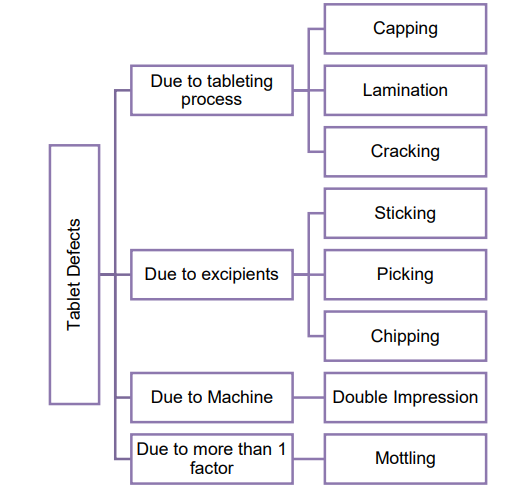
Tablet Defects:
Capping
Lamination
Cracking
Tablet Defects due to tableting process [3]
Sticking
Picking
Chipping
Tablet Defects due to excipients [3]
Double Impression
Tablet Defects due to machine [1]
Mottling
Tablet Defects due to more than 1 factor [1]
c. Capping
[Tablet Defects due to Tableting Process]
Partial or complete separation of top or bottom crown (air entrapment)
a. Lamination
b. Cracking
c. Capping
d. Chipping
c. Lamination
[Tablet Defects due to Tableting Process]
Separation into 2 or more distinct horizontal layers (air entrapment)
a. Capping
b. Sticking
c. Lamination
d. Cracking
b. Cracking
[Tablet Defects due to Tableting Process]
Tablet defect occurring in concave tablets; rapid expansion of tablets
a. Capping
b. Cracking
c. Lamination
d. Picking
c. Sticking
[Tablet Defects due to Excipients]
Adhesion of material to die wall or face of the punch (excessive moisture)
a. Picking
b. Chipping
c. Sticking
d. Double Impression
b. Picking
[Tablet Defects due to Excipients]
Adhesion of material to the design embedded on the punch tip (excessive moisture)
a. Sticking
b. Picking
c. Chipping
d. Mottling
c. Chipping
[Tablet Defects due to Excipients]
Removal of small portion of tablet edges (lack of binder)
a. Sticking
b. Picking
c. Chipping
d. Cracking
b. Double Impression
[Tablet Defects due to Machines]
2 engravings on the surface due to free rotation of punches with engraving on faces
a. Mottling
b. Double Impression
c. Capping
d. Sticking