Esterification and Hydrolysis
 Call Kai
 Learn
Learn Practice Test
 Spaced Repetition
 Match
Match Flashcards
 Knowt Play
1/17

Earn XP
Description and Tags
OCHEM II Lab Final
Name | Mastery | Learn | Test | Matching | Spaced | Call with Kai | Chat |
|---|
No analytics yet
Send a link to your students to track their progress
18 Terms
How can esters be prepared?
reacting a carboxylic acid with an alcohol in the presence of catalyst
con. H2SO4, HCl, p-toluene sulfonic acid
Fisher esterfication
to upset equilibrium, we can increase the concentration of either the alcohol or acid
another way is to remove water
adding to the reaction mixture molecular sieves (an artificial zeolite), which preferentially adsorbs water
most other drying agents will not remove water at the temps used to make esters
third way: preferentially remove the water as an azeotrope ( a constant-boiling mixture of water and an organic liquid)
vapor is homogenous, but when it condenses, it separates into two layers
upper layer = 11% alcohol, 86% ester, 3% water
lower layer = 97% water w/ traces of alcohol and ester
remove lower layer from the condensate and still return the upper layer to the reaction mixture, then the equilibrium can be upset, and nearly 100% of the ester can be produced on some of the phenyl groups
Resin
in the form of small beads, is a cross-linked polystyrene that bears sulfonic acid groups on some of the phenyl groups
Ion exchange catalyst
advantage that at the end of the reaction, it can be easily removed by filtration
if h2so4 conc was used as a catalyst
it would be necessary to dilute the reaction mixture with ether, wash the ether layer successively with water, sodium carbonate solution, and sat. NaCl solution, then dry the ether layer with anhydrous calcium chloride pellets before evaporating the ether
Reaction
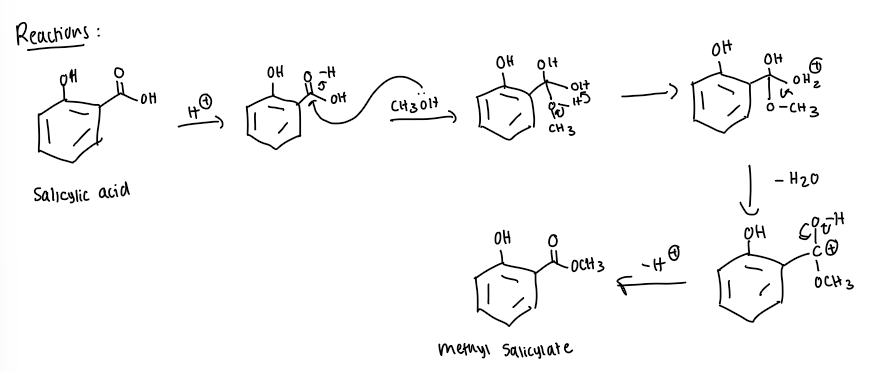
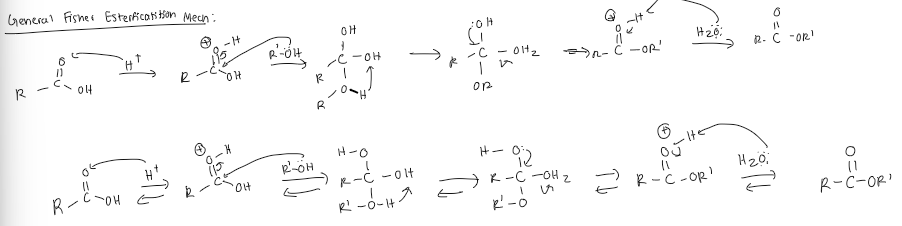
General Fisher Esterification Mech:
Write the detailed mechanism for the acid-catalyzed hydrolysis of methyl benzoate.

In the preparation of methyl benzoate, what is the purpose of a) washing the organic layer with sodium bicarbonate solution? b) washing the organic layer with sat. sodium chloride solution? c) treating the organic layer with anhydrous calcium chloride pellets?
a) remove the remaining unreacted benzoic acid
b) remove any water from the organic layer.
c) further dry the organic layer by soaking up any remaining water present
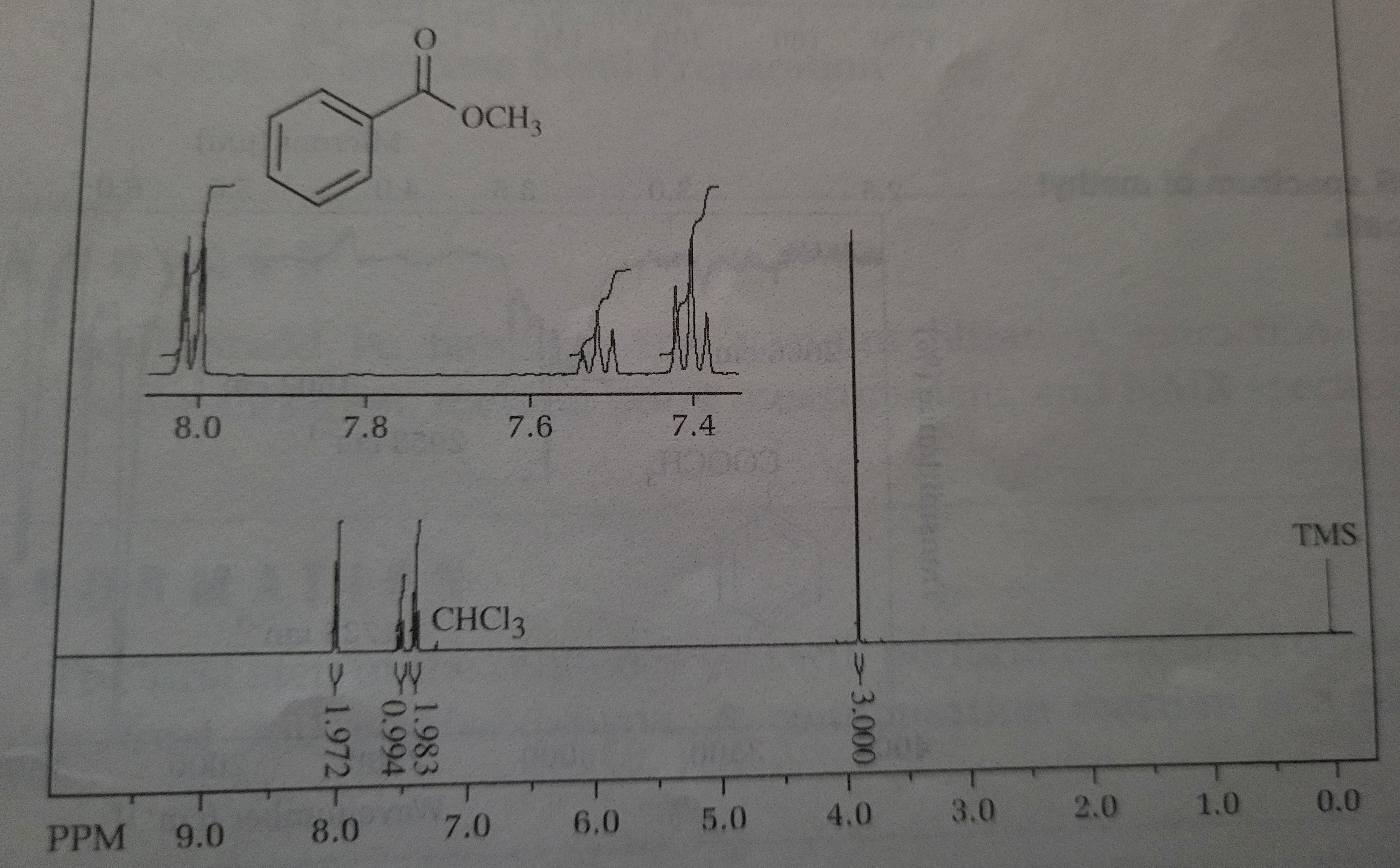
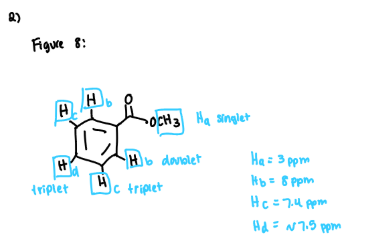
Assign the resonances in Figure 8 to specific protons in methyl benzoate.
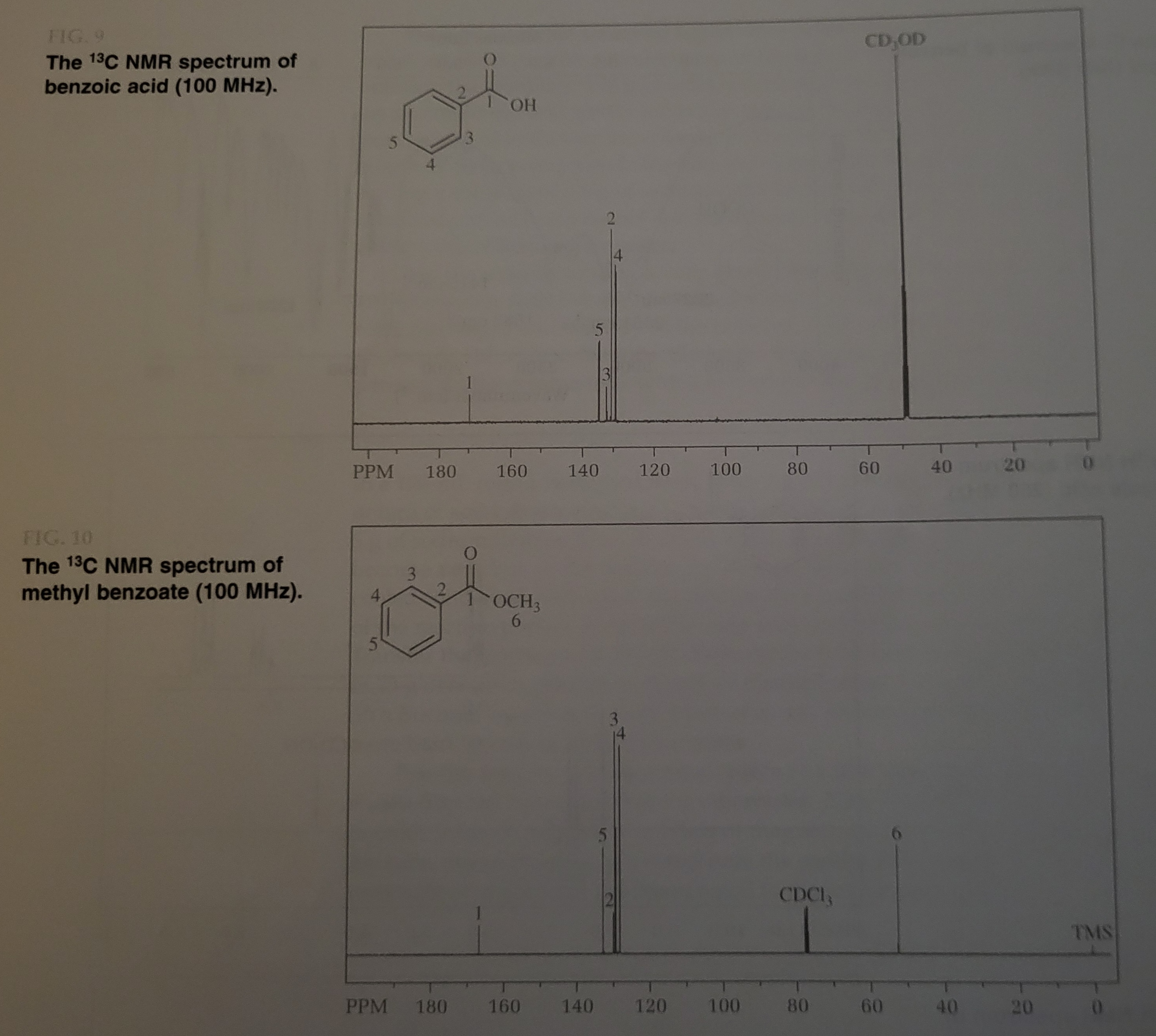
Figures 9 and 10 each have two resonances that are very small. What do the carbons causing these peaks have in common?
The two small resonances represent the carbons that are near the carbonyl group
These carbons are next to an electron withdrawing group which de-shields the carbons, making them appear more downfield in the carbon NMR spectrum
What are the steps for this experiment?
salicylic acid + methanol into rbf
dissolve acid and cool in ice bath and slowly add 3 ml of H2SO4 and reflux
flaks cool at room temp, and pour into sep funnel (quenching) w/ DI water
rinse flaks with t-butyl methyl ether and it to funnel, swirl, vent, and drain aq. layer
perform a second wash with water + drain aq. layer
wash organic layer twice w/ 0.5 M sodium bicarbonate to remove any unreacted salicylic acid
add NaCl to help pull water out of organic layer and drain aq. layer
transfer organic layer to E.F and add 4 scoops of sodium sulfate to absorb any remaining water
decant + rotovap
Why do we use a large amount of methanol in the reaction?
to drive the equilibrium to the right to maximize the yield of methyl salicylate
Why do we add H2So4 slowly?
releases heat when mixed with methanol
temp can spike and splash methanol out of the flask
can form side reaction
reflux to heat to b.p of methanol without losing the solvent to evaporation
overcomes energy barrier
Why do we add water after refluxing?
quenches reaction
h2so4 + methanol are highly soluble in water, but methyl salicylate is an oil, and helps separate them
Why do we use tbme for the extraction solvent?
methyl salicylate is soluble in ether , picks up product and creates a layer
Why do we use sodium bicarbonate?
neutralize any sulfuric acid
convert unreacted salicylic acid into a water soluble salt
produces Co2 gas when shaken, so need to vent
Why do we use NaCl for extraction?
high salt concentration in the brine pulls bulk water out of organic ether layer
sodium sulfate to dry out fr fr
TLC plate
salicylic acid = highly polar, low Rf value
methyl salicylate = ester, less polar, higher Rf