Eduqas DT GCSE
 Call Kai
 Learn
Learn Practice Test
 Spaced Repetition
 Match
Match Flashcards
 Knowt Play
1/292

There's no tags or description
Looks like no tags are added yet.
293 Terms
mass production
when hundreds or thousand of the same product are produced (usually on a production line)
assembly line
a line of workers and equipment in a factory. A product is gradually assembled as it moves through each stage of the line until it is completely assembled
automated production
the use of automatically (computer) controlled equipment or machinery to manufacture products
market pull
a new product is produced in response to demand from the market
technology push
a development in materials, components or manufacturing methods leads to the development of a new product
life cycle
the stages a product goes through from initial idea to disposal
examples of market pull
mobile phone - people wanted to be able to contact each other when they were out and about
examples of technology push
development in electronics mean small powerful components could be put into smartphones allowing them to perform a range of functions, graphene is likely to have applications in a wide range of industries
LCA
product life cycle analysis
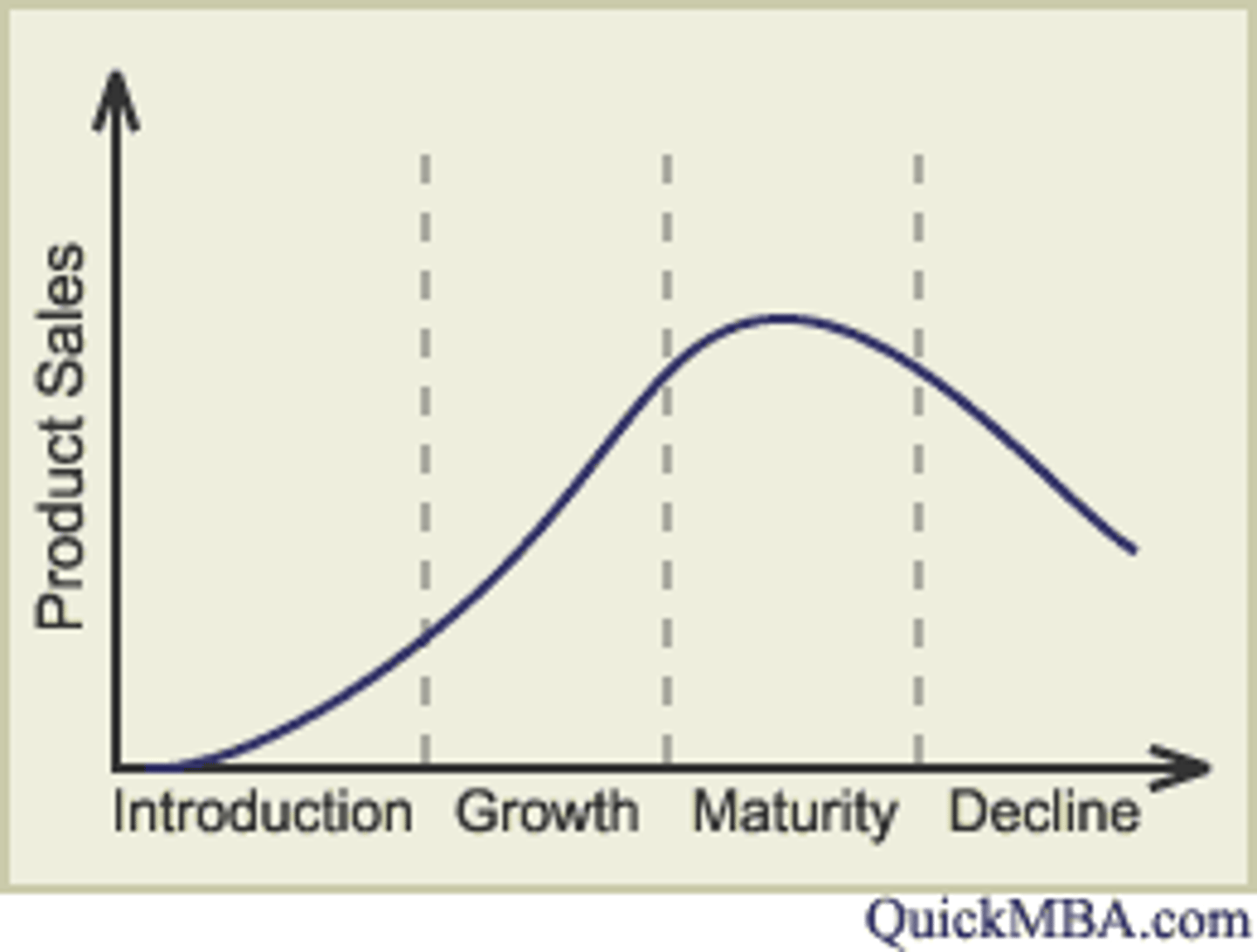
what are the stages of the product life cycle?
introduction, growth, maturity, decline
what is the introduction phase of a product life cycle?
when new products are launched and are heavily publicised so that consumers know they are available. This might be a new product or a new version of an existing product
example of a product in the introduction phase?
a new model of a smartphone with a larger memory and longer battery life
what is the growth phase of a product's life cycle?
once the product is available, sales will grow as more people become aware of the products and buy it to replace previous products or older models
what is the maturity stage of a product's life cycle?
sales of the product reach their peek. Companies want this stage to last for as long as possible to get the maximum number of sales
what is the decline stage of a product's life cycle?
at this stage, most interested consumers have already bought the product or a newer model will be available, at which point sales will begin to fall
downsides of globalisation and development?
- importing cheap products can lead to job losses locally and working conditions in other countries may be poor,
- increasingly automated production causes job losses,
- mobile technology leads to fewer face-to-face interactions making people feel isolated blurring work and leisure time,
What is The Consumer Rights Act 2015?
it protects customers when buying products or services. It covers you for faulty goods, counterfeit goods, poor services and problems with builders
The Consumer Rights Act 2015 allows you to request a refund, repair or replacement when a purchase does not meet which standards?
- the product does not function as intended it needs to be fit for purpose,
- of satisfactory quality, it should not be damaged or defective,
- it is not as it was described at time of purchase
compensation
payment, usually money given to someone as a result of loss
counterfeit
an imitation of something valuable sold with the intention to defraud or deceive someone
ethical traders
share a breakdown of costs for the products
sustainability
meeting today's needs without compromising the needs of future generations (producing goods and services without impacting on the needs of the future populations)
examples of ways in which new and emerging technologies can be used to help us to use, manufacture and dispose products in a more sustainable way?
- hybrid technologies and electric cars,
- developments in renewable energy,
- recycling technology
fossil fuels
finite resources that cannot be replaced
advantages of CAD
- quality of presentation of drawings is higher,
- 2D and 3D CAD models can be created, amended and edited easily,
- textures and colours can be applied to make models photorealistic,
- the design can be securely stored, shared and worked on collaboratively,
- the 3D model can be exported to CAM machines which can produce a working prototype,
- ideas, concepts and models can be exposed to clients and opinions sought to develop the product,
- speeds up the designing process and reduce lead-in time so the product gets to market quicker,
disadvantages of CAD
- powerful computers are necessary for 3D modelling and rendering,
- users will need training to use the software to its full potential,
- requires higher level of expertise to use efficiently,
- can be slower to generate initial ideas than on paper,
- software is being continually updated and can be expensive to keep up to date,
- hardware such as 3D printers can be expensive and quite slow to manufacture large objects,
CAM
computer-aided manufacture
CNC machines
Computer Numerically Controlled machines
advantage of CAM
- faster than traditional manufacture,
- high degree of manufacturing accuracy,
- consistent and repeatable processes,
- less waste is produced than in traditional manufacturing processes,
- allows for flexible manufacturing systems to be implemented into industry,
disadvantages of CAM
- can be expensive,
- needs regular maintenance and servicing,
- traditional skills and workforces can be displaced,
- costs generally inhibit CAM in small-scale manufacture
what is CNC embroidery and why is it good?
- CAD designs can be sewn into a range of textiles and fabrics,
- lends itself well to flexible manufacture by being able to personalise garments,
- designs can be saved or shared to allow for short or long production runs
examples of CNC embroidery
school uniforms, any applications where branding or logos need to be applied
Vinyl cutters
- using a roll of self adhesive vinyl, a simple pattern is cut out from a CAD drawing using a sharp cutting blade,
- the most affordable CAM machines, making them commonplace in schools
examples for uses of vinyl cutters
lettering or shapes for sign writing, applying branding to vehicles
CNC routing
- a rotating router cutter is used to cut around a path or shape determined by a CAD drawing,
- the profile of the cut can be changed by fitting alternative cutting tools and the depth of the cut are usually determined by different colours being used on the CAD drawing
uses of CNC routers?
more comprehensive 3D shapes can be produced on CNC routers that have attachments that rotate the workpiece while being machined
laser cutter
- use a directed laser beam to cut through or vaporise material, leaving a high quality accurate cut,
- the workpiece can be easily held as there is no force from a blade this means means intricate patterns can be cut out
uses of laser cutters
used to cut or engrave a wide range of materials, jigsaws, decorative designs in greeting cards
additive manufacture
the process of building up a physical shape, layer by layer
how do 3D printers work?
- uses a thermoforming polymer roll or spool of filament that is heated and extruded through a headed moving on an x and y axis,
- following the printing of the first layer the bed of the printer moved down and the next layer of polymer is extruded
positives of 3D printing
- a working prototype can be quickly produced,
- designers can test products and bring them to market without expensive tooling,
- makes small scale manufacture possible
how does the Under armour Architech footwear use CAD and CAM?
- they used generative design to develop a sole for their 'Architech' shoe,
- it has a lattice structure with cushioning properties,
- the sole is complex and can only be produced by 3D printing,
- the time taken to make each sole has limited production
rendering
applying a colour or texture to a drawing
environmental directive
a type of law to provide protection for the environment
what is the European Ecolabel?
- manufacturers can apply to have the label,
- products have to meet a tough set of environmental criteria taking into account a products whole life cycle,
- intended to simplify consumer choice in seeking out products which are good for the environment
circular economy
considering how to recover the assets from a product at the end of its life cycle and invest them in a new product
cradle-to-cradle
considering a product's life cycle, including its rebirth into a new product
energy rating label
- a label which helps consumers choose energy efficient products,
- A+++ = most efficient,
- G = least efficient
linear economy
- products are produced as cheaply as possible,
- once the product is broken or no longer wanted it is simply disposed of
what are the six R's?
rethink, reduce, recycle, reuse, refuse, repair
what are the stages of life cycle analysis?
acquiring raw materials, material processing, manufacturing, use, end of life, transportation
Fairtrade
- social economic and environmental standards are set for all companies, producers and workers involved in the supply chain
carbon foorprint
a measure of the amount of greenhouse gases released as a result of our activities
ecological footprint
the area of the Earth that they need to sustain their lifestyle. A measure of the impact that human activity has on the environment
ecological deficit
a measure to indicate that more natural resources are being used than nature can replace
sources of renewable energy
wind, solar, geothermal, hydroelectric, wood, biomass, wave, tide
sources of non-renewable energy
nuclear, coal, oil, gas
greenhouse gase
atmospheric pollution which traps heat at the Earth's surface
cons of renewable energy
equipment needed to extract renewable energy can be expensive, there is often a high initial outlay
cons of wind and solar energy
they are not always available, quite small energy output, unsightly and spoil natural environment
cons of hydroelectric power
involves building large dam structures in rural areas flooding countryside and natural habitats
cons of geothermal energy
very expensive to install, only profitable in some areas
cons of electric cars
- electricity can still be produced by fossil fuels,
- battery can take hours to recharge,
- car's range is limited,
pros of electric cars
- avoid congestion tax,
- cheap to run,
- efficient as they can recover kinetic energy when the driver brakes and store it in the battery,
- no emissions
smart materials
materials whose physical or mechanical properties react to a change in their environment
electroluminescent materials
a material that provides a visible light when exposed to a current
how does electroluminescent wire work?
- thin copper is coated in phosphorus powder which when subjected to an ac current glows
when is electroluminescent wire used?
- in application's where the wire's flexibility is most beneficial such as decorative lighting, signage and clothing
what forms can electroluminescent technology be found in?
wire, flexible films / panels
how does electroluminescent film/panels work?
- phosphor is sandwiched between a pair of conductive electrodes and emits light when subjected to ac current
how is EL (electroluminescent) film better than LCD displays?
- they can be flexible,
- do not generate heat,
- increased reliability and durability,
where is EL (electroluminescent) film used?
mobile phones, car dashboard displays, watch illumination, signage
what is Quantum tunnelling composite (QTC)?
flexible polymer that contain conductive nickel particles, change from insulators to conductors under pressure
what are shape memory alloys (SMA's)?
- can be shaped and deformed but when heated the metal returns to its original shape
where are shape memory alloys (SMA's) used?
medical application e.g. medical fastenings, braces
what is polymorph?
a thermoforming polymer (usually in granules) when heated to 62C it becomes soft and easily moulded
where is polymorph used?
versatile modelling material, used in schools when modelling ergonomic features on a product
what is photochromic pigment?
change colour in response to light intensity
where are photochromic pigments used?
sunglasses
what are thermochromic pigments?
change colour in response to a change in heat, can be engineered to a specific temperature or temperature range
where are thermochromic pigments used?
temperature of a baby's bath, indicate baby food is cool enough to eat, labels of drinks
what is microencapsulation?
a process of applying microscopic capsules to fibres or fabric, substances are released through friction when in contact with skin
uses of microencapsulated fabrics?
- medical textiles (antiseptics embedded on dressing),
- sportwear (chemicals which repel odour and prevent fungal infections),
- children's wear or for sensitive skin (encapsulated with moisturisers and oils to soothe and heal),
- household textiles (lavender and camomile for soothing properties in bed sheets)
what is biomimicry?
taking ideas and mimicking features from nature
example of biomimicry
Fastskin swimwear from Speedo, mimicked shark's natural sandpaper skin by reducing drag. It was banned for giving an unfair advantage
what is a composite material?
a material manufactured from a combination of two materials with desirable properties
what are the parts of a composite material called?
one is called the matrix, the other is called the fibre or reinforcement
examples of composite materials
carbon fibre reinforced polymer (CFRP), glass reinforced plastic (GRP), Kevlar
what is carbon fibre reinforced polymer (CFRP)?
a composite of carbon fibre strand woven together and encased in a polymer resin. The resin is lightweight and rigid, the carbon strands have a high tensile strength to create a high-performance engineering material
what is carbon fibre reinforced polymer (CFRP) used for?
manufacture of racing bikes and mountain bikes due to it's strength to weight ratio and stiffness and ability to produce streamlined shapes,
also for F1 components, high performance sports equipment, and aerospace industry
what is glass reinforced plastic (GRP)?
a composite of glass fibres and polymer resin. Lower cost and more accessible manufacturing methods than carbon fibre reinforced plastic.
Resin makes it tough and lightweight, glass fibres provide rigidity
why are composite materials difficult to recycle?
- when the matrix has set or cured it is impossible to reverse the process
what is glass reinforced plastic (GRP) used for?
less attractive surface finish than CRFP so usually has a pigmented finish,
used in boats, canoes, hockey sticks and car body works
what is Kevlar?
a tradename for a fibre manufactured by DuPont. It is a lightweight, flexible and extremely durable fibre that has good resistance to heat and damage from chemicals.
what is Kevlar used for?
protective clothing, e.g. police body armour where it is woven in a lattice against knives
fibre thread in sportswear such as motorbike clothing and protective padding worn by mountain bikers and skateboarders
interactive textiles
fabrics that contain a device or circuit that responds and reacts with the user
what are common uses of interactive textiles?
heart-rate monitors, performance monitors for athletes, GPS tracking systems, heating and flexible solar panels, communication devices
microfibres
tiny fibres about a hundred times thinner than a human hair
properties of micrfibres
lightweight, versatile, high strength to weight ration, water resistance, breathability
where are microfibres used?
clothing, cleaning cloths, insulation