(L2) IMED2004 - Intro to Genetics and Development II
 Call Kai
 Learn
Learn Practice Test
 Spaced Repetition
 Match
Match Flashcards
 Knowt Play
1/70

There's no tags or description
Looks like no tags are added yet.
Name | Mastery | Learn | Test | Matching | Spaced | Call with Kai | Chat |
|---|
No analytics yet
Send a link to your students to track their progress
71 Terms
What are the six learning outcomes for this lecture?
1. Describe the human karyotype and define diploid and haploid with reference to somatic cells and gametes.
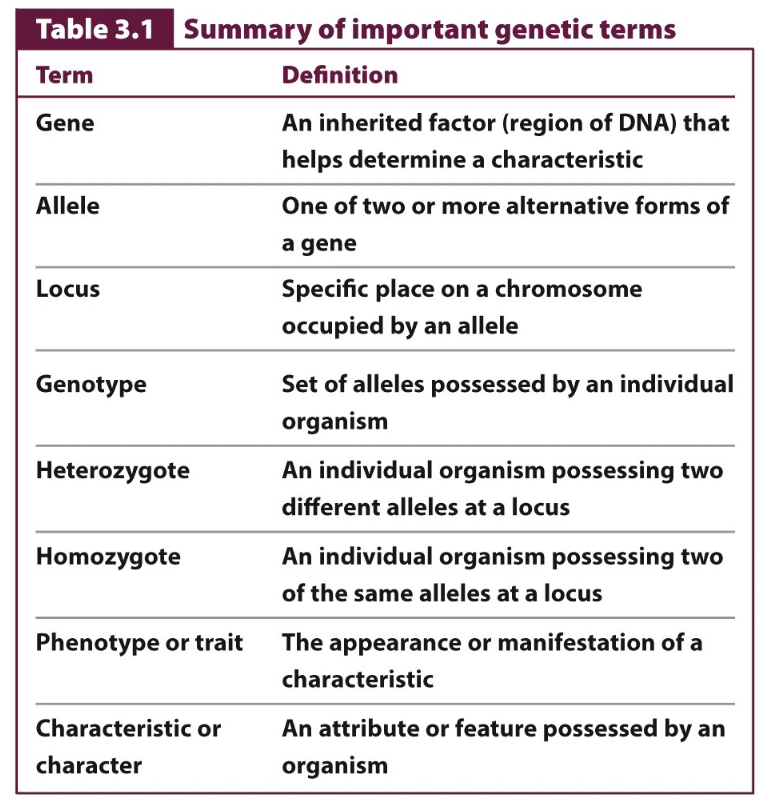
2. Define gene, allele, locus/loci, genotype, phenotype, homozygous and heterozygous.
3. List and describe Mendel's three principles of inheritance.
4. Draw and interpret a Punnett square.
5. Define somatic, germline and de novo mutations and determine whether each may be inherited.
6. Use correct pedigree nomenclature and symbols and predict possible inheritance patterns.
What is the approximate size and chromosome composition of the human genome?
The human genome contains approximately 3 billion base pairs of DNA.
A typical somatic cell contains:
- 46 chromosomes arranged in 23 pairs
- 22 pairs of autosomes
- 1 pair of sex chromosomes
- XX in a typical female
- XY in a typical male
What is a karyotype, and how are human chromosomes arranged in it?
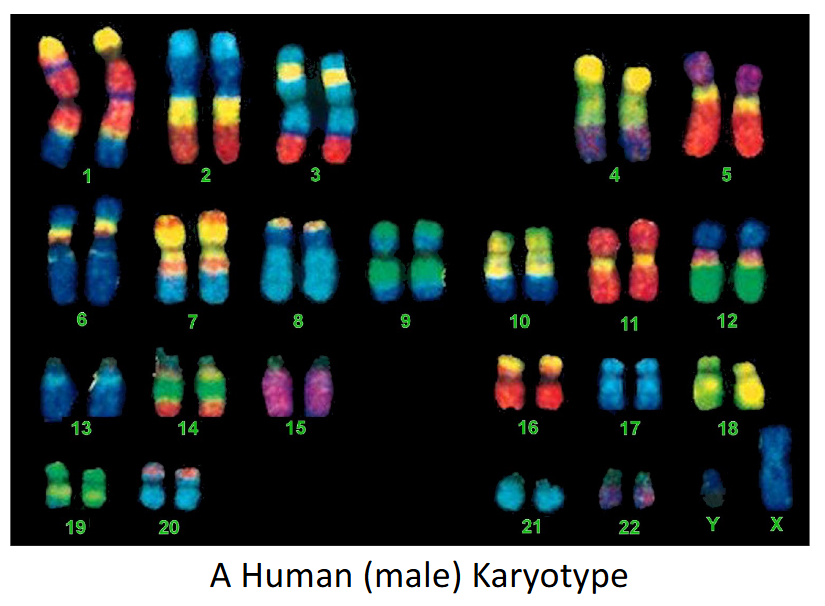
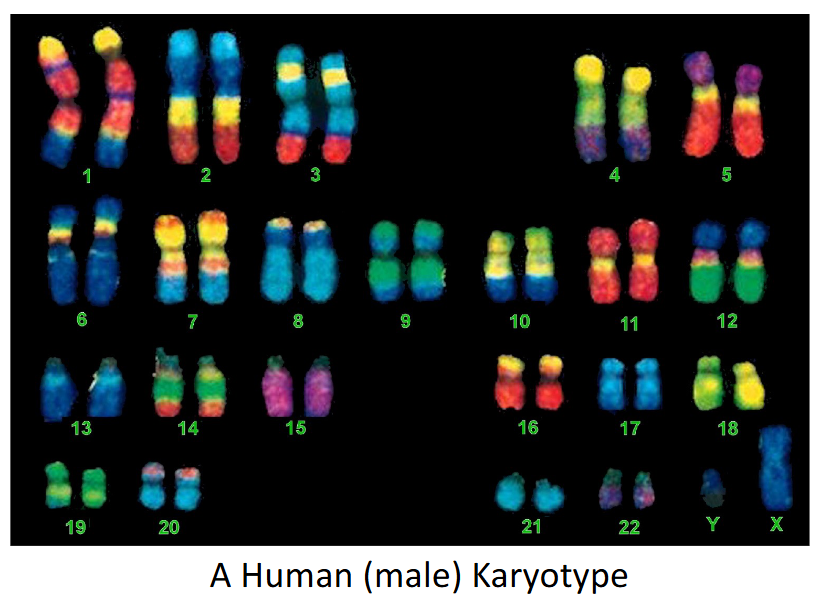
A karyotype is an organised display of chromosomes in homologous pairs.
Human chromosomes are generally:
- Identified by number
- Arranged from largest to smallest
- Displayed as chromosomes 1-22 plus the sex chromosomes
Lecturer explanation:
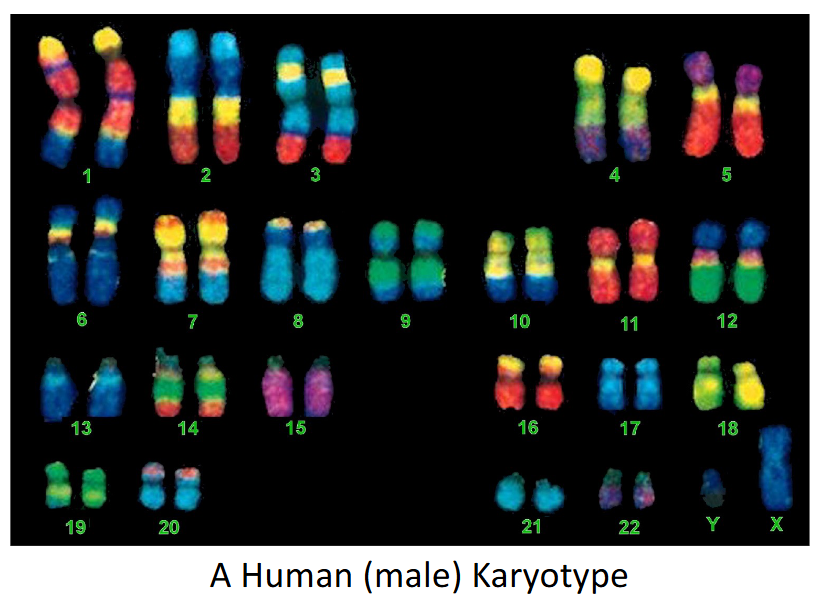
In the slide image, different fluorescent probes were used to identify the chromosomes.
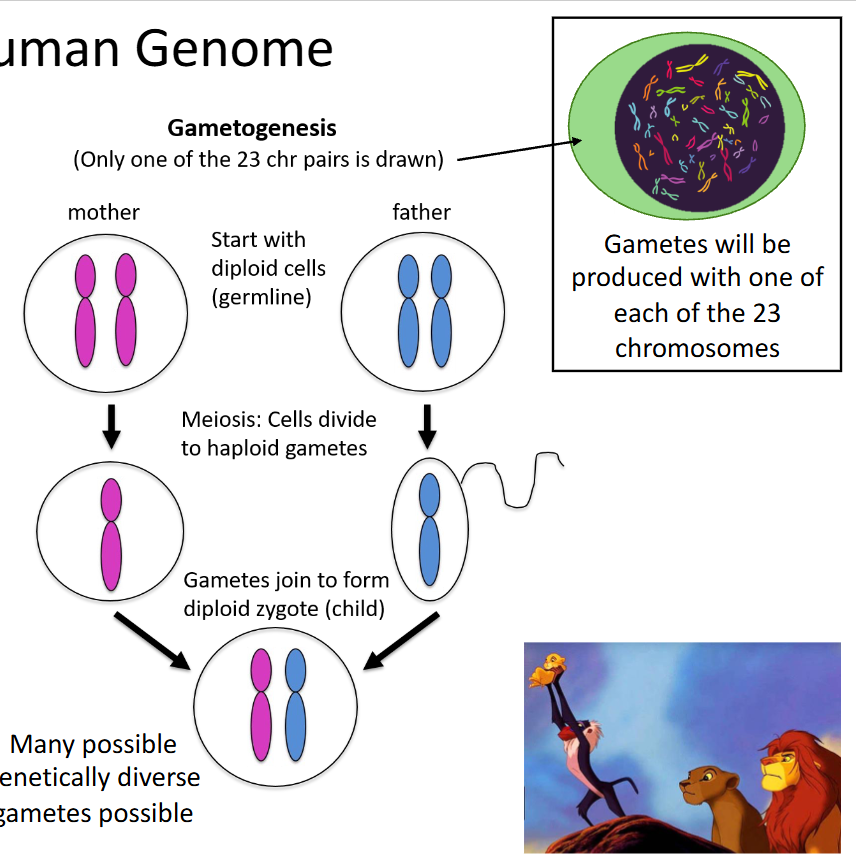
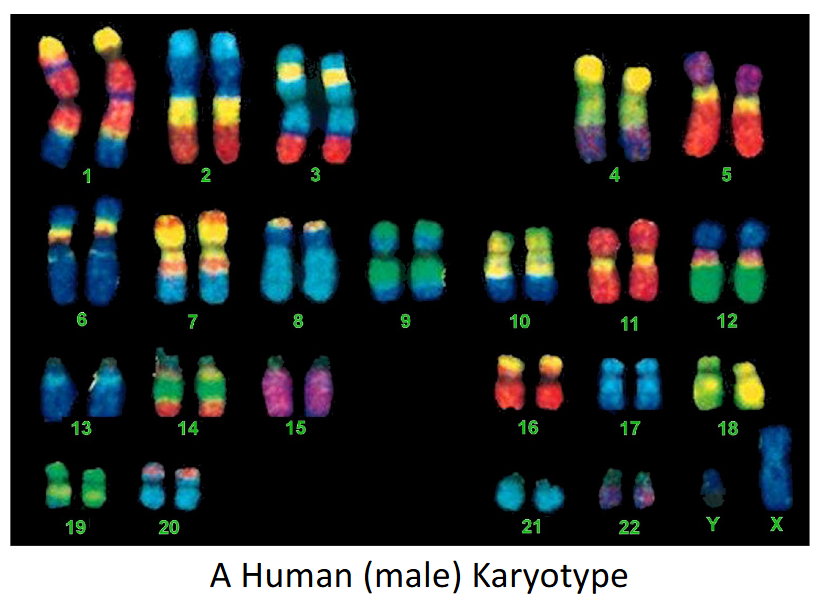
What should you identify in the male human karyotype?
- 23 chromosome pairs and 46 chromosomes in total
- 22 autosome pairs
- One X chromosome and one Y chromosome
- Homologous pairs arranged by chromosome number, generally from largest to smallest
- Different fluorescent labelling used to distinguish chromosomes
What is the germline?
The germline is the cell lineage from which gametes are derived.
Germ cells:
- Are set aside during embryonic development
- Migrate to the developing gonads
- Undergo cell division and differentiation
- Ultimately produce sperm or ova
How do diploid and haploid cells differ in humans?
Diploid cells:
- Contain two sets of chromosomes
- Have 46 chromosomes in 23 pairs
- Include most somatic cells and germline cells before meiosis
.
Haploid cells:
- Contain one set of chromosomes
- Have 23 chromosomes
- Include sperm and ova produced through meiosis
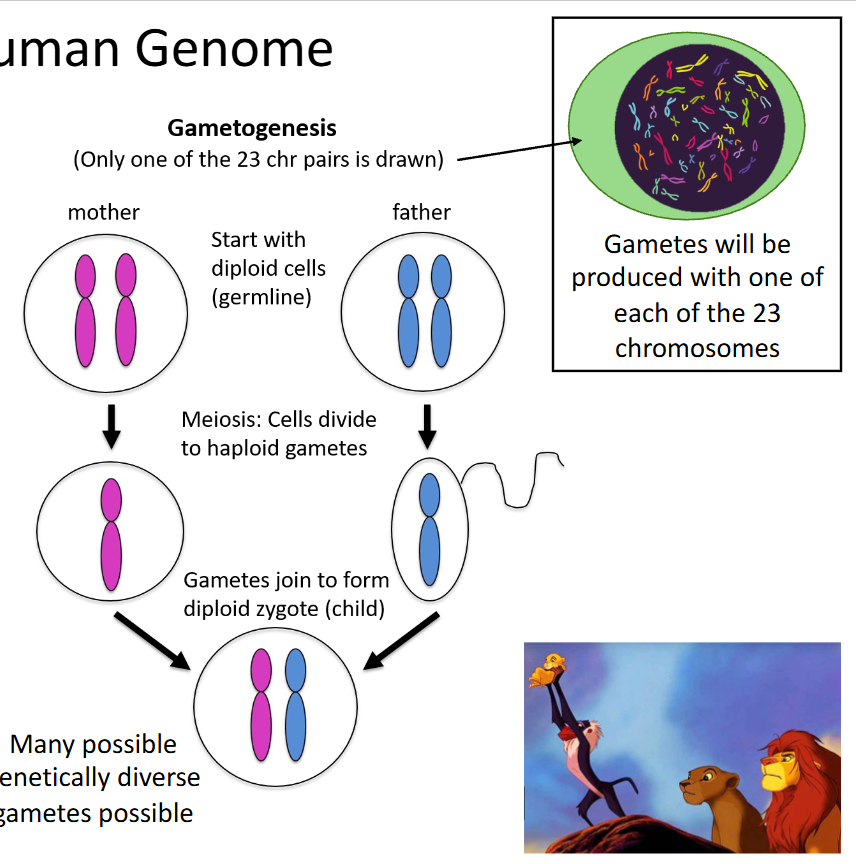
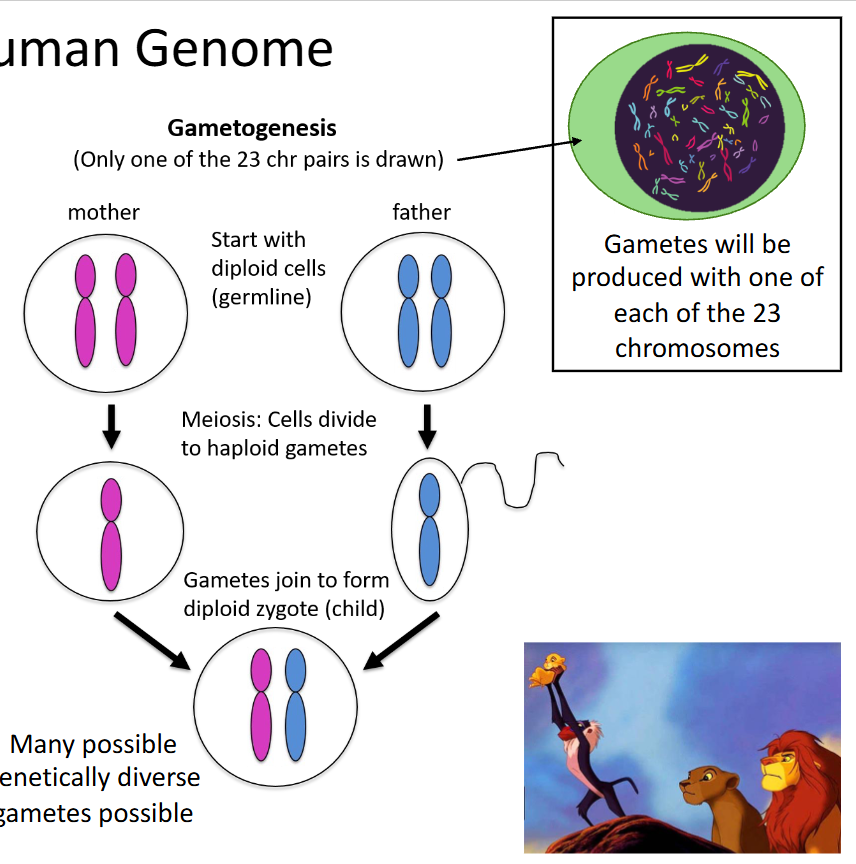
How do meiosis and fertilisation change chromosome number?
1. Diploid germline cells undergo meiosis.
2. Meiosis produces haploid gametes containing one chromosome from each of the 23 pairs.
3. A haploid sperm and haploid ovum fuse at fertilisation.
4. Their chromosome sets combine to form a diploid zygote with 46 chromosomes.
Why can one individual produce many genetically different gametes?
During meiosis, one chromosome from each homologous pair enters each gamete.
Which maternal or paternal homologue enters a particular gamete is random, producing many possible chromosome combinations.
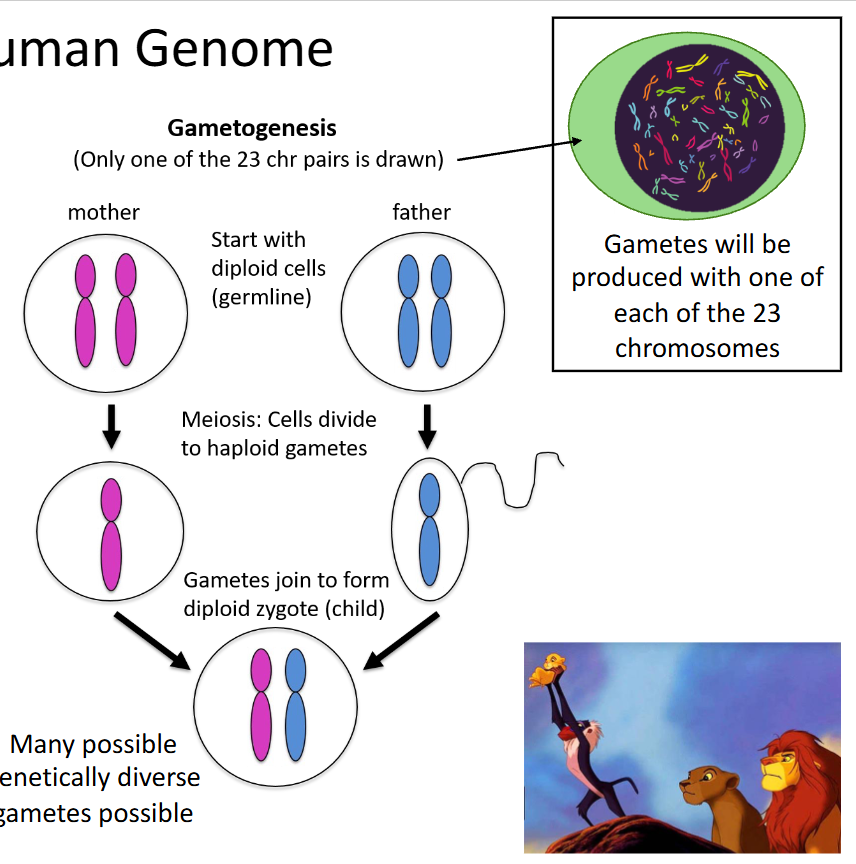
What should you identify in the gametogenesis diagram?
- Diploid maternal and paternal germline cells
- Meiosis producing haploid gametes
- One chromosome from each homologous pair entering a gamete
- Many possible genetically diverse gametes
- Fusion of two haploid gametes to restore a diploid zygote
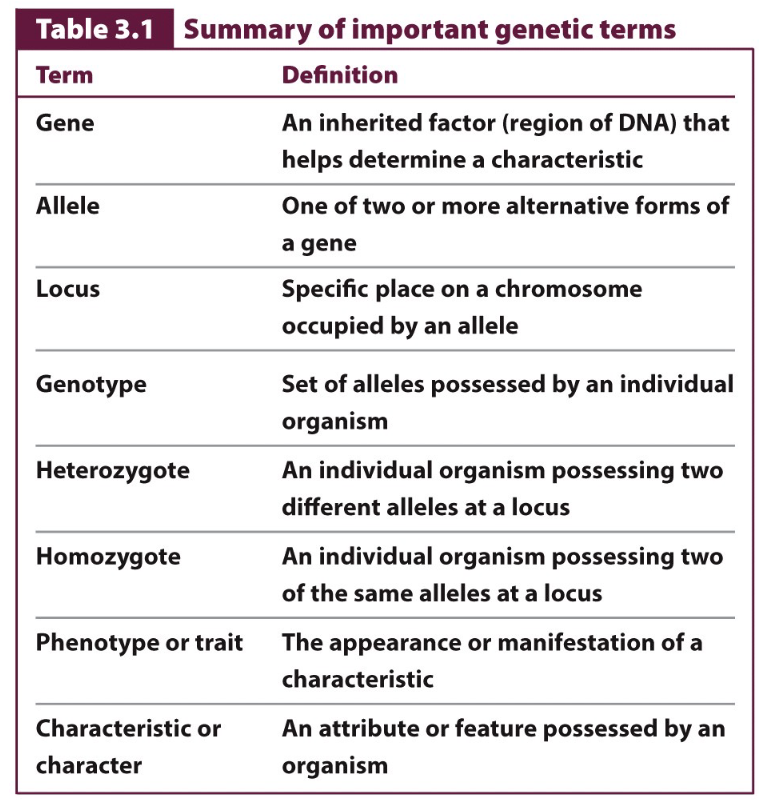
What is a gene?
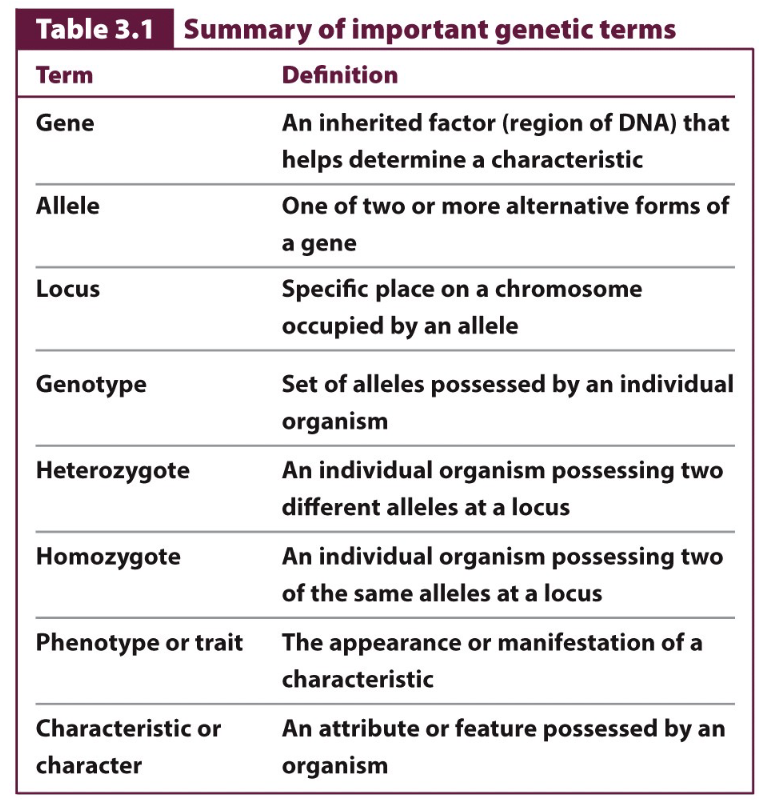
A gene is an inherited factor or region of DNA that helps determine a characteristic.
What is an allele?
An allele is one of two or more alternative versions of a gene.
Alleles of the same gene may differ slightly in DNA sequence and may produce different versions or activity of the gene product.
What is a locus, and what is its plural form?
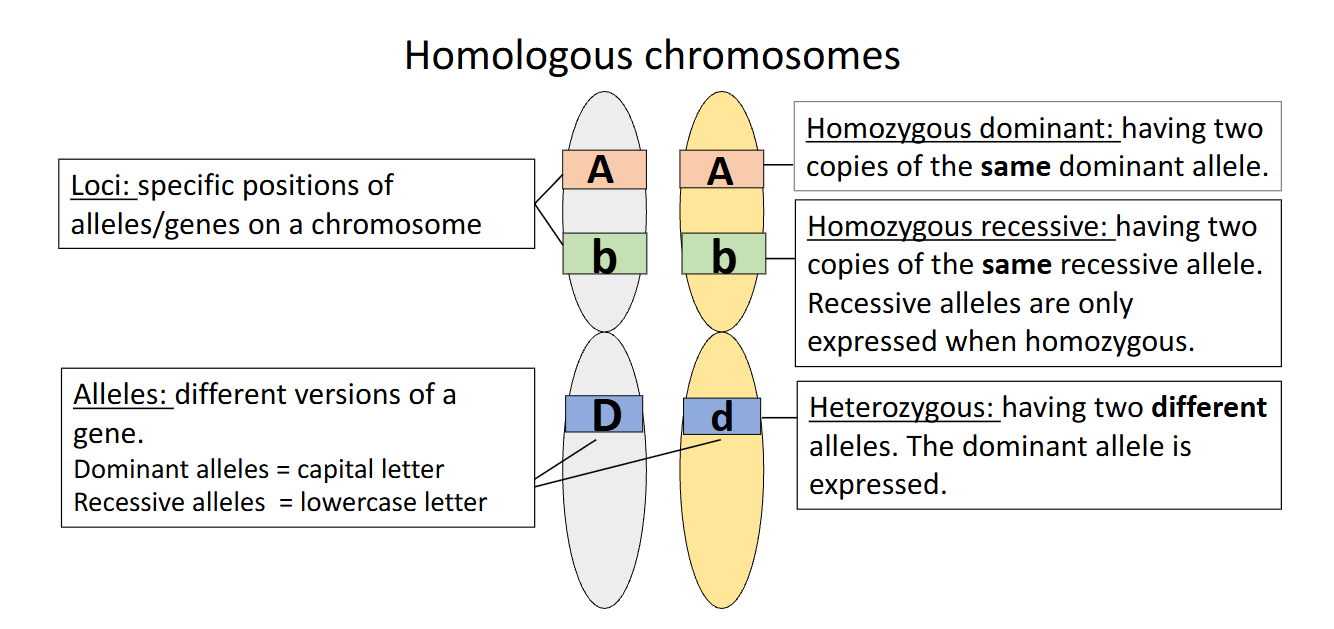
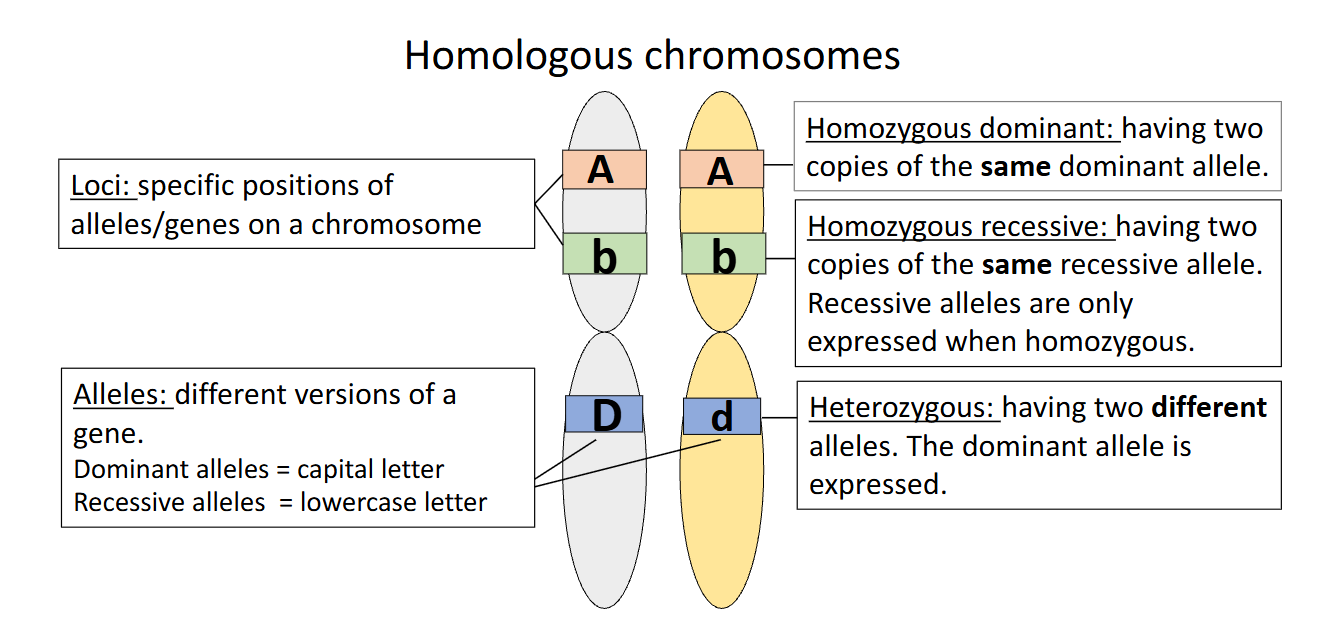
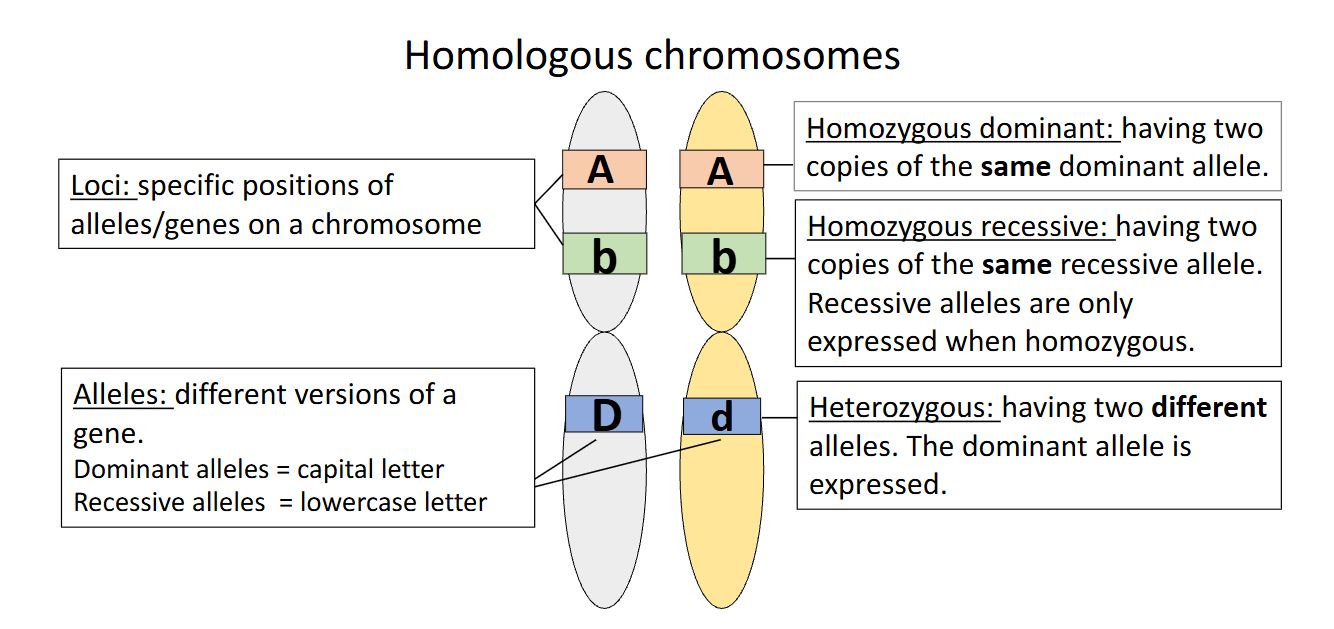
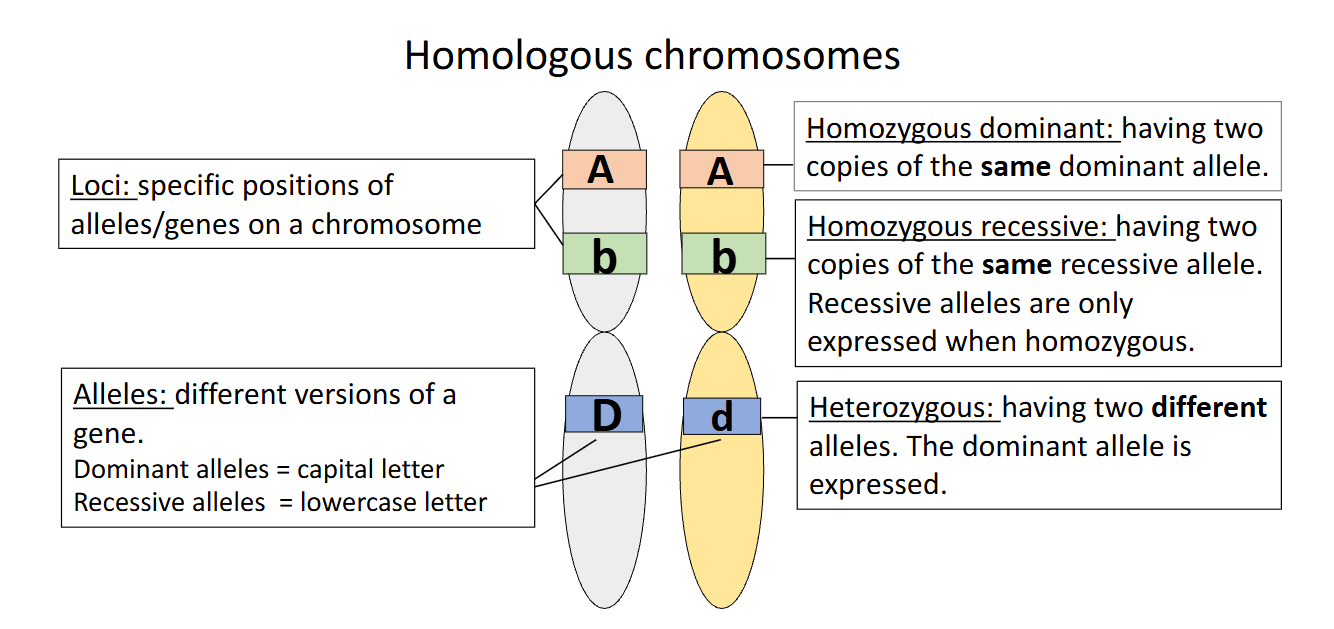
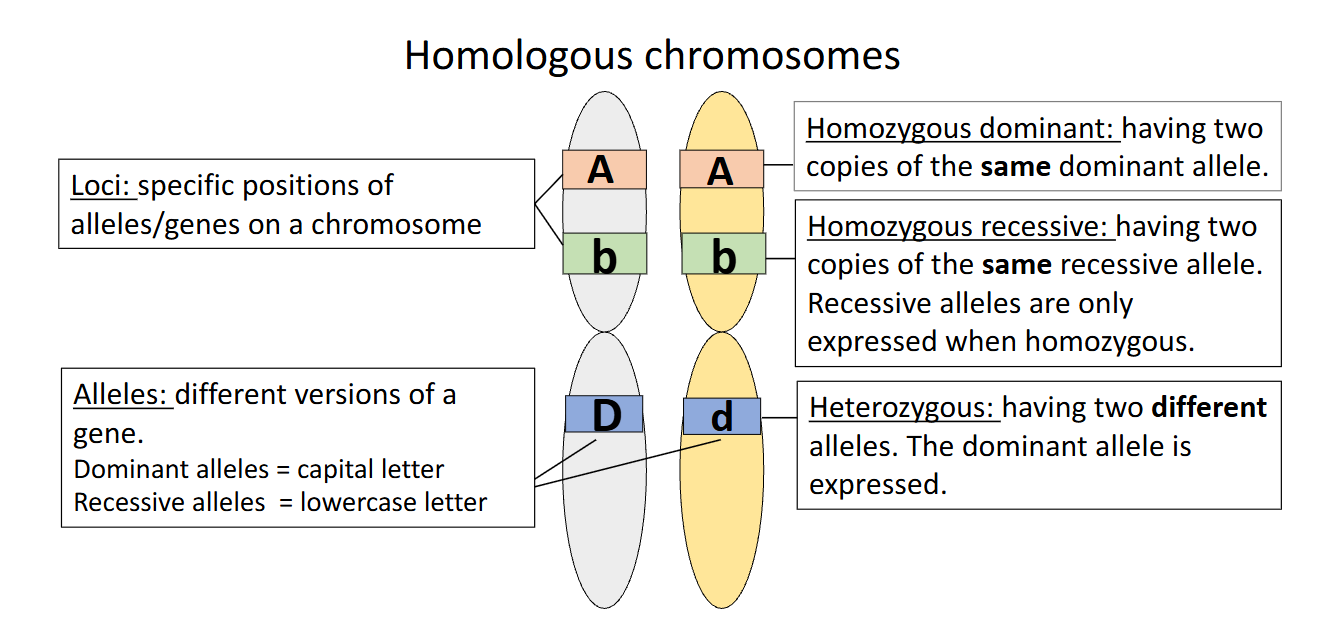
A locus is the specific position or region on a chromosome occupied by a gene or allele.
The plural of locus is loci.
Lecturer explanation:
A locus may refer to a precise genomic position or a broader chromosomal region.
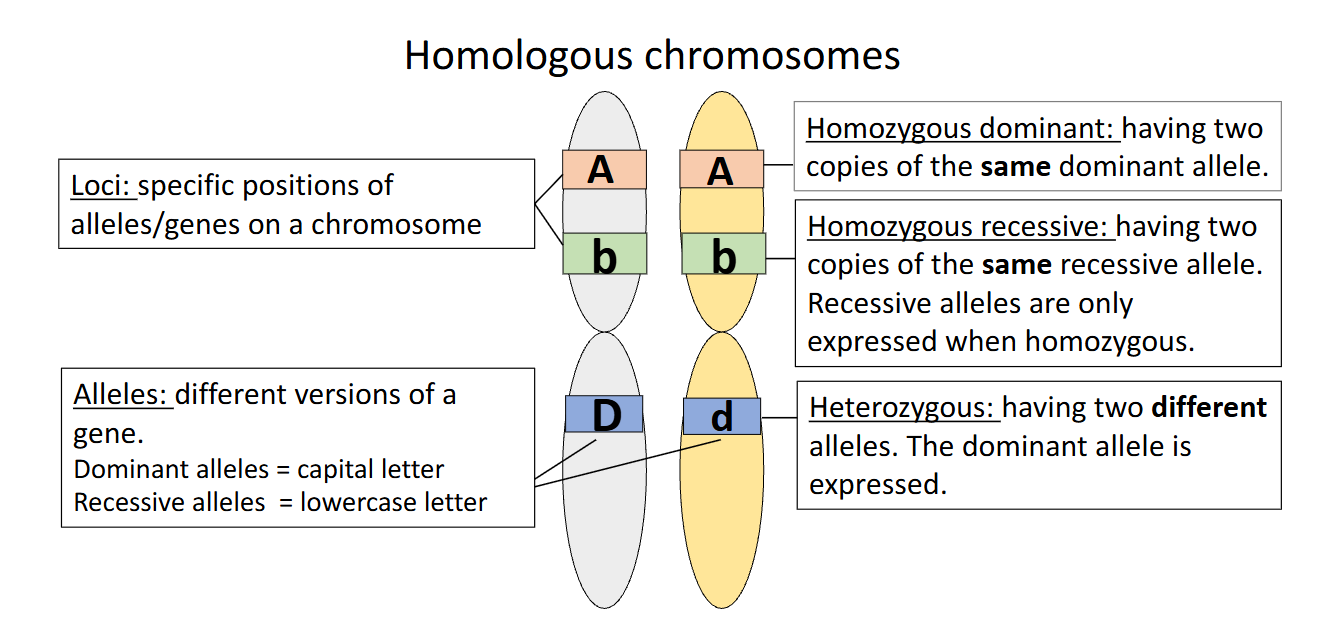
What are homologous chromosomes?
Homologous chromosomes are a pair of similar chromosomes, one inherited from each parent.
They:
- Carry genes for the same traits at corresponding loci
- May carry different alleles of those genes
How are dominant and recessive alleles conventionally represented?
- Dominant alleles are represented with capital letters, such as D.
- Recessive alleles are represented with lowercase letters, such as d.
What do homozygous dominant, homozygous recessive and heterozygous mean?
Homozygous dominant:
- Two copies of the same dominant allele, such as DD
Homozygous recessive:
- Two copies of the same recessive allele, such as dd
- A recessive trait is expressed under the simple complete-dominance model
Heterozygous:
- Two different alleles, such as Dd
- The dominant allele is expressed under the simple complete-dominance model
What is genotype?
Genotype is the set or combination of alleles carried by an individual, such as AA, Aa or Dd.
What is phenotype?
Phenotype is the appearance, manifestation or observable expression of a characteristic produced by an organism's alleles.
What is a characteristic or character in genetics?
A characteristic or character is an attribute or feature possessed by an organism.
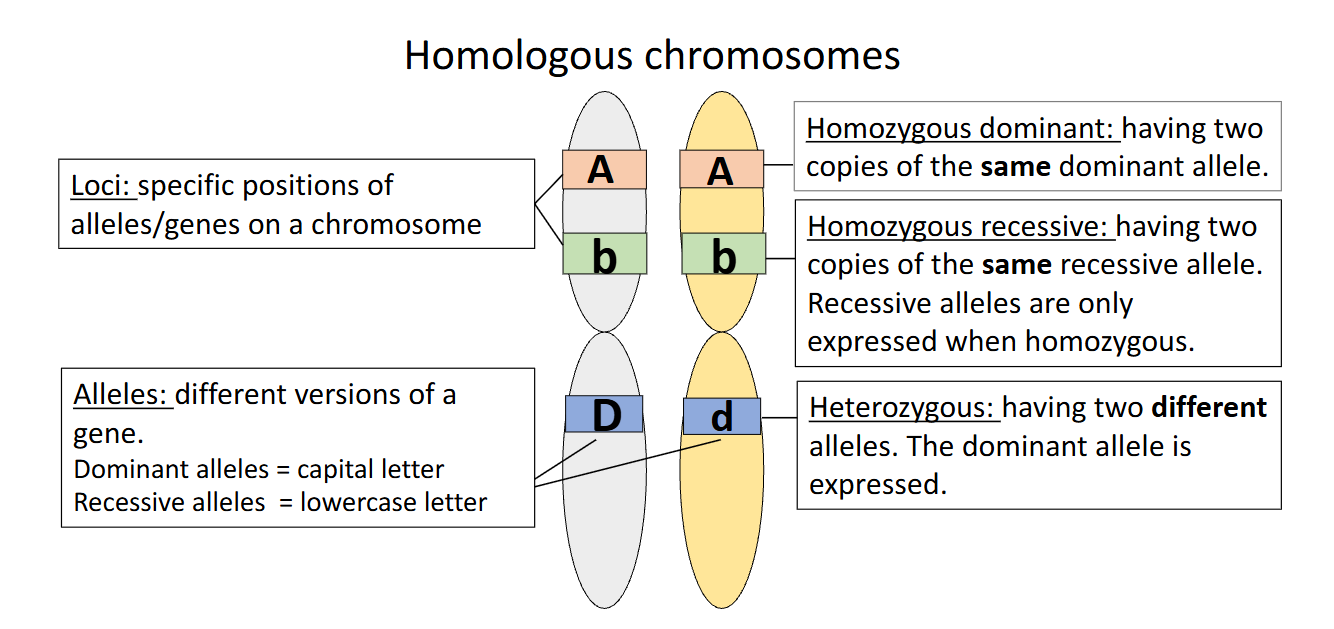
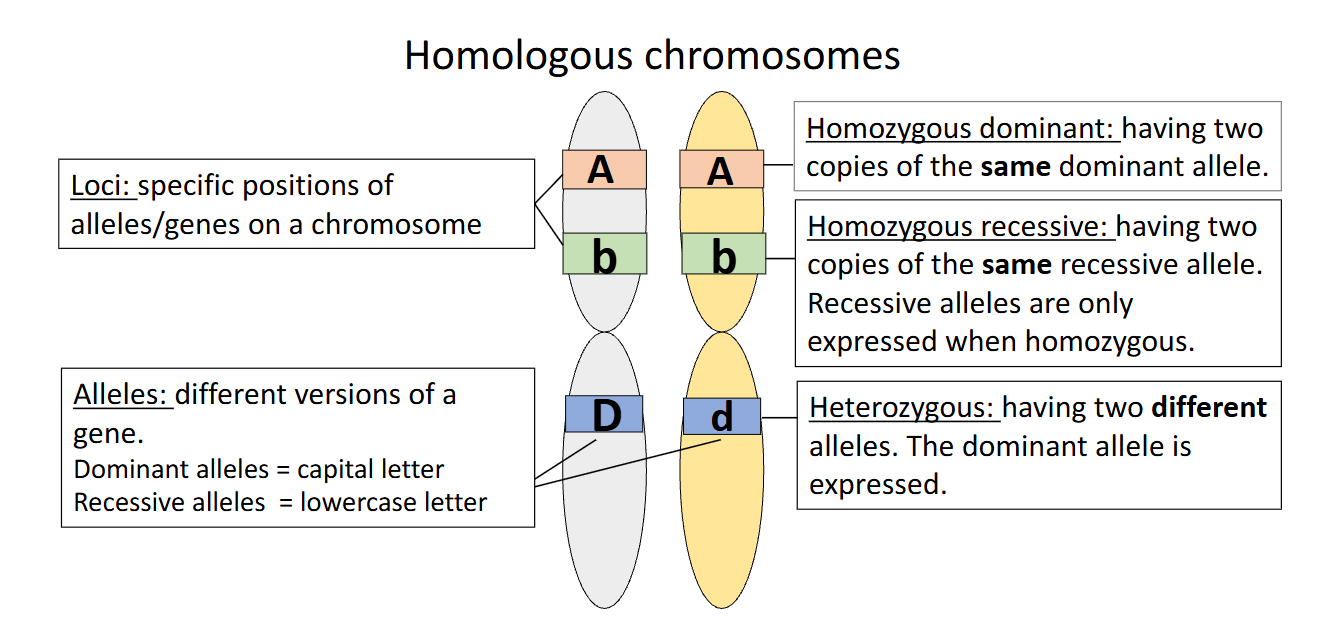
What should you identify in the homologous-chromosome terminology diagram?
- Homologous chromosomes carrying genes at corresponding loci
- Loci as chromosome positions
- Alleles as different versions of genes
- Examples A/A, b/b and D/d
- Homozygous dominant, homozygous recessive and heterozygous combinations
- Genotype as allele combination
- Phenotype as expression of the alleles
Who was Gregor Mendel, and why is he important to genetics?
Gregor Mendel (1822-1884) was an Austrian monk regarded as the "father of genetics".
He:
- Studied inheritance in pea plants
- Performed controlled crosses and counted offspring traits
- Proposed that paired "heritable elements" specified traits
- Showed that traits such as pea colour and shape were inherited in predictable mathematical proportions
Those heritable elements are now understood as genes.
What broad sequence of discoveries linked Mendel's inheritance patterns to DNA? (NOT ASSESSABLE)
- 1865: Mendel documented inheritance patterns in peas.
- 1869: Miescher identified DNA as "nuclein".
- 1902: Sutton and Boveri proposed chromosome theory.
- 1915: Morgan and colleagues supported chromosome theory.
- 1927: Muller showed that X-rays induce mutations.
- 1928: Griffith demonstrated bacterial transformation.
- 1930s: Hämmerling linked hereditary information to the nucleus.
- 1931: McClintock demonstrated recombination in corn.
- 1941: Beadle and Tatum proposed "one gene-one enzyme".
- 1944: Avery, MacLeod and McCarty identified DNA as the transforming principle.
- 1950: Chargaff found A = T and C = G.
- 1952: Hershey and Chase supported DNA as hereditary material.
- 1953: Watson and Crick proposed the DNA double helix.
- 1961: Jacob and Monod proposed mRNA.
- 1990s: large-scale genome sequencing projects began.
Lecturer explanation:
The lecturer stated that the details of the individual experiments did not need to be memorised; the timeline shows how DNA became established as the physical basis of heredity.
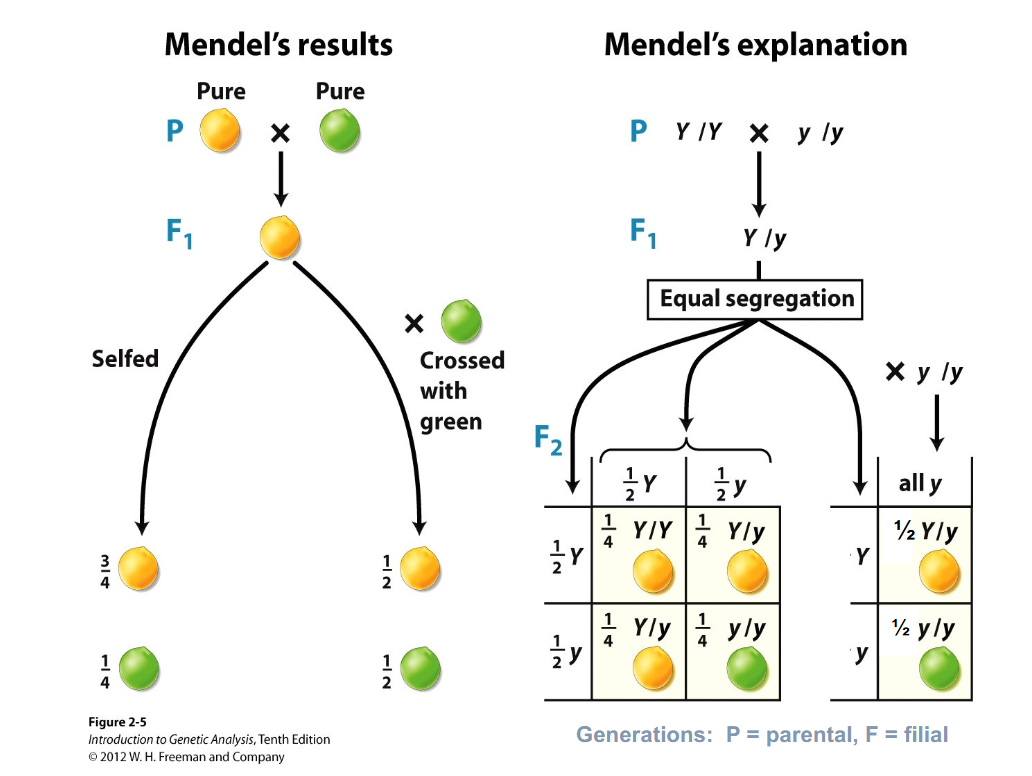
What do P, F₁ and F₂ mean in Mendelian crosses?
- P = parental generation
- F₁ = first filial generation
- F₂ = second filial generation
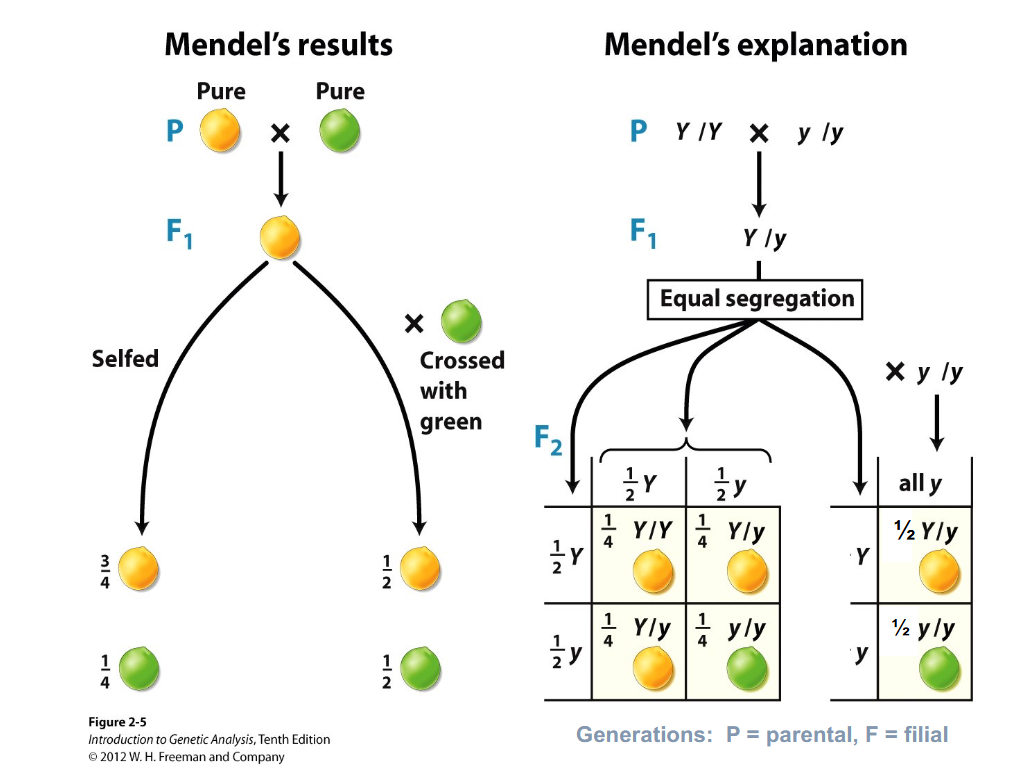
What results did Mendel obtain when crossing pure yellow and pure green pea plants?
Parental cross:
- Pure yellow × pure green
.
F₁ generation:
- All yellow
.
When F₁ plants were self-crossed:
- 3/4 yellow
- 1/4 green
.
When F₁ plants were crossed with pure green plants:
- 1/2 yellow
- 1/2 green
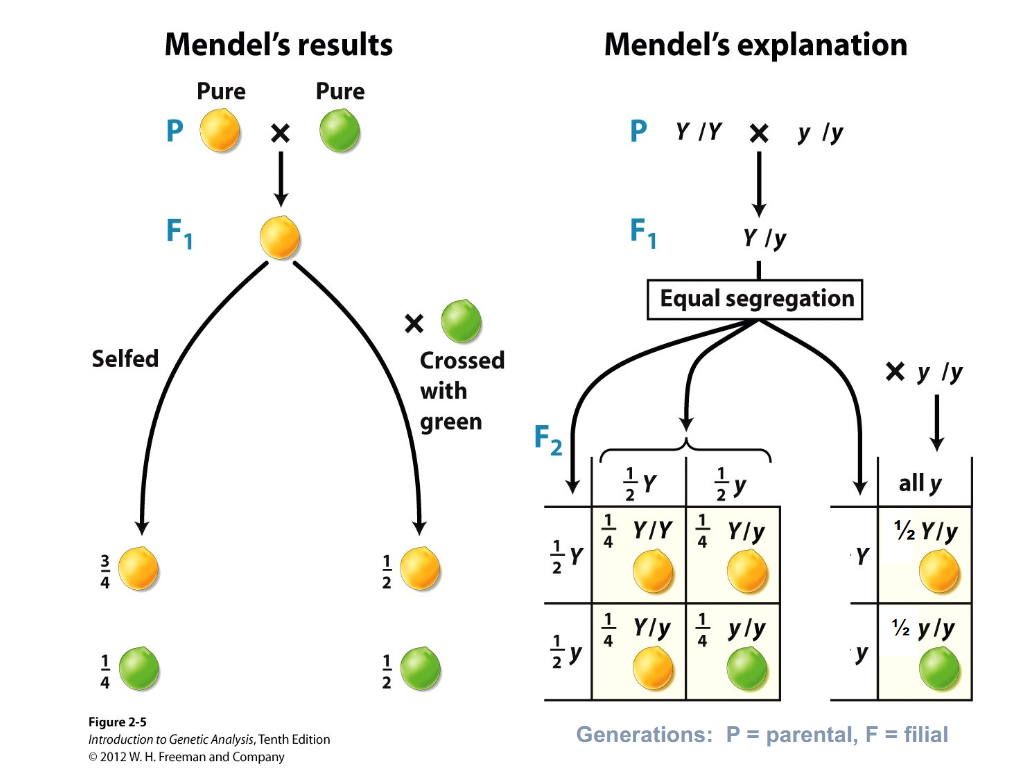
How did Mendel explain the yellow-versus-green pea results?
Mendel proposed paired heritable elements, now called alleles.
Using Y for yellow and y for green:
- P: Y/Y × y/y
- F₁: all Y/y and yellow
- F₁ self-cross: Y/y × Y/y
- F₂ genotypes: 1/4 Y/Y, 1/2 Y/y, 1/4 y/y
- F₂ phenotypes: 3/4 yellow, 1/4 green
- Test cross: Y/y × y/y
- Offspring: 1/2 Y/y yellow and 1/2 y/y green
The model depended on equal segregation of alleles into gametes.
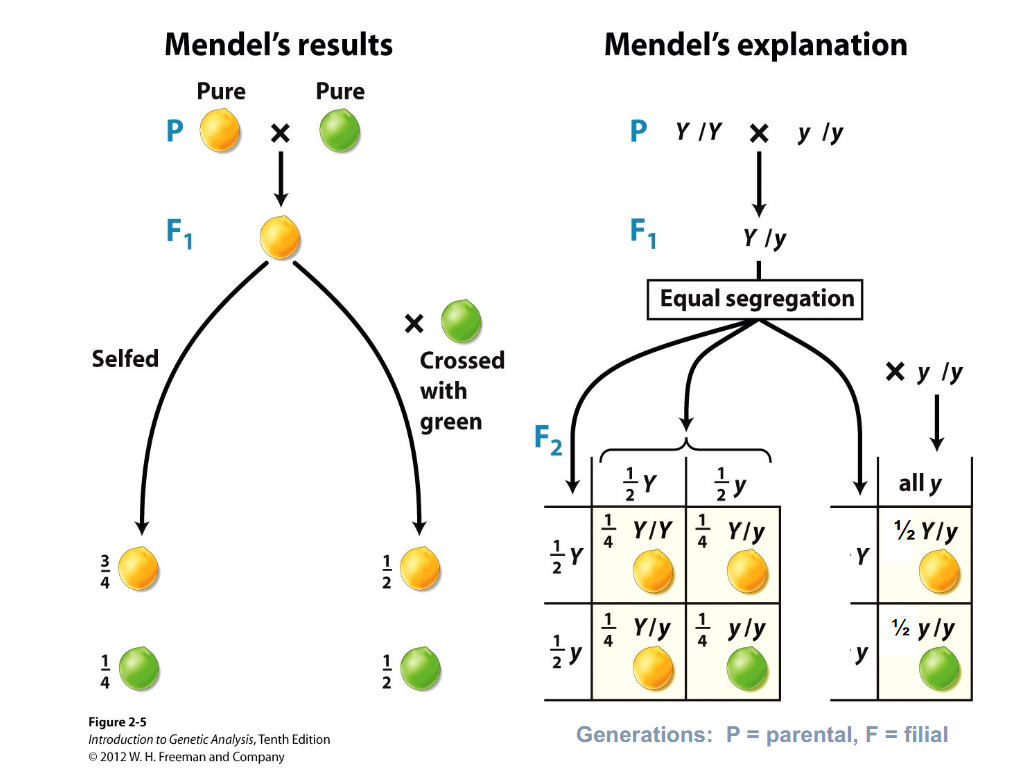
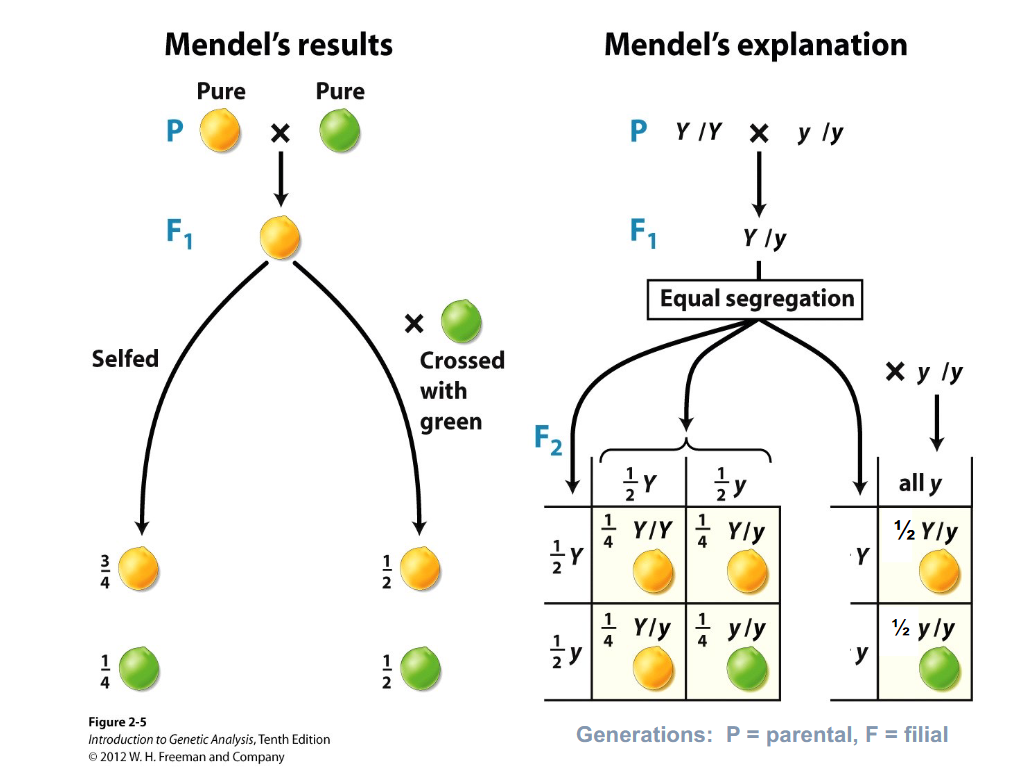
What should you identify in Mendel's single-gene inheritance diagram?
- Pure yellow and pure green parental strains
- All-yellow F₁ generation
- F₁ self-cross producing a 3:1 yellow-to-green phenotypic ratio
- F₁ × green test cross producing a 1:1 ratio
- Genotypes Y/Y, Y/y and y/y
- Equal segregation of Y and y alleles
What are Mendel's three foundational principles of inheritance?
1. Law of Segregation
2. Law of Independent Assortment
3. Principle or Law of Dominance
Lecturer explanation:
These are simplified foundational rules; later material examines important exceptions.
What is Mendel's Law of Segregation?
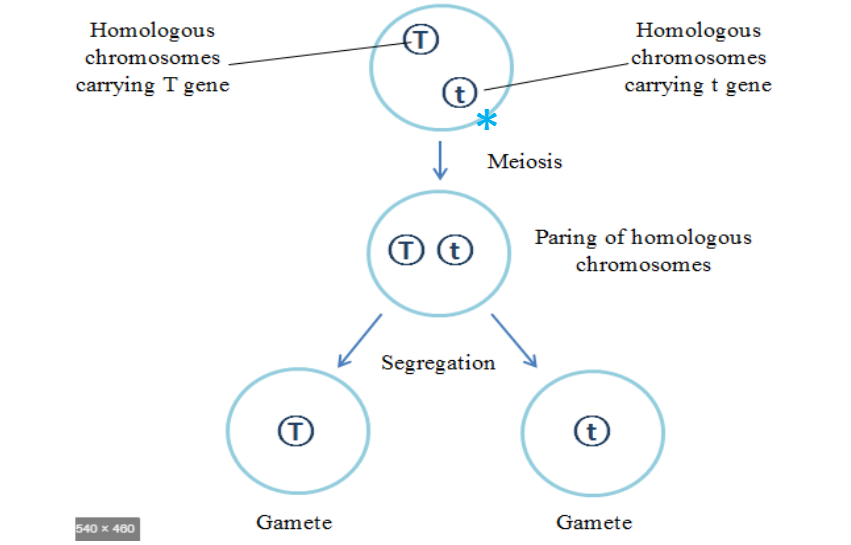
- Cells contain 2 copies (alleles) of each gene
- When gametes form, the two alleles of a gene separate so that each gamete carries only one allele for that gene.
- Which allele enters a particular gamete is random
- Gametes carry only one copy of each gene
What is Mendel's Law of Independent Assortment?
Allele pairs for different genes segregate independently during gamete formation, so inheritance of one trait does not necessarily determine inheritance of another.
This applies most clearly when the genes are on different chromosomes.
What is Mendel's Principle of Dominance?
In a heterozygote, a dominant allele masks the phenotypic effect of a recessive allele.
Under complete dominance:
- One dominant allele is sufficient for the dominant phenotype.
- A recessive phenotype requires two recessive alleles.
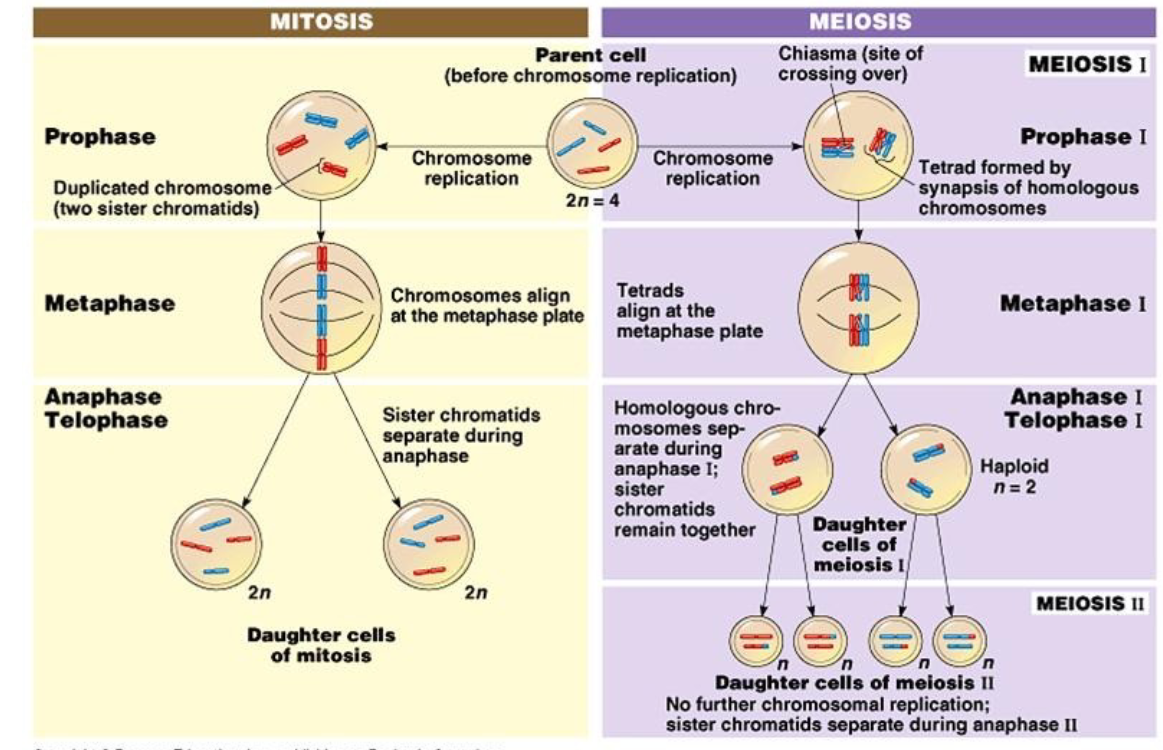
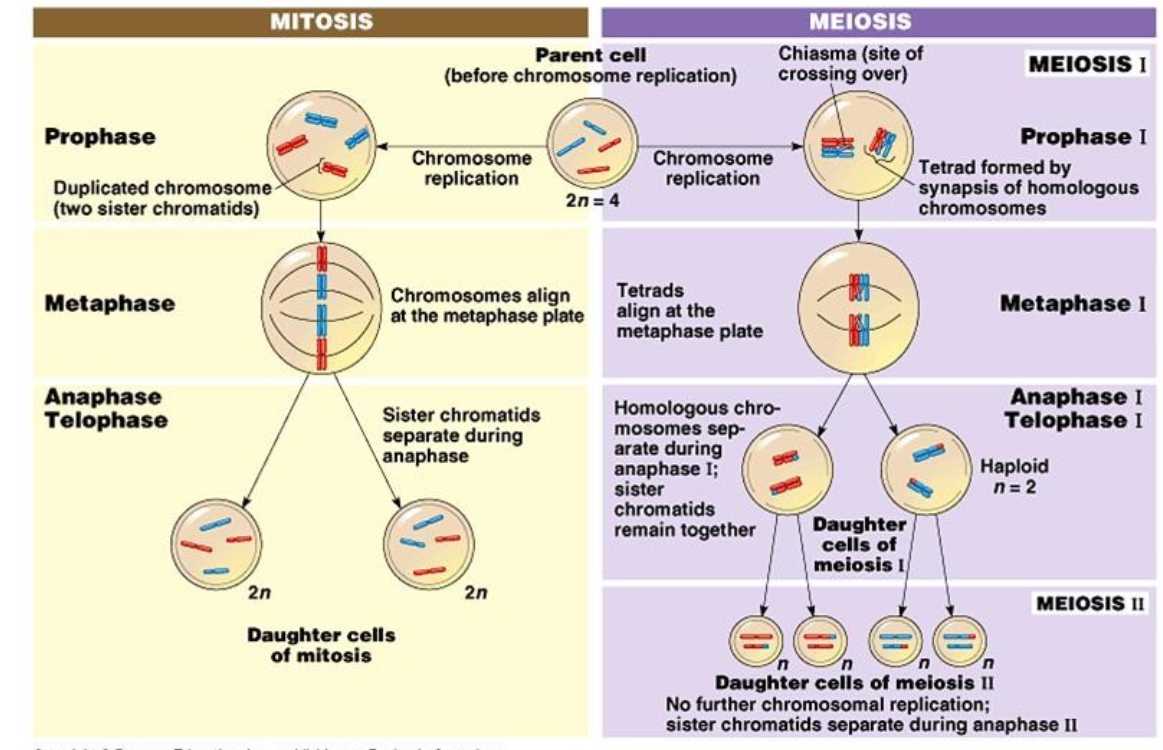
How do mitosis and meiosis differ in chromosome behaviour and products?
Mitosis:
- Chromosomes replicate once.
- Duplicated chromosomes align individually at metaphase.
- Sister chromatids separate.
- Produces daughter cells with the same diploid chromosome complement as the parent.
.
Meiosis:
- Chromosomes replicate once.
- Homologous chromosomes pair as tetrads in meiosis I.
- Crossing over can occur at chiasmata.
- Homologous chromosomes separate in meiosis I.
- Sister chromatids remain together until meiosis II.
- Produces haploid cells with one chromosome from each homologous pair.
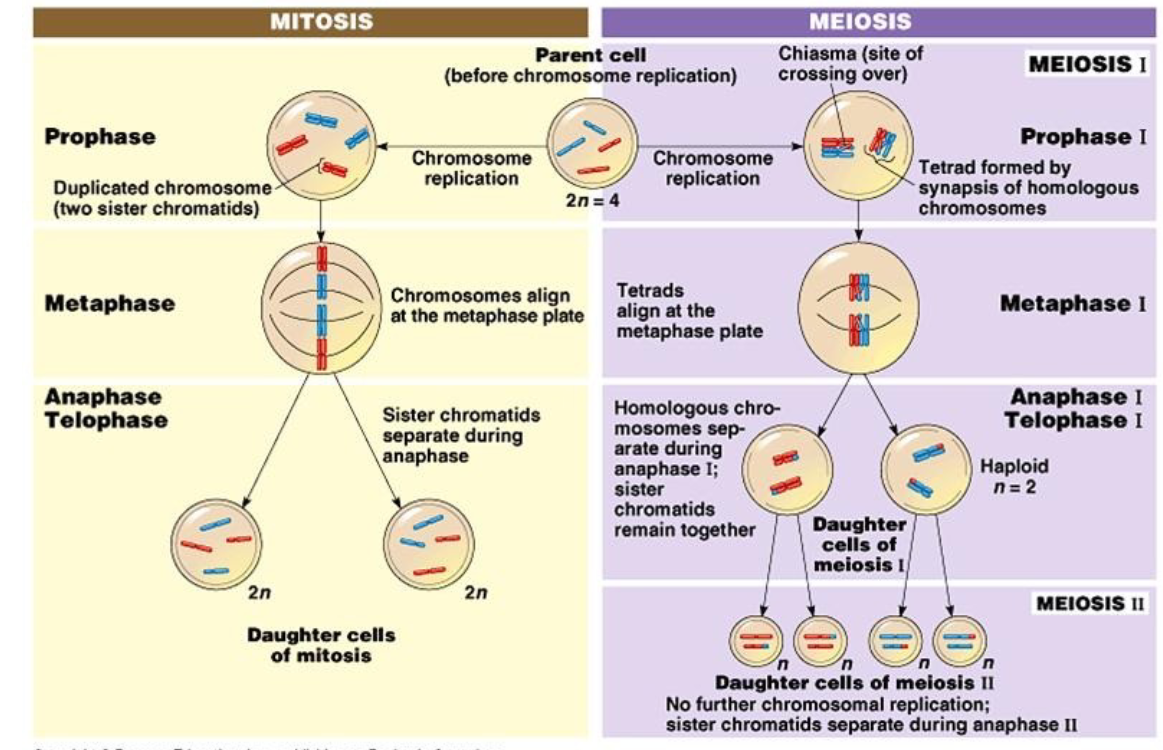
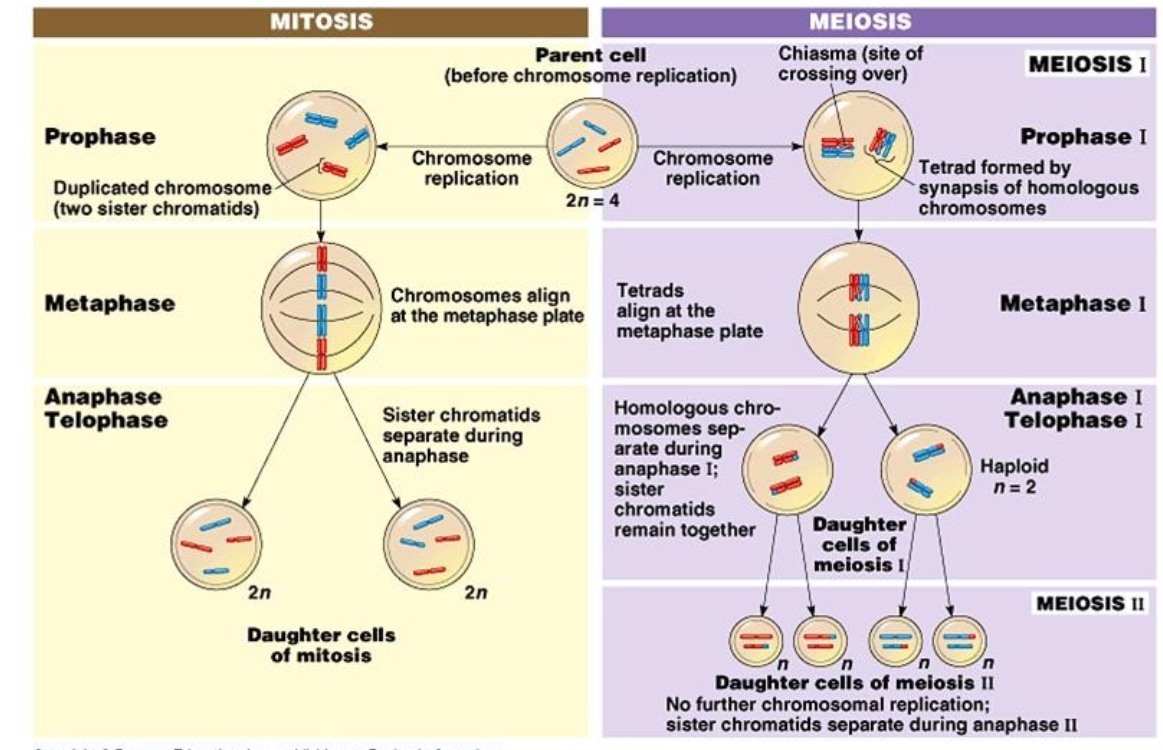
What should you identify in the mitosis-versus-meiosis diagram?
Mitosis:
- Parent cell 2n = 4
- Chromosome replication
- Metaphase alignment
- Separation of sister chromatids
- Two diploid daughter cells
Meiosis:
- Parent cell 2n = 4
- Homologue pairing and tetrad formation
- Chiasma and crossing over
- Homologue separation during meiosis I
- Haploid cells after meiosis I
- Sister-chromatid separation during meiosis II without another replication
- Four haploid products
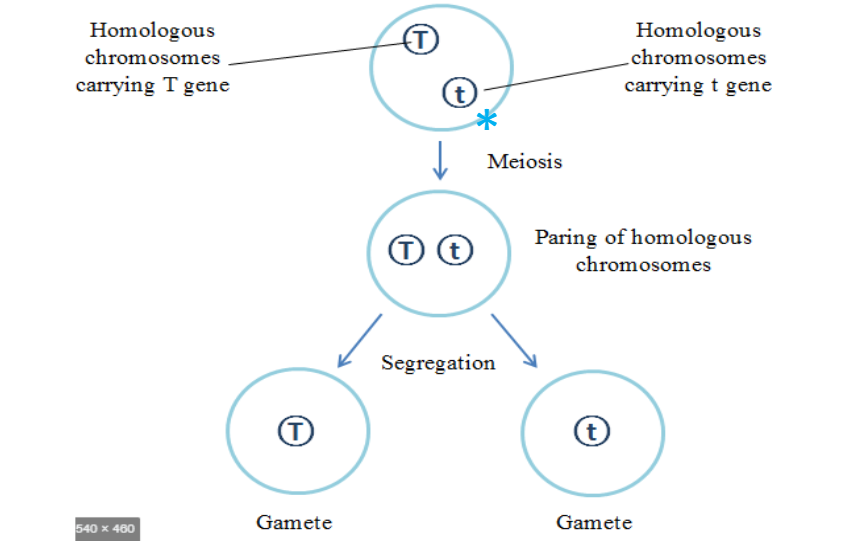
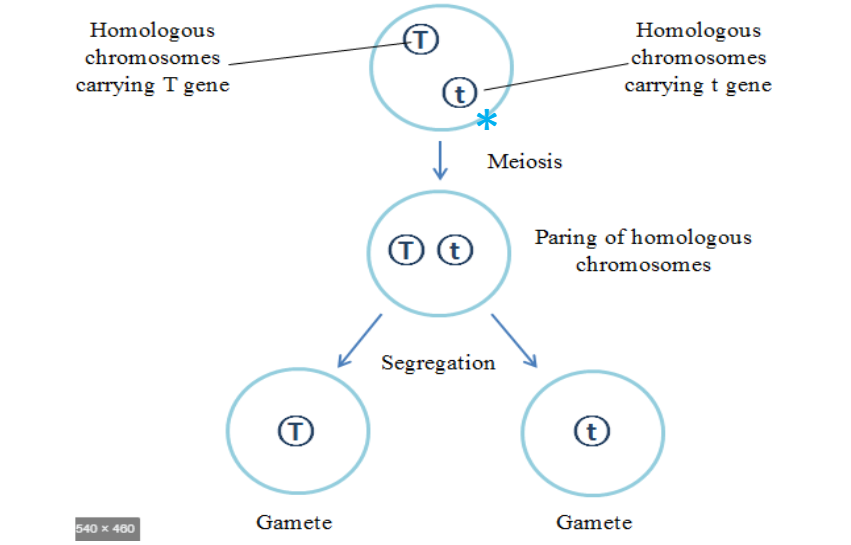
How does meiosis provide the physical basis for the Law of Segregation?
The two alleles of a gene occupy corresponding loci on homologous chromosomes.
During meiosis:
1. Homologous chromosomes pair.
2. The homologues separate into different cells.
3. Each gamete receives only one homologue.
4. Therefore, each gamete receives only one allele of the gene.
Example:
A T/t cell produces gametes carrying either T or t.
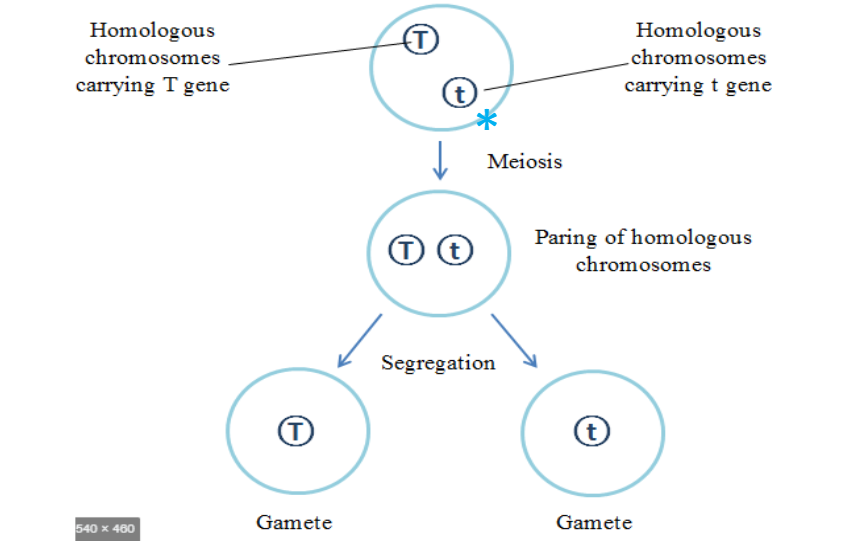
What should you identify in the T/t segregation diagram?
- Homologous chromosomes carrying T and t at corresponding loci
- Pairing of homologous chromosomes during meiosis
- Segregation of the homologues
- One gamete receiving T
- Another gamete receiving t
How is the number of possible chromosome combinations in gametes calculated?
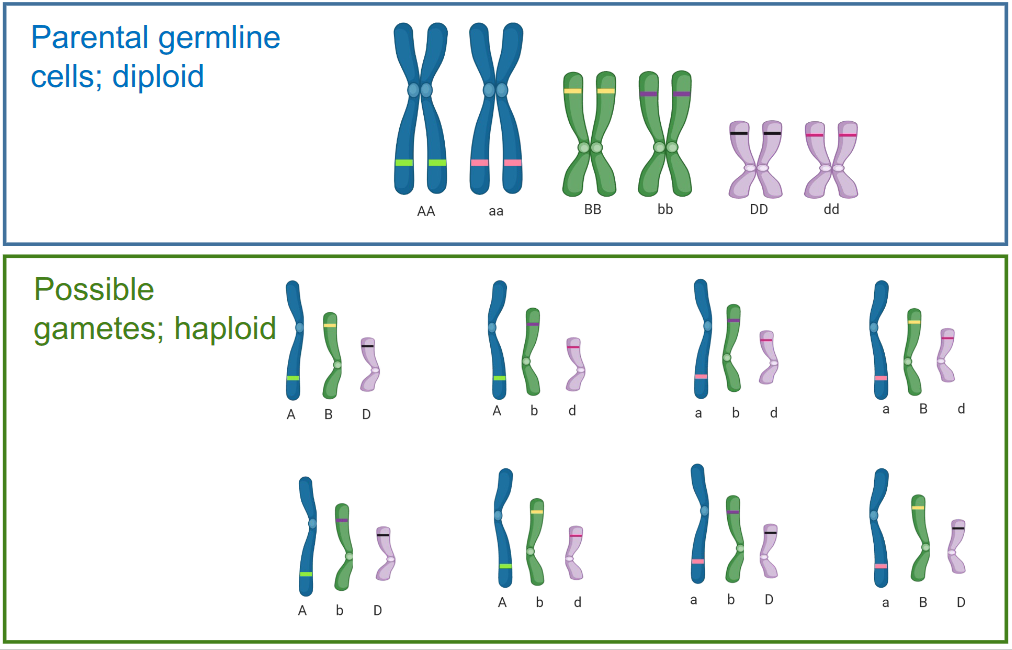
A diploid organism can produce 2ⁿ chromosome combinations through independent assortment, where n is the haploid chromosome number.
Examples:
- n = 3 → 2³ = 8 possible gamete combinations
- Humans: n = 23 → 2²³ = 8,388,608 possible combinations
This count is generated by independent assortment alone, before considering recombination.
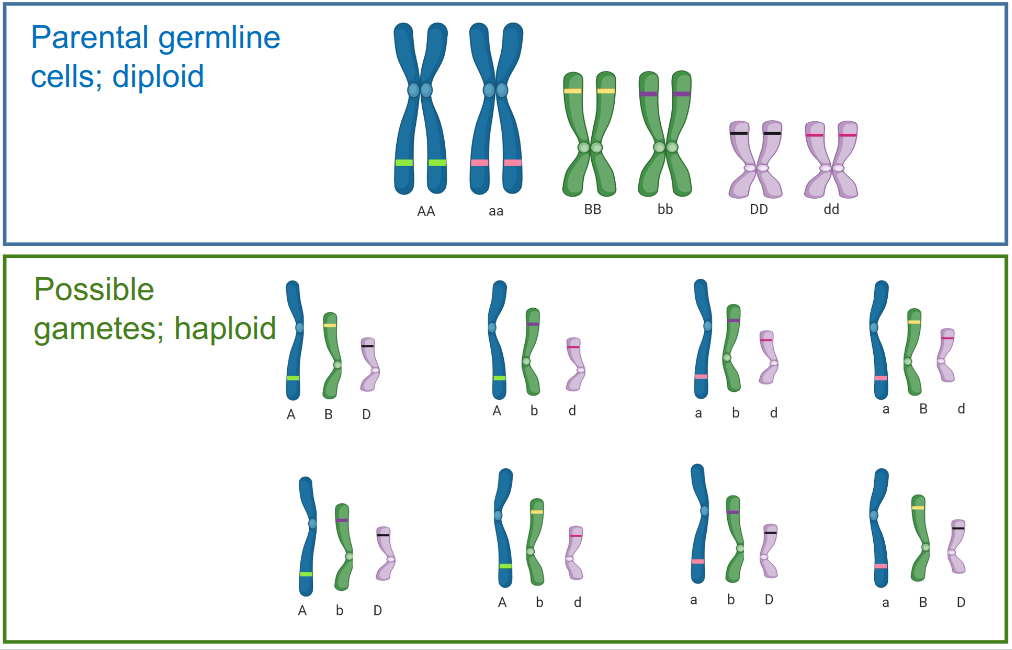
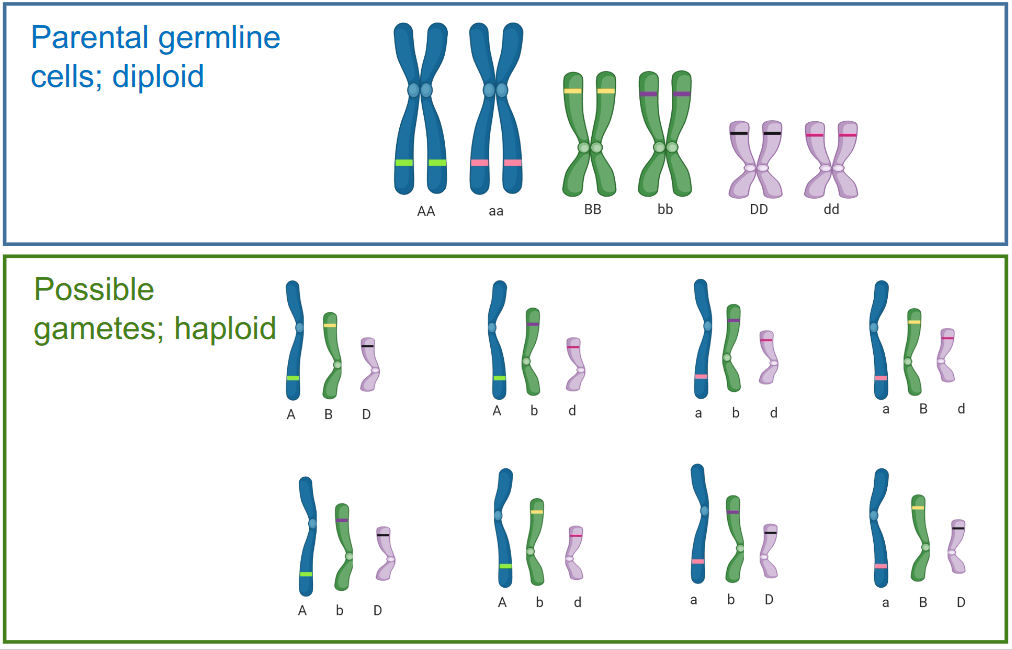
Why does a three-chromosome example produce eight possible gametes?
Each of the three homologous chromosome pairs offers two possible parental homologues for a gamete.
Therefore:
2 × 2 × 2 = 2³ = 8 combinations.
The assortment of one pair is random and independent of the assortment of the other pairs.
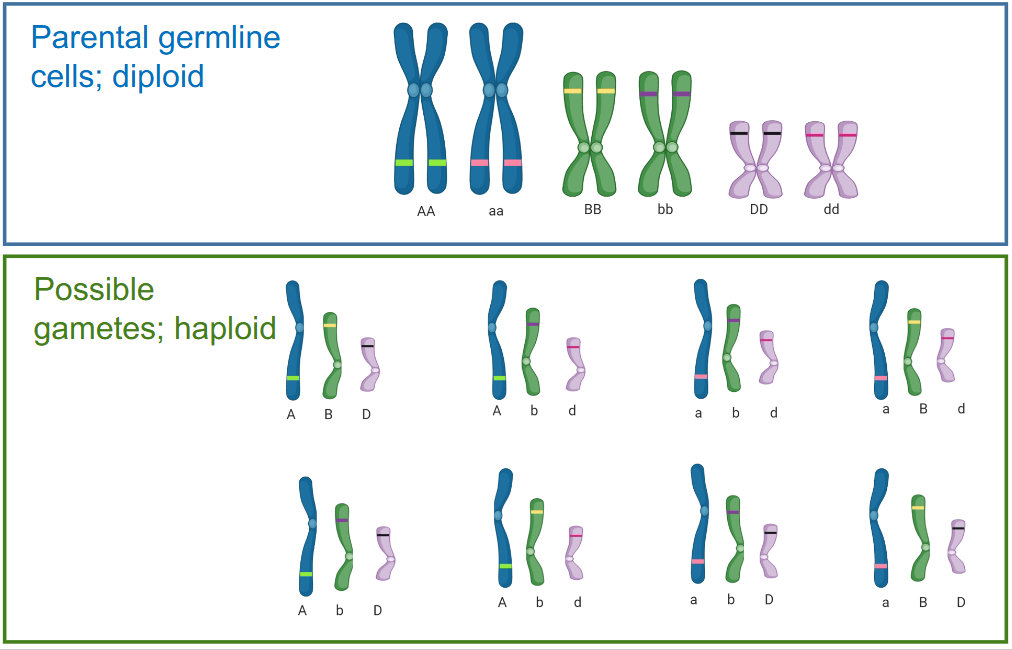
What should you identify in the 2ⁿ gamete-combination diagram?
- A diploid parental germline cell with three homologous chromosome pairs
- Different loci represented on the chromosome pairs
- Haploid gametes containing one homologue from each pair
- All eight possible chromosome combinations
- The relationship 2³ = 8
- The human relationship 2²³ = 8,388,608
DIAGRAM ON SLIDE 13
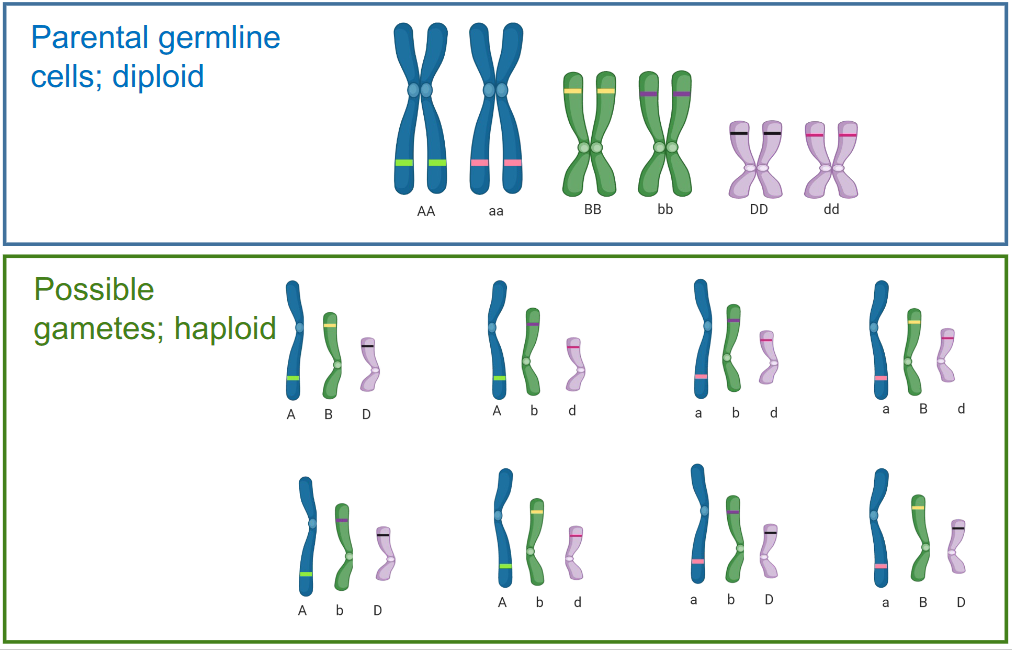
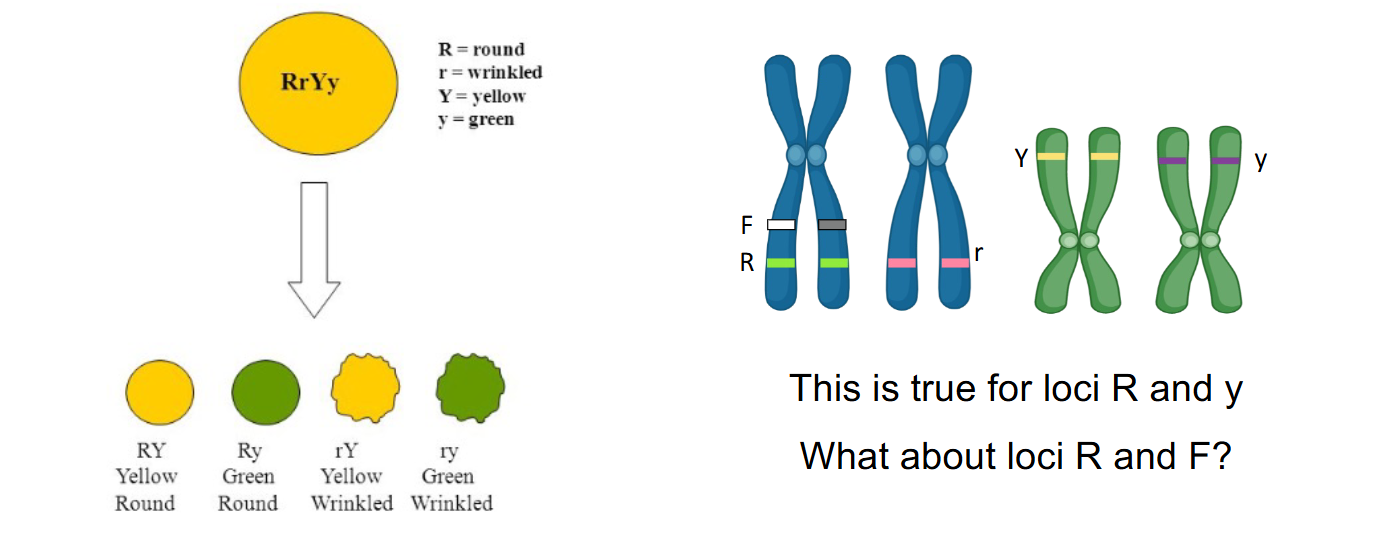
How did Mendel's pea-colour and pea-shape experiments support independent assortment?
Mendel followed two traits:
- Pea shape: R = round, r = wrinkled
- Pea colour: Y = yellow, y = green
A heterozygous RrYy plant could produce combinations corresponding to:
- RY: round, yellow
- Ry: round, green
- rY: wrinkled, yellow
- ry: wrinkled, green
The observed proportions supported the idea that inheritance of colour did not influence inheritance of shape.
When is independent assortment most likely to apply, and what is linkage?
Independent assortment applies most clearly to loci on different chromosomes, such as R and Y in the lecture example.
Linkage occurs when genes are on the same chromosome, especially when they are close together, so they may be inherited together rather than assorting independently.
Lecturer explanation:
The R-versus-F question was introduced as a conundrum to be revisited later.
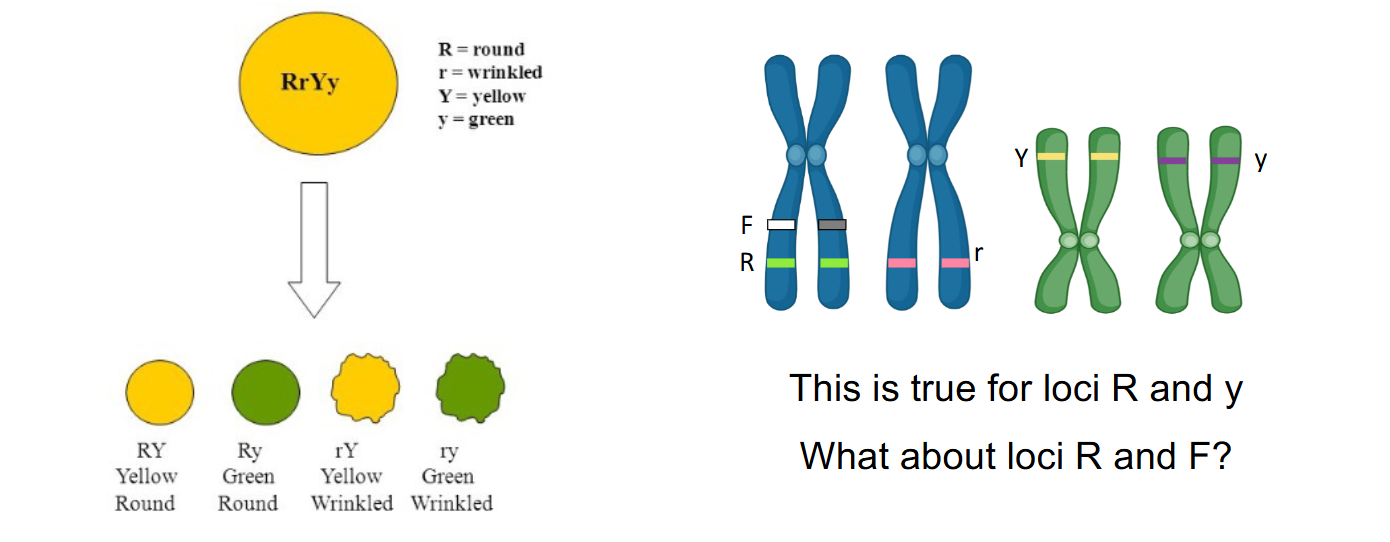
What should you identify in the independent-assortment diagram?
- R/r as round versus wrinkled
- Y/y as yellow versus green
- RrYy as the dihybrid genotype
- RY, Ry, rY and ry combinations
- R and Y on different chromosomes as an example consistent with independent assortment
- R and F on the same chromosome as a prompt introducing linkage
How does complete dominance affect the relationship between genotype and phenotype?
For a dominant allele Y and recessive allele y:
- Y/Y → dominant phenotype
- Y/y → dominant phenotype
- y/y → recessive phenotype
Therefore:
- A dominant phenotype does not reveal whether an individual is homozygous or heterozygous.
- A recessive phenotype identifies the homozygous recessive genotype under complete dominance.
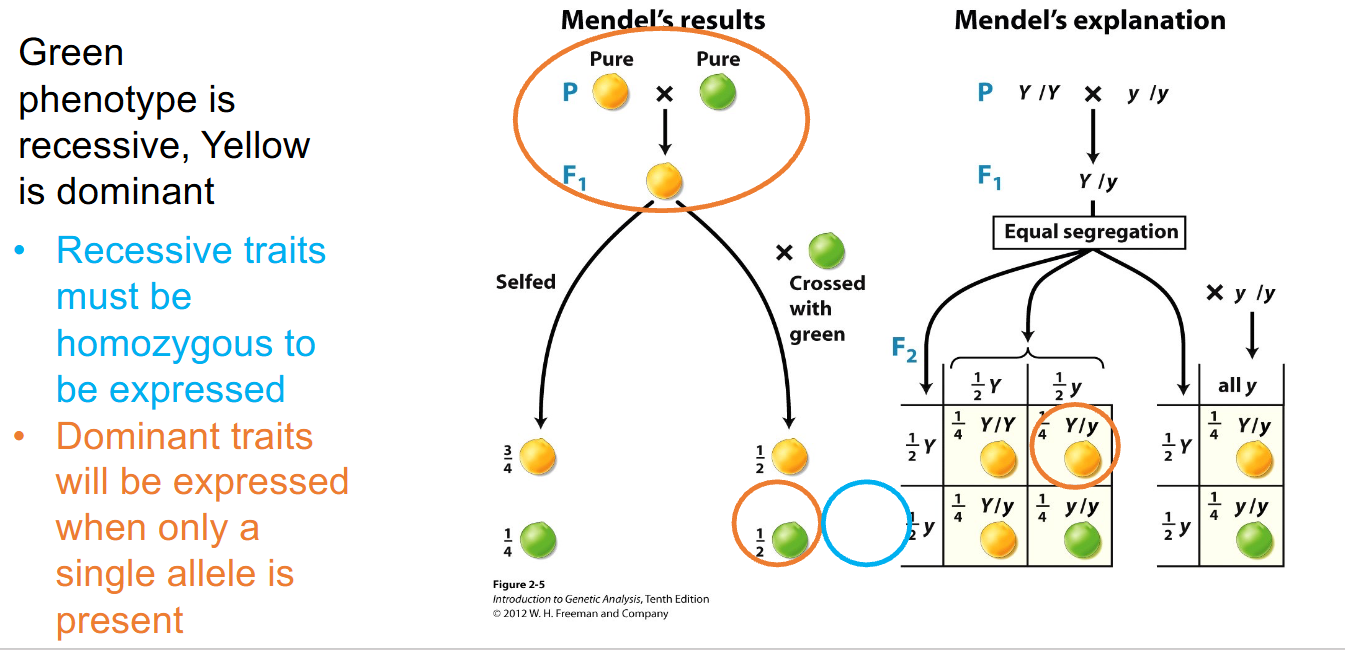
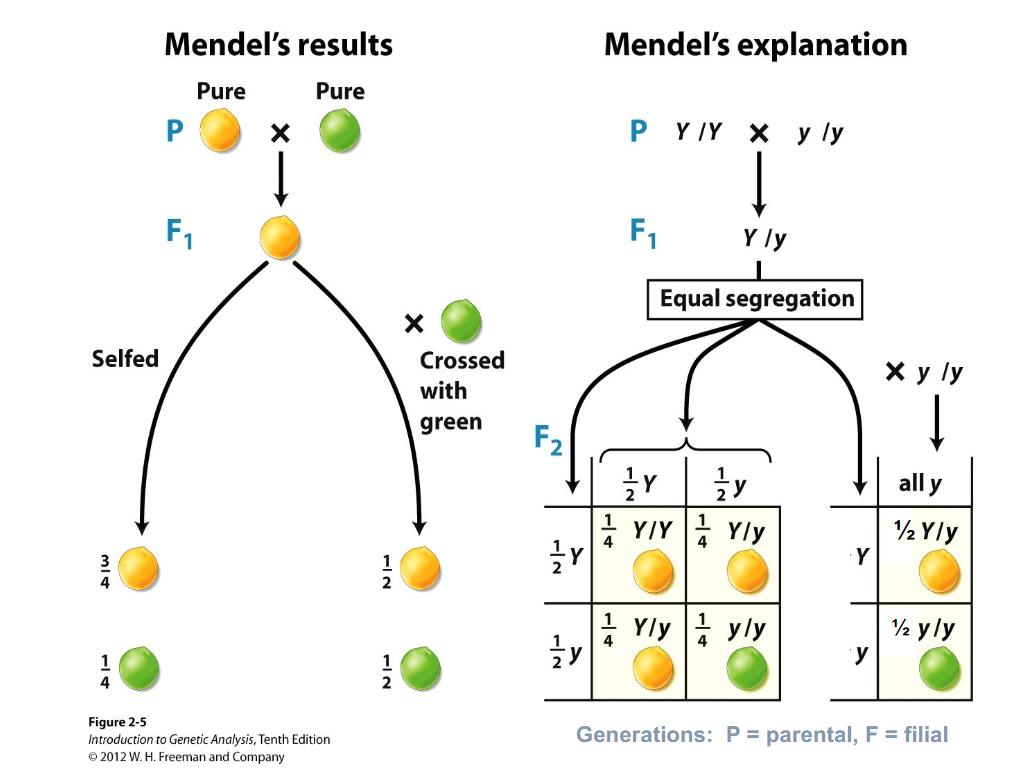
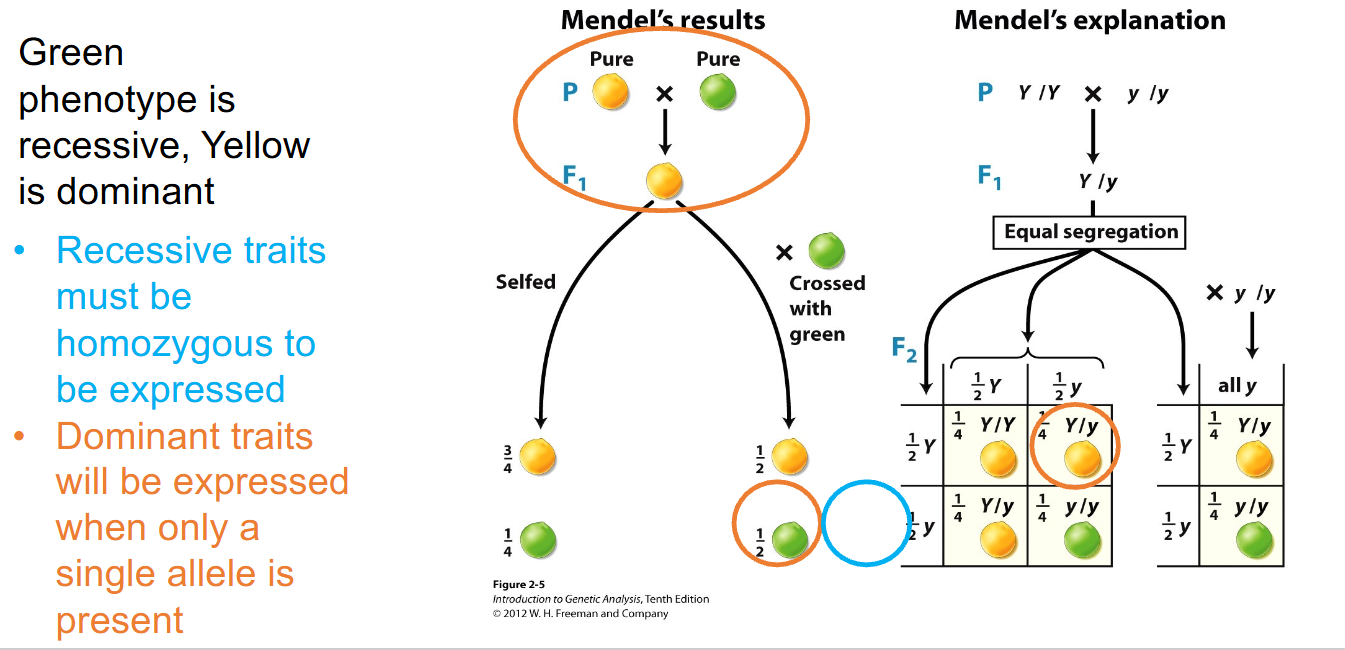
What should you identify in the Law of Dominance diagram?
- Pure yellow × pure green producing yellow F₁ offspring
- Yellow as dominant and green as recessive
- Y/y expressing yellow
- y/y expressing green
- F₁ self-cross producing 3/4 yellow and 1/4 green
- Test cross producing 1/2 yellow and 1/2 green
What is a Punnett square used for?
A Punnett square:
- Lists the possible gametes from each parent
- Combines parental gametes to show possible offspring genotypes
- Predicts genotype and phenotype probabilities for offspring
It does not guarantee the outcome of any individual pregnancy; it gives expected probabilities.
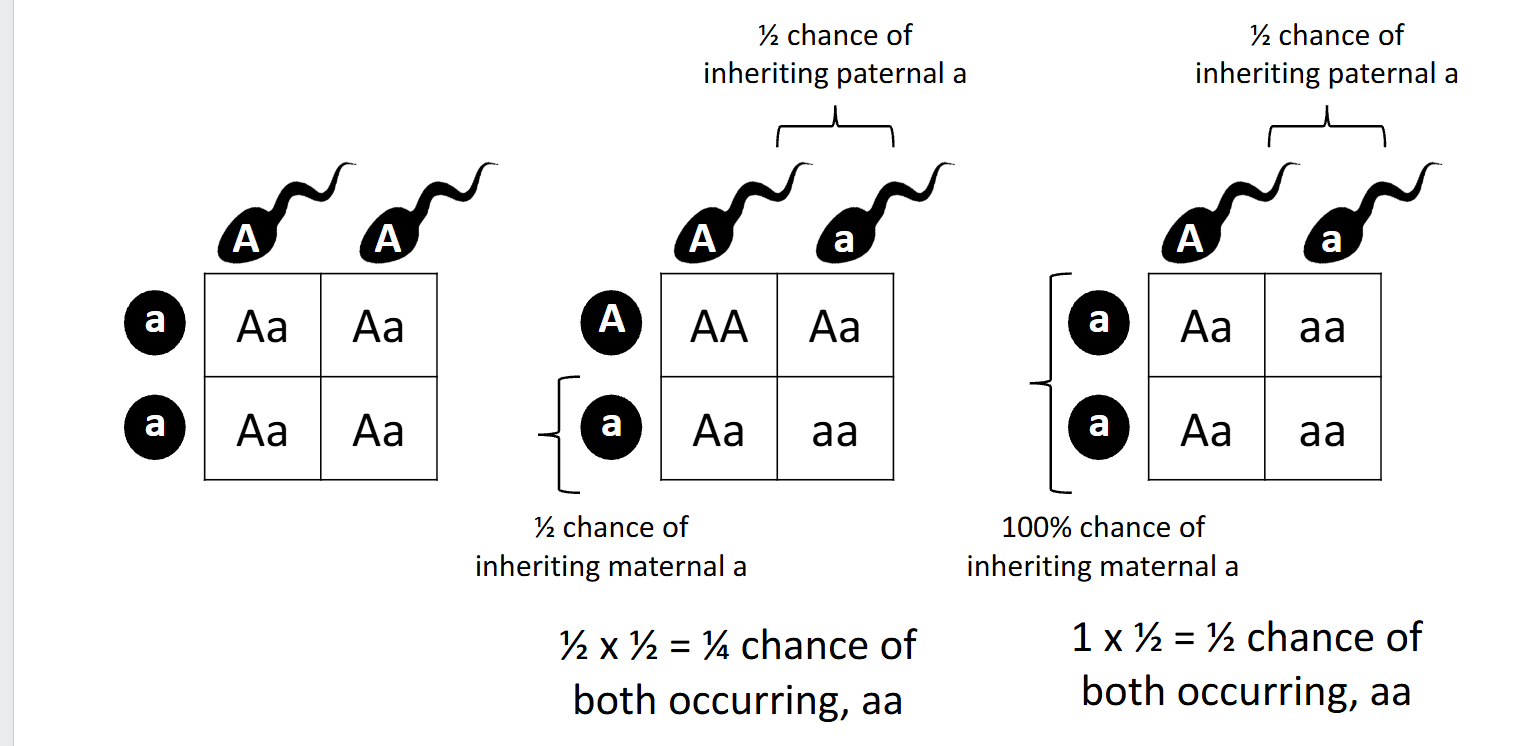
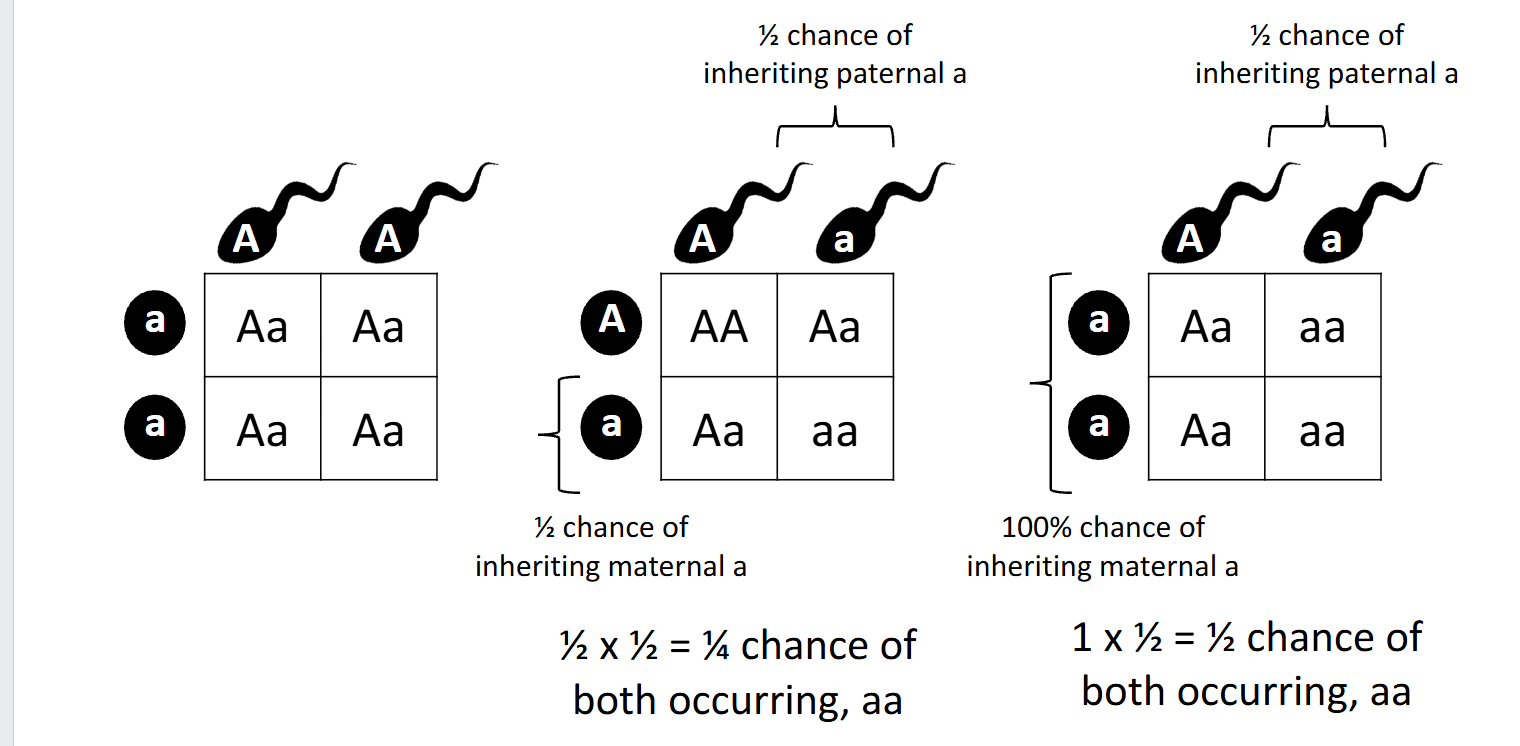
What offspring are predicted from AA × aa?
Gametes:
- AA parent produces only A gametes.
- aa parent produces only a gametes.
Offspring:
- 100% Aa
- All are heterozygous
- Under complete dominance, all show the dominant phenotype.
What offspring are predicted from Aa × Aa?
Genotype probabilities:
- 1/4 AA
- 1/2 Aa
- 1/4 aa
Under complete dominance, phenotype probabilities are:
- 3/4 dominant phenotype
- 1/4 recessive phenotype
Probability reasoning:
- Chance of paternal a = 1/2
- Chance of maternal a = 1/2
- Chance of aa = 1/2 × 1/2 = 1/4
What offspring are predicted from Aa × aa?
Genotype probabilities:
- 1/2 Aa
- 1/2 aa
Under complete dominance, phenotype probabilities are:
- 1/2 dominant phenotype
- 1/2 recessive phenotype
Probability reasoning:
- Chance of a from the heterozygous parent = 1/2
- Chance of a from the homozygous recessive parent = 1
- Chance of aa = 1/2 × 1 = 1/2
What should you identify in the three Punnett-square examples?
- AA × aa → all Aa
- Aa × Aa → 1/4 AA, 1/2 Aa, 1/4 aa
- Aa × aa → 1/2 Aa, 1/2 aa
- Parental gametes on the margins
- Offspring genotypes inside the squares
- Multiplication of independent probabilities to calculate aa
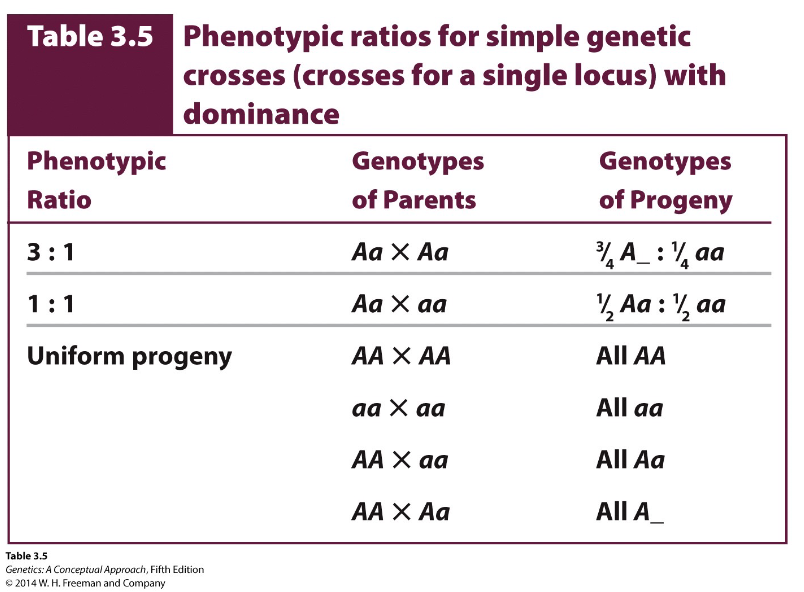
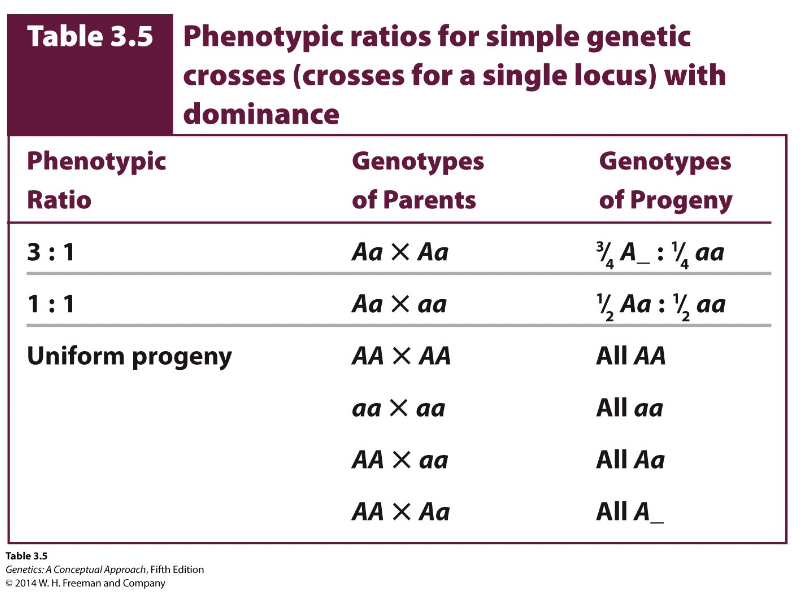
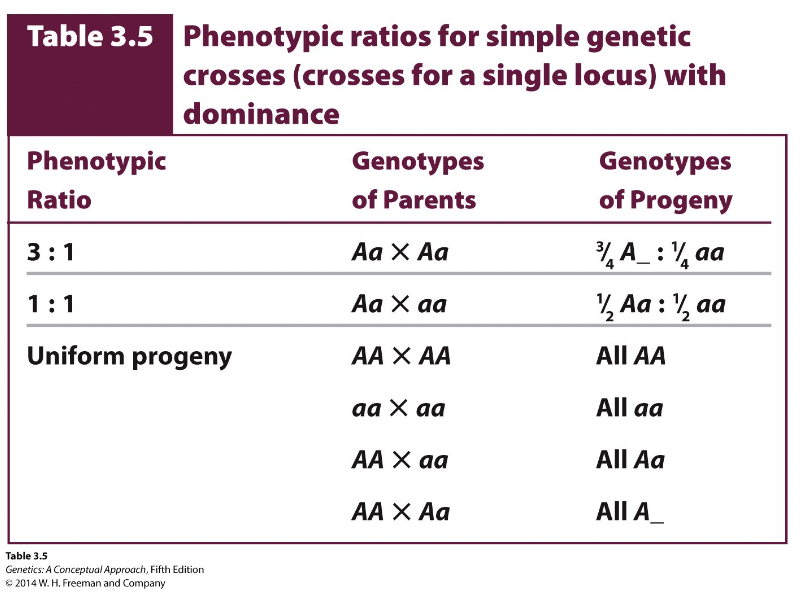
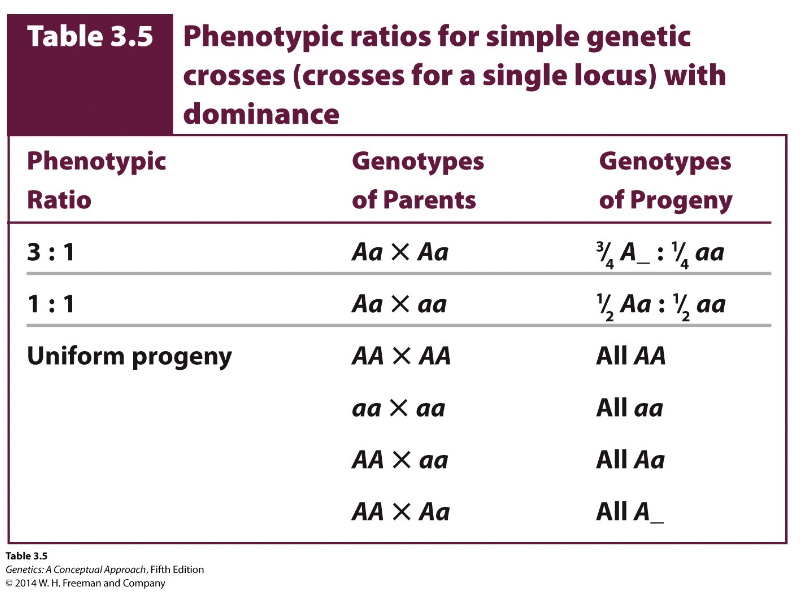
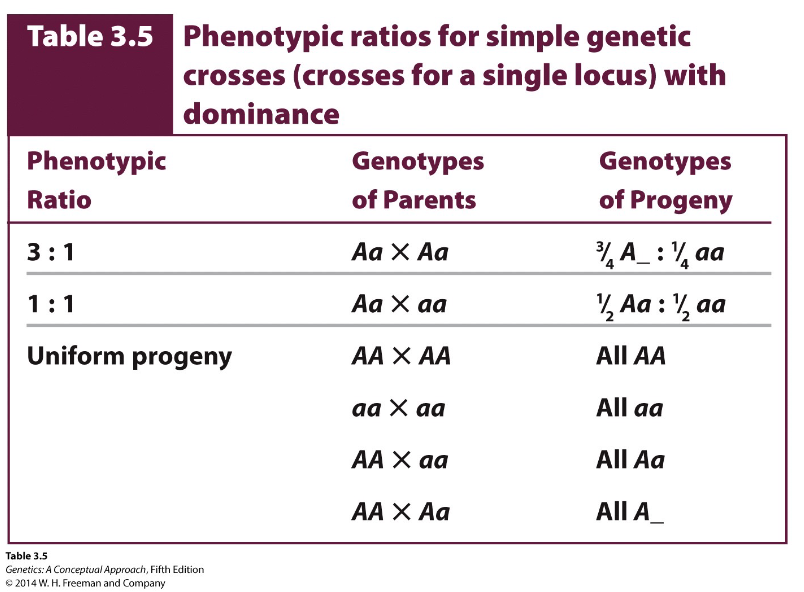
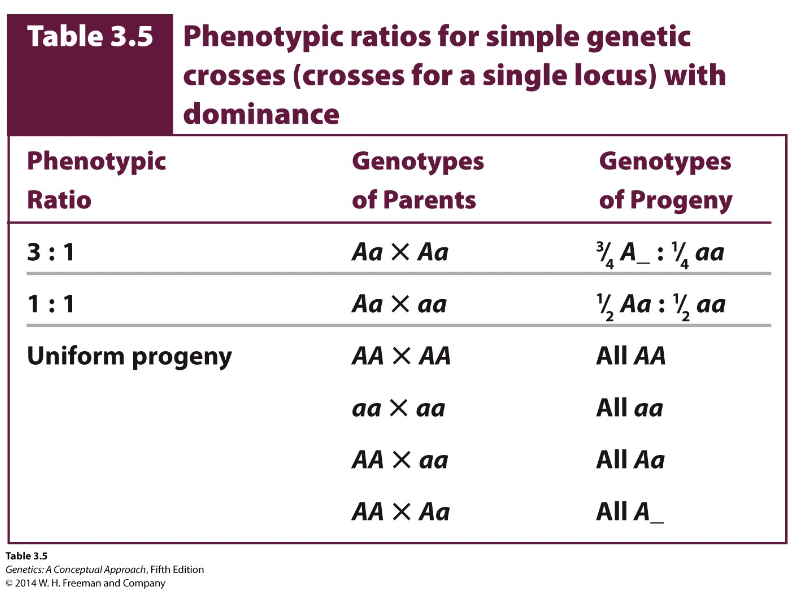
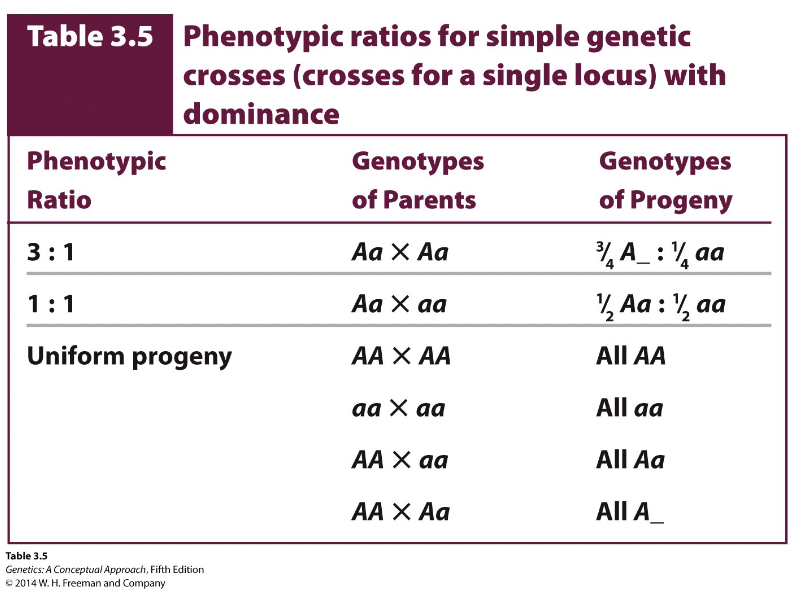
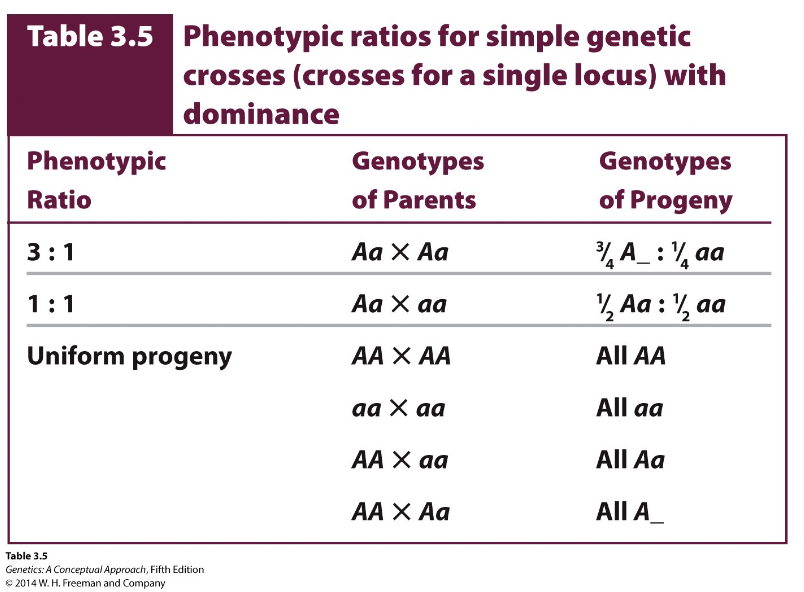
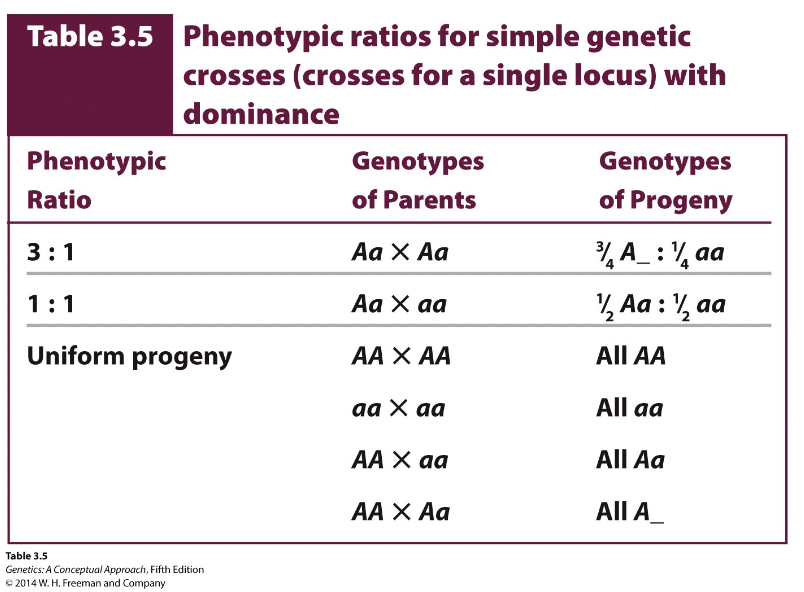
What phenotypic and genotypic ratios occur in common single-locus crosses with complete dominance?
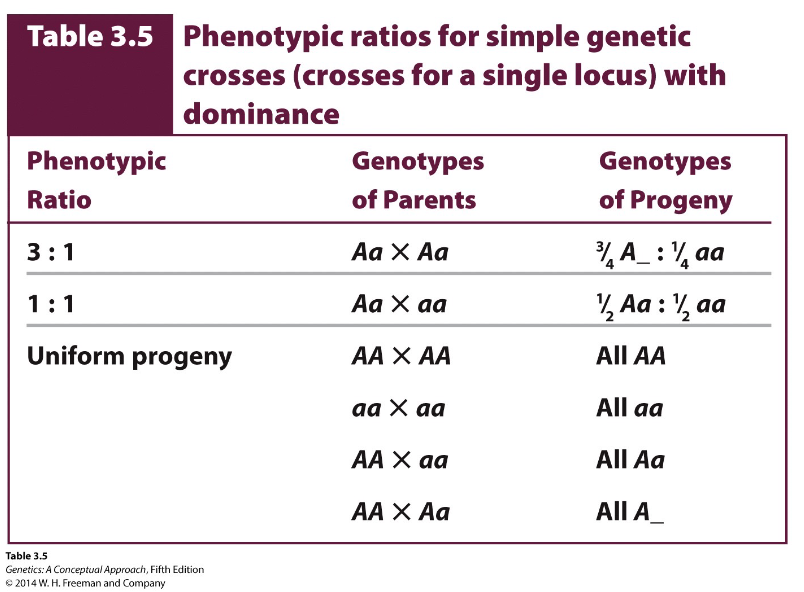
Aa × Aa:
- Phenotype: 3 dominant : 1 recessive
- Genotype: 1/4 AA, 1/2 Aa, 1/4 aa
Aa × aa:
- Phenotype: 1 dominant : 1 recessive
- Genotype: 1/2 Aa, 1/2 aa
Uniform progeny examples:
- AA × AA → all AA
- aa × aa → all aa
- AA × aa → all Aa
- AA × Aa → all dominant phenotype, written A_
Was Mendel wrong because not every trait follows simple dominant-recessive inheritance?
No. Mendel identified important foundational principles from traits that followed relatively simple patterns.
.
However:
- Not every trait is completely dominant or recessive.
- Many traits have more complex inheritance patterns.
- Some genes are linked.
- Later material examines exceptions to the simplified Mendelian model.
Lecturer explanation:
Mendel's mathematical approach was innovative but unfamiliar and was not fully appreciated until after his death.
What is a Mendelian disease?
A Mendelian disease is a disorder in which a mutation in a single gene can cause the disease and the trait follows a recognisable inheritance pattern.
Different mutation types can still affect:
- How the disorder is inherited
- Which tissues carry the mutation
- Disease manifestation and severity
What are the three mutation categories compared in this lecture?
1. Germline mutation
2. Somatic mutation
3. De novo mutation
What is a germline mutation, and can it be inherited?
A germline mutation is a mutation present in the reproductive lineage or a gamete.
It:
- Can be passed to offspring
- Enters the offspring through the zygote
- Is then generally present in cells throughout the offspring's body
- Can often be tested using DNA from many different tissues
Example:
Inherited cancer predisposition involving BRCA1 or BRCA2.
What is a somatic mutation, and can it be inherited?
A somatic mutation arises in a non-reproductive body cell.
It:
- Is not inherited by offspring
- Is confined to the affected cell and its descendants
- Is not present in every tissue
- Can accumulate over time and contribute to cancer
- Can also arise during embryonic development and cause consequences other than cancer
What is a de novo mutation, and can it be inherited?
De novo means "new".
A de novo variant:
- Is not present in the parent's sampled somatic cells
- Appears for the first time in the offspring
- May arise in a parental sperm or ovum
- May arise in the zygote or early embryo
Future inheritance depends on where it arose:
- If the offspring's germline carries it, it may be passed on.
- If it is restricted to somatic cells, it will not be passed on.
How do germline, somatic and de novo mutations differ?
Germline mutation:
- Present in reproductive lineage
- Can be inherited
- Usually widespread through the offspring after fertilisation
.
Somatic mutation:
- Arises in non-reproductive cells
- Is not inherited
- Is limited to the affected cell lineage
.
De novo mutation:
- Newly arises in a gamete, zygote or early embryo
- Is absent from the parents' somatic cells
- May or may not be transmitted by the affected offspring, depending on germline involvement
Why are pedigrees useful when studying inherited disease?
Pedigrees:
- Display biological relationships within a family
- Help detect possible inheritance patterns
- Help estimate recurrence risks
- Allow likely genotypes or carrier states to be inferred
Accurate family history and clinical information are essential for reliable interpretation.
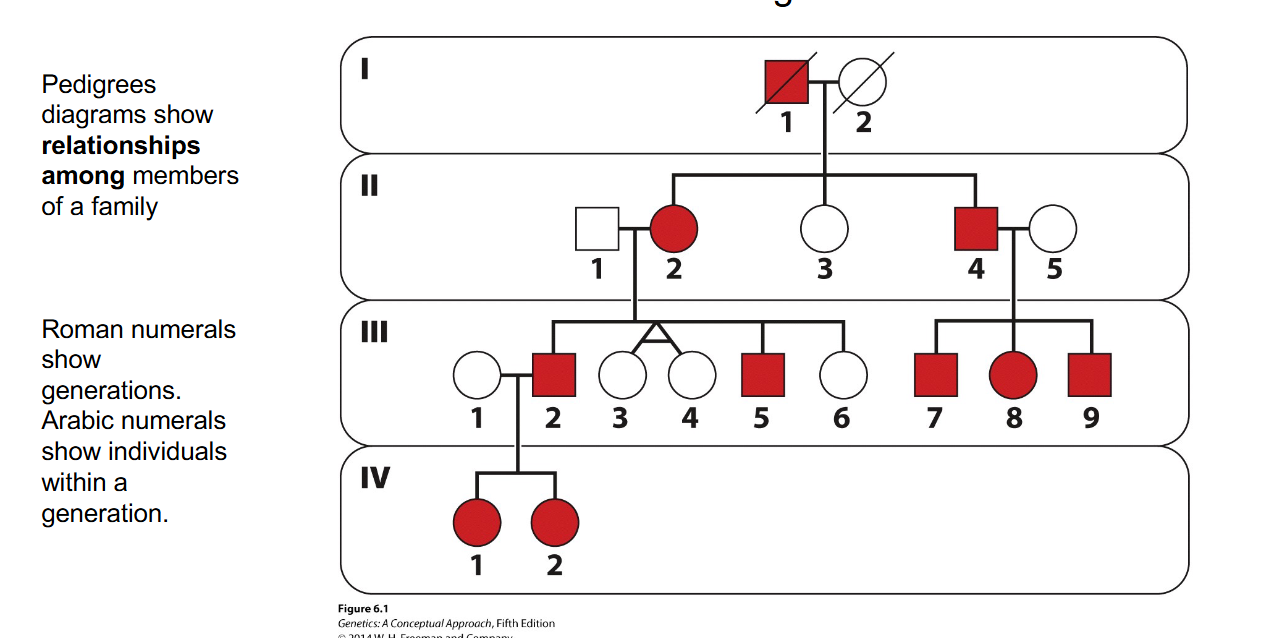
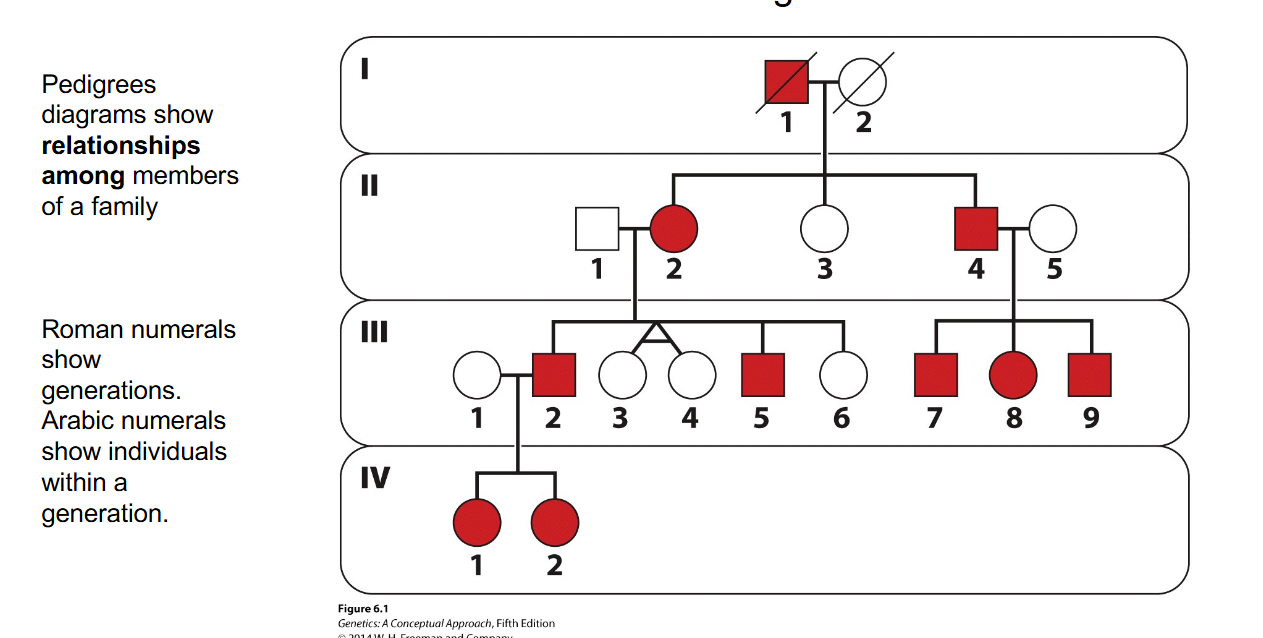
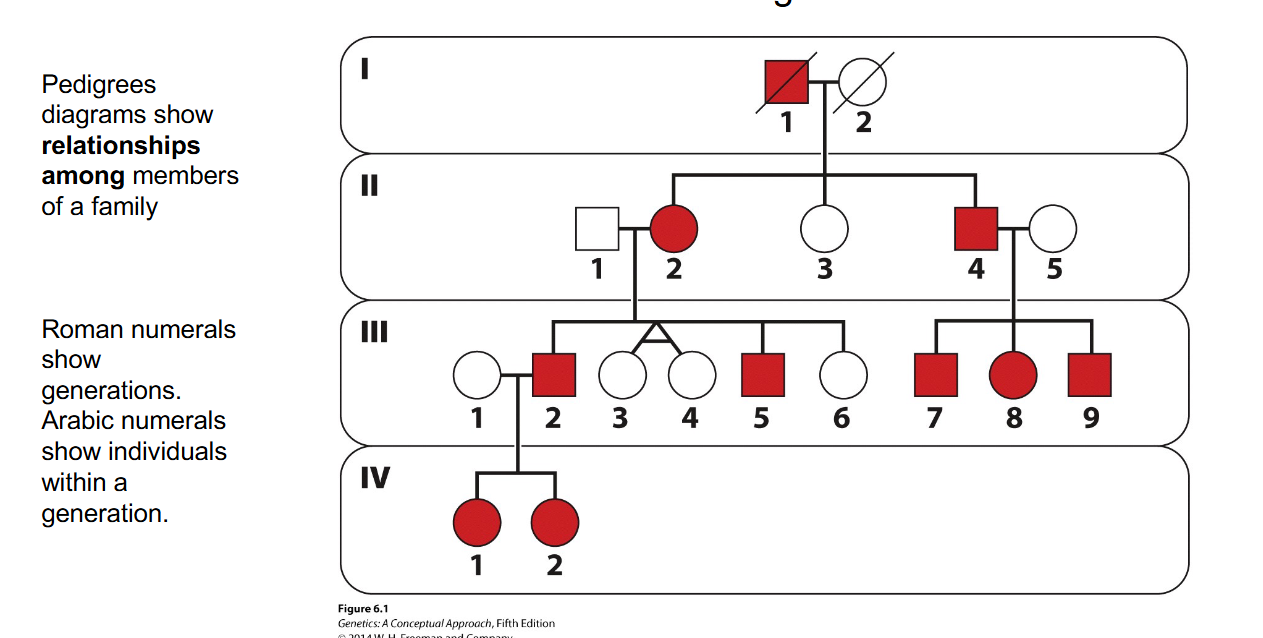
How are people and generations labelled in a pedigree?
- Roman numerals identify generations, such as I, II and III.
- Arabic numerals identify individuals within each generation.
- A person can therefore be identified as II-2, III-4 and so on.
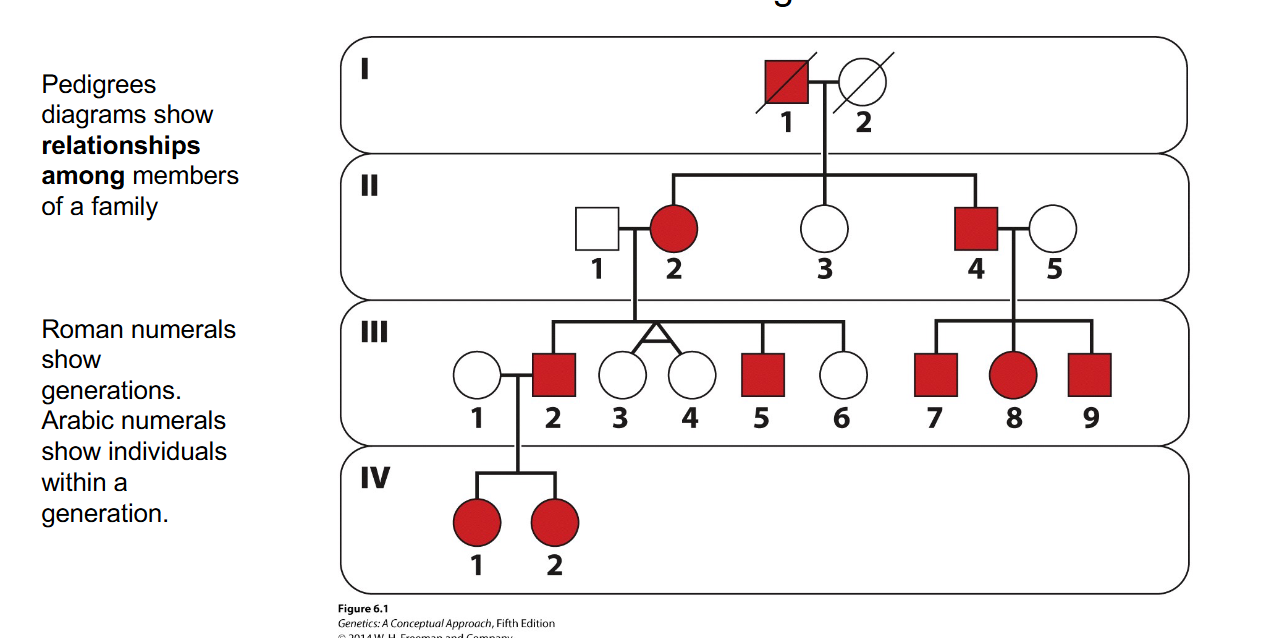
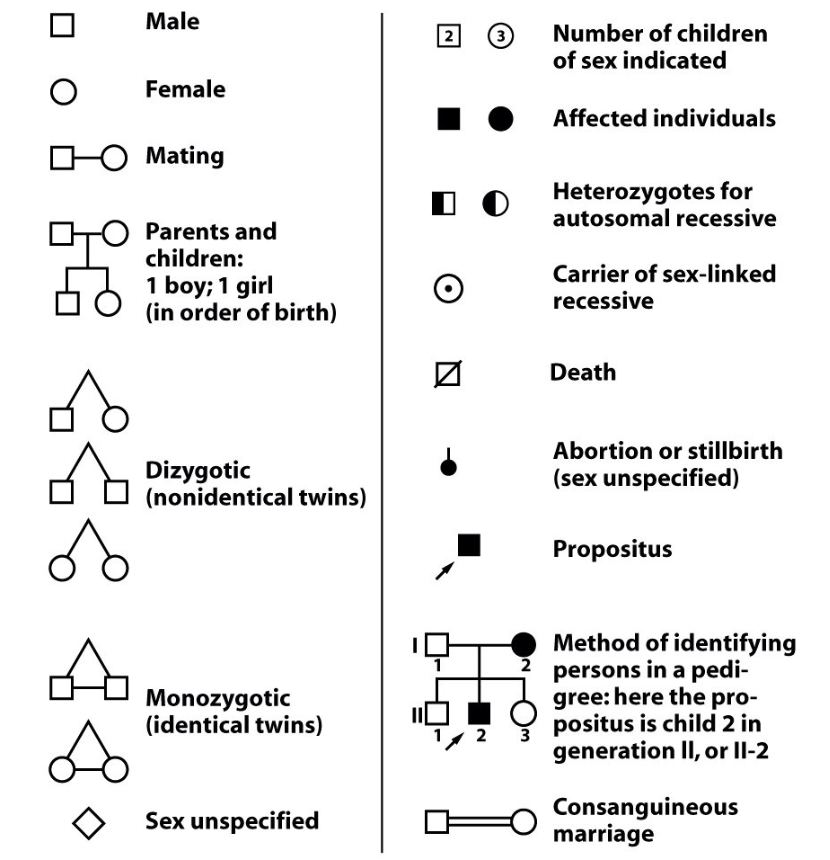
What are the basic pedigree symbols for sex, mating, descent and affection status?
- Square: genetic male
- Circle: genetic female
- Diamond: sex unspecified
- Horizontal line between two individuals: mating or union
- Vertical descent line: offspring relationship
- Filled symbol: affected individual
- Slash through a symbol: deceased individual
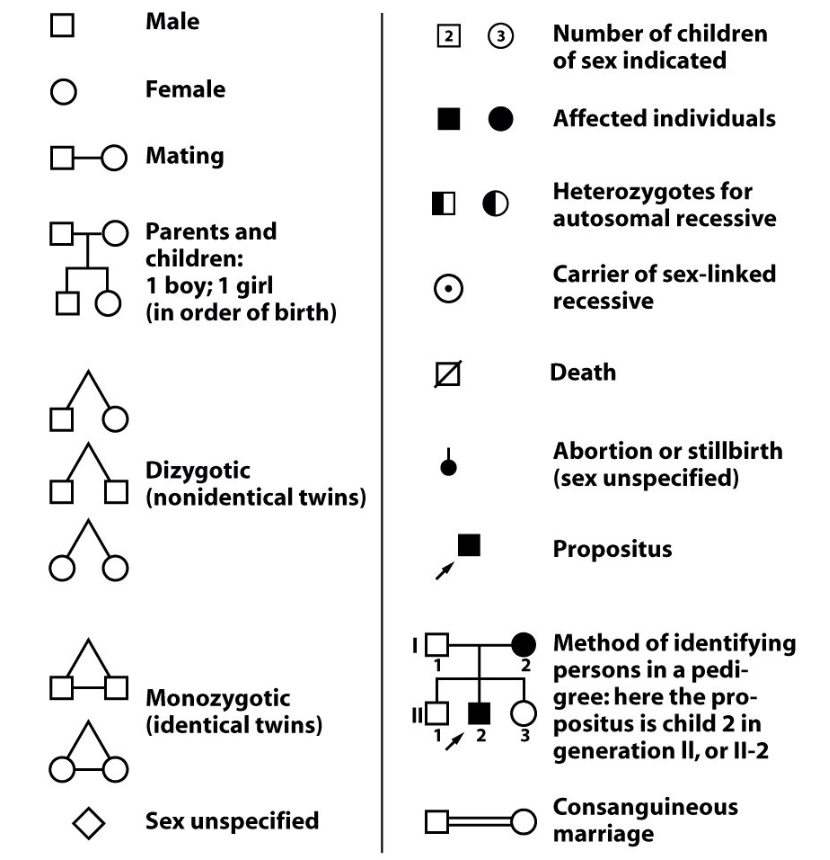
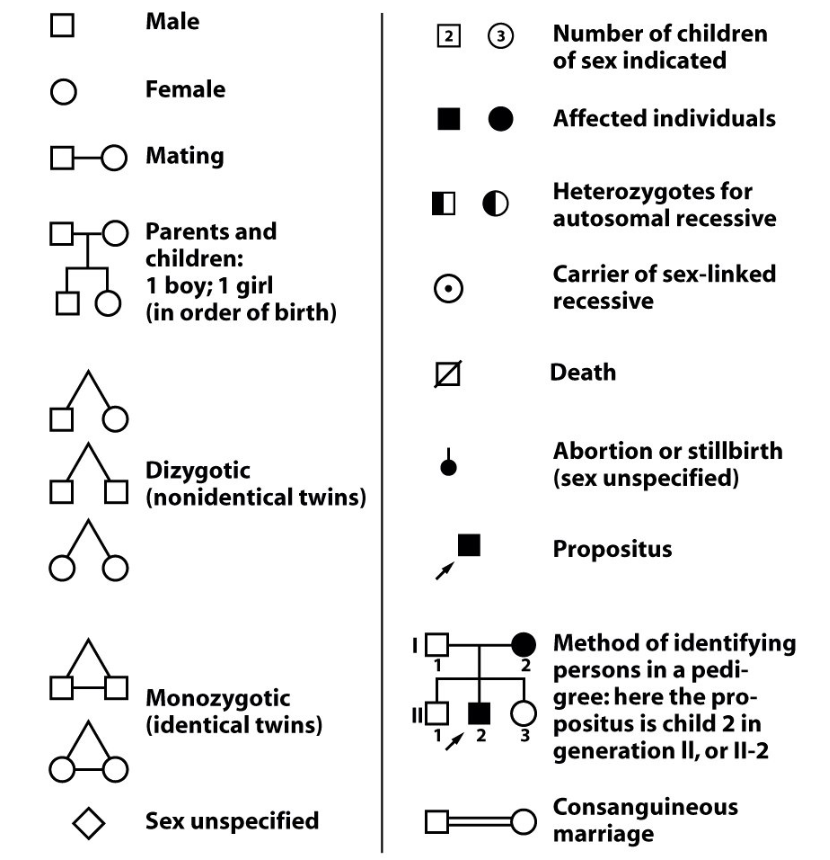
What pedigree symbols represent twins, carriers and multiple children?
Twins:
- Two diagonal lines from one branching point
- Dizygotic twins have no connecting line between the twin symbols
- Monozygotic twins have a connecting line between them
Carriers:
- Half-filled symbol: heterozygote for an autosomal recessive trait
- Dot in a circle: carrier of a sex-linked recessive allele
Multiple children:
- A number inside a square or circle indicates the number of children of the indicated sex.
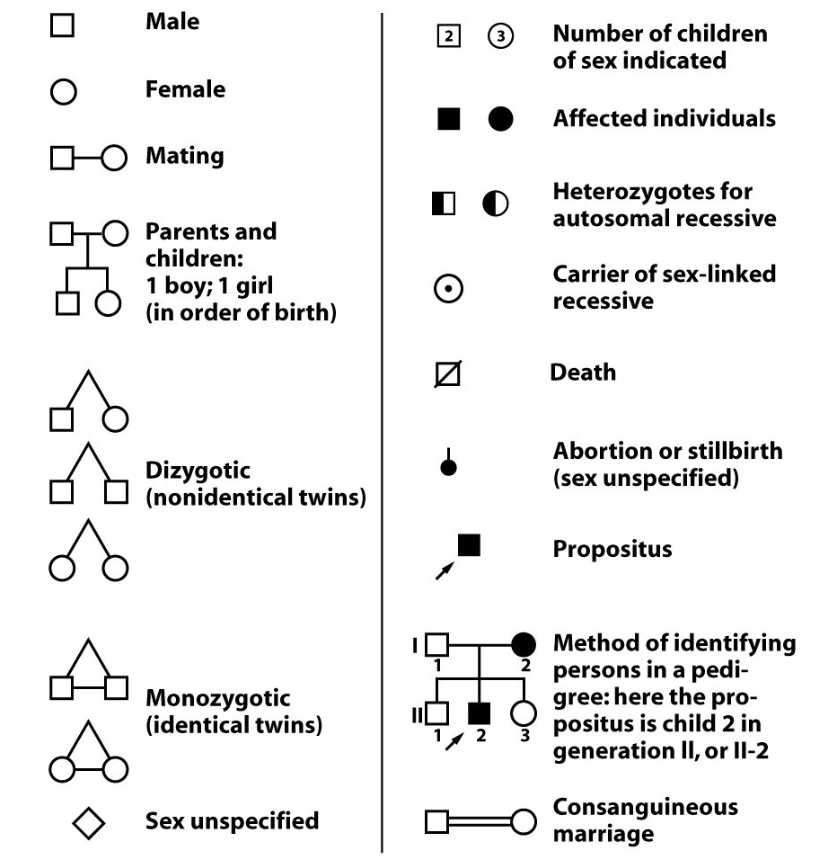
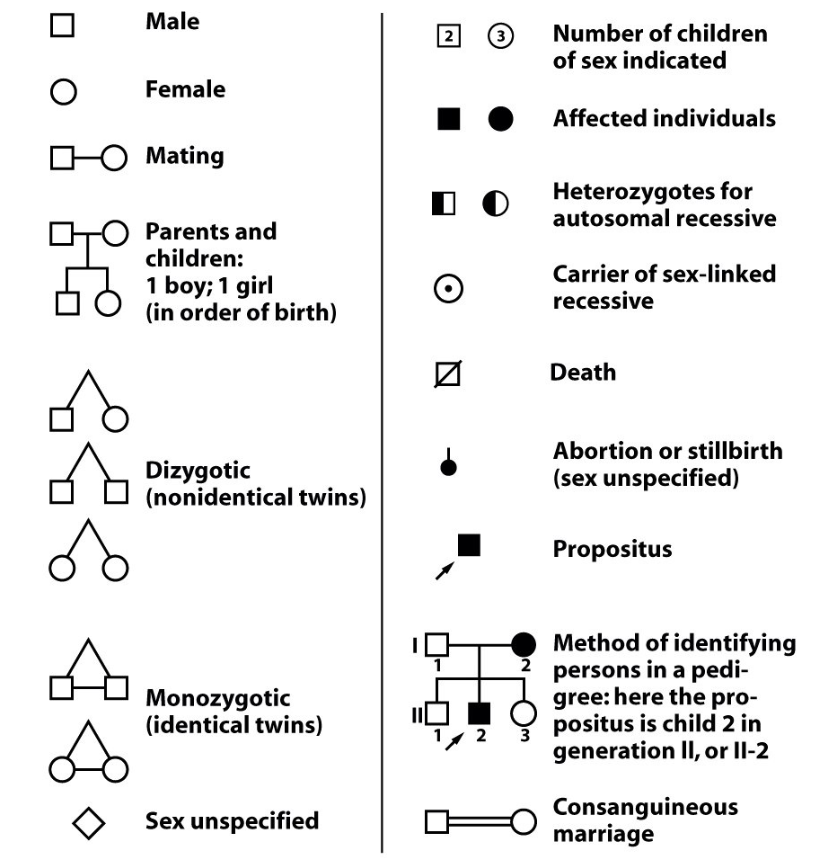
What do propositus/proband, consanguinity, abortion and stillbirth symbols mean in a pedigree?
Propositus or proband:
- The first person investigated in a family study
- The person through whom family relationships are referenced
- Marked by an arrow
Consanguineous union:
- Mating between related individuals
- Shown with a double horizontal line
Abortion or stillbirth:
- Represented by a small filled symbol on a descent line when sex is unspecified, as shown in the lecture key.
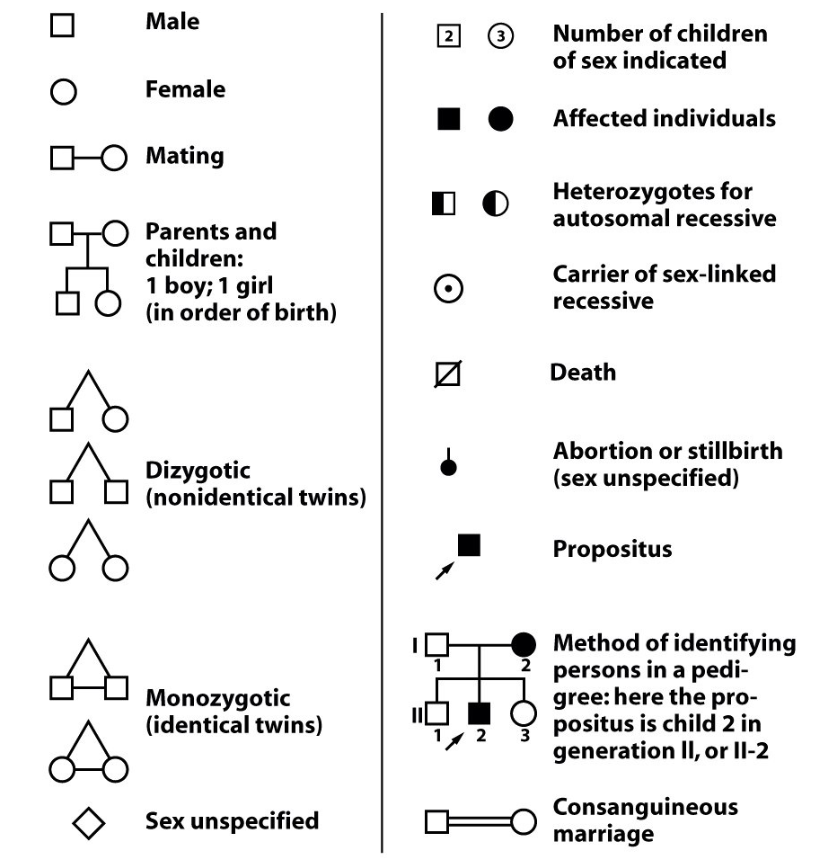
What should you identify in the pedigree-symbol key?
- Male, female and sex-unspecified symbols
- Mating and parent-child lines
- Birth order
- Dizygotic and monozygotic twins
- Number of children of a specified sex
- Affected individuals
- Autosomal-recessive heterozygotes
- Sex-linked recessive carriers
- Death
- Abortion or stillbirth
- Propositus/proband arrow
- Consanguineous union
- Roman generation numbers and Arabic individual numbers
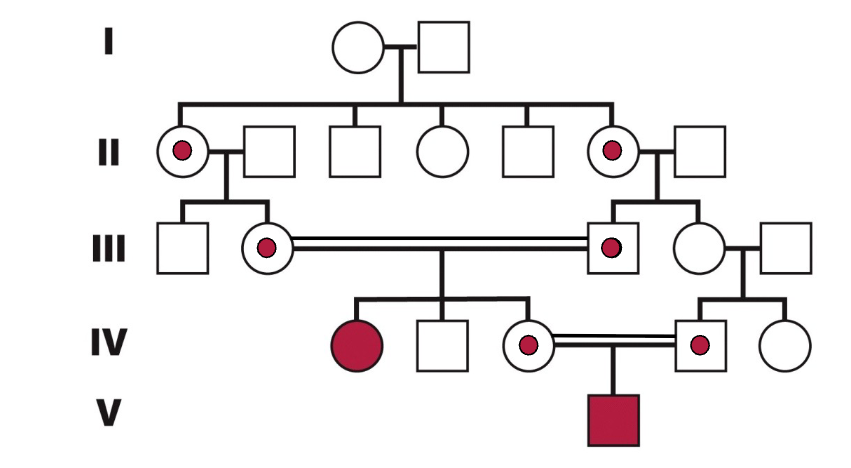
What pattern suggests autosomal recessive inheritance in a pedigree?
- Affected individuals may have unaffected parents.
- Affected individuals are homozygous recessive.
- Heterozygous individuals are unaffected carriers under the simple model.
- The trait may appear to skip generations.
- The pedigree can be worked backwards to infer likely carriers.
- heterozygous for trait = carrier
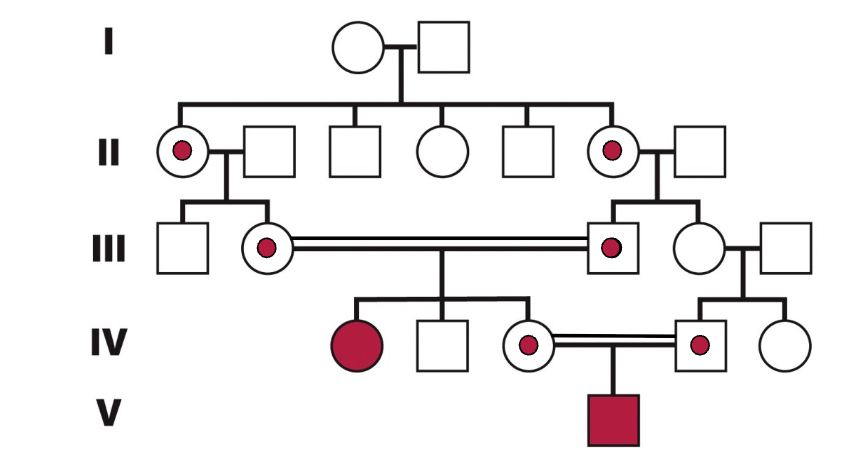
What should you identify in the recessive-trait pedigree?
- Affected individuals with homozygous recessive genotypes
- Unaffected heterozygous carriers
- Affected offspring born to unaffected carrier parents
- The use of carrier symbols to infer transmission through generations
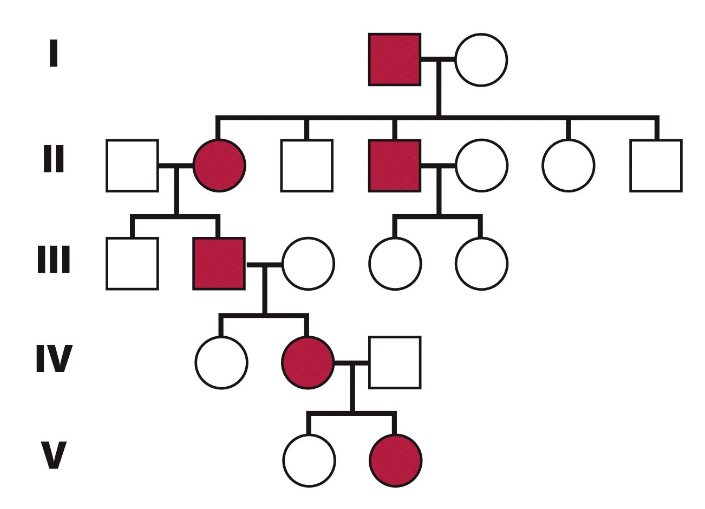
What pattern suggests autosomal dominant inheritance in a pedigree?
- One dominant allele is sufficient to produce the trait.
- Affected individuals are generally expected to have at least one affected parent.
- The trait commonly appears in successive generations.
- If an affected person is heterozygous and the partner is unaffected, each child has a 1/2 probability of inheriting the condition.
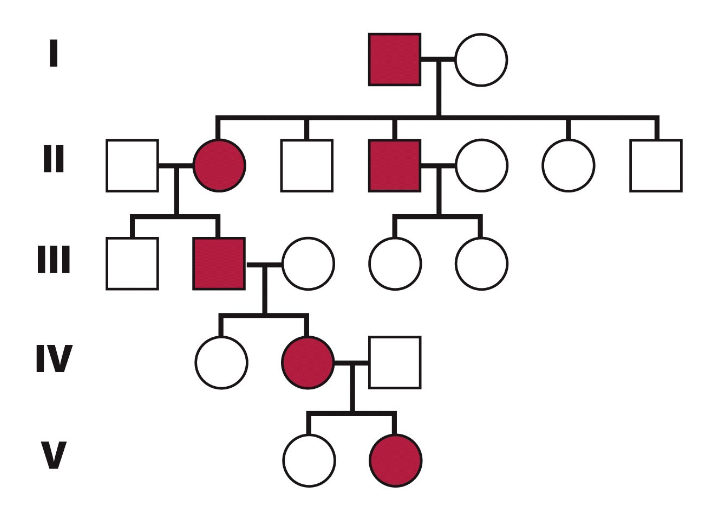
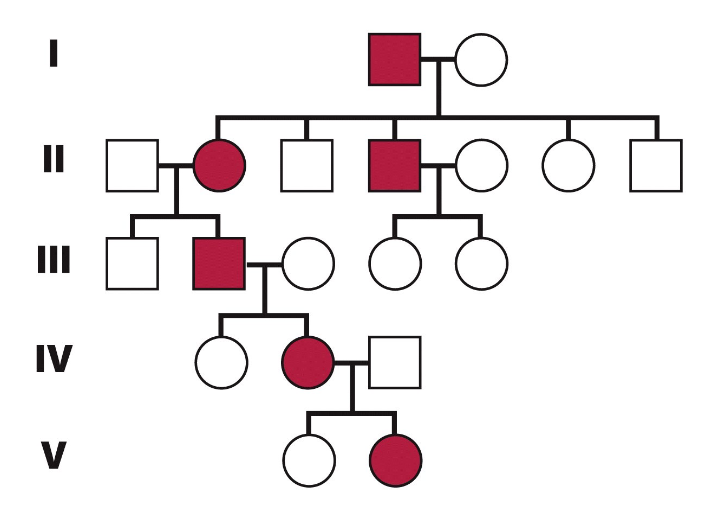
Why are many people with harmful dominant traits expected to be heterozygous?
If a dominant condition reduces viability or fertility, individuals carrying two dominant alleles may be less likely to survive or reproduce.
Therefore, many affected individuals are heterozygous and, with an unaffected partner, are expected to transmit the condition to approximately half their children.
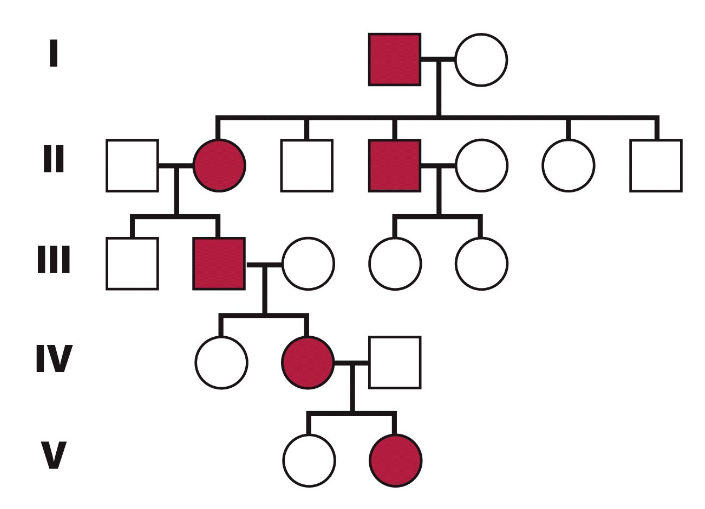
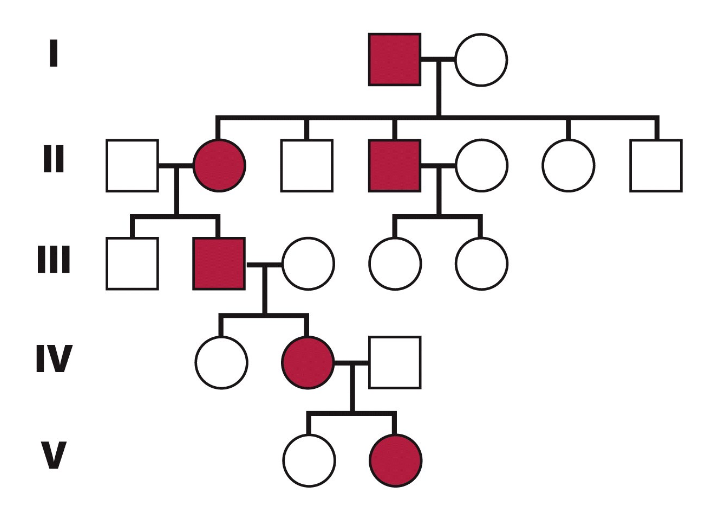
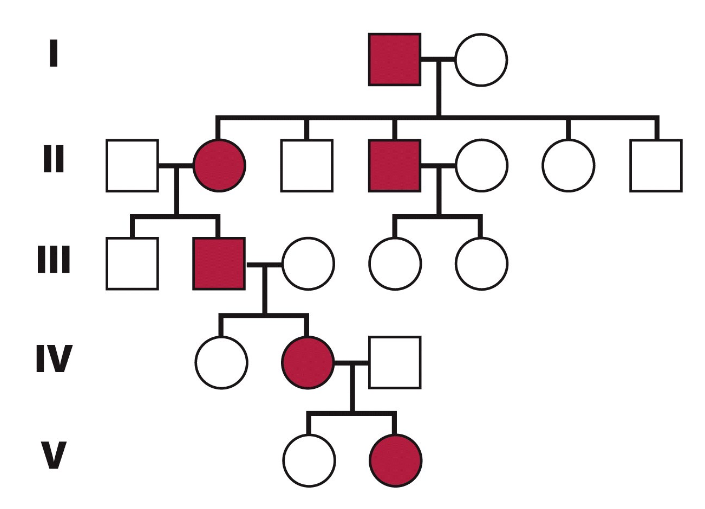
What should you identify in the dominant-trait pedigree?
- Affected individuals in successive generations
- At least one affected parent for each affected person under the simple model
- Both males and females affected
- Approximate 1/2 transmission from a heterozygous affected parent to children
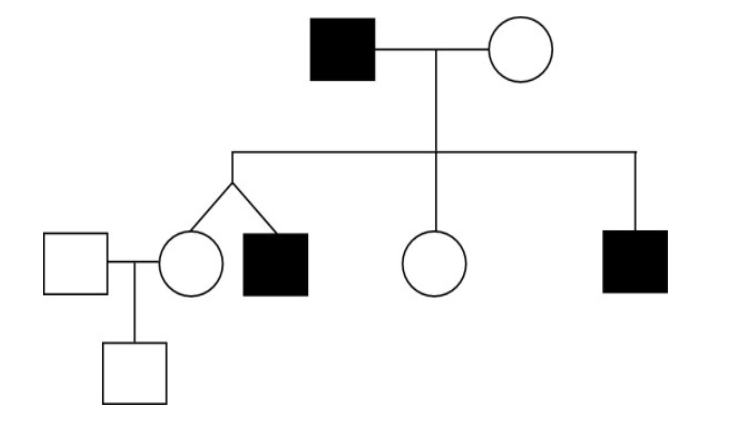
Why can the mode of inheritance be difficult to determine from a pedigree?
Pedigrees may contain:
- Only a small number of individuals
- Few generations
- Unknown genotypes
- Uncertain or incomplete affection status
- Missing or unavailable relatives
- Inaccurate or incomplete family history
As a result, several inheritance models may fit the same observed family.
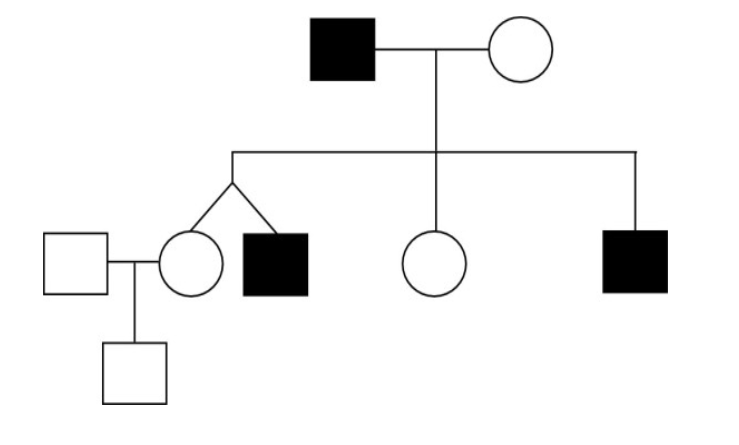
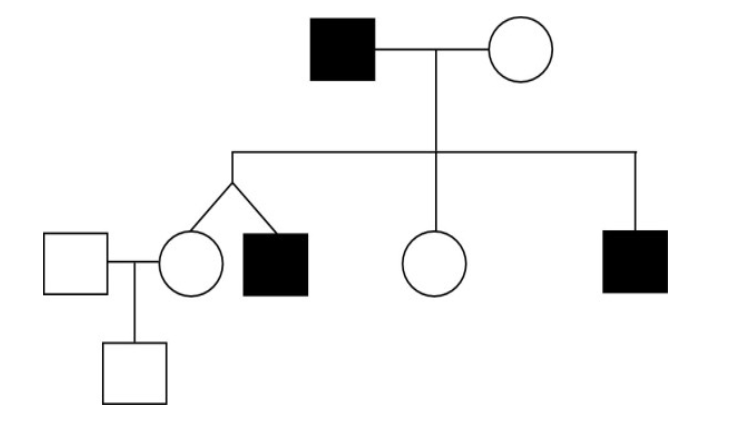
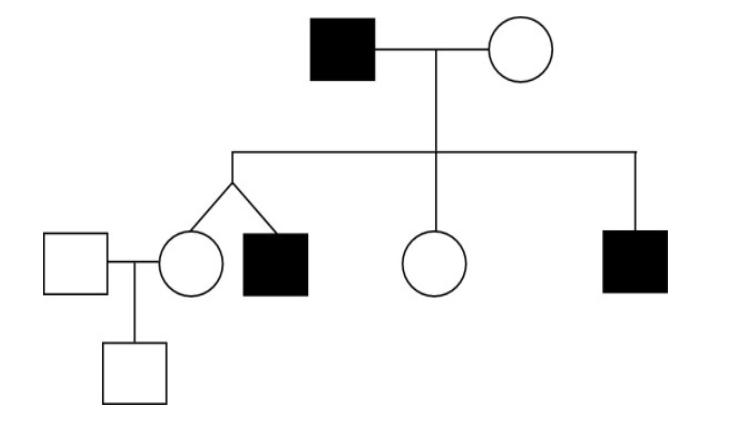
What is the mode of inheritance in the pedigree on Slide 23?
Correct answer:
The mode of inheritance cannot be determined definitively from the pedigree alone.
Why:
- The family is small.
- Only a few generations are shown.
- Genotypes are unknown.
- More than one inheritance pattern can explain the affected individuals.
Lecturer explanation:
Accurate family history and clinical information are essential.
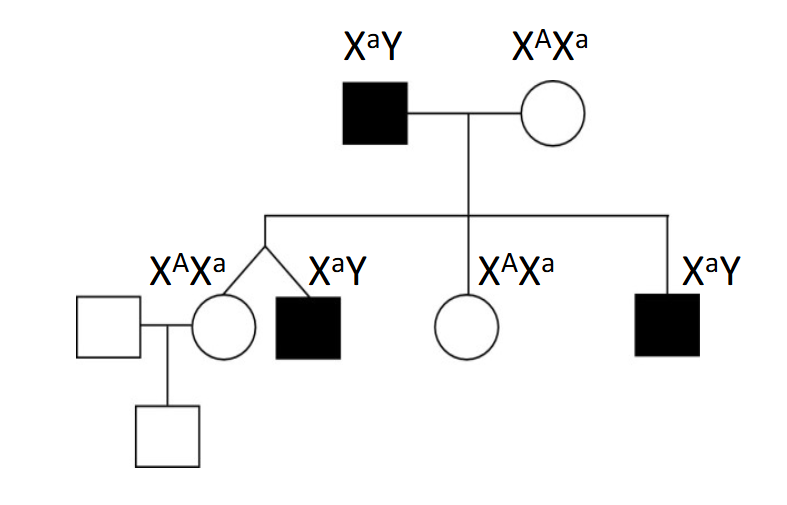
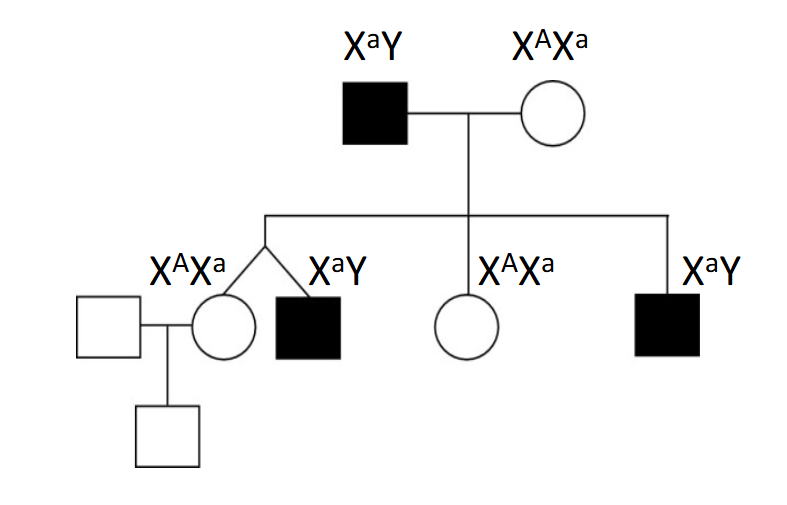
How can the Slide 23 pedigree be explained by X-linked recessive inheritance?
Possible X-linked recessive model:
- The affected father is XᵃY.
- The mother is treated as XᴬXᵃ.
- Males are hemizygous because they have only one X chromosome.
- A male inheriting Xᵃ is affected.
.
Correct interpretation:
X-linked recessive inheritance is compatible with the pedigree but is not proven by it.
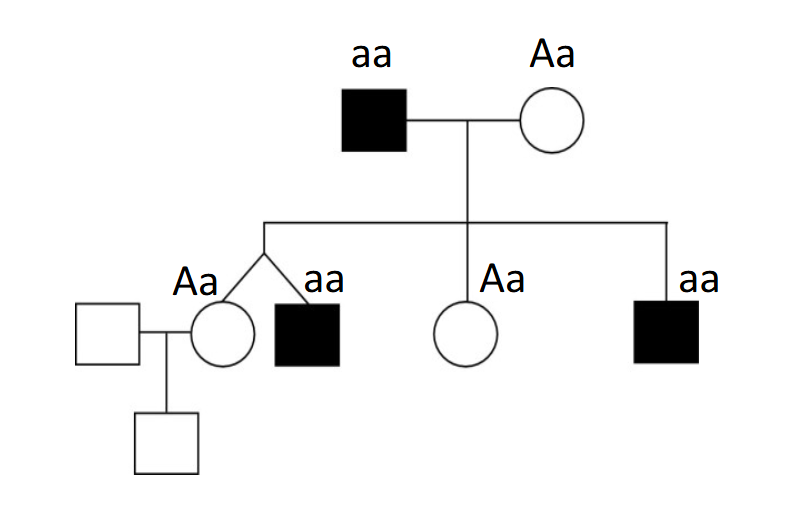
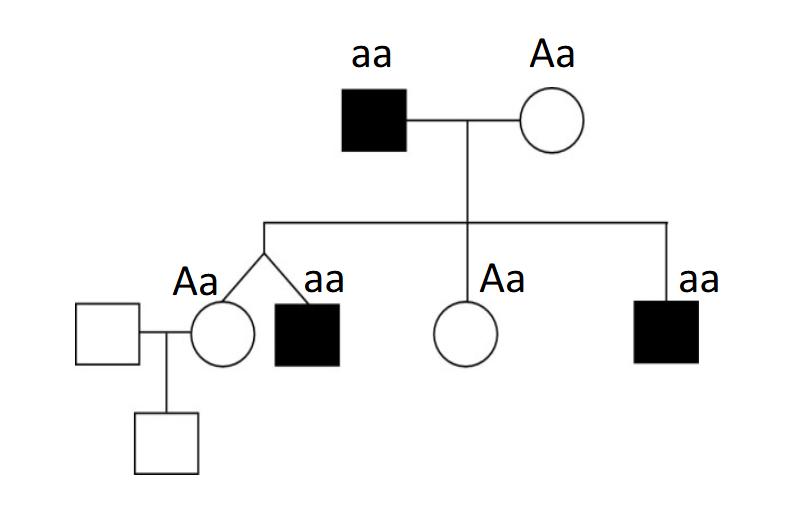
How can the same pedigree be explained by autosomal recessive inheritance?
Possible autosomal recessive model:
- Affected father: aa
- Carrier mother: Aa
- Cross aa × Aa
- Expected offspring: 1/2 aa affected and 1/2 Aa carriers
Correct interpretation:
Autosomal recessive inheritance is compatible with the pedigree but is not proven by it.
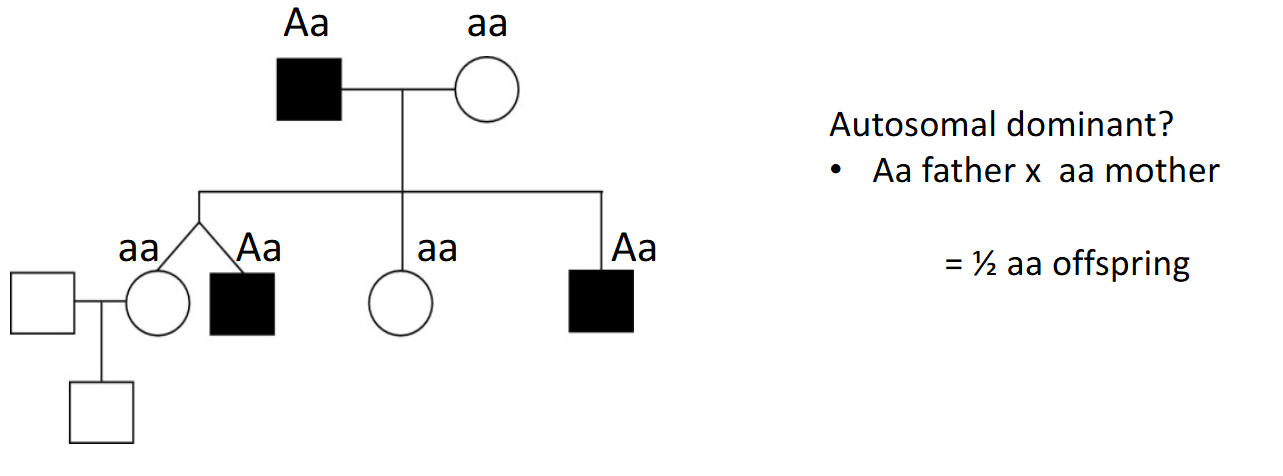
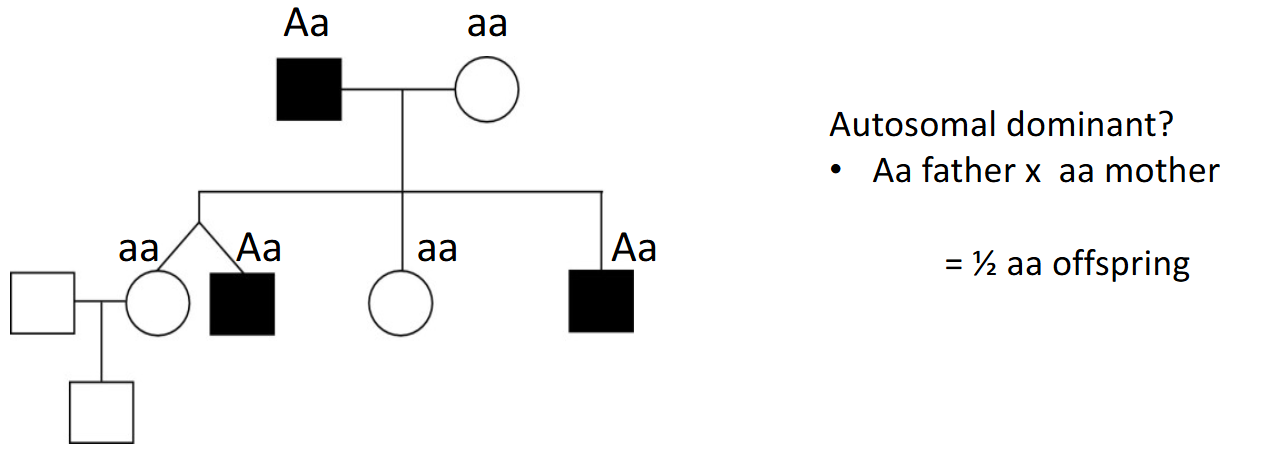
How can the same pedigree be explained by autosomal dominant inheritance?
Possible autosomal dominant model:
- Affected father: Aa
- Unaffected mother: aa
- Cross Aa × aa
- Expected offspring: 1/2 Aa affected and 1/2 aa unaffected
Correct interpretation:
Autosomal dominant inheritance is compatible with the pedigree but is not proven by it.
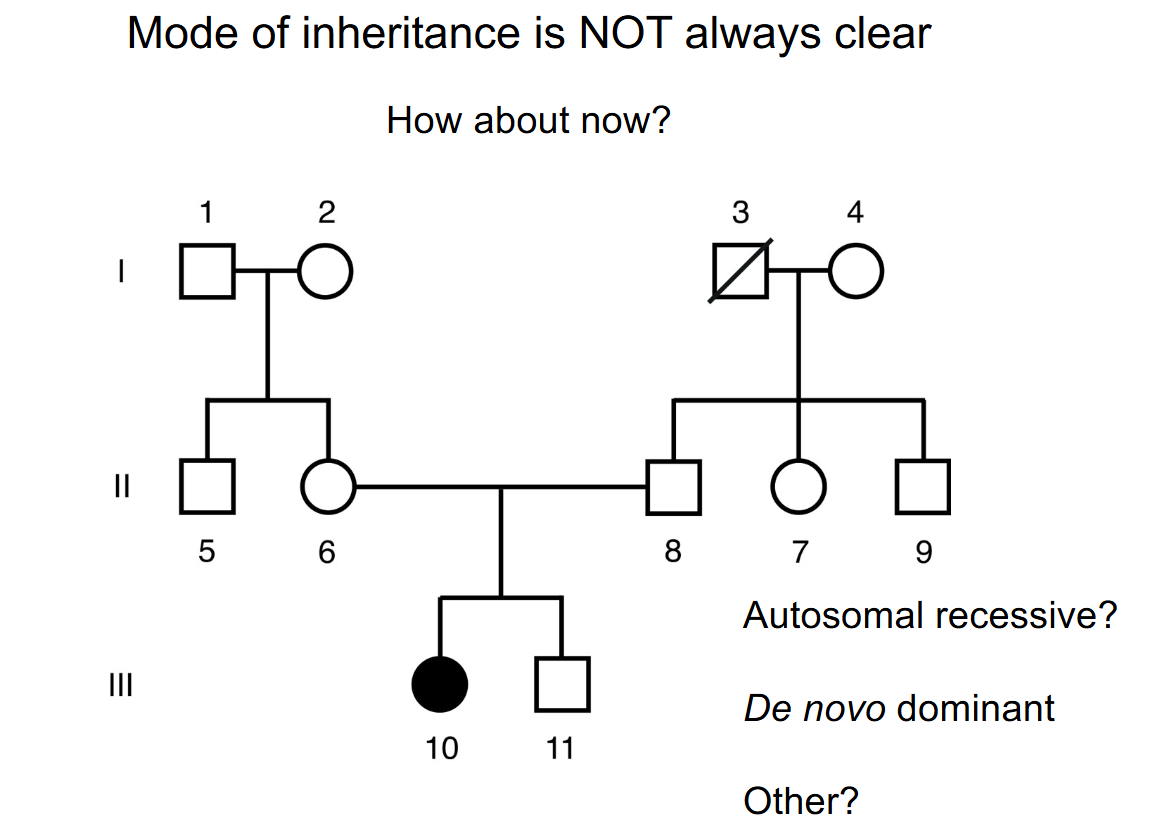
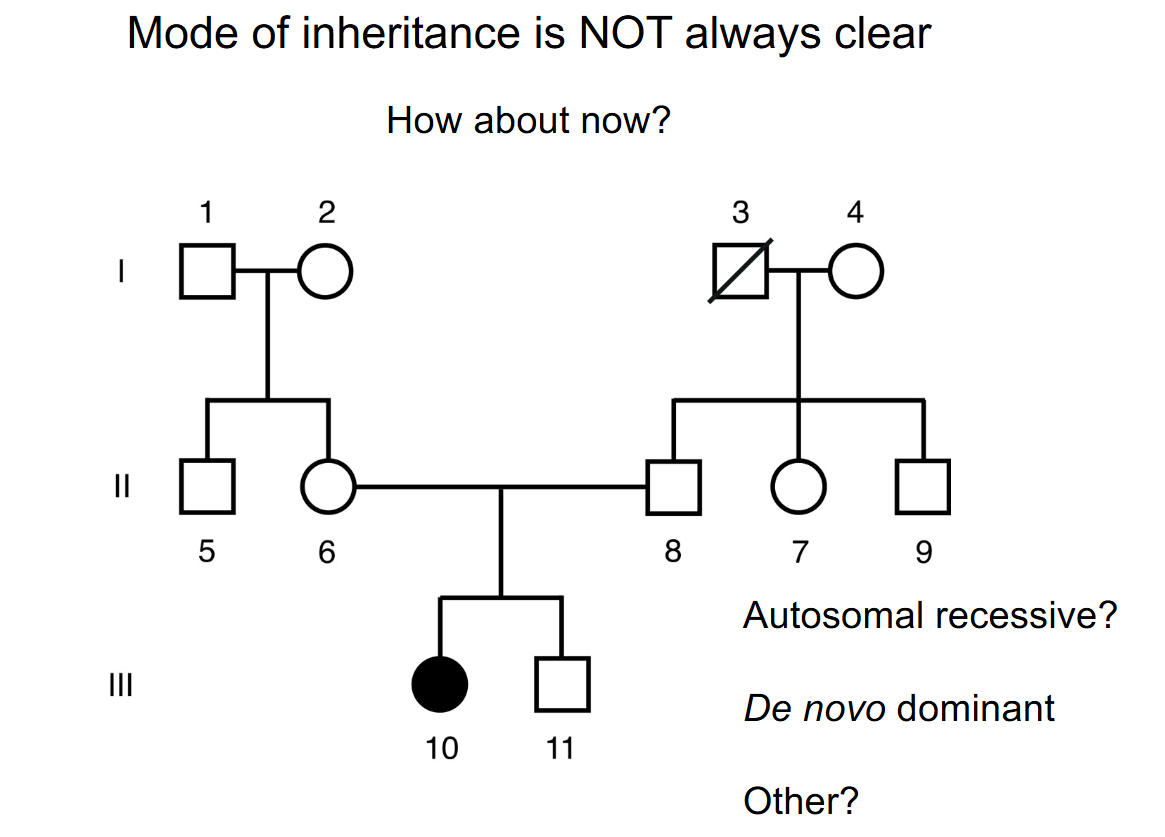
A pedigree shows one affected child born to unaffected parents.
.
Which explanation is correct?
A. Autosomal recessive
B. De novo dominant
C. Another mechanism
Correct answer:
The mode of inheritance cannot be determined definitively from the pedigree alone.
Why each option remains possible:
A. Autosomal recessive: both unaffected parents could be carriers, allowing an affected child.
B. De novo dominant: a new dominant mutation could arise in the affected child.
C. Another mechanism: limited pedigree data or more complex biology could produce the same observation.
Lecturer explanation:
Rare disorders often provide too little family information to assign a mode confidently.