Geoscience exam 1
 Call Kai
 Learn
Learn Practice Test
 Spaced Repetition
 Match
Match Flashcards
 Knowt Play
1/53

There's no tags or description
Looks like no tags are added yet.
Name | Mastery | Learn | Test | Matching | Spaced | Call with Kai | Chat |
|---|
No analytics yet
Send a link to your students to track their progress
54 Terms
Environmental Science
The interactions and impacts between the biological, chemical, and physical components of the environment and humanity
Sustainability
The quality of not being harmful to the environment or depleting natural resources, and thereby supporting long-term ecological balance
Meeting the needs of the present without compromising the needs of future generations
The use of a resource that neither depletes nor destroys the resource or the ability of natural systems to ”absorb” the waste and pollution produced by human activities
Environmentally Sound
Does not negatively affect the environment.
Reduces environmental damage through processes and materials that generate fewer potential damaging substances
Economically Feasible
Is there a potential to create jobs? Is it cost effective?
Equity
Are we making sure that people have access to what is being created?
fairness or justice in the way people are treated, and especially freedom from bias or favoritism
Equality
the quality or state of having the same rights and opportunities.
Interdisciplinary
•Environmental science that includes a variety of fields of study (disciplines) such as:
Atmospheric sciences
Ocean science
Ecology
Agronomy
Soil Science
Geography
Holistic Approach
Environmental science has to consider information from a variety of different disciplines to help solve the issues related to human impacts on the environment
Environment
The natural world, as a whole or in a particular geographical area, especially as affected by human activity.
The surroundings or conditions in which a person, animal, or plant lives or operates
Biotic Factors
organisms, their food, and their interactions
Abiotic Factors
sunlight, soil, air, water, climate, and pollution
Ecology
study of the interactions between organisms and between organisms and their environment
Ecosystem
includes all organisms living in an area and the physical environment with which these organisms interact
Anthropogenic
Originating in and from human activity
Scientific Method
Systematic process for learning about the world and testing our understanding of it.
Natural Resource
resources that are drawn from nature and used with few modifications. This includes the sources of valued characteristics such as commercial and industrial use, aesthetic value, scientific interest and cultural value. (Note renewable vs. non-renewable)
Natural Capital
the world's stock of natural resources, which includes geology, soils, air, water and all living organisms. Some natural capital assets provide people with free goods and services, often called ecosystem services. All of these underpin our economy and society, and thus make human life possible
Ecosystem Services
wide range of services that humans derive from natural capital.
Permaculture
an approach to land management and settlement design that adopts arrangements observed in flourishing natural ecosystems
Sustainable City / Green City
a city designed with consideration for social, economic, environmental impact, and resilient habitat for existing populations, without compromising the ability of future generations to experience the same.
Green Building & Sustainable Architecture
architecture that seeks to minimize the negative environmental impact of buildings through improved efficiency and moderation in the use of materials, energy, development space and the ecosystem at large.
Sustainable Agriculture
Farming in sustainable ways meeting society's present food and textile needs, without compromising the ability for current or future generations to meet their needs. It can be based on an understanding of ecosystem services.
Opinion
a view or judgment formed about something, not necessarily based on fact or knowledge
Scientific Hypothesis
Suggested solution for an unexplained occurrence that does not fit into current accepted scientific theory.
are either supported by the data collected or refuted by the data collected.
Scientific Theory
A well-substantiated explanation of some aspect of the natural world, based on a body of facts that have been repeatedly confirmed through observation and experiment. Such fact-supported theories are not "guesses" but reliable accounts of the real world. explains WHY.
Scientific Law
Descriptions — often mathematical descriptions — of natural phenomenon; laws simply describe the observation, not why they work. flexible. It can have exceptions, be proven wrong or evolve over time. explains HOW.
Paradigm Shift (aka scientific revolution)
A significant change in a theory or practice.
Paradigm Theory (normal science)
general theory that helps to provide scientists working in a particular field with their broad theoretical framework i.e. basic assumptions, key concepts, and methodology. It gives research its general direction and goals. It represents an exemplary model of good science within a particular discipline.
Falsifiable
In science, a claim must be testable in a way that could show it to be false or refute it.
System
a term used for any complex whole, with smaller connected parts working together.
Subsystem
Complex systems are made up of multiple Of these
Cycle
is something that never stops- with no beginning and no end
Geosphere
the earth and its internal components
The crust of the planet composed of rock and minerals. it includes the solid crust (lithosphere or crust), the molten mantle and the liquid and solid parts of the earth's core.
Atmosphere
layer of gases surrounding the earth
the gaseous layer surrounding the earth and held to its surface by gravity.
Hydrosphere
all water on earth
Those parts of the earth system composed of water in its liquid, gaseous (vapor) and solid (ice) phases.
Cryosphere
ice, snow, permafrost
Solar Energy Cycle
Interaction of the sun’s solar energy with the surface of the earth.
Biosphere
all of life. Contains all living organisms and it is intimately related to the other three spheres.
Greenhouse Effect
the natural trapping of the sun's warmth in a planet's lower atmosphere, due to the greater transparency of the atmosphere to visible radiation from the sun than to infrared radiation emitted from the planet's surface.
Greenhouse Effect
the natural trapping of the sun's warmth in a planet's lower atmosphere, due to the greater transparency of the atmosphere to visible radiation from the sun than to infrared radiation emitted from the planet's surface.
Water cycle phase 2
Water vapor evaporates from the ocean into the atmosphere to form clouds.
Water cycle phase 3
This condenses into clouds which are transported over land.
Water cycle phase 4
Precipitation (rain or snow) happens (over land and water)
Water cycle phase 5
Some of the water sinks into the ground becoming groundwater.
Water cycle phase 6
All water eventually makes it way back to the oceans.
Biogeochemical Cycles
Important biological cycles are geochemical cycles
Positive Feedback Loop
A change that makes itself worse — the result feeds back into the cause and pushes things further in the same direction
It speeds a system up or pushes it off balance. The system does not recover to its original state.
Negative Feedback Loop
A change that corrects itself — the result pushes back against the cause and brings the system back toward balance. It keeps a system stable.
Local consequences
Effect a certain community or place
Global consequences
Consequences that effect the world as a whole.

Rock cycle
Transitions through geologic time via plate tectonics. Among the three main rock types: sedimentary, metamorphic, and igneous
One of the geospheres important earth cycles
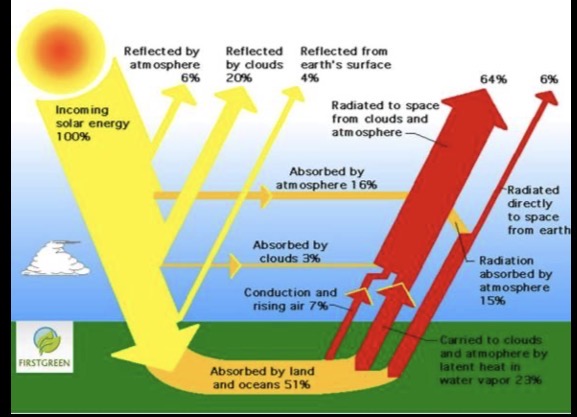
Solar Energy Cycle
Interaction of the sun’s solar energy with the surface of the earth.
One of the atmospheres cycles
Example of an hydrosphere cycle
The water cycle
Geochemical cycles
The nitrogen cycle, phosphorus cycle, sulfur cycle, carbon cycle