Lab Exam 1 Review
0.0(0)
Studied by 0 people Call Kai
 Learn
Learn Practice Test
 Spaced Repetition
 Match
Match Flashcards
 Knowt Play
Card Sorting
1/88

There's no tags or description
Looks like no tags are added yet.
Last updated 7:55 PM on 7/9/26
Name | Mastery | Learn | Test | Matching | Spaced | Call with Kai | Chat |
|---|
No analytics yet
Send a link to your students to track their progress
89 Terms
1
New cards
What are general senses?
Senses that respond to touch, pressure, pain, heat, cold, stretch, vibration, and changes in body position.
2
New cards
What are the five special senses?
Vision, hearing, equilibrium (balance), smell, and taste.
3
New cards
What are exteroceptors?
Receptors that respond to external stimuli; found near the body surface (skin).
4
New cards
What are interoceptors (visceroreceptors)?
Receptors that respond to stimuli from internal organs, such as stretch and chemical changes.
5
New cards
What are proprioceptors?
Receptors in muscles, tendons, joints, and ligaments that monitor body position and movement.
6
New cards
What are nonencapsulated receptors?
Sensory receptors without a connective tissue capsule.
7
New cards
What do free nerve endings detect?
Pain and temperature.
8
New cards
What do Merkel (tactile) discs detect?
Light touch.
9
New cards
What do hair follicle receptors detect?
Light touch and bending of hair.
10
New cards
What are encapsulated receptors?
Sensory receptors surrounded by a connective tissue capsule.
11
New cards
What do Meissner corpuscles detect?
Light pressure and discriminative touch.
12
New cards
What do bulbous corpuscles detect?
Deep pressure and stretch.
13
New cards
What do Pacinian (lamellar) corpuscles detect?
Deep pressure, vibration, and stretch.
14
New cards
What do muscle spindles detect?
Muscle stretch (proprioception).
15
New cards
What is a sensory transducer?
A receptor that converts a stimulus into a nerve impulse.
16
New cards
What is sensation?
Awareness of a stimulus.
17
New cards
What is perception?
Interpretation of the meaning of a stimulus.
18
New cards
What are the four cutaneous sensations?
Touch, heat, cold, and pain.
19
New cards
Which sensory receptors are the most numerous?
Pain receptors.
20
New cards
What is punctate distribution?
Sensory receptors are clustered in specific locations rather than evenly distributed.
21
New cards
Where are touch receptors most densely clustered?
Hands and face.
22
New cards
What is two-point discrimination?
The ability to distinguish two closely spaced points touching the skin as separate points.
23
New cards
What is the two-point threshold?
The smallest distance at which two points of contact are felt as two separate points.
24
New cards
What does the two-point discrimination test measure?
Tactile sensitivity and receptor density.
25
New cards
How is the two-point threshold determined?
Gradually change the distance until the subject correctly identifies two separate points.
26
New cards
What does a small two-point threshold indicate?
High tactile sensitivity and a high density of sensory receptors.
27
New cards
What does a large two-point threshold indicate?
Lower tactile sensitivity and fewer sensory receptors.
28
New cards
Which body areas have the smallest two-point threshold?
Fingertips, lips, and face.
29
New cards
What is tactile location?
The ability to determine which area of the skin has been touched.
30
New cards
What is sensory adaptation?
A decrease in receptor response when a constant stimulus remains over time.
31
New cards
How is touch receptor adaptation demonstrated?
Place coins on the forearm with eyes closed and note how long the sensation persists.
32
New cards
How is temperature receptor adaptation demonstrated?
Expose the skin to different temperatures and observe how sensation decreases over time.
33
New cards
What is referred pain?
Pain felt in one location but originating from another area of the body.
34
New cards
Examples of referred pain
Heart → left arm/jaw
Pancreas → back
Liver/Gallbladder → shoulder/neck
Sinus → tooth
Throat infection → ear.
35
New cards
What is a stimulus?
A change in the internal or external environment detected by sensory receptors.
36
New cards
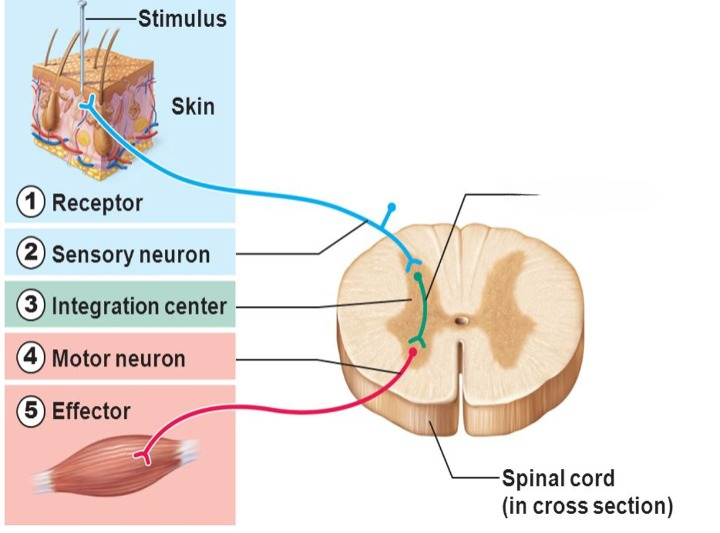
what is the blue line?
afferent
37
New cards
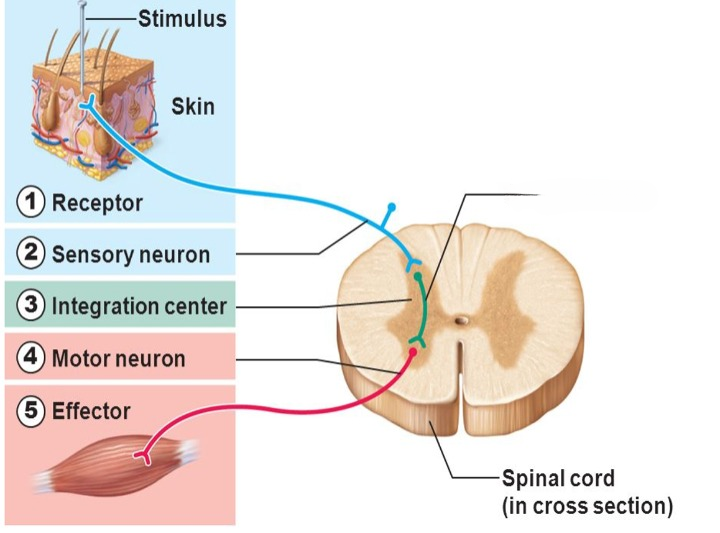
What is the redline?
efferent
38
New cards
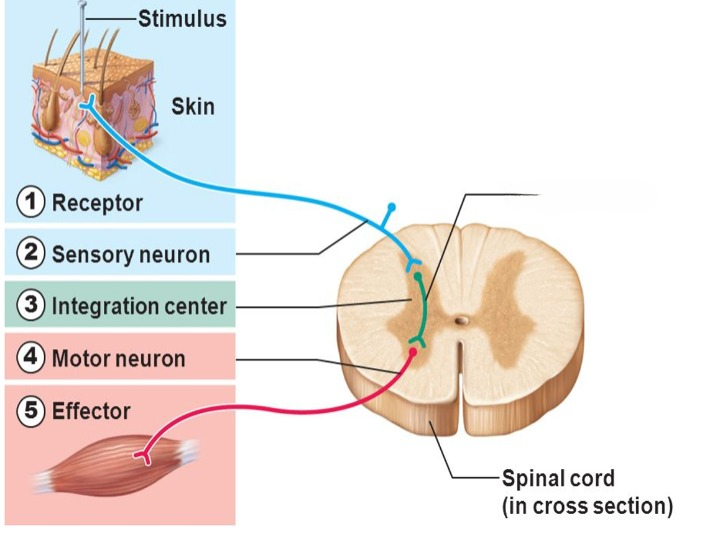
What is the green line?
interneuron
39
New cards
What is a reflex?
A rapid, predictable, involuntary motor response to a stimulus.
40
New cards
What are the two types of reflexes?
Inborn (intrinsic) reflexes and learned reflexes.
41
New cards
Are reflexes voluntary or involuntary?
Involuntary.
42
New cards
What are autonomic (visceral) reflexes?
Reflexes that are usually not consciously perceived and involve internal organs.
43
New cards
What structures are involved in autonomic reflexes?
Smooth muscle, cardiac muscle, and glands.
44
New cards
What are examples of autonomic reflexes?
Digestion, blood pressure regulation, salivation, sweating, and pupillary reflexes.
45
New cards
What type of reflex is the pupillary reflex?
Autonomic (visceral) reflex.
46
New cards
What are somatic reflexes?
Reflexes involving stimulation of skeletal muscles.
47
New cards
What type of muscle is involved in somatic reflexes?
Skeletal muscle.
48
New cards
What are the two major divisions of the nervous system?
Central nervous system (CNS) and peripheral nervous system (PNS).
49
New cards
What structures make up the central nervous system (CNS)?
Brain and spinal cord.
50
New cards
What are the two divisions of the peripheral nervous system (PNS)?
Somatic nervous system and autonomic nervous system.
51
New cards
What does the somatic nervous system control?
Skeletal muscles.
52
New cards
What does the autonomic nervous system control?
Smooth muscles, cardiac muscles, and glands.
53
New cards
What are the two divisions of the autonomic nervous system?
Sympathetic nervous system and parasympathetic nervous system.
54
New cards
What is the receptor in a reflex arc?
The site where the stimulus acts.
55
New cards
What does the sensory neuron do in a reflex arc?
It transmits afferent impulses to the CNS.
56
New cards
What does afferent mean?
Information traveling toward the CNS.
57
New cards
What is the integration center?
One or more synapses within the CNS where information is processed.
58
New cards
What does the motor neuron do in a reflex arc?
It conducts efferent impulses from the integration center to an effector organ.
59
New cards
What does efferent mean?
Information traveling away from the CNS.
60
New cards
What is the effector in a reflex arc?
A muscle fiber or gland that responds to efferent impulses.
61
New cards
How does a muscle respond as an effector?
By contracting.
62
New cards
How does a gland respond as an effector?
By secreting.
63
New cards
What are the components of a reflex arc in order?
Receptor → sensory neuron (afferent) → integration center (CNS) → motor neuron (efferent) → effector.
64
New cards
What is the patellar reflex?
A deep tendon reflex caused by stretching the quadriceps muscle, resulting in knee extension.
65
New cards
How is the patellar reflex tested?
Tap the patellar tendon below the patella with a reflex hammer.
66
New cards
What is the expected response of the patellar reflex?
The quadriceps contracts, causing the knee to extend (leg kicks forward).
67
New cards
What muscle is responsible for the patellar reflex response?
The quadriceps muscle.
68
New cards
If the patellar tendon is tapped and the knee does not extend, what response is abnormal?
An absent or reduced patellar reflex.
69
New cards
What is the calcaneal tendon (Achilles) reflex?
A deep tendon reflex that tests ankle plantar flexion through stimulation of the Achilles tendon.
70
New cards
How is the calcaneal tendon (Achilles) reflex tested?
Tap the calcaneal (Achilles) tendon at the back of the ankle.
71
New cards
What is the normal response of the calcaneal tendon (Achilles) reflex?
Plantar flexion of the foot (foot points downward).
72
New cards
What muscles contract during the calcaneal tendon (Achilles) reflex?
Gastrocnemius and soleus muscles.
73
New cards
What is dorsiflexion?
Movement of the foot upward toward the shin.
74
New cards
What is plantar flexion?
Movement of the foot downward away from the shin.
75
New cards
The patient pulls their toes toward their nose. What movement is this?
Dorsiflexion.
76
New cards
The patient points their toes downward like pressing a gas pedal. What movement is this?
Plantar flexion.
77
New cards
What are superficial reflexes?
Reflexes produced by stimulation of the skin surface.
78
New cards
How are superficial reflexes different from deep tendon reflexes?
Superficial reflexes involve skin stimulation; deep tendon reflexes involve muscle stretch.
79
New cards
Give examples of superficial reflexes.
Plantar reflex, corneal reflex, and abdominal reflex.
80
New cards
What is the Babinski test?
A neurological test where the sole of the foot is stroked to assess the plantar reflex.
81
New cards
How is the Babinski test performed?
Stroke the lateral side of the sole of the foot from the heel toward the toes.
82
New cards
What is the normal adult response during the Babinski test?
Toes curl downward (plantar flexion).
83
New cards
What is a positive Babinski sign?
The big toe extends upward and the other toes fan outward.
84
New cards
Is a positive Babinski sign normal in adults?
No. It may indicate a neurological problem.
85
New cards
Is a positive Babinski sign normal in infants?
Yes. It is normal because their nervous system is still developing.
86
New cards
What is a somatic reflex?
A reflex that involves skeletal muscle as the effector.
87
New cards
What type of muscles are involved in somatic reflexes?
Skeletal muscles.
88
New cards
Are patellar and calcaneal tendon reflexes somatic reflexes?
Yes. They cause skeletal muscle contraction.
89
New cards
What is the difference between a somatic reflex and an autonomic reflex?
Somatic reflex → skeletal muscle response
Autonomic reflex → smooth muscle, cardiac muscle, or gland response.