A&P Slideshow Chapter 3
 Call Kai
 Learn
Learn Practice Test
 Spaced Repetition
 Match
Match Flashcards
 Knowt Play
1/265

There's no tags or description
Looks like no tags are added yet.
Name | Mastery | Learn | Test | Matching | Spaced | Call with Kai | Chat |
|---|
No analytics yet
Send a link to your students to track their progress
266 Terms
_____ are the structural units of all living things.
cells
The human body has __ to __ cells.
50 to 100 trillion
What is cell theory?
the cell is the smallest unit of life
all organisms are made of one or more cells
cells arise only from other cells
What is cell diversity?
thousands of different types of human cells
types differ in size, shape, and sub cellular components; these differences lead to differences in functions
What 3 basic parts do all human cells have?
plasma membrane
cytoplasm
nucleus
What is the plasma membrane?
flexible outer boundary acts as an active barrier separating intracellular fluid (ICF) from extracellular fluid (ECF)
plays dynamic role in cellular activity by controlling what enters and what leaves cell
also known as the “cell membrane”
What is cytoplasm?
intracellular fluid containing organelles
What is the nucleus?
DNA containing control center
What are extracellular materials?
substances found outside cells
classes of extracellular materials include:
extracellular fluids (ECFs)
cellular secretions (e.g., saliva, mucus, gastric fluids)
extracellular matrix
What are extracellular fluids (ECFs)?
body fluids including:
interstitial fluid: cells are submersed (bathed) in this fluid
blood plasma: fluid of the blood
cerebrospinal fluid: fluid surrounding nervous system organs
What are some examples of cellular secretions?
e.g., saliva, mucus, gastric fluids
What is extracellular matrix?
substance that acts as glue to hold cells together
What plays a dynamic role in cellular activity by controlling what enters and what leaves the cell?
plasma membrane
What is the fluid mosaic model of the plasma membrane?
depicts a moving membrane made of many pieces:
bilayer of phospholipids with smaller amounts of cholesterol
embedded membrane proteins

Membrane structures help to hold cells together through _____.
cell junctions
What is the lipid bilayer made up of?
mostly phospholipids, which consist of 2 parts:
phosphate heads
fatty acid tails
20% cholesterol
located between the phospholipid tails
increases stiffness of the membranes
What are phosphate heads?
are polar (charged), so are hydrophilic (water-loving)
What are fatty acid tails?
are non polar (no charge), so are hydrophobic (water-hating)
Where is the cholesterol located in a lipid bilayer and what does it do?
located between the phospholipid tails
increases stiffness of the membrane
What are membrane proteins?
allow cell communication with environment
make up about half the mass of plasma membrane
most have specialized membrane functions
some float freely, and some are tethered to intracellular structures
What makes up about half the mass of the plasma membrane?
membrane proteins
What are the 2 types of membrane proteins?
integral proteins
peripheral proteins
What are integral proteins?
inserted into membrane; most are transmembrane proteins (span membrane)
have both hydrophobic region that interact with lipid tails and hydrophilic regions that interact with water inside and outside the cells
function as:
transport proteins (channels and carriers)
enzymes
receptors
What do integral proteins function as?
transport proteins (channels and carriers)
enzymes
receptors
What are peripheral proteins?
loosely attached to integral proteins or anchored to the membrane
function as:
enzymes
motor proteins for shape change during cell division and muscle contractions
cell-to-cell connections
What do peripheral proteins function as?
enzymes
motor proteins for shape change during cell division and muscle contractions
cell-to-cell connections
What tasks do membrane proteins perform?
a) transport
b) receptors for signal transduction
c) enzymatic activity enzymes
d) cell-cell recognition
e) cell-to-cell joining
f) attachment to the cytoskeleton and extracellular matrix (ECM)
Explain how a membrane protein performs the transport task.
transport proteins allow cells to control which substances enter or exit the cell
a protein (left) that spans the membrane may provide a hydrophilic channel across the membrane that is selective for a particular solute
other transport proteins move a substance from one side to the other by changing shape
pumps use the power of ATP to drive the shape change; carriers do not require ATP

Do pumps or carriers use ATP?
pumps use the power of ATP to drive the shape change
carriers do not require ATP
Explain how membrane proteins perform the receptors for signal transduction” task.
receptors allow a cell to receive information from other cells
a receptor’s extracellular binding site fits the shape of a specific chemical messenger, such as a hormone
binding the chemical messenger causes the protein to change shape, which initiates a chain of chemical reactions in the cell
this is called signal transduction and effectively moves the message from outside of the cell to inside it

What is signal transduction?
binding the chemical messenger causes the protein to change shape, which initiates a chain of chemical reactions in the cell called signal transduction
effectively moves the message from outside of the cell to inside it
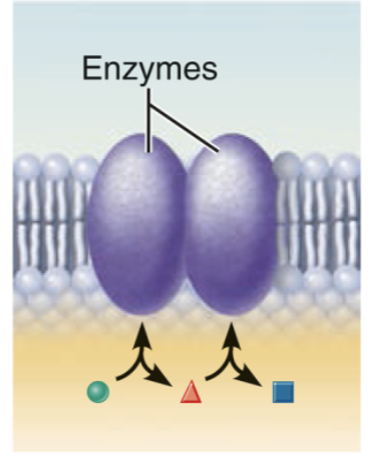
Explain how membrane proteins perform enzymatic activity.
enzymes in the membrane allow cells to transform one substance into another
the active site of the enzyme may face the solution on either side of the membrane
a team of several enzymes in a membrane may catalyze sequential steps of a metabolic pathway
Explain how membrane proteins perform cell-cell recognition.
some proteins in the membranes of adjacent cells allow them to recognize each other through direct physical contact
some glycoproteins (proteins bonded to short chains of sugars which help to make up the hlycocalyx) serve as identification tags that are specifically recognized by other cells
this type of cell-cell binding is usually short-lived compared with cell-to-cell joining

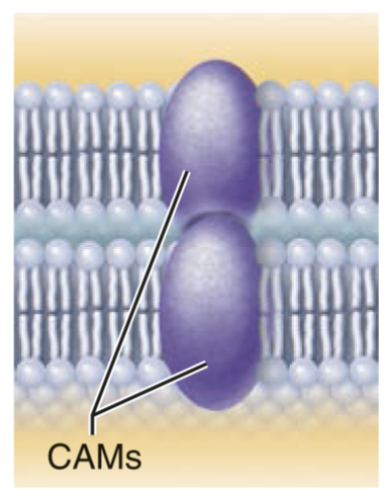
Explain how membrane proteins perform cell-to-cell joining.
membrane proteins of adjacent cells may be hooked together in various kinds of long-lasting intercellular junctions (e.g., tight junctions and gap junctions)
some membrane proteins (cell adhesion molecules, or CAMs) of this group provide more short-lived binding sites that guide cell migration and other cell-to-cell interactions
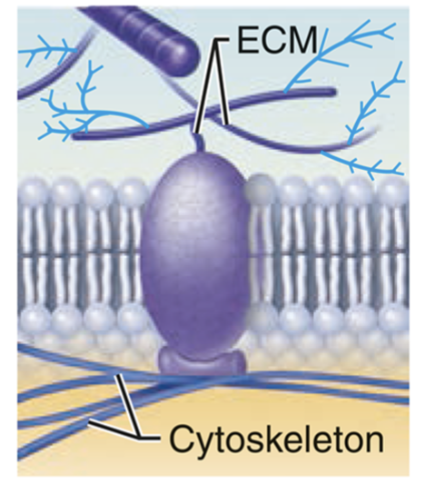
Explain how membrane proteins perform the attachment to the cytoskeleton and extracellular matrix (ECM).
some membrane proteins anchor elements of the cytoskeleton (cell’s internal framework) and the extracellular matrix (fibers and other substances outside the cell)
helps maintain cell shape, fixes the location of certain membrane proteins, and plays a role in cell movement
What is glycocalyx?
consists of sugars (carbohydrates) sticking out of cell surface
some sugars are attached to lipids (glycolipids) and some to proteins (glycoproteins)
every cell type has different patterns of this “sugar coating”
functions as specific biological markers for cell-to-cell recognition
allows immune system to recognize “self” vs “non self”
_____ junctions allow adjacent cells to adhere or communicate.
intercellular
What are the 3 types of cell junctions.
tight junctions
desmosomes
gap junctions
What are tight junctions?
integral proteins on adjacent cells fuse to form an impermeable junction that encircles whole cell
prevents fluids and most molecules from moving in between cells
create 2 compartments, one on each side of the layer of cells
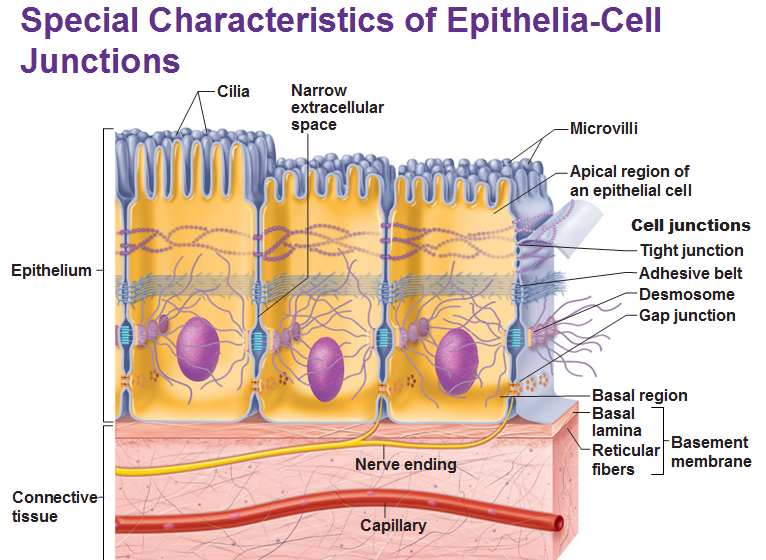
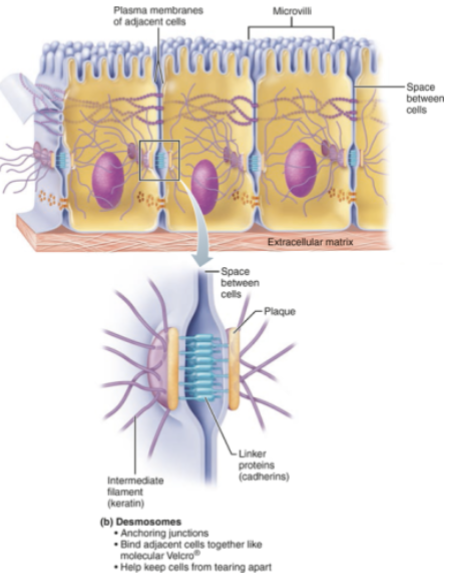
What are desmosomes?
anchoring junctions
rivet-like cell junction formed when linker proteins (cadherins) of neighboring cells interlock like teeth of a zipper
linker protein is anchored to its cell through thickened “button-like” areas on inside of plasma membrane called plaques
keratin filaments connect plaques inter cellularly for added anchoring strength
help keep cells from leaving apart
What are gap junctions?
transmembrane proteins (connexions) form tunnels that allow small molecules to pass from cell to cell
used to spread ions, simple sugars, or other small molecules between cells
allows electrical signals to be passed quickly from one cell to next cell
used in cardiac and smooth muscle cells

What are 2 essential ways substances cross the plasma membrane?
passive transport: no energy is needed
active transport: energy (ATP) is required
What is passive transport?
requires no energy input
all molecules have random, high-speed movement due to their intrinsic kinetic energy that result in collisions between molecules
molecules in higher concentration areas collide more, resulting in molecules being scattered to lower concentration areas
What are the 3 types of passive transport?
simple diffusion
facilitated diffusion
osmosis
All types of passive transport involve _____.
diffusion
What is diffusion?
natural movement of molecules from areas of high concentration to areas of low concentration
also referred to as moving down a concentration gradient
_____ is also referred to as moving down a concentration gradient.
diffusion
What 3 factors is the speed of diffusion influenced by?
concentration— the greater the difference of concentration between 2 areas, the faster diffusion occurs
molecular size— smaller molecules diffuse faster
temperature— higher temperature increase kinetic energy which results in faster diffusion
The system reaches equilibrium when there is _____ of molecules in one direction.
no net movement
The plasma membrane is _____ permeable.
selectively, or differentially
What does the plasma membrane being selectively permeable mean?
allows nutrients to enter the cell, but prevents many undesirable substances from entering
keep valuable cell proteins and other necessary substances in the cell, but allows wastes to exit
_____ core of plasma membranes stops diffusion and creates concentration gradients by acting as selectively permeable barriers. (hydrophobic/hydrophilic)
hydrophobic
What is simple diffusion?
lips-soluble molecules and small molecules can cross plasma membrane
substance diffuse directly through the lipid bilayer
nonpolar lipid-soluble (hydrophobic) substances diffuse directly through phospholipid bilayer
Ex: oxygen, carbon dioxide, steroid hormones, fatty acids
small amounts of very small polar substances such as water, can even pass
What are examples of substances that go through simple diffusion?
oxygen, carbon dioxide, steroid hormones, fatty acids
small amounts of very small polar substances, such as water, can even pass
What is facilitated diffusion?
transport across the plasma membrane with assistance of carrier or channel protein
certain hydrophobic molecules (e.g., glucose, amino acids, and ions) are transported passively with assistance down their concentration gradient
carrier-mediated facilitated diffusion
channel mediated facilitated diffusion
water-soluble molecules and large molecules require assistance crossing plasma membrane
What are 2 types of facilitated diffusion?
carrier-mediated facilitated diffusion
substances bind to protein carriers
channel-mediated facilitated diffusion
substances move through water-filled channels
What is carrier-mediated facilitated diffusion?
carriers and transmembrane integral proteins that transport specific polar molecules, such as sugars and amino acids, that are too large for membrane channels
binding of molecule causes carrier to envelope it and change shape that results in molecule being moved across membrane
carriers are saturated when all are bound to molecules and are busy transporting

Carriers are _____ when all are bound to molecules and are busy transporting.
saturated
What is channel-mediated facilitated diffusion?
channels are transmembrane proteins with aqueous-filled cores that transport molecules, such as ions, down their concentration gradient
specificity based on pore size and/or large
2 types:
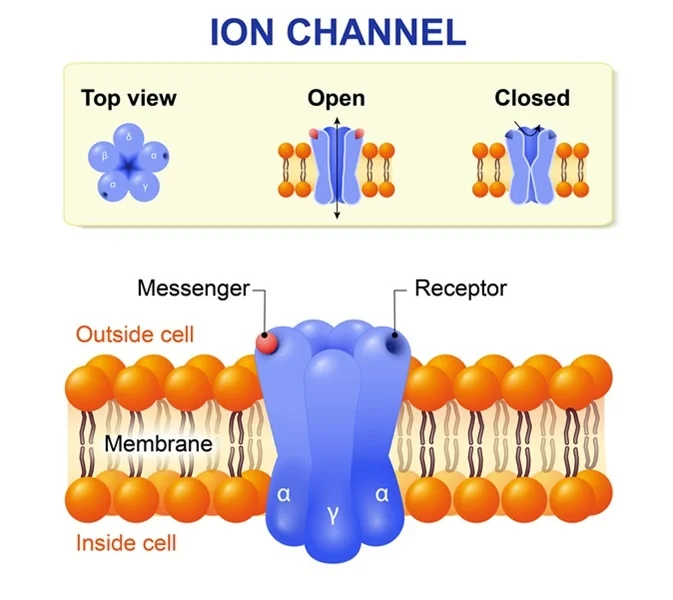
leakage channels which are always on
gated channels which are controlled by chemical or electrical signals

What are leakage channels?
a type of channel-mediated facilitated diffusion channels
always on

What are gated channels?
a type of channel-mediated facilitated diffusion channels
are controlled by chemical or electrical signals
What is osmosis?
the movement of water through a selectively permeable membrane
extremely important in determining the distribution of water in the various fluid containing compartments of the body
water diffuses across plasma membranes
through lipid bilayer (even though water is polar, it is so small that some molecules can sneak past non polar phospholipid tails)
through specific water channels called aquaporins (AQPs)
osmosis occurs whenever the solute concentration differs on the 2 sides of a membrane

What is osmolarity?
total concentration of all solute particles in a solution
When solute concentration goes up —> _____.
water concentration goes down
Water moves by osmosis from areas of _____ solute concentration to areas of _____ solute concentration.
low solute concentration to high solute concentration
How is osmolarity expressed?
osmoles/liter (osmol/L)
What is equilibrium?
same concentration of solutes and water molecules on both sides, with equal volume on both sides
When solutions of different osmolarities are separated by a membrane that is permeable only to water, only _____ will occur until equilibrium is reached.
only osmosis (not diffusion)
What 2 pressures does the movement of water involve?
hydrostatic pressure
osmotic pressure
What is hydrostatic pressure?
the back pressure exerted by water against the cell wall
What is osmotic pressure?
the tendency of water to move into the cell by osmosis
When hydrostatic pressure _____ osmotic pressure, no further net movement of water occurs.
equals (water trying to exit equals water trying to enter)
Why can animal cells not limit hydrostatic and osmotic pressures like plant cells?
plant cells are surrounded by strong cell walls that limit hydrostatic pressure levels, which limits osmotic pressure
animal cells do not have cell walls, and therefore cannot limit hydrostatic and osmotic pressures
Osmotic imbalances cause animal cells to _____ or _____.
swell or shrink
Why do osmotic imbalances cause animal cells to swell or shrink?
due to net water gain or loss
What is tonicity?
ability of a solution to change the shape ,or plasma membrane tension, of cells by altering the cells’ internal water volume
What is an isotonic solution?
has same osmolarity as inside the cell, so volume remains unchanged

What is a hypertonic solution?
has higher osmolarity than inside cell, so water flows out of cell, resulting in cell shrinking
shrinking is referred to as crenation

What is cell shrinking referred to as?
crenation
What is crenation?
cell shrinking
What is hypotonic solution?
has lower osmolarity than inside cell, so water flows into cell, resulting in cell swelling
can lead to cell bursting, referred to as lysing

What is cell bursting referred to as?
lysing
What is lysing?
cell bursting
An _____ process occurs whenever cell uses energy directly or indirectly to move solutes across the membrane against their concentration gradient (from low to high).
active (requires energy (ATP))
What are 2 major active membrane transport processes?
active transport
vesticular transport
Why might active or vesticular transport reuiqre ATP to move solutes across a plasma membrane?
solute is too large for channels
solute is not lipid soluble
solute is not able to move down concentration gradient
What is primary active transport?
energy to do work ones directly from hydrolysis of ATP by transport proteins called pumps
energy from hydrolysis of ATP causes change in shape of transport protein, which causes solutes (ions) bound to protein to be pumped across membrane
examples of pumps: calcium, hydrogen (proton), Na+ -K+ pumps
What is secondary active transport?
energy stored in concentration gradients of ions created by primary active transport pumps
always move more than one substance at a time using a con transport protein
What is a sodium-potassium pump?
most studied pump
the pump protein is a enzyme Na^+ -K^+ ATPase, that pumps 3Na^+ out of cell and 2K^+ into cell for each ATP molecules used
located in all plasma membranes, but especially active in excitable cells (nerves and muscles)
What is secondary active transport?
also called cotransport
depends on ion gradient that was created by primary native transport systems,
energy stored in gradients is used indirectly to drive transport of other solutes
Low Na concentration that is maintained inside cell by Na -K pump strengthens sodium’s drive to want to enter cell
Na can drag other molecules with it as it flows into cell through carrier proteins (usually supporters) in membrane
What are supporters?
transport 2 different substances in the same direction
What are antiporters?
transport 1 substance into cell while transporting it
What is vesticular transport?
moves large substances, or large amounts of a substance, across cellular membranes inside bubble-like, membranous sas called vesicles
requires cellular energy (usually ATP)
What are the 4 types of vesticular transport?
transcytoosis
vesicular trafficking
endocystosis
exocytosis
What is transcytosis?
moves substances into, across, and then out of the cell
What is vesicular trafficking?
moves substances from one area (or membranous organelle) in the cell to another
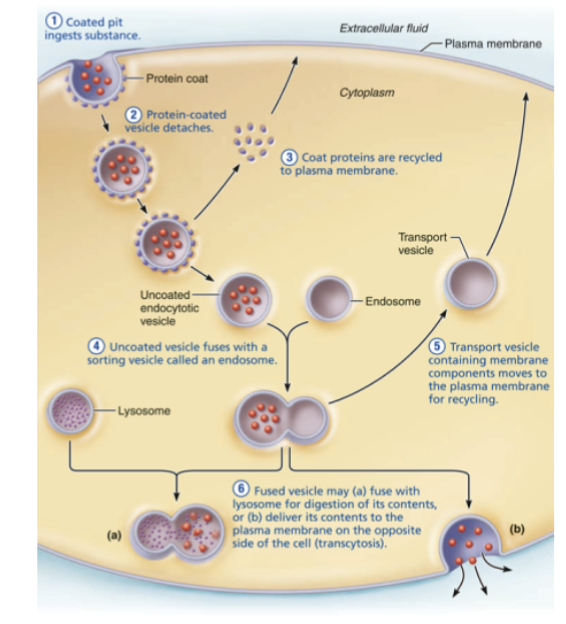
What is endocytosis?
transport into cell
involves formation of protein-coated vesicles
usually involve receptors, and therefore, can be a very selective process
substance being pulled in must be able to bind to its unique receptor
some pathogens are capable of hijacking receptor for transport into cell
once veislce isp pulled inside cell, it may:
fuse with lysosome or
undergo transcytosis
phagocytosis, pinocytosis, receptor-mediated endocytosis
What is exocytosis?
transport out of cell
What is phagocytosis?
type of endocytosis that is referred to as “cell eating”
membrane projections called pseudopods form and flow around solid particles that are being engulfed, forming a vesicle which is pulled into the cell
is sued by macrophages and certain other white blood cells

What is the formed vesicle in phagocytosis called?
phagosome