Ecology Exam 4 Review
0.0(0)
Studied by 3 people Call Kai
 Learn
Learn Practice Test
 Spaced Repetition
 Match
Match Flashcards
 Knowt Play
Card Sorting
1/36

Earn XP
Description and Tags
ECCB 205 WKs 13-15
Last updated 10:54 PM on 4/28/23
Name | Mastery | Learn | Test | Matching | Spaced | Call with Kai |
|---|
No analytics yet
Send a link to your students to track their progress
37 Terms
1
New cards
Competition
interaction b/w two or more organisms using the same limited resource (when fundamental niches overlap)
(-/- interaction, affects both population growth)
(-/- interaction, affects both population growth)
2
New cards
Fundamental Niche
* environmental conditions under which a species can survive and reproduce
* temp, rainfall, nutrient levels, etc. (abiotic factors)
* not restricted by interactions with other species
* temp, rainfall, nutrient levels, etc. (abiotic factors)
* not restricted by interactions with other species
3
New cards
Realized Niche
* Environmental condition in which the species is actually found in nature
* A subset of the species’ fundamental niche
* Restricted by BIOTIC interactions (competition, predation, parasitism)
* A subset of the species’ fundamental niche
* Restricted by BIOTIC interactions (competition, predation, parasitism)
4
New cards
Intraspecific Competition
Competition among members of the same species
5
New cards
Interspecific Competition
Competition between members of different species
6
New cards
What alters competition?
* Disturbances
* Predation and herbivory
* Other interspecific interactions
* Predation and herbivory
* Other interspecific interactions
7
New cards
Amensalism
(-/0) interaction
8
New cards
Commensalism
(+/0) interaction
9
New cards
Mutualism
(+/+) interaction
10
New cards
Competitive exclusion principle
No two species can coexist in the exact same niche
* Does not uphold in all situations (paradox of plankton)
* Does not uphold in all situations (paradox of plankton)
11
New cards
Exploitative (resource) Competition
competition in which individuals consume and drive down the abundance of a resource to a point that other individuals cannot persist
* indirect competition
* indirect competition
12
New cards
Interference Competition
when competitors do not immediately consume resources but defend them, preventing est. of a competitor
* Direct competition
* Direct competition
13
New cards
Allelopathy
a type of interference competition that occurs when organisms use chemicals to harm their competitors (effective strategy for invasive plants)
14
New cards
Preemption
type of interference competition determines by who finds and occupies a place first (think trees)
15
New cards
Territoriality
Active defense of resources that excludes other organisms
16
New cards
Browsers
eat woody plants
17
New cards
Grazers
eat herbaceous plants (grass, forbs, herbs)
18
New cards
Granivores
eat seeds
19
New cards
Frugivores
eat fruit
20
New cards
Consumer- resource dynamics
* populations of consumers are self-limited: as they grow, their resources become scarcer
* Consumers are limited by density dependent factors
\
* Resource population are limited by consumers
* Resources tend NOT to be limited by density dependent factors
* Consumers are limited by density dependent factors
\
* Resource population are limited by consumers
* Resources tend NOT to be limited by density dependent factors
21
New cards
Predator-Prey Cycle
Predator/prey cycles increase and decrease in regular cycles
22
New cards
Lotka-Volterra model
Reproduces cyclic predator-prey interactions
* Period and frequency depend on physical environment
* Stochastic (random) events will alter it and may cause extinction
* Model does NOT include randomness
* Model assumes closed system, no refuge for prey, no handling time for predators, prey grow expo. w/o predators, and predators consume infinite amounts of prey
* Model can have added parameters to fit reality
* Period and frequency depend on physical environment
* Stochastic (random) events will alter it and may cause extinction
* Model does NOT include randomness
* Model assumes closed system, no refuge for prey, no handling time for predators, prey grow expo. w/o predators, and predators consume infinite amounts of prey
* Model can have added parameters to fit reality
23
New cards
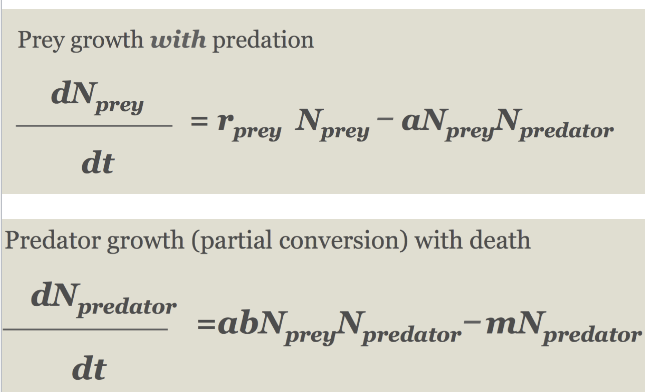
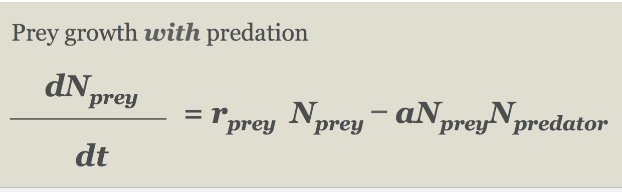
Lotka-Volterra model equation
rprey: per capita growth rate of prey (intrinsic growth rate)
Nprey: # of prey
Npredator: # of predators
a: search efficiency of predator (attack rate)
b: conversion rate (converts encounter rate to # of new predators produced)
m: mortality rate (of predator in predator eq.)
Nprey: # of prey
Npredator: # of predators
a: search efficiency of predator (attack rate)
b: conversion rate (converts encounter rate to # of new predators produced)
m: mortality rate (of predator in predator eq.)
24
New cards
Parasites
Endo- internal
* runs into hosts immune defenses
Ecto - external
* easier transmission from host to host
* non-steady supply of food
* more variable environment
* runs into hosts immune defenses
Ecto - external
* easier transmission from host to host
* non-steady supply of food
* more variable environment
25
New cards
Nutritional Defense
Nutrients is stored away from available parts of plants. Areas exposed to herbivores are not nutritionally dense (dominantly in plants)
26
New cards
Tolerance Defense
Changes to plant growth in response to herbivory (dominantly in plants)
27
New cards
Behavioral defenses
Alarm calling, reduces activity, mobbing, schooling/flocking, growing/ flowering when herbivores are scarce… etc (predominantly in animals)
28
New cards
Physical Defenses
Physical features to protect animals or plant from being eaten or injured
29
New cards
\*\*\*
Defenses can be phenotypically plastic
30
New cards
Crypsis Defense
(both animals and plants) Cryptic coloration and disruptive coloration to hide animals to avoid predators
31
New cards
Chemical Defenses
(both animals and plants) Ex: tobacco producing nicotine, Bombadier beetle mixing chemicals to spray predators with boiling hot liquid
32
New cards
Aposematic coloration
Conveys chemical defense before attack occurs
* Warning coloration (aposematism) where distastefulness evolves n association with very conspicuous colors and patterns
* Predators can have innate aversions to aposematic colors; others learn to avoid through experience
* Warning coloration (aposematism) where distastefulness evolves n association with very conspicuous colors and patterns
* Predators can have innate aversions to aposematic colors; others learn to avoid through experience
33
New cards
Mimicry Defense
Individuals without chemical defenses can mimic aposematic species with chemical defenses by copying physical traits
\
* Batesian mimicry: when palatable (eatable) species evolve warning coloration that resembles unpalatable species
* Mullerian mimicry: when two unpalatable species evolve similar warning coloration to reinforce coloration-unpalatability association in predators
\
* Batesian mimicry: when palatable (eatable) species evolve warning coloration that resembles unpalatable species
* Mullerian mimicry: when two unpalatable species evolve similar warning coloration to reinforce coloration-unpalatability association in predators
34
New cards
Coevolution
when two or more species affect each other’s evolution; mutualistic species evolve mutual adaptations to promote the relationship
* evolve by natural selection imposed by each other, reciprocal adaptation
* may be faster and more evident in antagonistic interactions b/c they directly impact survival (evolutionary arms race)
* selection for prey defenses should favor the selection for counter-adaptation in predators
* evolve by natural selection imposed by each other, reciprocal adaptation
* may be faster and more evident in antagonistic interactions b/c they directly impact survival (evolutionary arms race)
* selection for prey defenses should favor the selection for counter-adaptation in predators
35
New cards
Costs of sexual reproduction
Evolutionary arms races occur more frequently: sexual organs require considerable energy and resources, mate attraction requires time and energy, copulation exposes disease
36
New cards
Red Queen hypothesis
* Extinction rates (macroevolution-between species): extinction appears to be a random process probably due to COEVOLUTION which forces organisms to constantly evolve
* Sexual reproduction (microevolution-within species): hosts are ablet o present a moving target for evolving pathogens through sex and genetic recombination
* Hypothesis: Species that evolve fast enough to keep up with (or outpace) evolution in their enemies will generally persist longer than those that evolve more slowly/. Thus, like the Red Queen, a species and its enemies continually evolve “to keep in the same place”
* Sexual reproduction (microevolution-within species): hosts are ablet o present a moving target for evolving pathogens through sex and genetic recombination
* Hypothesis: Species that evolve fast enough to keep up with (or outpace) evolution in their enemies will generally persist longer than those that evolve more slowly/. Thus, like the Red Queen, a species and its enemies continually evolve “to keep in the same place”
37
New cards
Benefits of sexual reproduction
* coping with environmental variation
* coping with parasites and pathogens
(via genetic variation)
* coping with parasites and pathogens
(via genetic variation)