bio 300 lab quiz 4
 Call Kai
 Learn
Learn Practice Test
 Spaced Repetition
 Match
Match Flashcards
 Knowt Play
1/67

There's no tags or description
Looks like no tags are added yet.
Name | Mastery | Learn | Test | Matching | Spaced | Call with Kai | Chat |
|---|
No analytics yet
Send a link to your students to track their progress
68 Terms
What are traits of adapting to water scarcity? and what are their functions
cuticle - waxy covering to stop water from evaporating out
stomata - pores for gas exchange
spores - reproduction in open air
vascular tissue- Transport water, minerals and food
What is the benefit for access to sunlight
Structural support through lignified vascular tissues
(allowing for increased height)
what is primary growth?
growth vertically from cell division in apical meristems
where does primary growth occur
at apical meristems in the tips of roots and shoots.
what are meristems?
Regions of actively dividing cells that produce new plant tissues.
what is an apical meristem
A mitotic growth region at the tip of a root or shoot.
what is an axillary bud?
A new shoot apical meristem formed from the shoot apical meristem.
what does primary growth produce
Primary tissues of leaves, stems, and roots.
What are the three primary tissue groups?
Dermal, vascular, and ground tissues.
what is dermal tissue
The outer protective tissue, mainly the epidermis.
What does vascular tissue include?
Xylem and phloem, which transport materials through the plant.
What is ground tissue?
Tissue between dermal and vascular tissues; includes pith, cortex, and mesophyll.
label this coleus

1) shoot apical meristem
2)leaf primordium
3)axillary bud

label 1-4
1)vascular bundles
2)primary xylem
3)primary phloem
4)cortex

which is dicot (eustele) and which is monocot (atacostle)
left dictator
right monocot

label this medicago
1)vascular bundle
2)cortex
3)xylem
4)phloem
5)pith
which plants go through primary growth ***???
coleus,
zea mays
medicago
What is secondary growth?
It increases GIRTH of stems and roots.
What is the vascular cambium?
A secondary meristem that produces new vascular tissue.
Where does the vascular cambium appear?
Between the primary xylem and primary phloem.
What does the vascular cambium produce?
Secondary xylem and secondary phloem.
What is the secondary xylem?
Wood, it grows toward the interior of the stem.
What is secondary phloem?
Vascular tissue that grows toward the exterior of the stem.
Which direction does secondary xylem grow?
Toward the inside (interior) of the stem.
Which direction does secondary phloem grow?
Toward the outside (exterior) of the stem.
What type of meristem is vascular cambium?
A secondary meristem involved in secondary growth.
Label this young tilia stem

1) xylem
2) phloem
3) cambial zone
4) vascular bundle
What does secondary xylem conduct?
Water and minerals.
What are vessel elements?
Water-conducting cells in angiosperms.
What are key features of vessel elements?
Open ended, lignified, and dead at maturity.
What are tracheids?
Water conducting cells in gymnosperms and some angiosperms.
What do fiber cells do?
Provide support but do not conduct fluid.
What does secondary phloem conduct?
Photosynthates (food/sugars).
What are the main phloem conducting cells?
Sieve cells and sieve tube elements.
What are companion cells?
Cells associated with sieve tube elements.
What structures allow flow between sieve elements?
Sieve plates and pores.
How does xylem differ from phloem?
Xylem moves water
phloem moves food/photosynthates
Label this young woody stem (left to right)
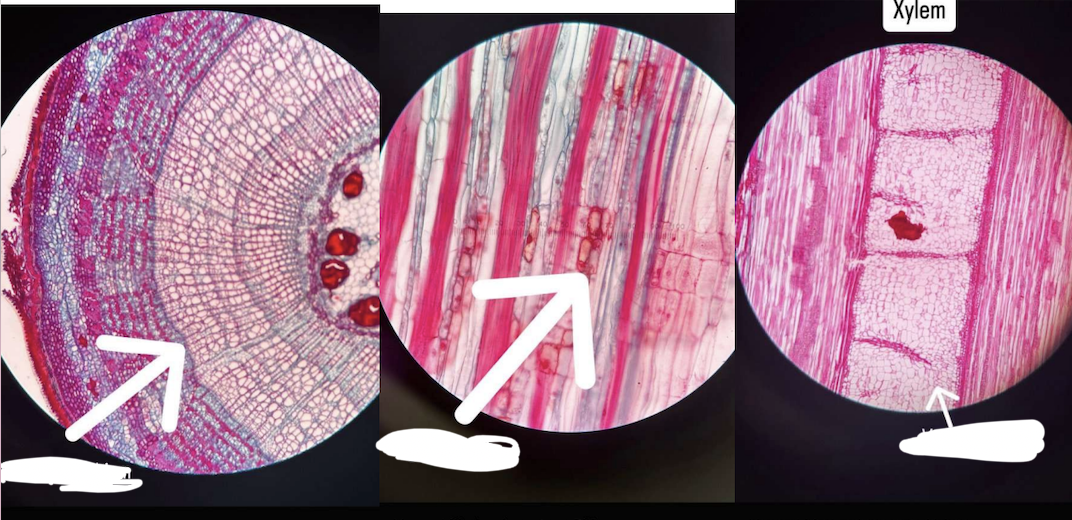
vascular cambian
sieve cell
vessel element
What does each annual ring represent?
One year of secondary growth
What is spring wood?
Wider wood with thinner walled tracheary elements
What is summer wood
Narrower wood with thicker walled tracheary elements
What do parenchyma rays do
Deliver photosynthates through the stem
What does cork cambium produce/do
It is a secondary meristem that adds lateral growth as periderm
what are features of lycophytes
• Club mosses & relatives
• Low growing plants,
typically in shaded environments
• Often have moss-like appearance
What are function of protostele
Central core of xylem tissue surrounded by layer of phloem tissue
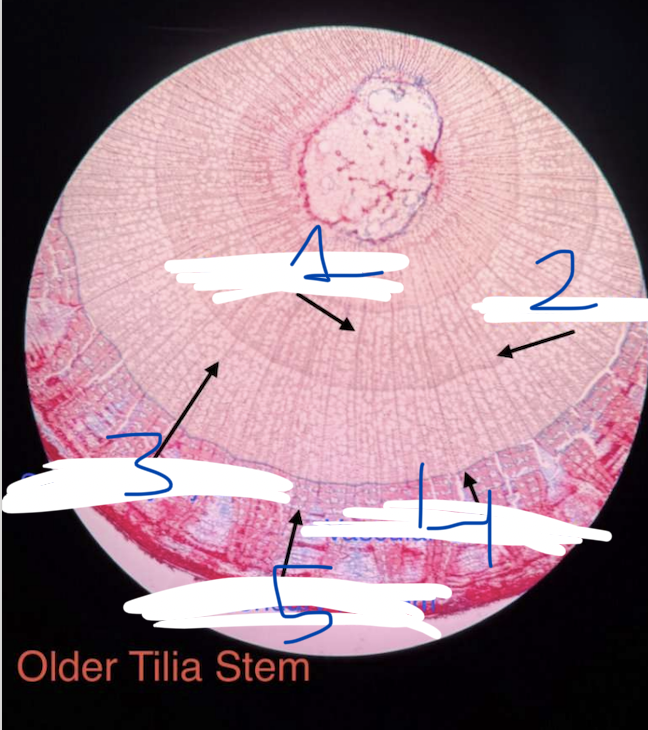
Label this older tilia stem
1) springwood
2)summer wood
3)secondary xylem
4)vascular cambian
5)secondary phloem
Label this Dendrolycopodium obscurum

1)xylem
2)phloem
3)ground tissue
4)epidermis
What are microphylls?
Small leaves of lycophyte plants.
Why are microphylls not considered anatomically true leaves?
They lack complex venation and a gapless connection to the protostele.
What are Lycopodium strobili made of?
Densely packed leaves (sporophylls) with attached sporangia.
What are homosporous strobili?
They produce one size of spores that form bisexual gametophytes.
What do megasporangia produce?
Larger spores (megaspores) that form female gametophytes.
What do microsporangia produce?
Smaller spores (microspores) that form male gametophytes.
Homosporous vs. heterosporous
Homosporous: one spore size heterosporous: two spore sizes.
What is the role of a strobilus?
A conelike structure where sporophylls and sporangia are grouped.
Label this

label this Selaginella Strobilus
1) microspores
2) microsporangium
3) megasporium
4) megaspores
5) microphyll
What are euphyllophytes?
A group that includes ferns and seed plants.
What are megaphylls?
True leaves with complex vascularization.
What is a leaf gap?
A rerouting of vascular tissue into a leaf at the lower stem.
What is a siphonostele?
A C-shaped or ring of vascular tissue in a fern rhizome.
What are fern leaves called?
Fronds.
How do fern fronds develop?
From spirally folded buds called fiddleheads.
What are sori?
Clusters of sporangia on fern fronds.
What are sori?
Clusters of sporangia on fern fronds.
What is an indusium?
A thin protective sheet covering a sorus.
Where are fern sporangia found?
On the underside of fronds or modified non-photosynthetic fronds.
Label this Fern rhizome
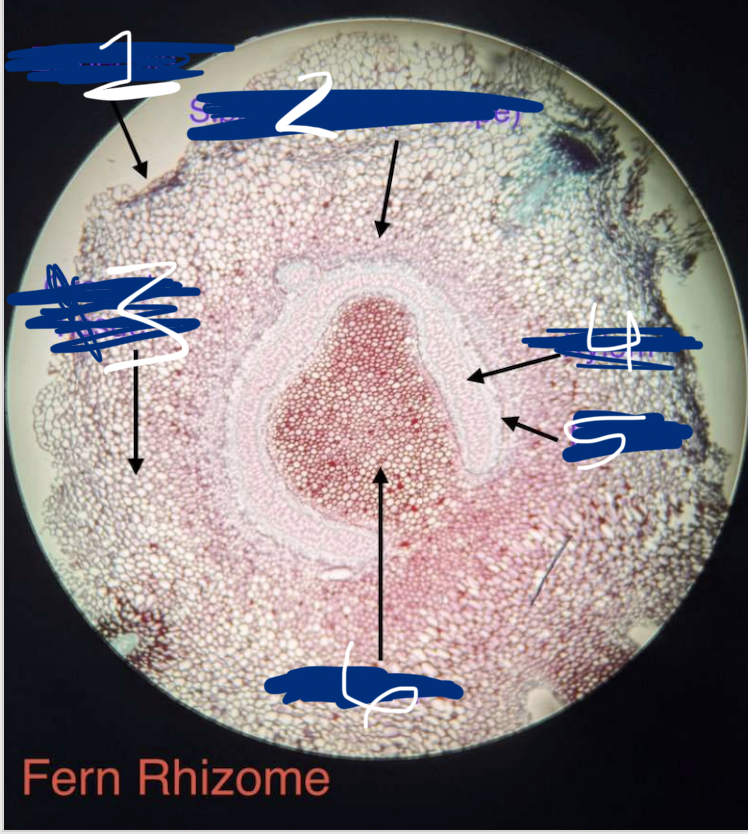
1)epidermis
2)siphonestle
3) ground tissue
4) xylem
5) phloem
6) leaf gap
Label this Cyrtomium frond

1) sporangium
2) spore
3) insidium
4) sorus (whole structure)