MCAT Analaysis FL #1 (Score 488)
 Call Kai
 Learn
Learn Practice Test
 Spaced Repetition
 Match
Match Flashcards
 Knowt Play
1/17

There's no tags or description
Looks like no tags are added yet.
Name | Mastery | Learn | Test | Matching | Spaced | Call with Kai | Chat |
|---|
No analytics yet
Send a link to your students to track their progress
18 Terms

you got this one wrong, and you were so sure about it.
If Reaction 2 (Figure 4) is repeated with HCl and the compound shown below, which of the following compounds is NOT a direct product (without rearrangement)?
Reaction 2 (Figure 4): you replace the OH with something. One of the things you replace the OH with is with the double bond. However, A is the correct answer because it requires rearrangement.
you did not read clearly enough.
The stereocenter is R.
Here’s the priority ranking using CIP rules:
OH — O has the highest atomic number.
Alkyl chain — directly attached atom is C.
D (deuterium) — D and H are both hydrogen isotopes, but D has greater mass.
H — lowest priority.
In the drawing, H is on the dashed wedge, so H (priority 4) is pointing away from you.
Now trace 1 → 2 → 3:
OH → carbon chain → D
This goes clockwise, so the configuration is:
R
The key detail is that D outranks H, even though both have atomic number 1.
The product of the reaction compound 1 with HBr results in water leaving, with Bromide being attached.

I was also sure about this one.
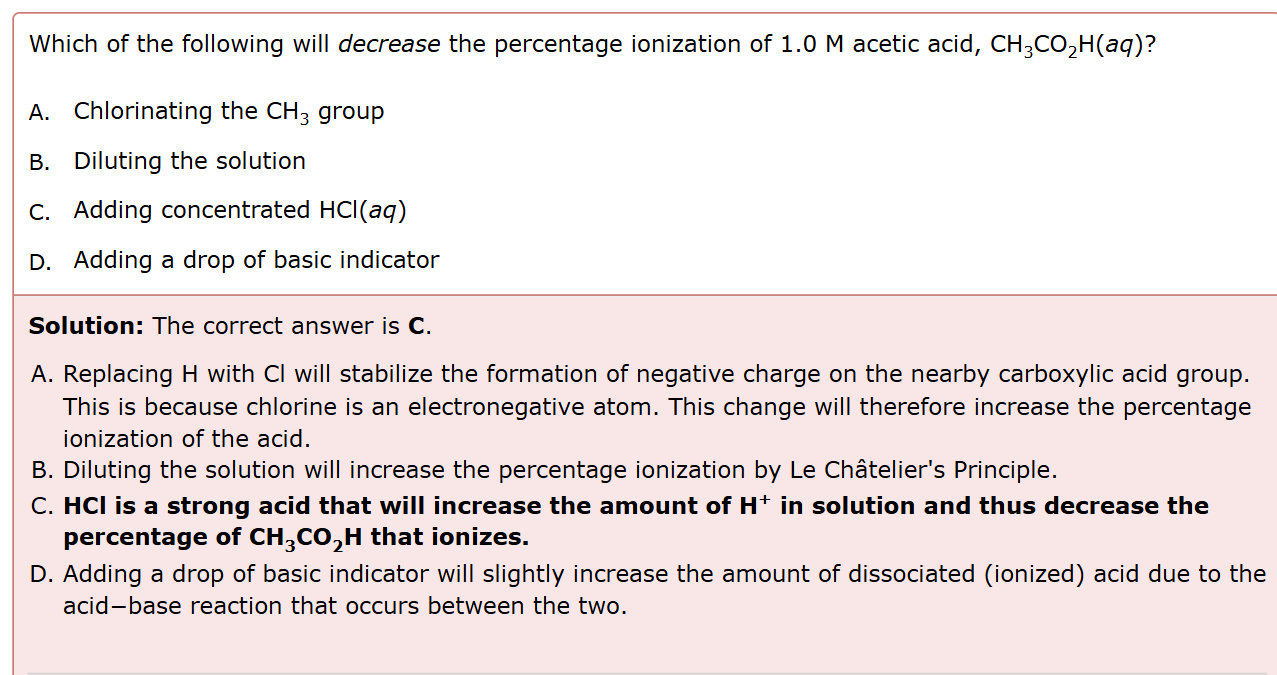
The answer was obvious. You add an acid to an acid to prevent an acid from de-ionizing.
you did not know the formula for the index of refraction.
1. index of refraction= velocity of light in vacuum/ velocity of light in medium= (3.0×10⁸ m/s)(2.1×108 m/s)= 1.4 m/s


This answer is correct according to the decay stuff you learned.
The intensity of radiation is emitted by oxygen sensor directly proportional to the number of photons emitted.
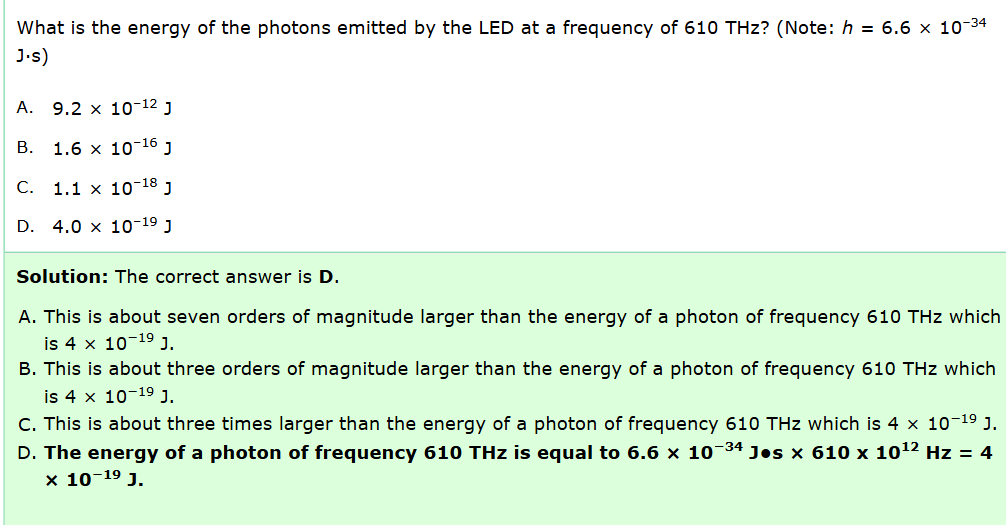
E=hf

you wrote this equation incorrectly when you did it today.
you put the 3 under the entire line, which you were not supposed to do. You were just supposed to put 3 under Pp.
Equation 1: PMPA = Pd + (Ps – Pd)/3
and the pulse pressure Pp is defined as
Equation 2: Pp = Ps – Pd
-your mistake: you 3 under the entire “Pd + (Ps – Pd)”. You were just supposed to put 3 under “Pp” when you combined the equation.
you got this correct.
The value is 760 mmHG.


you were sure about this one.
why did you get this one wrong? you did not know the formula for half life.
This answer is correct because based on the radioactive decay law N(t) = N (1/2)t/T where T = 2 min, this fraction of 15O decays in t = 2 min × ln(1/32) ÷ ln(1/2) = 10 minutes.
Why choice D is 10 minutes
Every half-life cuts the amount in half:
After 1 half-life (2 min): 1/2 remains
After 2 half-lives (4 min): 1/4 remains
After 3 half-lives (6 min): 1/8 remains
After 4 half-lives (8 min): 1/16 remains
After 5 half-lives (10 min): 1/32 remains
What is the work generated by a healthy adult who circulates 9 L of blood through the brachial artery in 10 min?
W=Pt
Work = power x time
A volume flow rate of 9 liters in 10 minutes means 900 mL/min.
According to the figure (which you did not use), this flow rate correlates to a power of 200 W.
600 seconds came from 10 minutes. 1 minute= 60 seconds, 2 minutes = 120 seconds, 60 × 10= 600 seconds.
The work is then 200 W × 600 s = 120 kJ.


The passage: “Molecules of Compound 1 spontaneously self-assemble into cylindrical micelles in water at pH 4”
the passage is telling you the pH has something to do with it.
In order for pH to affect self-assembly of Compound 1, there must be side chains whose net charge respond to pH.
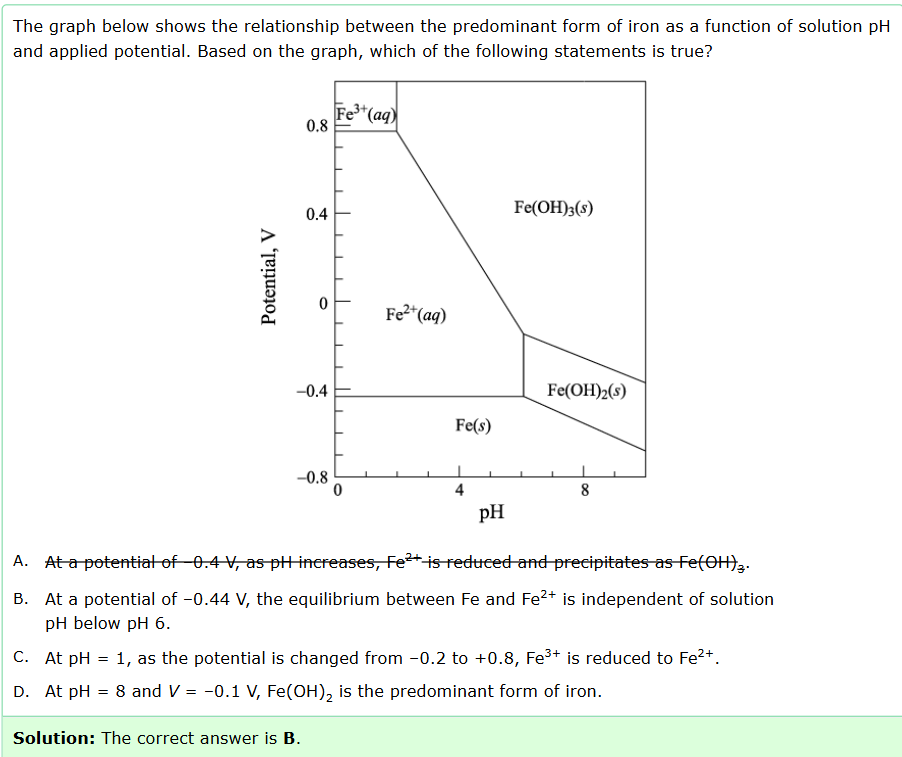
good job

good job
good job

Particles of an ideal gas are treated as having no volume because it is a helpful mathematical assumption, not a physical reality.
Intermolecular forces are treated as negligible in an ideal gas because the molecules are assumed to be spread so far apart and moving so fast that their attractive and repulsive interactions have no meaningful impact on their overall behavior
-the answer was from the passage.
-read the question: “the production of a variety of opsins”
“Human rhodopsin is a G protein-coupled receptor (GPCR) found in rod cells of the retina. Rhodopsin is composed of opsin, a family of seven helix transmembrane proteins, and a covalently attached coenzyme, retinal.
-this part says only something about the structure of opsin, but opsin was mentioned later in the passage.
Retinal is derived from all-trans-retinol, also known as vitamin A (Figure 1). When rhodopsin is exposed to light, the 11-cis-retinal (Figure 1) converts to all-trans-retinal. Subsequent structural changes in rhodopsin allow it to interact with and activate the intracellular G protein transducin. The signal is turned off via phosphorylation of rhodopsin by rhodopsin kinase and subsequent binding of the protein arrestin to rhodopsin. Rhodopsin has a maximum absorption at 500 nm. Additional opsin based receptors are expressed in specialized cone cells and have maximum absorptions at 420 nm, 530 nm, and 560 nm when reconstituted with 11-cis-retinal.”
“variety”= “additional”

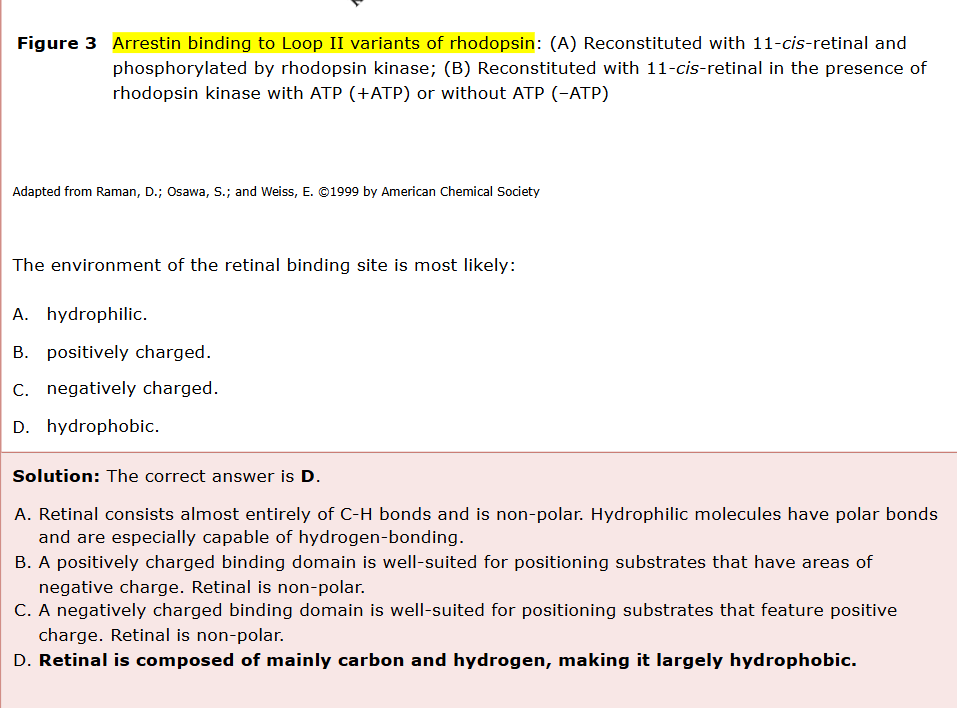
-use the figure from the passage.
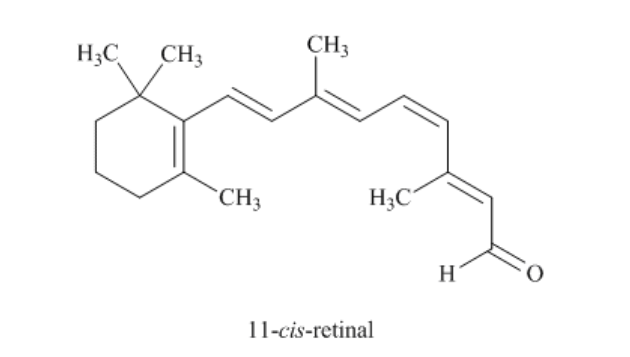
Retinal is composed of mainly carbon and hydrogen, making it largely hydrophobic. This answer came from the figure in the passage.
Just because there is one oxygen, it’s mainly carbon and hydrogen, which means h
-read all the answer choices. The correct answer was ATP.

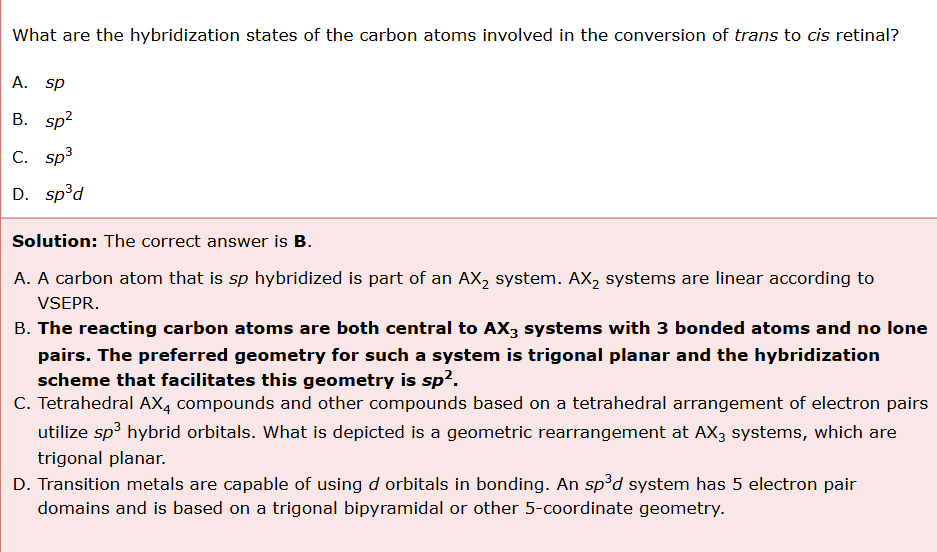
use the passage
the figure was given an an abbreviated line structure, in which the hydrogens are hidden
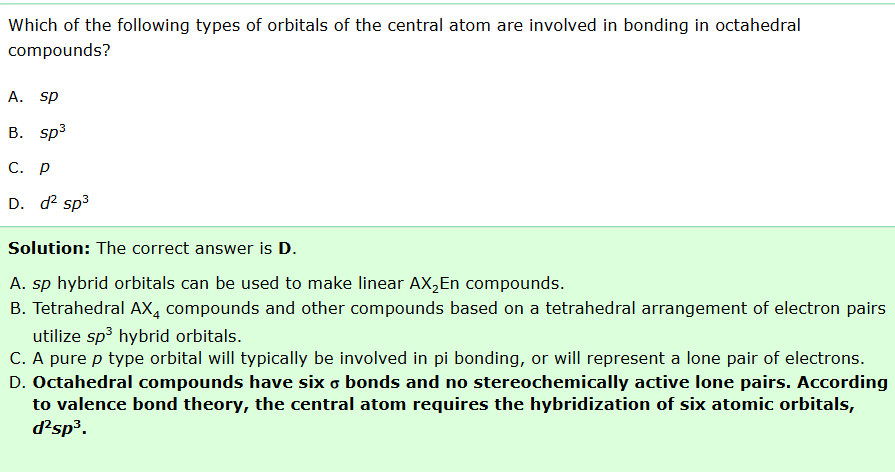
therefore, the answer is sp2.
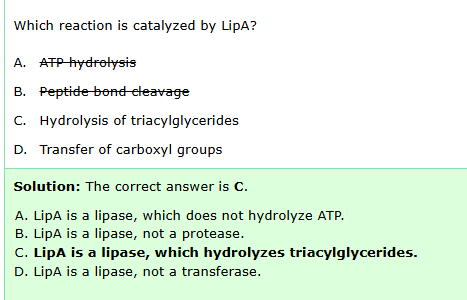
I got the answer from the passage.
This is something you need to pay attention to.
Compared to the wild-type LipA, what is the change in net charge in variant XI at pH 7?
it’s asking for the change in net charge, not the net charge.
Variant XI has a change of –1 charge with R33G (+1 to 0), –2 charge with K112D (+1 to –1), and –1 charge with M134D (0 to –1) for a net change of –4.
-each letter is an amino acid

The information came from this table.
Variant XI mutations
The notation tells you:
R33G = Arginine (R) at position 33 → Glycine (G)
K112D = Lysine (K) at position 112 → Aspartic acid (D)
M134D = Methionine (M) at position 134 → Aspartic acid (D)
At approximately neutral physiological pH, their charges are:
Mutation | Original | Original charge | New amino acid | New charge | Change |
|---|---|---|---|---|---|
R33G | Arginine (R) | +1 | Glycine (G) | 0 | −1 |
K112D | Lysine (K) | +1 | Aspartate (D) | −1 | −2 |
M134D | Methionine (M) | 0 | Aspartate (D) | −1 | −1 |


look at Figure 1
choice D does not align fully with figure 1
Choice C does. Read the choice.
SDS Page
SDS-PAGE (sodium dodecyl sulfate-polyacrylamide gel electrophoresis) is a common laboratory technique used to separate proteins based on their molecular weight.
Denaturation: A detergent called SDS breaks down protein shapes and gives them a uniform negative charge.
Reduction: Reducing agents like beta-mercaptoethanol break chemical links (disulfide bonds) inside the proteins.
Migration: An electric current pushes the negatively charged proteins through a porous polyacrylamide gel toward a positive charge.
Separation: Smaller proteins move faster and farther through the gel mesh, while larger proteins move slower
thin lens equation
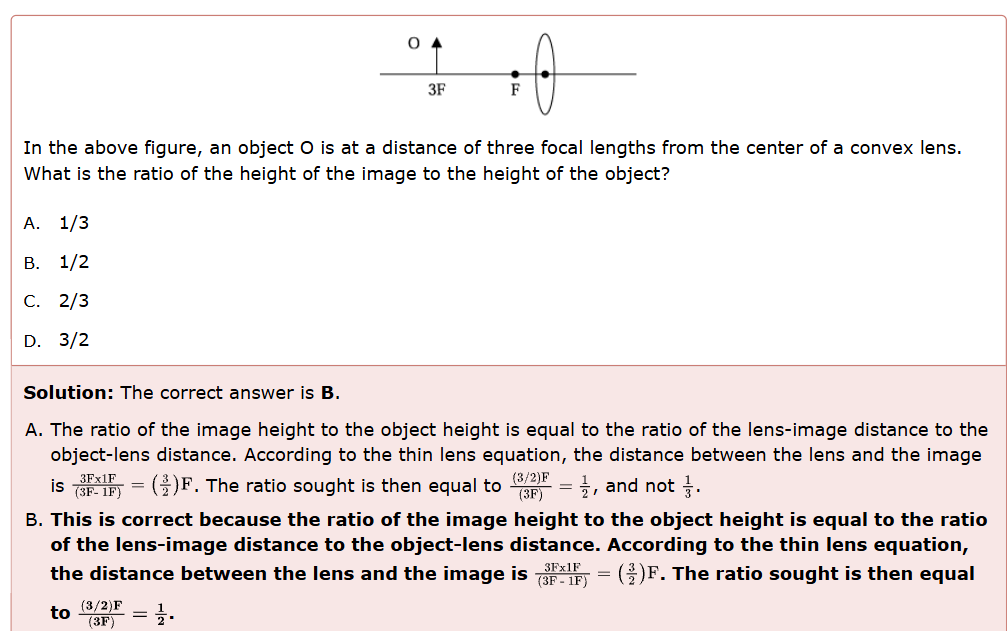

read the question
A negative reduction potential means a chemical species has a lower tendency to be reduced.
A positive reduction potential means a chemical species gains electrons easily


-when reading a passage, look at the figures and tables (you are studying an experiment, and you want to see the data of an experiment).
Assume that a circuit similar to that in Figure 2 is set up in which X = Al, Xn+ = Al3+, Y = Cu, and Ym+ = Cu2+. Which of the following reactions will occur?
A. 2Al3+(aq) + 3Cu(s) → 2Al(s) + 3Cu2+(aq)
according to the table in the passage, Al3+ does not react with Copper.
B. 3Al3+(aq) + 2Cu(s) → 3Al(s) + 2Cu2+(aq)
according to the data in the table, Al3+ does not react with Copper.
C. 2Al(s) + 3Cu2+(aq) → 2Al3+(aq) + 3Cu(s)
this fits the data in the table AND the reaction is balanced for charge. There is net +6 on one side and net +6 on the other side.
D. 3Al(s) + 2Cu2+(aq) → 3Al3+(aq) + 2Cu(s)
this equation is not balanced for charge. There is a net +9 on the product side, but only net +4 on the reactant side.
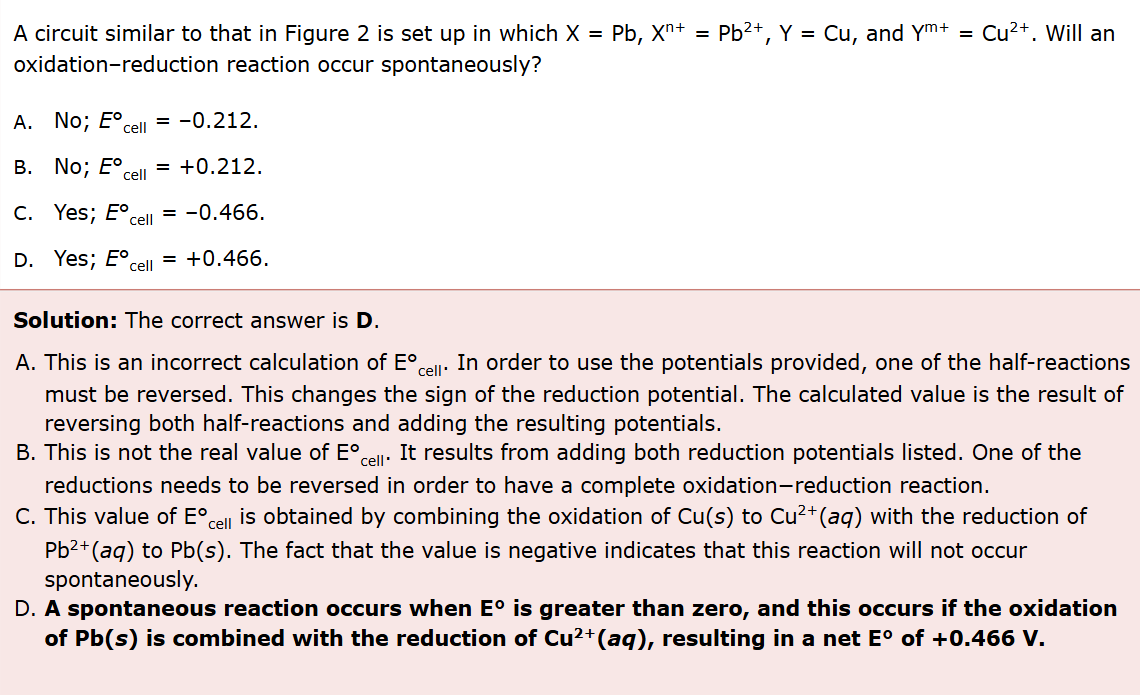
Ecell = Ecathode - Eanode
Pb2+(aq) + 2e– → Pb(s) E°red = –0.127 V
Reaction 1
Cu2+(aq) + 2e– → Cu(s) E°red = +0.339 V
-A spontaneous reaction occurs when E° is greater than zero, and this occurs if the oxidation of Pb(s) is combined with the reduction of Cu2+(aq), resulting in a net E° of +0.466 V.
0.339+0.127=0.466
MCAT CARS
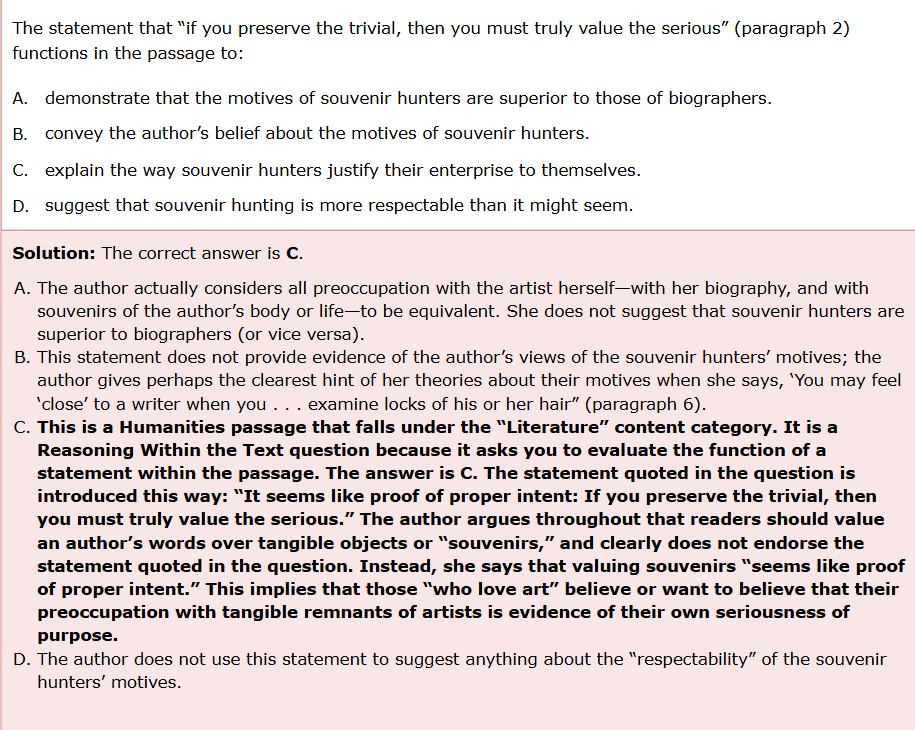
It is a Reasoning Within the Text question because it asks you to evaluate the function of a statement within the passage. The answer is C. The statement quoted in the question is introduced (in the passage) in this way: “It seems like proof of proper intent: If you preserve the trivial, then you must truly value the serious.”
The author argues throughout that readers should value an author’s words over tangible objects or “souvenirs,” and clearly does not endorse the statement quoted in the question. Instead, she says that valuing souvenirs “seems like proof of proper intent.” This implies that those “who love art” believe or want to believe that their preoccupation with tangible remnants of artists is evidence of their own seriousness of purpose.
B. convey the author’s belief about the motives of souvenir hunters.
“convey the authors belief”: the author does not belief they should be souvenir hunting according to the main idea of the passage. The main idea of the passage states the author is against what they are doing.
you chose B. B is wrong because it does NOT convey the author’s belief about the motives of souvenir hunters.
C. explain the way souvenir hunters justify their enterprise to themselves
this is correct.
Reverent souvenir hunting is often deeply installed in those who love art.
It seems like proof of proper intent: If you preserve the trivial, then you must truly value the serious.
answer choice C sticks best to the main idea of the passage.


with this one, you were in-between choices. You chose A, it was correct, but why was it correct?
After the Napoleonic Wars, the Portuguese people demanded democratic reforms, including major restrictions on the power of monarchs.
Together with information in the passage, this fact most clearly indicates that:
“Amid these diverse sentinels lurked a small minority—students, Freemasons, scientists, poets, businesspeople, a few officials, even a noble or two—who were irked by the despotism of the past, furtively flirted with philosophy, and dreamed of representative government, free trade, free assembly, free press, free thought, and a stimulating participation in the International of the Mind.”
A.
D. Freemasonry was coming into the social and political mainstream.
-D is wrong, because it’s too specific, it does not reflect all of the liberal minority according to the passage, it just reflects free masons
Although the Freemasons were part of the “minority” who were “irked by the despotism of the past,” a move away from such despotism does not necessarily imply support for the Freemasons’ ideas specifically.
Which of the following facts most strongly supports the authors’ image of John VI as resistant to social change in his realm?
From the passage, we know John VI was extremely resistant to social reform.
This is a Reasoning Within the Text question, as it asks you to evaluate the strength of evidence for passage claims.
The answer is B. “Reforms,” especially in the context of this passage, represent clear efforts at making progressive social changes. Retraction of such measures by a highly repressive King (possibly initially consented to as the price for being allowed to return from exile) would strongly illustrate this king’s resistance to change.
