Chapter 2 Aqueous Chemistry
 Call Kai
 Learn
Learn Practice Test
 Spaced Repetition
 Match
Match Flashcards
 Knowt Play
1/58

There's no tags or description
Looks like no tags are added yet.
Name | Mastery | Learn | Test | Matching | Spaced | Call with Kai | Chat |
|---|
No analytics yet
Send a link to your students to track their progress
59 Terms
what % of humans are made of water
60% by weight
functions of life requiring water
grow, function, reproduce
breakdown of water in body
40% intracellular
15% extracellular
5% circulatory system
40% non water
H2O geometry
tetrahedral
is water polar or nonpolar, why?
polar, has uneven distribution of charges (partial negative on O, partial positive on H)
how do water molecules interact with each other
via hydrogen bonds
hypothetically and actually, how many hydrogen bonds can a water molecule take part in
theoretically 4: 2 pairs of unshared e-s to ‘accept’ hydrogen, 2 hydrogens to ‘donate’
reality 2: one accepted, one donated
what are the hydrogen bond donors and acceptors in water?
donor: H
acceptor: O
what are the hydrogen bond donor and acceptors in an amine molecule?
donor: H
acceptor: N
what are electrostatic forces and what are the types
noncovalent bonds/forces; include ionic bonds, hydrogen bonds, van der waals interactions
distance between atoms in covalent bonds, force
1 angstrom, 460 kJ/mol
distance between atoms in hydrogen bonds, force
1.8 angstroms, 20 kJ/mol
distance between atoms required for there to be no force/bond
2.7 angstrom
most common functional groups forming hydrogen bonds in biomolecules
hydroxyl groups (-OH), amine groups (NH3)
what is electronegativity
how much an atom likes electrons (affinity for them/will attract)
what are van der waals interactions
interactions between polar molecules that aren’t charged
dipole-dipole interactions, strength
strong van der waals interaction between strongly polar groups, 9 kJ/mol
london dispersion forces, strength
weak van der waals interaction between nonpolar molecules; small fluctuations in electron distributions create temporary separation of charges, 0.3 kJ/mol
why are electrostatic/small forces important despite being weak?
they have a cumulative effect since they are occurring between many many molecules at a time
water’s dielectric constant is…
relatively high
what is the dielectric constant
measure of a solvent’s ability to diminish electrostatic interactions between dissolved ions
why is seawater not drinkable
seawater contains too much salt for our kidneys to process without pulling water from our bodies - as a result, seawater dehydrates our bodies
why is water essential to life/cells
a couple water molecules can fit inside each cell, giving an aqueous environment for them to exist in without too much space - maintains cells’ contents in crowded but fluid state
hydrophilic v hydrophobic
hydrophilic: likes water (polar)
hydrophobic: avoids water (nonpolar)
hydrophobic effect, ex oil in water
exclusion of nonpolar substances from an aqueous solution; ex, a drop of oil in water will be surrounded by a layer of constrained water molecules and stay separate/not form a mixture
change in entropy of water molecules with addition of drop of nonpolar substance, several drops, etc
introduction of nonpolar substance will decrease entropy since some water molecules must ‘protect’ the nonpolar substance, so there are fewer possible molecular arrangements
if there are several drops, initially entropy will decrease as water molecules surround all of the nonpolar substance. due to the hydrophobic effect, thought, the nonpolar molecules will clumb together, requiring fewer water molecules to surround them, so entropy increases.
is the hydrophobic effect a bond?
NO, just an observable phenomenon/interaction
ampiphilic molecules
have both hydrophilic and hydrophobic portions; ex, lipids (polar head, nonpolar tail)
hydrophobic effect & phospholipid bilayer
polar/hydrophilic heads are located towards aqueous cell interior AND exterior, while nonpolar/hydrophobic tails remain inside. this takes two layers of lipids (bilayer) and creates a protective layer around a cell that selectively allows molecules in an out, is a barrier to diffusion (ex, ions or polar substances can’t get through due to hydrophobic/nonpolar core)
hydronium and hydroxide ions
hydronium: H3O+
hydroxide: OH-
water chemical equilibrium

what are some of the fastest biochemical reactions
acid-base reactions
why are acid base reactions so fast
water has a 'jumping proton’ that moves through H-bond connected water molecules → H+ mobility in water is greater than mobility of other ions that must diffuse amongst water molecules
dissociation constant K
K = [H+][OH-]/[H2O]
Kw
ionization constant of water, since the concentration of H2O (55.5 M) is so much greater than [H+] or [OH−] it’s considered constant, redefinition of K
10^-14
relationship between [H+] and [OH-]
inverse
pH equation
pH = -log [H+']
difference of one pH unit indicates?
10 fold difference in [H+] in a solution, since pH is a logarithmic scale
Ka
= K [H2O] → acid dissociation constant
pKa
= -log (Ka)
what does higher/lower pKa value indicate
lower = stronger acid; acid more fully dissolved in water
henderson-hasselbach equation
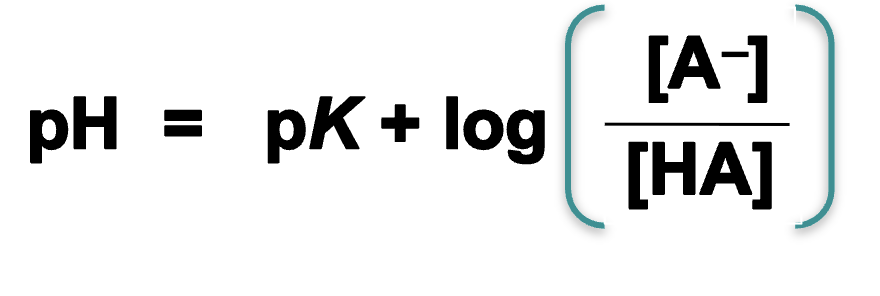
pK is ___ to a specific acid
constant
what are buffers
weak acid/conjugate base system (HA/A-) that prevents dramatic changes in pH when acid/base is added to a solution
general buffering capacity of an acid
± 1 pH unit of acid’s pK
major buffering systems in the human body
bicarbonate and phosphate
human physiological pH
6.9-7.4
pK of buffering system involving CO2 in blood
6.1
bicarbonate buffer system, normal conditions

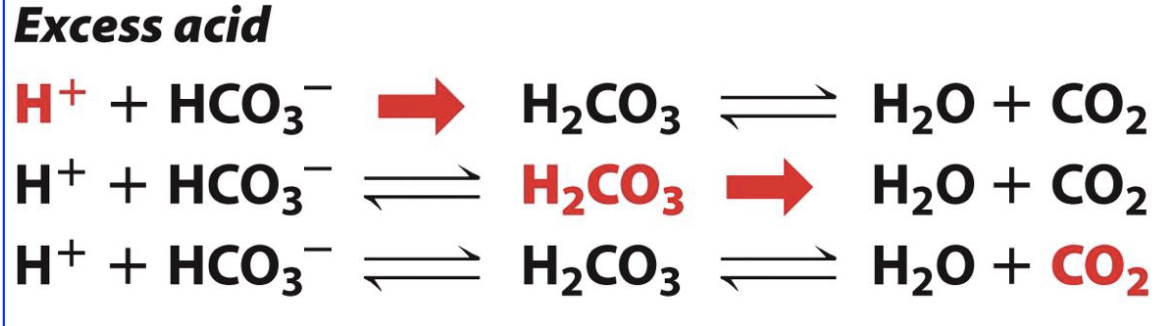
bicarbonate buffer system, excess acid
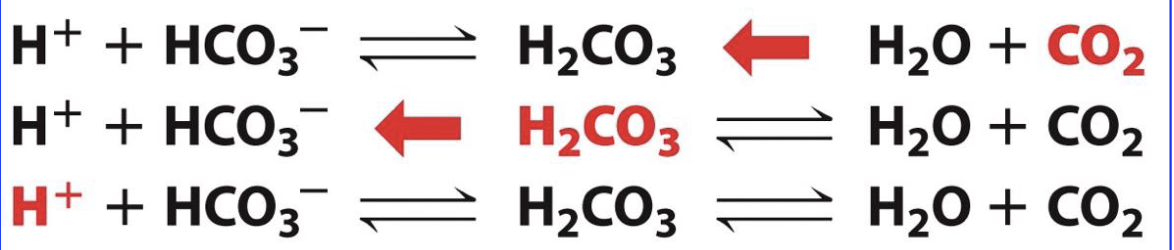
bicarbonate buffer system, insufficient acid
why do humans need a buffering system
we will not survive if physiological pH is incorrect, but many biochemical reactions produce acid so we need a system to ensure that this acid doesn’t dramatically decreases body pH
long-term vs short-term pH changes in the blood
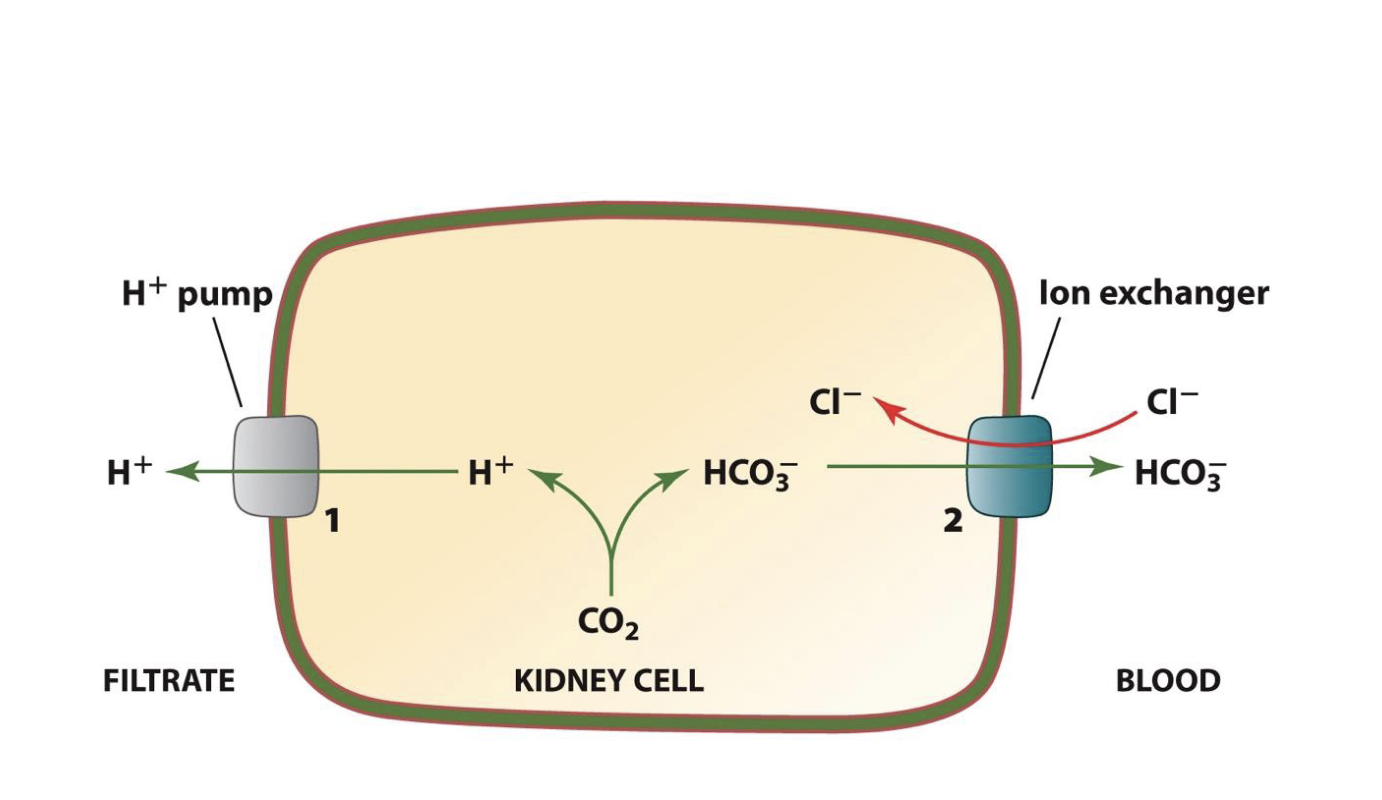
long-term changes made by the kidneys (hours → days)
short-term changes can be made by changes in pulmonary function, ie heart racing (minutes → hours)
bicarbonate reabsorption in kidneys looks like
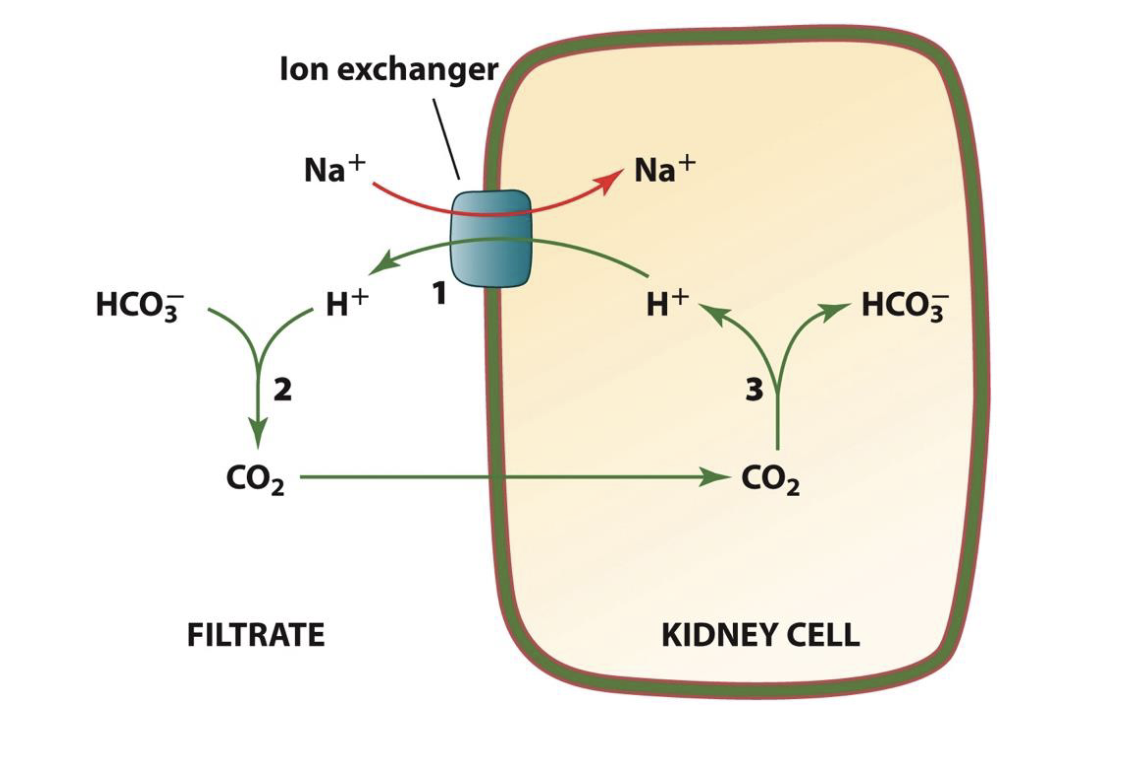
bicarbonate production in kidneys looks like
acidosis
blood pH < 7.35
alkylosis
blood pH > 7.45
metabolic acidosis/alkylosis is disease of
kidneys
respiratory acidosis/alkylosis is disease of
lungs