Differential Equations
 Call Kai
 Learn
Learn Practice Test
 Spaced Repetition
 Match
Match Flashcards
 Knowt Play
1/58

There's no tags or description
Looks like no tags are added yet.
Name | Mastery | Learn | Test | Matching | Spaced | Call with Kai | Chat |
|---|
No analytics yet
Send a link to your students to track their progress
59 Terms
Differential Equation
It is one in which involves one or more independent variables, a dependent variable and one or more of their differential coefficients.
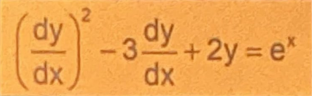
ORDINARY DE
the unknown function depends on only one independent variable
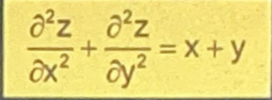
PARTIAL DE
the unknown function depends on two or more independent variables
dependent variable
dy in dy/dx (numerator)
Independent Variable
dx in dy/dx (denominator)
Differential Coefficients
dy/dx
- another name for the derivative of a function
- It measures how fast a function is changing with respect to its variable at a particular point.
ORDER
The highest ordered derivative appearing in a differential equation.
*more important than degree
DEGREE
The exponent of the highest ordered derivative.
*must be a whole number so fix the exponent first if it is in fraction form
DE OF FAMILY OF CURVES
A family of curves on a plane is usually defined by an equation containing one or more parameters together with the coordinates of a point on the plane.
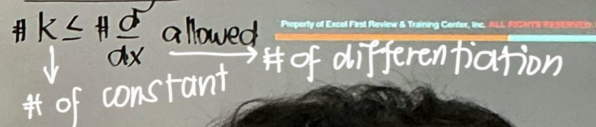
Number of parameters (arbitrary constant)
The one that distinguishes one form from another in a family of curves
Arbitrary constant
No. of times to derive y
*DE must have no parameters
If “Find the differential equation”
Derive y
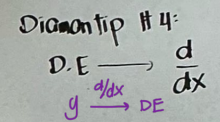
If “Find the solution to the differential equation”
Integrate the given DE
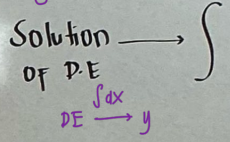
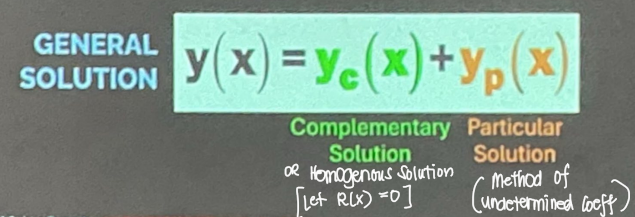
GENERAL SOLUTION
set of all possible solutions, which includes the particular and singular solutions.
PARTICULAR SOLUTION
solution obtained from the general solution by assigning particular values to the arbitrary constants.
Order of DE
Number of times to integrate
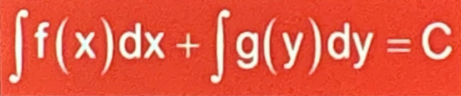
VARIABLE SEPARABLE
Possible to re-arrange the terms of the differential equation in two groups, each containing only one variable, the variables are said to be separable.

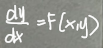
HOMOGENEOUS
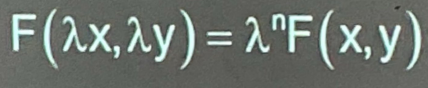
A differential equation where, x and y are replaced by λx and λy, it will be written in the form:
To solve, put y = ux then dy = udx + xdu and the differential equation reduces to variable separable.
Short cut in checking: same degree both sides
EXACT DE
A differential equation which is the result of a simple differentiation.

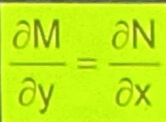
Test for exactness
*MAY NAX
INTEGRATING FACTOR for EXACT DE
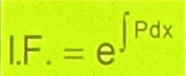
A given D.E. may not be integrable. But it may become integrable when it is multiplied by a function. Such function is called
Advantage of the solution of Exact DE
Even if the equation is not exact, there is a way for it to be exact by incorporation of an Integrating Factor (compared to homogenous that doesn’t have another way)
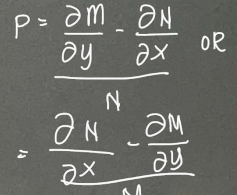
To solve for P in the Integrating Factor for Exact DE
LINEAR DE
To be linear, the dependent variable should be linear.
There can be any sort of complicated function of x in the equation. Thus a linear equation can be written as
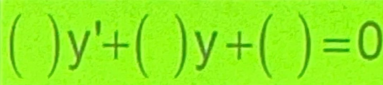
Conditions for LINEAR DE
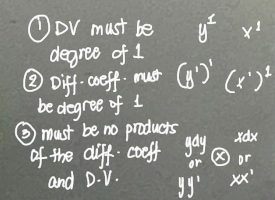
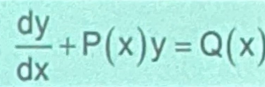
Linear in Y
yes Pdx, QeSPdx, dxC
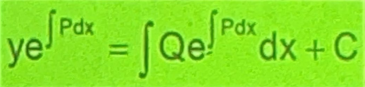
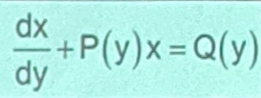
Linear in X
xes Pdy, QeSPdy, dyC
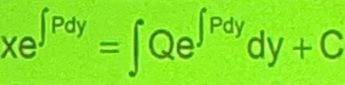
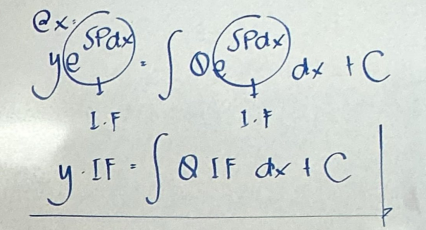
General equation for the solution of Linear DE (at x)
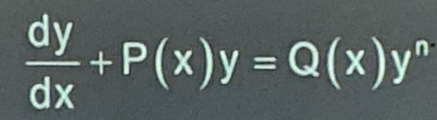
BERNOULLI'S DE
Some equations not in the linear form may be reduced to the linear form by a suitable substitution.
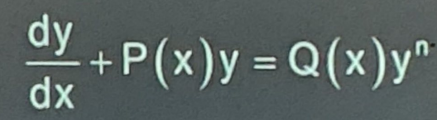
Solution to Bernoulli’s DE

n = 0, linear
n = 1, homogenous
n ≠ 1 or 0, Bernoulli
conditions on how to choose appropriate solution to DE
HIGHER ORDER LINEAR DIFFERENTIAL EQUATION
An ordinary differential equation of order n is called linear if it may be written in the form:

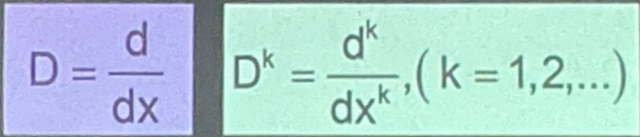
DIFFERENTIAL OPERATOR
When placed before a function of x, it means that the function is to be differentiated.
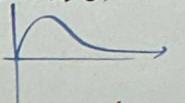
Case 1: Overdamped
Roots: Real & Distinct
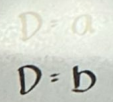
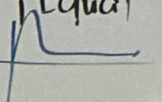
Case 2: Critically Damped
Roots: Real & Equal
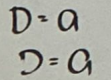
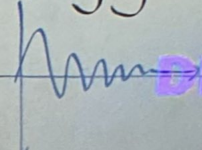
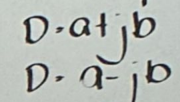
Case 3: Underdamped
Roots: Complex and Conjugate
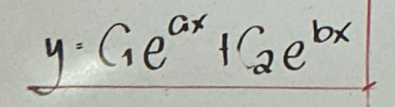
Case 1: Overdamped solution
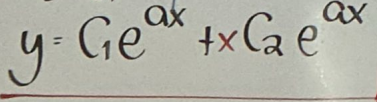
Case 2: Critically Damped solution
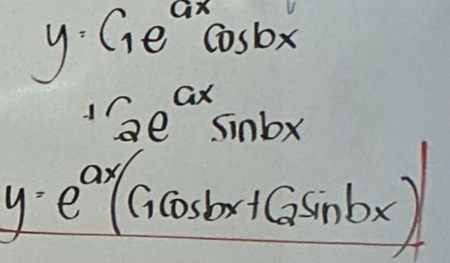
Case 3: Underdamped
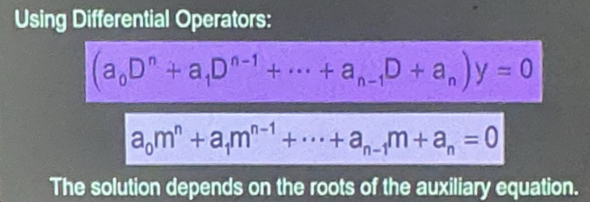
HOMOGENEOUS LINEAR DE solution


NON-HOMOGENEOUS LINEAR DE solution
Algebraic
Exponential
Trigonometric
To what equations can we apply non-homogenous linear DE
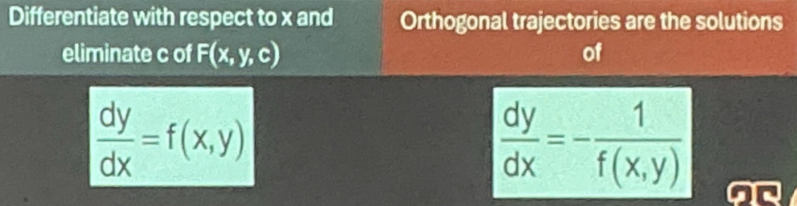
ORTHOGONAL TRAJECTORIES
Family of curves G(x,y,x) intersecting another family of curves F(x,y,c) @ right angles (90°)
Application of lower math (2 lines only) to higher math (finding 90° @ all points in the curve)
Solution to Orthogonal Trajectories
Differentiate to get slope
Negate and reciprocate the slope
Integrate
NATURAL GROWTH
"The rate of change of y is proportional to the present value of y."
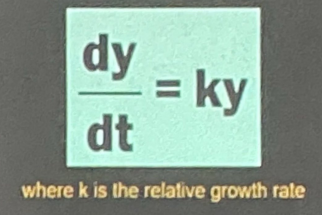
Population Growth
Unrestricted population growth
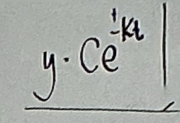
Radioactive Decay
Radioactive Decay
Bank Accounts
Continuous Compounding
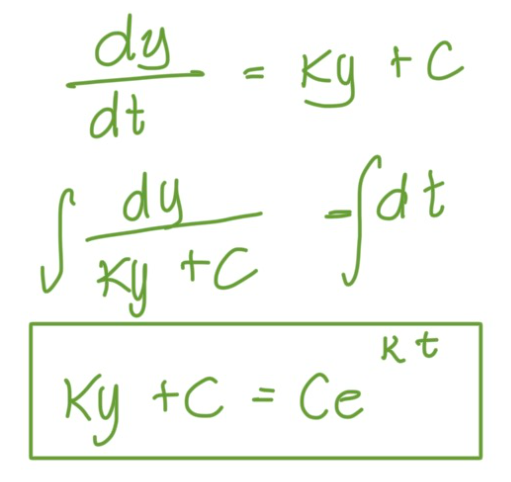
SHIFTED NATURAL GROWTH
"The rate of change of y is proportional to the value of y along with some other constant growth/decay rate."
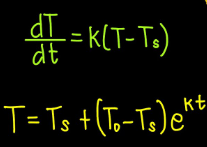
NEWTON'S LAW OF COOLING
"The rate of change of temperature of an object is proportional to the difference between the object and surrounding temperature."
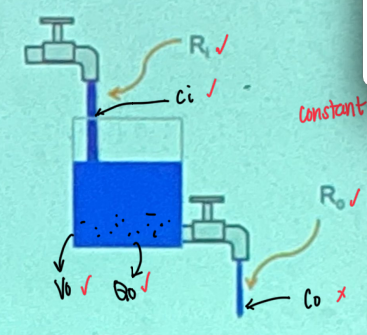
MIXING PROBLEMS
rate in L/min
concentration density in kg/L, g/L
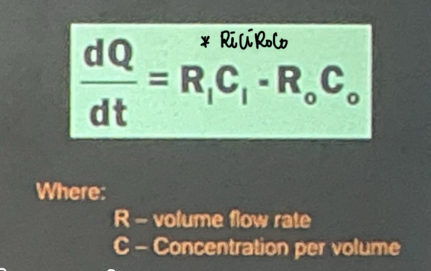
Solving for Co (output concentration) in Mixing Problems
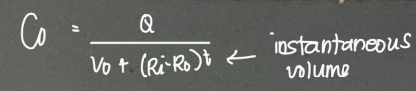
Concentration or Density
Amount of substance / volume; mass / volume
Case 1 in Mixing Problems
Ri = Ro
Solved using either Exact or Linear
Case 2 in Mixing Problems
Ri ≠ Ro
Case 3 in Mixing Problems
Ro = 0
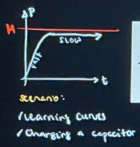
LIMITED EXPONENTIAL GROWTH
“The rate of change of P is proportional to the difference of the maximum and present value of P.”
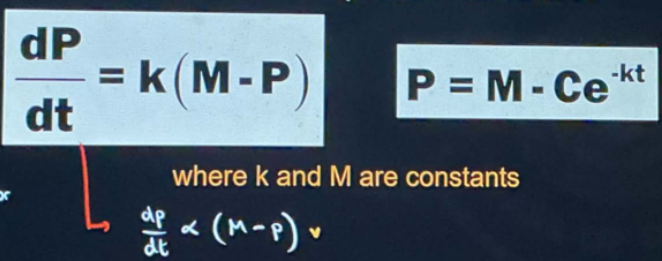
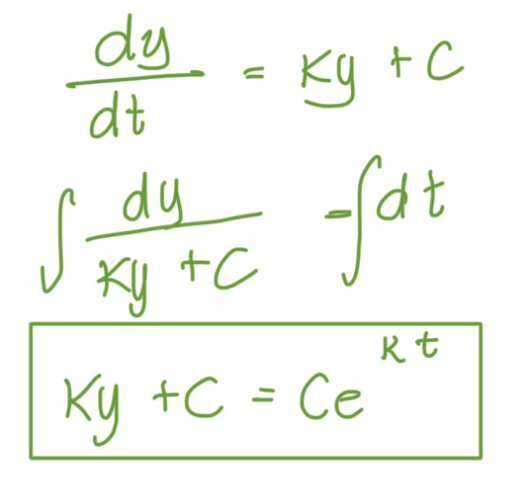
Shortcut in solving for Shifted Exponential Growth
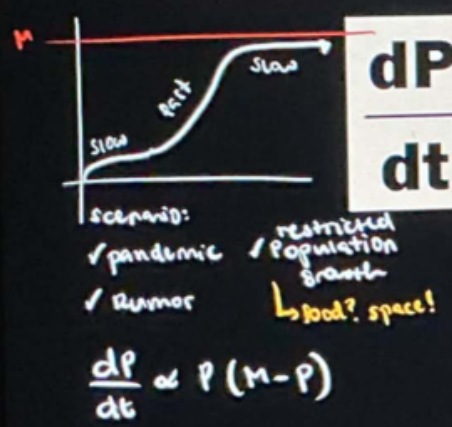
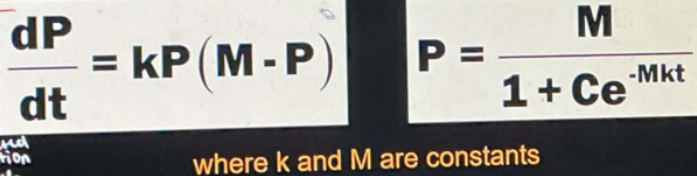
Logistic Growth
“The rate of change of population is proportional to the present value of P and to the allowable additional value of P.”