Research Design and Data

0.0(0)
Studied by 0 people
call kaiCall Kai
learnLearn
examPractice Test
spaced repetitionSpaced Repetition
heart puzzleMatch
flashcardsFlashcards
GameKnowt Play
Card Sorting

1/8

flashcard set

Earn XP

Description and Tags

Link between study design and data, levels of measurement, data types with psychological examples

Last updated 11:19 AM on 5/24/26
Name
Mastery
Learn
Test
Matching
Spaced
Call with Kai

No analytics yet

Send a link to your students to track their progress

9 Terms

1
New cards

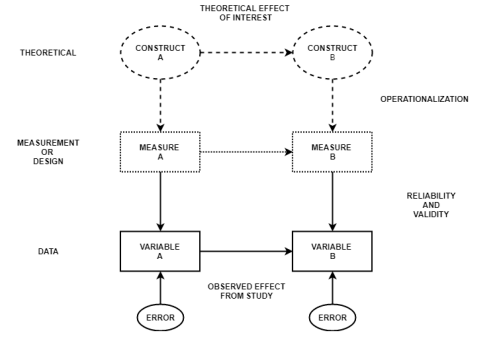
Which concepts are involved in measurement?

  • Theoretical -> construct (abstract ideas e.g intelligence) -> operationalised 

  • Measurement/design (e.g IQ test) -> must be reliable + valid 

  • Data (links to variables + errors) -> observed effect from study (e.g % on IQ test) 
<ul><li><p class="Paragraph SCXO10852133 BCX0" style="text-align: left;"><span style="background-color: inherit; line-height: 20.7px; color: windowtext;">Theoretical -&gt; construct (abstract ideas e.g intelligence) -&gt; operationalised</span><span style="line-height: 20.7px; color: windowtext;">&nbsp;</span></p></li><li><p class="Paragraph SCXO10852133 BCX0" style="text-align: left;"><span style="background-color: inherit; line-height: 20.7px; color: windowtext;">Measurement/design (e.g IQ test) -&gt; must be reliable + valid</span><span style="line-height: 20.7px; color: windowtext;">&nbsp;</span></p></li><li><p class="Paragraph SCXO10852133 BCX0" style="text-align: left;"><span style="background-color: inherit; line-height: 20.7px; color: windowtext;">Data (links to variables + errors) -&gt; observed effect from study (e.g % on IQ test)</span><span style="line-height: 20.7px; color: windowtext;">&nbsp;</span></p></li></ul><p></p>
2
New cards

What are the broad categories for data types?

  • Categorical = discrete number of response options (coded as integers) 

  • Numeric = continuous variables which can take any real number value within the specified range of measurement 

3
New cards

What are the categorical data types?

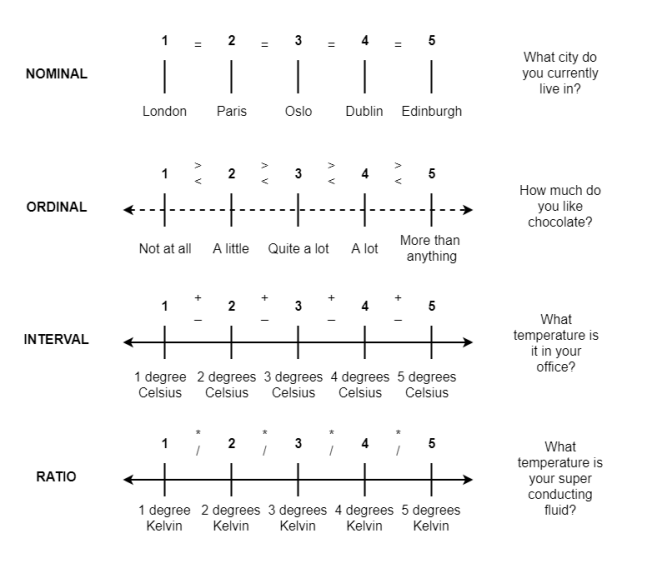
  • Nominal = binary/categorical variable where numerical markers share no relationship (no meaningful ordering) 

  • Ordinal = binary/categorical variable where there’s a meaningful way to rank/order responses (BUT cannot meaningfully quantify the difference e.g likert scale) 
  • Binary (special case) → only 2 possibilities 

4
New cards

What are the numeric data types?

  • Interval/ratio - numerical values have meaning 

  • Continuous 

  • Discrete

    • Count = variables which can only take non-negative integer values (0, 1, etc)

5
New cards

Who coined the term ‘levels of measurement’?

Stevens (1946)

6
New cards

What are the levels of measurement?

  • Interval 

    • No true 0 point on scale (0 does not mean absence of x variable) 

    • BUT can consider differences (which have a true 0 point) 

    • E.g IQ scores (debated) 

  • Ratio 

    • Has true 0 point on scale (absolute 0, e.g can double/half values) 

    • So -> is plausible to multiple + divide ratio variables 

    • Can legitimately talk about double x 

    • E.g reaction time

  • Nominal

    • Binary/categorical variable where numerical markers share no relationship (no meaningful ordering) 

  • Ordinal

    • Binary/categorical variable where there’s a meaningful way to rank/order responses (BUT cannot meaningfully quantify the difference e.g likert scale) 

<ul><li><p class="Paragraph SCXO266997537 BCX0" style="text-align: left;"><span style="background-color: inherit; line-height: 20.7px; color: windowtext;">Interval</span><span style="line-height: 20.7px; color: windowtext;">&nbsp;</span></p><ul><li><p class="Paragraph SCXO266997537 BCX0" style="text-align: left;"><span style="background-color: inherit; line-height: 20.7px; color: windowtext;">No true 0 point on scale (0 does not mean absence of x variable)</span><span style="line-height: 20.7px; color: windowtext;">&nbsp;</span></p></li><li><p class="Paragraph SCXO266997537 BCX0" style="text-align: left;"><span style="background-color: inherit; line-height: 20.7px; color: windowtext;">BUT can consider differences (which have a true 0 point)</span><span style="line-height: 20.7px; color: windowtext;">&nbsp;</span></p></li><li><p class="Paragraph SCXO266997537 BCX0" style="text-align: left;"><span style="background-color: inherit; line-height: 20.7px; color: windowtext;">E.g IQ scores (debated)</span><span style="line-height: 20.7px; color: windowtext;">&nbsp;</span></p></li></ul></li><li><p class="Paragraph SCXO266997537 BCX0" style="text-align: left;"><span style="background-color: inherit; line-height: 20.7px; color: windowtext;">Ratio</span><span style="line-height: 20.7px; color: windowtext;">&nbsp;</span></p><ul><li><p class="Paragraph SCXO266997537 BCX0" style="text-align: left;"><span style="background-color: inherit; line-height: 20.7px; color: windowtext;">Has true 0 point on scale (absolute 0, e.g can double/half values)</span><span style="line-height: 20.7px; color: windowtext;">&nbsp;</span></p></li><li><p class="Paragraph SCXO266997537 BCX0" style="text-align: left;"><span style="background-color: inherit; line-height: 20.7px; color: windowtext;">So -&gt; is plausible to multiple + divide ratio variables</span><span style="line-height: 20.7px; color: windowtext;">&nbsp;</span></p></li><li><p class="Paragraph SCXO266997537 BCX0" style="text-align: left;"><span style="background-color: inherit; line-height: 20.7px; color: windowtext;">Can legitimately talk about double x</span><span style="line-height: 20.7px; color: windowtext;">&nbsp;</span></p></li><li><p class="Paragraph SCXO266997537 BCX0" style="text-align: left;"><span style="background-color: inherit; line-height: 20.7px; color: windowtext;">E.g reaction time</span></p></li></ul></li><li><p class="Paragraph SCXO266997537 BCX0" style="text-align: left;">Nominal</p><ul><li><p class="Paragraph SCXO266997537 BCX0" style="text-align: left;"><span style="background-color: inherit; line-height: 20.7px; color: windowtext;">Binary/categorical variable where numerical markers share no relationship (no meaningful ordering)</span><span style="line-height: 20.7px; color: windowtext;">&nbsp;</span></p></li></ul></li><li><p class="Paragraph SCXO266997537 BCX0" style="text-align: left;">Ordinal</p><ul><li><p class="Paragraph SCXO266997537 BCX0" style="text-align: left;"><span style="background-color: inherit; line-height: 20.7px; color: windowtext;">Binary/categorical variable where there’s a meaningful way to rank/order responses (BUT cannot meaningfully quantify the difference e.g likert scale)</span><span style="line-height: 20.7px; color: windowtext;">&nbsp;</span></p></li></ul></li></ul><p></p>
7
New cards

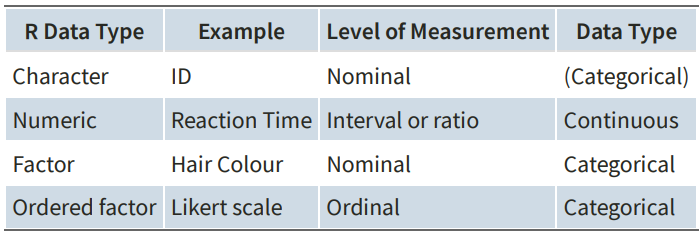
Data types and R

knowt flashcard image
8
New cards

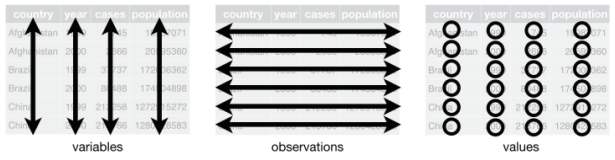
Data sets

knowt flashcard image
9
New cards

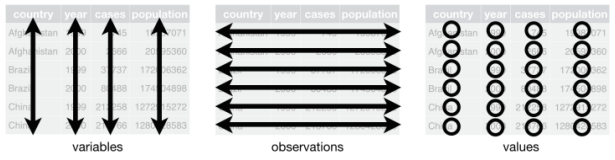
What does ‘tidy data’ consist of?

  • Each variable must have its own column

  • Each observation must have its own row

  • Each value must have its own cell

Each individual value belongs to both a variable + an observation
<ul><li><p>Each variable must have its own column</p></li><li><p>Each observation must have its own row</p></li><li><p>Each value must have its own cell</p></li></ul><p></p><p>Each individual value belongs to both a variable + an observation</p><p></p>