C4 - Inorganic Chemistry and the Periodic Table
 Call Kai
 Learn
Learn Practice Test
 Spaced Repetition
 Match
Match Flashcards
 Knowt Play
1/30

There's no tags or description
Looks like no tags are added yet.
Name | Mastery | Learn | Test | Matching | Spaced | Call with Kai | Chat |
|---|
No analytics yet
Send a link to your students to track their progress
31 Terms
Group 2 elements
Form 2+ ions
Can be seen by their electron configurations
The electrons in the outer s sub-shell are relatively weakly bound
Are lost during reactions
Loss of two electrons results in a stable noble gas electron config
G2 FIE
Decreases down group 2
Energy is a measure of the strength of electrostatic attraction between the outer electron and nucleus
Decreases due to
Nuclear charge increases
More protons
Atomic radius increases
More electron shells are added
Electron shielding increases
More inner electron shells reduce nuclear attraction
Shielding and atomic radius are stronger than nuclear charge
G2 Reactivity (water, oxygen and chlorine)
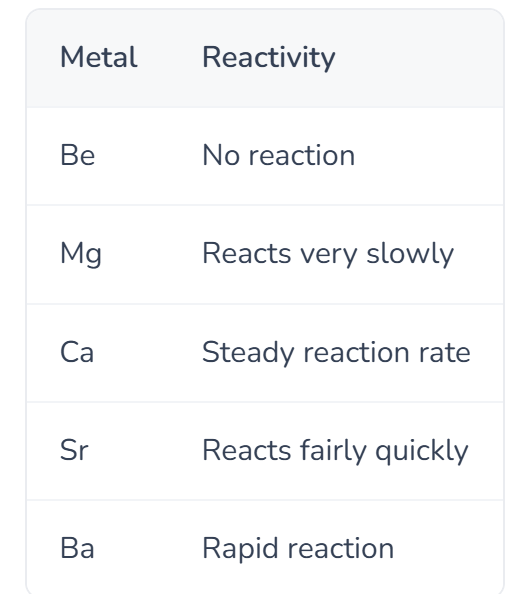
Reactivity increases down the group
Reactions of group 2 elements down group with water, oxygen and chlorine become more vigorous
Reaction with water
Produce metal hydroxide and hydrogen
Group two metal is oxidised from 0 to +2
Reactivity trend
Reaction with oxygen
When group 2 metals burn in oxygen, a solid white oxide is formed
2M + O2 ---> 2MO
Metal is oxidised from 0 to +2
Oxygen is reduced from 0 to -2
Reaction with chlorine
M + Cl2 ---> MCl2
Metal is oxidised from 0 to +2
Chlorine is reduced from 0 to -1
Solubility of G1 and G2 compounds
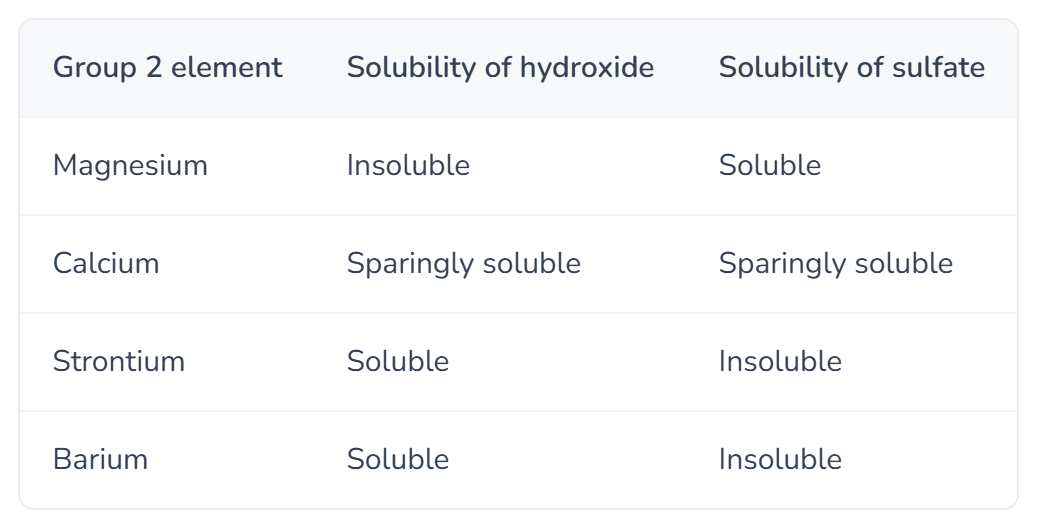
Solubility of group 2 metal hydroxides and sulfates follow opposite trades
Group 2 metal hydroxides become more soluble
Sulfates become less soluble down the group
Reaction of G2 oxides and hydroxides
Are basic and alkaline
Group 2 metal oxides readily react with water to form metal hydroxides (dissolve)
MO + H2O ----> M(OH)2
Releases OH- ions which makes the solution alkaline
pH of the resulting solution increases down the group
Solubility of hydroxide increases
Exception of MgO which reacts slowly and has low solubility
Group 2 metal hydroxides react with dilute acids such as HCl to form water and salt
Reactions become more vigorous down the group
G1-2 compounds thermal decomposition
Group 1 compounds
Are very stable and don’t decompose with Bunsen burner heating
Only lithium carbonate does
Li2CO3 ----> Li2O + CO2
Group one nitrates decompose to nitrites and oxygen for example
2NaNO3 ---> 2NaNO2 + O2
Exception of lithium nitrate
2LiNO3 ----> Li2O + 2NO2 + 1/2 O2
Group 2 compounds
Group two carbonates decompose to oxides and carbon dioxide
Group 2 nitrates decompose into oxides, nitrogen dioxide and oxygen
Thermal stability of carbonates and nitrates of G1-2
Increases as you go down G1 and G2
Due to ion polarisation and polarising power
Cation size
As we move down group, cations become larger
Larger cations have a lower charge density
Results in lower polarising power, causing less anion distortion
Less distortion leads to stronger C-O and N-O bonds, so more stable
Cation charge
G2 cations have higher charge than G1
Higher charge results in greater polarising power
Makes G2 less stable than G1 counterparts
Testing thermal stability of carbonates and nitrates
G2 Carbonates
Measure time taken to produce CO2 gas that can turn limewater cloudy
G1 nitrates
Tiem taken to produce enough O2 gas to relight a glowing splint
G2 nitrates
Measure time taken to produce brown NO2 gas
Flame test procedure
Take a platinum wire loop
Unreactive so it will not affect the results
Really high melting point so wont melt
Clean it with dilute hydrochloric acid, distilled water and heat it
Gets rid of any leftover ions
So the results do not get messed up
Hold it in the blue part of the flame
Use BLUE otherwise you won't see a colour change
Flame test colours
G1
Li - red
Na - orange/yellow
K - lilac
Rb - red
Cs - blue
G2
Ca - orange-red
Sr - crimson
Ba - green
Tests for carbonate/hydrogen carbonate ions
Add dilute nitric acid dropwise to sample
Observe for effervescence
CO32- + 2H+ ----> CO2 + H2O
HCO3- + H+ -----> CO2 + H2O
Pass bubbles of gas through limewater, does it turn cloudy?
Calcium carbonate forming
Identifying sulfate ions
Add nitric dropwise to a sample
Add a few drops of solution containing Ba2+ (barium chloride)
Observe for white precipitate (barium sulfate)
Identifying halides
Add nitric acid and silver nitrate dropwise
Chloride - white
Bromine - cream
Iodine - yellow
Add concentrated ammonia or dilute ammonia
Identifying ammonia ions
Add NaOH dropwise and mix
OH react with ammonia ions to produce ammonia gas
Moisten a piece of red litmus paper and hold over the test tube
Paper will turn blue if ammonia gas is present
Halogen physical properties
Highly reactive non-metals and tend to form diatomic molecules with one covalent bond
Melting and boiling points
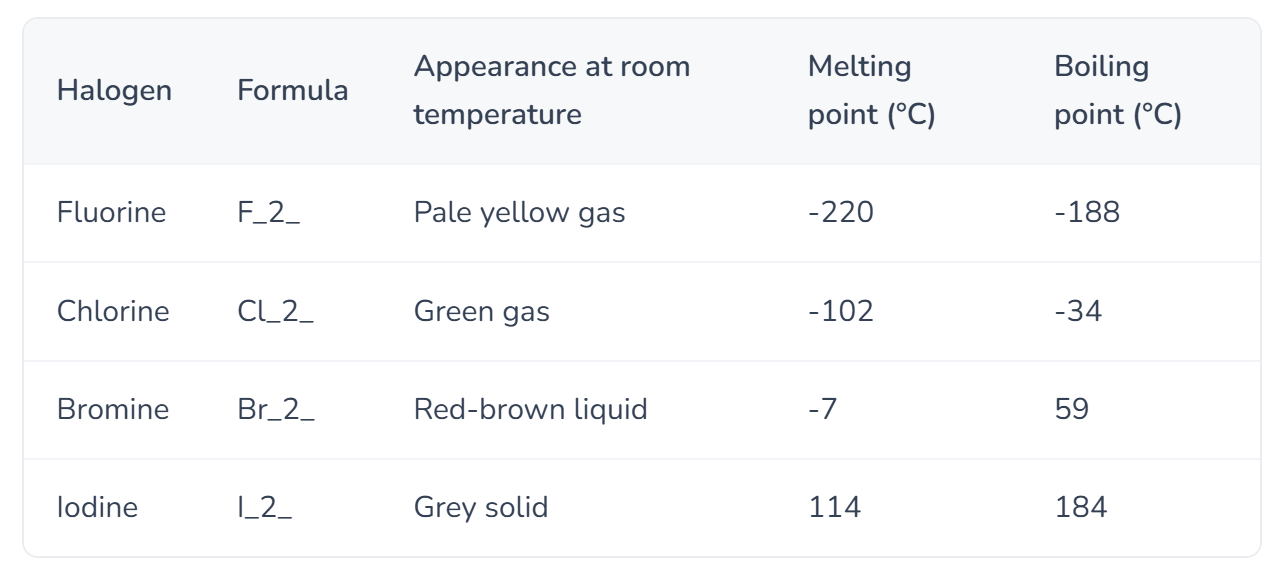
Increase down the group
Molecules become larger in size and relative mass
Allows for stronger DP-DP forces to develop between molecules
Stronger IMF require amounts of energy to overcome
Halogens melt and boil at higher temperatures down the group
Electronegativity
Related to atomic size, electronegativity of halogens shows an overall decrease going down the group
Refers to the tendency of an atom to attract a bonding pair of electrons
Because
Nuclear charge increases
Atomic radius increases
Electron shielding increases
Halogen properties
Gain an electron
Results in the halogen being reduced as ON decreases from 0 to -1
Halogens act as oxidising agents
Reactivity of G7
Atomic radius increases down the group as more electron shells are added
Increasing size leads to the other electrons being father from the positive nucleus
Outer electrons also experience more shielding from inner electron shells
Electrostatic attraction between outer electrons and nucleus gets progressively weaker
Increase in atomic radius and shielding outweigh the increase in nuclear charge
Harder for larger halogens to attract the electron needed to form a negative ion
Oxidising power of halogens
Decreases down group 7
Because increasing size and shielding makes it harder for larger halogens to remove electrons
Fluorine is the strongest oxidising agent
Halogens displace less reactive halide ions
Displacing halogen is reduced as it gains an electron to form halide
Displaced halide is oxidised so it loses an electron to form a halogen molecule
Halogen will displace any halide ion below it
Oxidising ability
Chlorine can oxidise both bromide and iodide
Bromine can oxidise iodide but not chloride
Iodine cannot oxidise any of them
Reaction of halogens with G1 and G2 metals
G1
React with halogens in a 2:1 ratio
2Na + F2 ---> 2NaF
Na is oxidised and fluorine is reduced
G2
Group 2 metals react with halogen in a 1:1
Mg + Cl2 ---> MgCl2
Mg is oxidised and chlorine is reduce d
Colour changes in halogen displacement
Colour changes in aqueous solution
If Br- is displaced and Br2 is formed, solution turns yellow
Iodide is displaced, solution turns orange and brown
If no reaction occurs, aqueous solution remains colourless
Colour changes in organic solution
Halogen products can be more clearly seen with an organic solvent
If it separates out on the top layer of the aqueous solution
Bromide is displaced, organic layer turns orange
Iodide is displaced, organic layer turns purple
No reaction, reaming colourless
Halide ions reaction
Are negatively charged ionic forms of the halogen fluorine, chlorine bromine and iodine
React by losing an electron to form neutral halogen
Electron loss results in halide being oxidised
As it loses its electron, it causes another substance to be reduced
Reducing power of halides
Increases down the group 7
Because
Ionic radius increases down halogens as more electron shells are added
Increasing ionic radius leads to the outer electron being farther from the positive nucleus
Outer electrons experience more shielding
Electrostatic attraction between the outer electrons and nucleus gets weaker
Increase in ionic radius and shielding outweighs the increase in nuclear charge
Fluorine is weakest reducing agent and iodide is the strongest
Reaction of halides with sulfuric acid: fluoride and chloride
Misty white fumes of HF or HCl gas are seen
NaF + H2SO4 ---> NaHSO4
NaCl + H2SO4 ---> NaHSO4 + HCl
These halides have low reducing power, so no further redox reactions occur
Oxidation number of sulfur remains at +6
Reaction of halides with sulfuric acid: bromide
Misty fumes of HBr gas are produced initially
NaI + H2SO4 ----> NaHSO4 + HI
Bromide ions then reduce sulfuric acid to sulfur dioxide
Orange bromine vapour and choking gas are observed
2HBr + H2SO4 ----> Br2 + SO2 + 2H2O
Sulfur is reduced as its ON decreases from +6 to +4
Bromine is oxidised as ON increases from -1 to 0
Reaction of halides with sulfuric acid: iodide
Iodide ions then reduce H2SO4 to SO2
Violent iodine vapour and choking SO2 gas are observed
2HI + H2SO4 ----> I2 + SO2 + 2H2O
Iodide ions then reduce SO2 further to produce H2S gas
Violet iodine vapour and the rotten egg smell of H2S gas are observed
6HI + SO2 ---> H2S + 3I2 + 2H2O
Sulfur is reduced as its ON decreases from +4 to -2
Iodide is oxidised as ON increases from -1 to 0
Testing for halide ions
Method
Add dilute nitric acid to sample to remove any ions
May interfere by also forming precipitates
Add silver nitrate to form silver halide precipitate
Results
Chlorine - white
Bromide - cream
Iodide - yellow
Adding excess dilute NH3
Chloride - dissolves
Bromide - remains insoluble
Iodide - remains insoluble
Adding concentrated NH3
Chloride - dissolves
Bromide - dissolves
Iodide - remains insoluble
Reactions of hydrogen halides
Reactions with water
Hydrogen halides are highly soluble in water, form acidic solutions
Reaction produces strong acids as the hydrogen halides fully dissociate in water
Resulting solutions will turn blue litmus paper red
When exposed to moist or water vapour, hydrogen halides form misty fumes due to the formation of tiny droplets of aqueous acid solution
Reactions with ammonia
React with ammonia gas to form ammonium halide salts
Acid-base reaction producing white fumes
HX + NH3 ---> NH4Cl
Occur readily due to strong affinity between acidic hydrogen halides and basic ammonia molecule
Disproportionation reactions
Occur when a substance is simultaneously oxidised and reduced in same chemical reactions
Chlorine to disinfect drinking water
When chlorine is bubbled through water, disproportionation occurs
Cl2 + H2O ----> HCl + HClO
Hypochlorous acid dissociates
HClO ---> H+ + ClO-
Hypochlorite ions act as a disinfectant which kills microorganisms
In sunlight chlorine gas react with water to form HCl and oxygen gas
Repletes the hypochlorite ion disinfectant
Making bleach using disproportionation
Mixing chlorine gas with cold dilute sodium hydroxide solution
Cl2 + 2NaOH ---> NaClO + NaCl + H2O
ON of chlorine increases from 0 to +1 in NaClO and decreases to -1 in NaCl
Bleach contains chlorate ions that act as oxidising agents to kill bacteria
If chlorine is reacted with hot sodium hydroxide, NaClO3 is formed
3Cl2 + 6NaOH ----> NaClO3 + 5NaCl + 3H2O
ON of chlorine from 0 to +5 and decreases to -1