Study Guide 2 Ch. 4-7
 Call Kai
 Learn
Learn Practice Test
 Spaced Repetition
 Match
Match Flashcards
 Knowt Play
1/69

There's no tags or description
Looks like no tags are added yet.
Name | Mastery | Learn | Test | Matching | Spaced | Call with Kai | Chat |
|---|
No analytics yet
Send a link to your students to track their progress
70 Terms
Tissue definition
A group of cells that work together to perform a specific function.
Four major tissue types
Epithelial tissue, connective tissue, muscle tissue, and nervous tissue.
Epithelial tissue characteristics
Tightly packed cells, apical and basal surfaces, basement membrane, avascular, and rapid regeneration.
Types of epithelial tissue
Surface epithelium and glandular epithelium.
Exocrine glands
Glands that secrete substances onto surfaces through ducts.
Endocrine glands
Ductless glands that release hormones directly into the bloodstream.
Simple epithelium
A single layer of cells.
Stratified epithelium
Multiple layers of cells.
Cell shapes in epithelial tissue
Squamous, cuboidal, columnar, and transitional.
Functions of epithelial tissue
Diffusion, absorption, secretion, and protection.
Connective tissue characteristics
Few cells with a large extracellular matrix, usually vascular, and supports and binds other tissues.
Extracellular matrix components
Ground substance and protein fibers.
Types of connective tissue fibers
Collagen fibers, elastic fibers, and reticular fibers.
Categories of connective tissue
Loose connective tissue, dense connective tissue, and specialized connective tissue.
Types of muscle tissue
Skeletal muscle, cardiac muscle, and smooth muscle.
Functions of muscle tissue
Movement and heat generation.
Nervous tissue location
Brain, spinal cord, and peripheral nerves.
Cell types in nervous tissue
Neurons and neuroglia.
Body membranes definition
Thin layers of tissue that cover surfaces, line cavities, and form protective sheets around organs.
Epithelial membranes
Include serous membranes, mucous membranes, and cutaneous membranes.
Functions of skin
Protection, temperature regulation, sensation, vitamin D production, barrier to pathogens, and water balance.
Layers of the skin
Epidermis - epithelial
Dermis - dense irregular ct
Hypodermis - adipose
Functions of the skeletal system
Support, protection of organs, movement, blood cell production, and mineral homeostasis.
Bone classification by shape
Long bones, short bones, flat bones, irregular bones, sesamoid bones, and sutural bones.
Anatomy of a long bone
Includes epiphysis, diaphysis, articular cartilage, spongy bone, compact bone, medullary cavity, periosteum, and endosteum.
Bone cells
Osteoblasts (bone formation), osteocytes (mature bone cells), and osteoclasts (bone resorption).
Bone formation types
Intramembranous ossification and endochondral ossification.
Types of fractures
Complete fractures, incomplete fractures, and compound (open) fractures.
Definition of a joint
A connection between two or more bones.
Classification of joints by movement
Synarthrotic, amphiarthrotic, and diarthrotic.
Types of muscle contractions
Isotonic contraction (muscle shortens) and isometric contraction (muscle length does not change).
Muscle attachments
Skeletal muscles attach to bones via tendons, with an origin (less movable) and insertion (more movable).
Muscle interactions
Muscles work in groups; agonist (prime mover) and antagonist (opposite movement).
Fibers are giant, multinucleated cells
Skeletal
Located only in the heart
Cardiac
Not striated and involuntary
Smooth
Located in wall of hollow organs
Smooth
Striated and voluntary
Skeletal
A motor unit consists of..
One motor neuron and many muscle fibers
Which statement is false?
The smaller the motor unit the more forceful the contraction
Why can whole muscles produce different levels of force?
Different numbers of motor units are recruited
Which characteristic is shared by cardiac and skeletal muscle but not smooth muscle?
Striations
Which structure is the contractile unit of muscle?
Sarcomere
Axon Terminal is
Neuron
Synpatic Vesicles
Neuron
Motor end plate is
Muscle fiber
Synpatic cleft
Neither (space)
What event directly triggers the muscle action (depolarization) potential?
Sodium entering the muscle fiber
What role does ATP play in the cross-bridge cycle?
ATP allows myosin to detach from actin
If calcium ions were not pumped back into the sarcoplasmic reticulum, what would happen?
Muscle would continue to connect
Why is calcium necessary for muscle contraction?
It exposes myosin binding sites on actin
Muscle in the relaxation phase
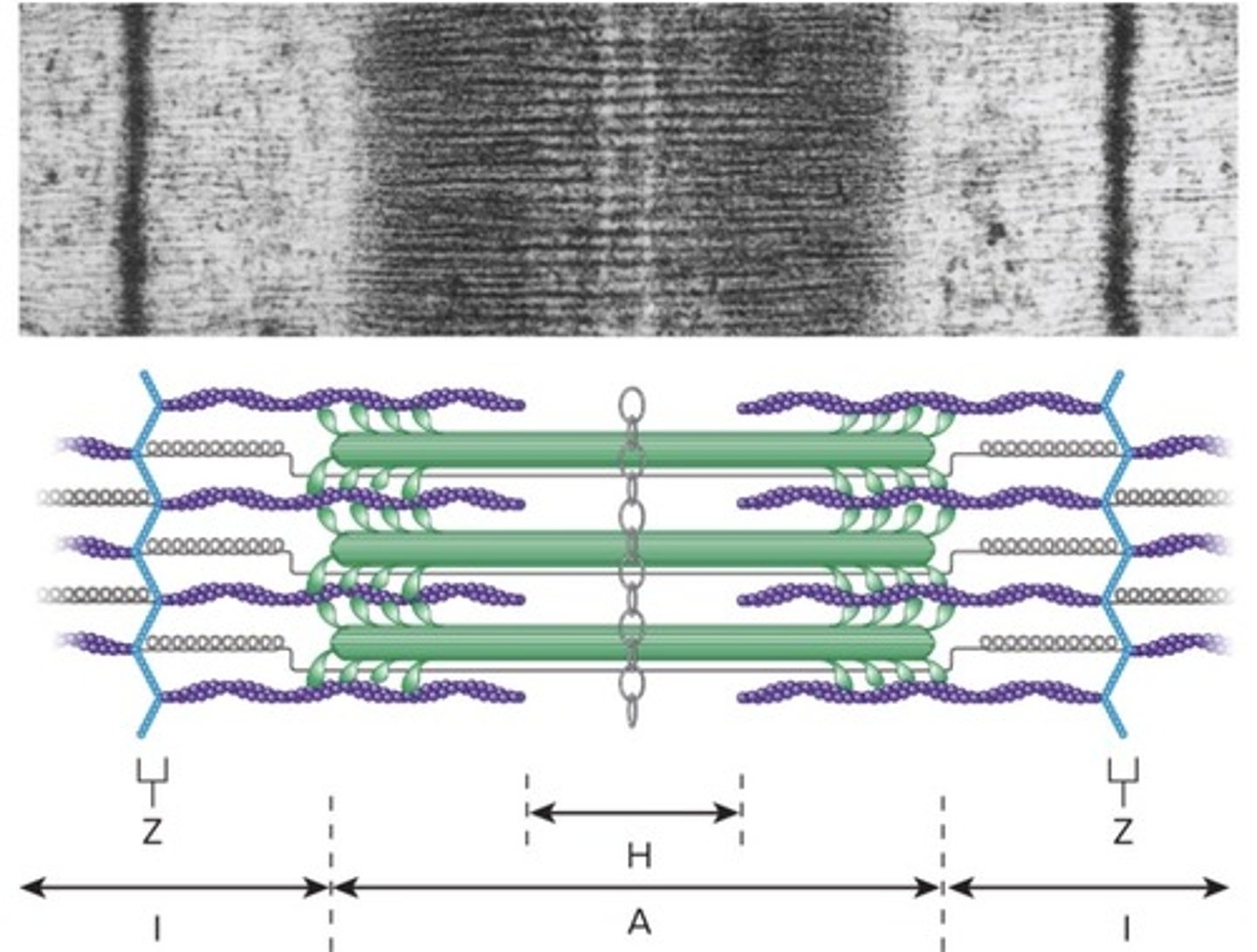
If blood calcium levels drop, which process would help restore normal levels?
Increased bone resorption; dissolving bone
Why is jumping good again?
Mechanical stress stimulates bone deposition
Which of the following joints are uniaxial?
Hinge
A 7-year-old child has bowed legs and delayed bone development. Blood tests reveal low vitamin D levels. What is the most likely diagnosis?
Rickets
A patient reports severe joint pain and swelling in both wrists and both knees. Blood tests show immune system activation against joint tissues. What condition is most likely?
Rheumatoid arthritis
Epithelial tissue is characterized by
Tightly packed cells
Which statement correctly compares intramembranous ossification and endochondral ossification?
Intramembranous ossification forms bone directly from mesenchyme, while
endochondral ossification replaces a hyaline cartilage model with bone.
Bundle of muscle fibers
Fascicle
Structure marks the boundary of a sarcomere
Z-line
Which athlete would rely most heavily on fast glycolytic fibers?
Sprinter
Place the stimulus in order
Receptor, sensory neuron, CNS, motor neuron, effector, response
During intense exercise, which ATP source provides energy first?
Creatine phosphate
Origin
Attachment to the less movable bone
Insertion
Attachment to the more
movable bone
Which situation represents an isometric contraction?
Holding a dumbbell in place without moving
Summation occurs when:
A second stimulus arrives before the muscle fully relaxes
Which muscle fiber type is best suited for long-distance running?
Slow oxidative fibers
Which ATP pathway provides energy fastest but for the shortest time?
Creatine phosphate pathway