Biology: Gene Expression
 Call Kai
 Learn
Learn Practice Test
 Spaced Repetition
 Match
Match Flashcards
 Knowt Play
1/15

Earn XP
Description and Tags
Specific Wording/Key Definitions
Name | Mastery | Learn | Test | Matching | Spaced | Call with Kai | Chat |
|---|
No analytics yet
Send a link to your students to track their progress
16 Terms
Transcription
The process where one DNA strand is used to create an RNA molecule that is an exact copy of the coding strand. This process occurs in the nucleus.
Translation
The process where the genetic code carried by the mRNA is decoded to produce the specific sequence of amino acids in a polypeptide chain/protein. This process occurs in the ribosomes.
Messenger RNA (mRNA)
A single strand of RNA that is a copy of the DNA which carries the copied code from the DNA in the nucleus to the ribosome in the cytoplasm.
Transfer RNA (tRNA)
A folded clover leaf shape of RNA which carried an amino acid at one end and has a anticodon which matches up with the codon on the mRNA, making sure that the correct amino acids are added to the polypeptide chain.
Ribosomal RNA (rRNA)
Found in the ribosome along with proteins to complete the ribosome structure and helps to read the mRNA sequence during translation.
Template Strand
The strand of DNA which is copied by the mRNA
Purpose of Transcription
To create an mRNA strand from DNA that codes for a polypeptide. The mRNA transports this code from the nucleus to the ribosomes, as DNA is too large (double-stranded) to exit the nucleus.
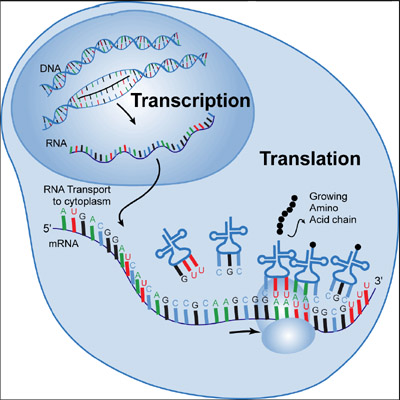
Process of Transcription
RNA polymerase unwinds the DNA, exposing the template and coding strands. Nucleotides match the DNA template following base-pairing rules to produce mRNA, replacing T with U. Synthesis continues until a stop codon is reached, then mRNA detaches and exits the nucleus into the ribosome.
Purpose of Translation
Translation is where the genetic code carried by the mRNA is used to create a polypeptide chain/protein so that the protein can be used for cellular functions.
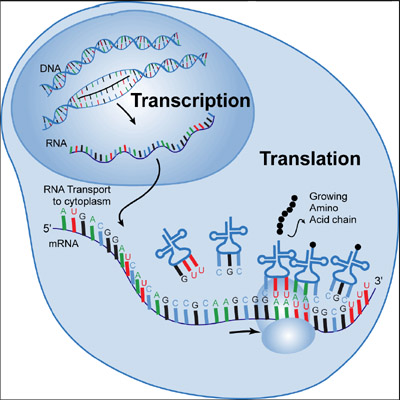
Process of Translation
The mRNA strand attaches to the ribosome and is read in codons. A tRNA with a complementary anticodon binds to each codon, bringing a specific amino acid. This process continues, forming a polypeptide chain until a stop codon is reached. Once the stop codon is reached, the amino acid chain/polypeptide chain is released from the ribosome. The chain is then folded into the precise shape required for it to operate as a functional protein.
Redundancy/Degeneracy
Where multiple codons can code for the same amino acid - there are 64 codon combinations but only 20 different amino acids.
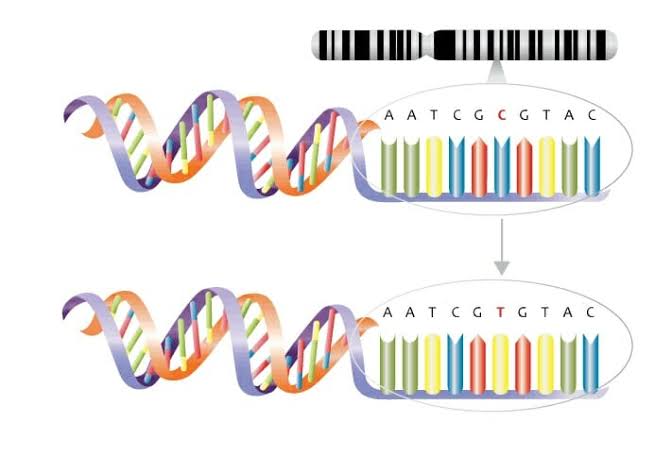
Base/Point Substitution
A gene mutation when a single base is replaced by another
Silent/Same Sense Mutation
Where the same amino acid is called into the chain, so there is no change. This has no effect on the folding and function of the final protein
Missense Mutation
Where one amino acid in the chain is changed, meaning that it may or may not affect the structure and function of the final protein - the effect of this mutation is determined by the protein’s role in the polypeptide chain.
Nonsense Mutation
Where a stop codon is coded for prematurely, ending the polypeptide chain before the protein is complete, making the protein short and unable to fold and function as intended.