neoplasms, hypothyroidism, parathyroid diseases
 Call Kai
 Learn
Learn Practice Test
 Spaced Repetition
 Match
Match Flashcards
 Knowt Play
1/64

Earn XP
Description and Tags
neoplasms, hypothyroidism, parathyroid diseases
Name | Mastery | Learn | Test | Matching | Spaced | Call with Kai | Chat |
|---|
No analytics yet
Send a link to your students to track their progress
65 Terms
How is hypothyroidism classified based on the level of dysfunction?
It is classified into primary (thyroid gland failure) and secondary (pituitary or hypothalamic failure).
Which drug used for cardiac arrhythmias is a known iatrogenic cause of hypothyroidism?
Amiodarone
What is the most common cause of neonatal hypothyroidism worldwide?
Iodine deficiency
In congenital hypothyroidism (cretinism), what are the 'six Ps' used to describe clinical manifestations?
Pot belly, Protruding umbilicus, Puffy face, Protruding tongue, Poor neurologic development, and Intellectual disability (formerly 'Poor neurologic development').
Which condition is defined as hypothyroidism developing in an older child or adult?
Myxedema
What life-threatening decompensated state of severe hypothyroidism classically presents in elderly patients?
Myxedema coma
What are the common triggers for a myxedema coma in a patient with stable hypothyroidism?
Stressful events such as infection, myocardial infarction, or stroke.
Which form of thyroiditis typically follows a viral infection and presents with a painful thyroid?
Subacute Granulomatous (de Quervain) thyroiditis
What is the most common cause of hypothyroidism in iodine-sufficient/developed countries?
Hashimoto thyroiditis (Autoimmune hypothyroidism)
Which $HLA$ subtypes are associated with an increased risk of Hashimoto thyroiditis?
HLA-DR3 and HLA-DR5
Patients with Hashimoto thyroiditis have a significantly increased risk of developing which malignancy?
Lymphoma (specifically marginal zone B-cell lymphoma).
What is the most sensitive autoimmune marker used for diagnosing Hashimoto thyroiditis?
Anti-thyroid peroxidase antibodies (Anti-TPO).
What is the other autoimmune marker?
Anti-thyroglobulin antibodies (Anti-Tg)
what are the histological features of Hashimoto thyroiditis?
Mononuclear inflammatory infiltrate with germinal centres
Atrophy of epithelium
Metaplasia of cuboidal follicular epithelium → Hurthle cells with eosinophilic cytoplasm
Can be complicated by papillary carcinoma or lymphoma

What are the three primary immunologic mechanisms of thyroid destruction in Hashimoto thyroiditis?
CD8 T-cell mediated destruction,
CD4 T-cell/macrophage mediated destruction
Antibody-dependent cell-mediated cytotoxicity.
Gross appearance in hashimoto’s
Diffuse enlargement of thyroid gland (may be localized in
certain cases).
Which rare form of thyroiditis is characterized by extensive fibrosis and a 'rock-hard' painless mass?
Riedel's thyroiditis (Riedel's struma)
Riedel's thyroiditis is associated with which systemic group of autoimmune fibrosing conditions?
IgG4-related diseases
In the context of hypothyroidism, what causes the characteristic periorbital and facial puffiness?
Accumulation of glycosaminoglycans in the interstitial tissue.
Are follicular adenomas considered precancerous lesions?
No, they are benign tumors and do not typically transform into carcinoma.
What is the 'gross' hallmark of a follicular thyroid adenoma?
A solitary, spherical, encapsulated lesion separated from normal tissue by a well-defined intact capsule.

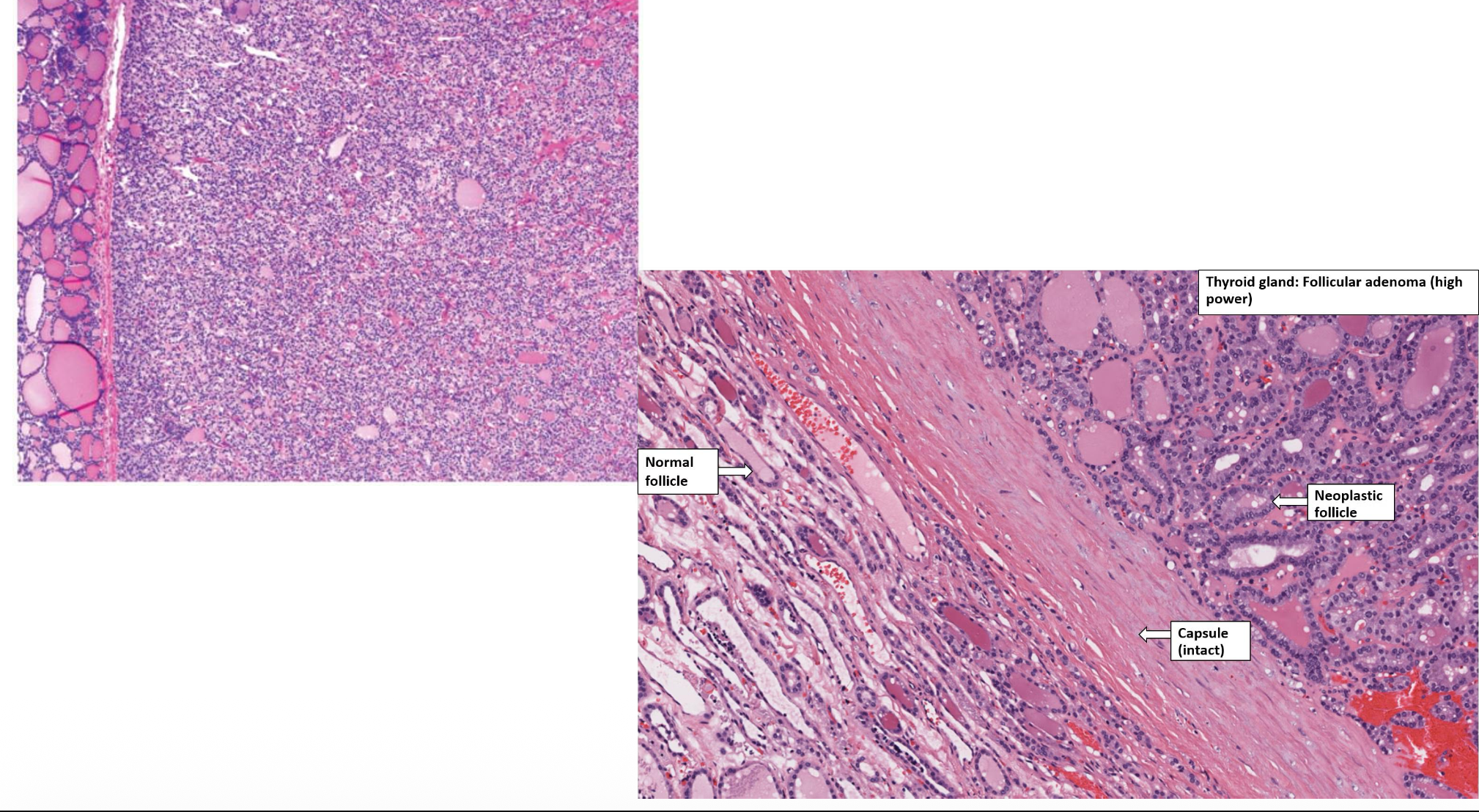
what is this and what do u see?
Follicular thyroid adenoma
Follicles resemble normal thyroid parenchyma
Little variation in cell size/shape/morphology
They share the same histological features of
follicular carcinoma, but do not invade the
tumour capsule or surrounding blood vessels
Why is Fine Needle Aspiration (FNA) insufficient for differentiating between follicular adenoma and follicular carcinoma?
FNA cannot assess the presence of capsular or vascular invasion, which is the defining criterion for malignancy.
clinical features of follicular adenoma
✓Unilateral, painless masses that are discovered during a
routine physical examination
✓ Nonfunctioning adenomas take up less radioactive iodine
(cold nodules) than does normal thyroid parenchyma
✓A histopathologic examination (Not FNAC) for the intact
capsule is mandatory for a definitive diagnosis of adenomas
What radioactive iodine uptake pattern is typical for most thyroid adenomas?
They are typically 'cold' nodules (take up less iodine than normal parenchyma).
What is the most common subtype of thyroid carcinoma, accounting for over 85% of cases?
Papillary thyroid carcinoma
Which two gene mutations are most frequently associated with Papillary thyroid carcinoma?
RET and BRAF

histological characteristics of Papillary carcinoma?
Branching papillae with fibro- vascular stalk and particularly nuclear features.
orphan annie & nuclear grooves
Nuclear elongation and intranuclear inclusions
psammoma bodies are often present

Gross appearance of papillary carcinoma
cystic mass with papillary excrescences
tumour invades lymphatics within the thyroid to metastasise
Clinical features of papillary carcinoa
asymptomatic thyroid nodules
may be in cervical LN
Not good prognosis in elderly
details on Follicular carcinoma
second most common thyroid cancer
cold nodules
vascular invasion
RAS mutations
Mostly affects women 40-50s
Gross appearance of follicular carcinoma
solid mass replacing thyroid lobe
tumour has tan appearance
small areas of haemorrhage and necrosis

histology of follicular carcinoma?
the distinction from adenoma is dependant on presence of capsular/vascular invasion by the tumour

where does medullary carcinoma originate from?
parafollicular cells which secrete calcitonin
When does medullary carcinoma occur?
occurs in the setting of MEN IIA/IIB in young patients
two types of medullary carcinoma
sporadic
familial
gross appearance of medullary carcinoma?
sporadic: single circumscribed but non-encapsulated, gray-tan mass
familial: can have multiple foci and can be infiltrative
large lesions → haemorrhage and necrosis

What are the familial type associated with?
multiple endocrine neoplasia syndrome

what is this? name 5 things you see
medullary carcinoma
cells are solid and nest like, arranged in sheets
polygonal/spindle shaped cells with round/oval nuclei
variable nuclear pleomorphisms
moderate eosinophilic/amphophilic cytoplasm
amyloid deposition

Details on anaplastic carcinoma
Undifferentiated tumours of follicular epithelium
65+ years.
Most likely to be painful.
Rapidly enlarging and infiltrative lesions with compression and invasion
Gene mutation for anaplastic carcinoma
p53
what does anaplastic carcinoma look like on ultrasound
Calcifications, irregular borders, and invasion into surrounding tissues (may suggest malignancy)

What are the primary sites for hematogenous metastasis of Follicular thyroid carcinoma?
Lungs, bones, and liver.
Which cells in the parathyroid gland are responsible for secreting Parathyroid Hormone?
Chief cells
3 functions of PTH?
increases serum calcium via bone resorption
increases renal calcium reabsorption, phosphate excretion
increases intestinal calcium absorption via vit D activation
main cause of primary hyperparathyroidism
parathyroid adenoma
pathogenesis of primary hyperparathyroidism
too much PTH → too much calcium + LOW phosphate
Clinical features of primary hyperparathyoidisim
bones, stones, groans and psychiatric overtones
(Osteitis fibrosa cystica, nephrolithiasis, GI symptoms, depression)

microscopy of parathyroid adenoma
uniform chief cells
minimal fat
compressed rim of normal parathyroid
treatment for parathyroid adenoma
surgical removal
compare the histology of parathyroid hyperplasia and parathyroid carcinoma
In hyperplasia, there is increased cellularity and decreased fat.
In carcinoma, there is invasion into surrounding tissue as well as increased mitotic activity
main cause of Secondary Hyperparathyroidism
chronic renal failure, this is because chronic hypocalcaemia results in increased PTH as a compensatory mechanism
what can Secondary Hyperparathyroidism develop into?
renal osteodystrophy
or tertiary hyperparathyroidism
lab findings in Secondary Hyperparathyroidism
increased PTH
increased phosphate
low/normal calcium
what are the 3 things that happen when the kidney fails?
phosphate accumulates (it’s also responsible for binding Ca)
Hypocalcaemia
PTH goes up
lab findings in hypoparathyroidism
low PTH
low calcium
high phosphate
three causes of hypoparathyoidism
post-surgical
autoimmune (aps)
DiGeorge syndrome
clinical features of Hypoparathyroidism
• Tetany, Chvostek’s and Trousseau’s signs
• Seizures, arrhythmias
How to diagnose parathyroid disease
PTH levels test
calcium, phosphate and vitamin D blood tests
renal function tests
ultrasound/MRI/CT
Most common cause of primary hyperparathyroidism?
Parathyroid adenoma
name 3 complication of hyperparathyroidism
• Osteoporosis
• Nephrolithiasis
• Calciphylaxis (in renal failure)
name 3 complication of hypoparathyroidism
• Hypocalcemic seizures
• Arrhythmias
• Basal ganglia calcifications
what is multiple endocrine neoplasia and what is it a result of?
disorders where tumours involving multiple endocrine organs resulting from mutations in tumour supressor pathways
what are two major syndromes?
MEN 1 → parathyroid + pituitary + pancreatic tumours
MEN 2 → Medullary thyroid carcinoma + pheochromocytoma ±
hyperparathyroidism
what is the gene profile of MEN2?
Gene: RET on chromosome 10q11.2
RET = receptor tyrosine kinase proto-oncogene
Inheritance: Autosomal dominant