V&F Ch 7: Typical Disfluency and the Development of Stuttering
 Call Kai
 Learn
Learn Practice Test
 Spaced Repetition
 Match
Match Flashcards
 Knowt Play
1/57

There's no tags or description
Looks like no tags are added yet.
Name | Mastery | Learn | Test | Matching | Spaced | Call with Kai | Chat |
|---|
No analytics yet
Send a link to your students to track their progress
58 Terms
age range for typical disfluency development/treatment level (years)
1.5-6^a (small amount of typical disfluency continues in mature speech)
age range for “younger preschoolers: borderline stuttering” development/treatment level
1.5-3.5 years
age range for “older preschoolers: beginning stuttering” development/treatment level
3.5-6 years
age range for “school age: intermediate stuttering” development/treatment level
6-13
age range for “older teens and adults: advanced stuttering” development/treatment level
≥ 14
T/F Stuttering levels of development are very clear cut and have no exceptions
FALSE-→ many exceptions
ex: children will show borderline stuttering and then show signs of beginning stuttering for several days and then return to borderline stuttering
others will retain milder level of stuttering even as they grow up
How many levels of development are there to determine treatment approach
4
What type of typical disfluency is this “mi-milk”
part-word repetition
What type of typical disfluency is this “I…I want that”
single-syllable word repetition
What type of typical disfluency is this “Lassie…Lassie is a good dog”
multisyllabic word repetition
What type of typical disfluency is this “I want a…I want ice-ceem comb”
phrase repetition
What type of typical disfluency is this “He went to the…uh…circus”
interjection
What type of typical disfluency is this “I lost my…Where’s mommy going?”
revision-incomplete phrase
What type of typical disfluency is this “I’m Tiiiiiiiimy Thompson”
prolongation
What type of typical disfluency is this “Can I have some more (lips together, sound) milk?”
tense pause
Between ages ____ and _____ , most children have typical repetitions, prologonations, and pauses
2 and 6
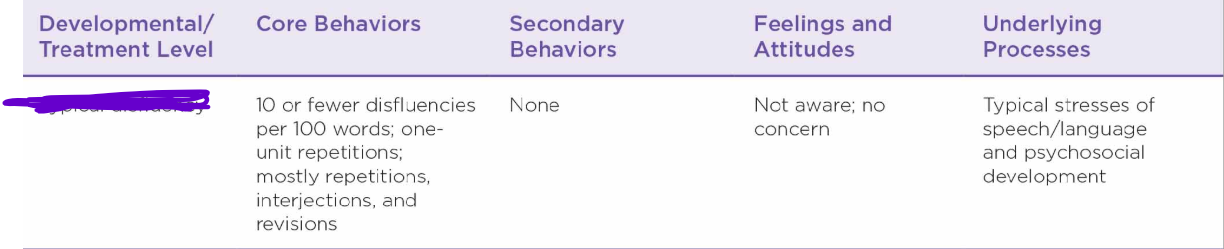
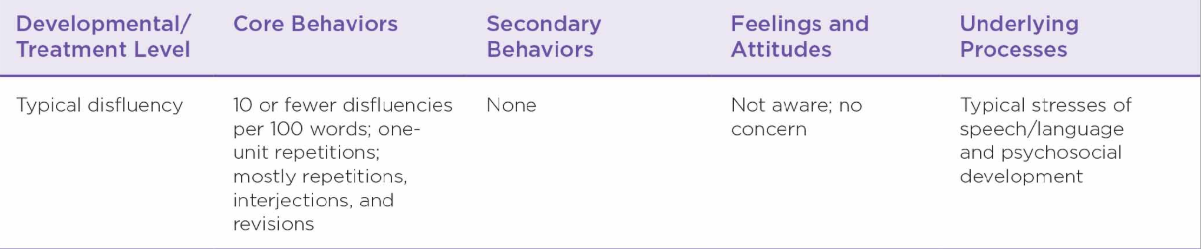
3 Characteristics of Typical Disfluency in a Nonstuttering Child:
No more than ____ disfluencies per ____ words
typically, ___ -___ _____ ; occasionally ____
most common disfluency types are ______ , ______ , and ___ -____ ______
as children mature past age ___ , use of ___ -___repetitions will decline
No more than 10 disfluencies per 100 words
typically, one-unit repetitons; occasionally two
most common disfluency types are interjections, revisions, and whole-word repetitions
as children mature past age 3, use of part-word repetitions will decline
T/F typically disfluent children don’t react to their disfluencies; they seem unaware of them
true
Typically disfluencies may be caused by:
demands on _______ _____
delayed ____ _______skills
what emotion?
________ and _______ when speaking
someone might interrupt you
demands on language acquisition
delayed speech motor skills
stress
competition and excitement when speaking
someone might interrupt you
characteristics of Borderline stuttering in a younger preschool child
more than ___ - _____disfluencies per _____ words
often more than _____ units in ______
more _______ and _______ than revisions or ______ phrases
disfluencies ______ and ______
rare for child to _____ to their ______
more than 6-10 disfluencies per 100 words
often more than two units in repetition
more repetitions and prolongations than revisions or incomplete phrases
disfluencies loose and relaxed
rare for child to react to their disfluencies
Borderline Stuttering Underlying Processes: Constitutional
Speech and Language Development
some _____ and _____ skills may be more ________ than others
________ in some language production processes
Speech and Language Development
some language and speech skills may be more advanced than others
inefficiencies in some language production processes
Borderline Stuttering Underlying Processes: Environmental
Communication Stress
models of ____ talking/few ____
interruptions, ____, etc
models of advanced ____ and ____
_________ to be heard
Communication Stress
models of fast talking/few pauses
interruptions, questions, etc
models of advanced vocab and syntax
competition to be heard
Borderline Stuttering Underlying Processes: Environmental pt 2
psychosocial stress
conflicts in ___
birth of new ____
changes in home, moving, etc
psychosocial stress
conflicts in family
birth of new siblings
changes in home, moving, etc
“Outgrowing” Borderline Stuttering
_____ reallocation to _____
____ and ______ systems mature
_____ resolve
resource reallocation to compensate
speech and language systems mature
conflicts resolve
Characteristics of Beginning Stuttering in an Older Preschool Child pt 1
signs of _____ tension and ____ appear in stuttering
repetitions are ____ and _____ with abrupt _________ of each element
pitch ____ may be present toward the ____ of a ____ or ______
signs of muscle tension and hurry appear in stuttering
repetitions are rapid and irregular with abrupt terminations of each element
pitch rise may be present toward the end of a repetition or prolongation
Characteristics of Beginning Stuttering in an Older Preschool Child pt 2
fixed ______ postures are sometimes evident when the child is momentarily unable to ____ a word, apparently as a result of ______ in speech _______
_______ behaviors are sometimes present in beginning stuttering
eye blinks, head nods, “ums”, etc
awareness of _______ and feelings of ______ are present, but there are no strong negative feelings about ____ as ______
fixed articulatory postures are sometimes evident when the child is momentarily unable to begin a word, apparently as a result of tension in speech musculature
escape behaviors are sometimes present in beginning stuttering
eye blinks, head nods, “ums”, etc
awareness of difficulty and feelings of frustration are present, but there are no strong negative feelings about self as speaker
Underlying Processes #1 of “Older Preschool Children: Beginning Stuttering”
Increases in ____ tension and t____
______ are seen as a sign that stuttering is worsening
these changes may be attempts to ____ or ______ from stutters
Increases in muscle tension and tempo
increases are seen as a sign that stuttering is worsening
these changes may be attempts to control or escape from stutters
_____ conditioning spreads emotion associated with stuttering to more situations
this means more ______ and faster ____
classical
tension and faster tempo
______ conditioning increases frequency of _____ behaviors
this means more eye blinks, head nods, etc
operant
escape
blocks in which the child shuts off sound or voice
probably will also have many repetitions and prolongations
what level do these occur in?
frequent core behaviors
Characteristics of Intermediate Stuttering in a School-Age Child
what level of stuttering occurs when child uses escape behaviors to terminate blocks
Characteristics of Intermediate Stuttering in a School-Age Child
what level of stuttering is this
child appears to anticipate blocks, often using avoidance behaviors prior to feared words
anticipate difficult situations and sometimes avoids them
Characteristics of Intermediate Stuttering in a School-Age Child
what level of stuttering is this
fear before stuttering, embarrassment during stuttering, and shame after stuttering
especially fear
Characteristics of Intermediate Stuttering in a School-Age Child
________ conditioning creates more and more tension in stuttering in more situations
classical
______ conditioning creates a more complex array of escape behaviors
operant
______ conditioning creates extra sounds and behaviors before the feared word and causes child to avoid more and more words and situations
my name is uh uh uh barry
avoidance
what level is this
more frequent core behaviors are longer, tense blocks, often with tremors of the lips, tongue, or jaw
individual will also probably have repetitions and prolongations
Older teens and adults: advanced stuttering
what level is this
stuttering may be suppressed in some individuals through extensive avoidance behaviors
Older teens and adults: advanced stuttering
what level is this
complex patterns of avoidance and escape behaviors characterize the stutterer
may be very rapid and so well habituated that the stutterer may not be aware of what they do
Older teens and adults: advanced stuttering
what level is this
fear, embarrassment, and shame are very strong
negative feelings about themselves as a person who is helpless and inept when they stutter
self-concept may be pervasive
Older teens and adults: advanced stuttering
what level is this
minimal influence of original constitutional, developmental and environmental factors
learning and experience changed brain structure and function
______ learning has created enduring stuttering patterns
Older teens and adults: advanced stuttering
avoidance
what level is this
_____ learning creates negative-self concept
comes from listener reactions from childhood and later
stutters also project their own negative feelings about stuttering onto others
Older teens and adults: advanced stuttering
cognitive


borderline stuttering

beginning stuttering

intermediate stuttering

advanced stuttering
an unusual way of speaking or acting that seems to reduce stuttering, like laughing and pretending that most things said were a joke
ex: speaking with an accent that the speaker pretends to have
antiexpectancy devices
rather than stuttering on a word, person might use a different way of saying something
“my father was in the N..n…he served aboard ships in the armed forces
circumlocutions
stuttering that the indiv. hides from listeners, usually by avoiding sounds, words, and situations that might precipitate stuttering
typically associated with deep shame
covert stuttering
sound prolongation, broken word, or other instance of ongoing phonation being stopped, extended, or distorted
dysrhythmic phonation
this is like a starter, but usually it just involves waiting a few beats before saying a feared word as in “Back then I use to drink a lot of…soda”
an avoidance
postponements
words or sounds used by someone who stutters to get started speaking when blocked or when anticipating a block
ex: “My name is, uh, Barry”
type of avoidance behavior bc used before indiv. is in a moment of stuttering
starters
short segmented repetitions, as well as sound prolongations and blocks
disfluencies typically judged by listeners as stuttering
stuttering like disfluencies
disfluencies in the speech of individuals who do not stutter
more prevalent in younger children (2-4 years)
typical disfluency
speculations about the process that may cause disfluencies or stuttering at each developmental level
help us understand why stuttering often changes from borderline to beginning to intermediate to advanced levels
underlying processes
disfluencies that occur within a word boundary such as repetitions of parts of words, prolongations, or blocks
stuttered speech is said to contain higher proportion of within-word disfluencies (as opposed to disfluencies that happen between/across words, such as hesitations, fillers, and repetitions of whole words)
within-word disfluencies