APWO Unit 2
 Call Kai
 Learn
Learn Practice Test
 Spaced Repetition
 Match
Match Flashcards
 Knowt Play
1/149

There's no tags or description
Looks like no tags are added yet.
Name | Mastery | Learn | Test | Matching | Spaced | Call with Kai | Chat |
|---|
No analytics yet
Send a link to your students to track their progress
150 Terms
What trading looks like in 1000 CE:
How do things get exchanged?
Disease (Black Death)
Trade routes
Ships
Conquest (war and territorial expansion)
Verbally/communication (news/religion/language)
Stealing/ Raiding (bandits and pirates)
Beasts of Burden
Water
Humans
Describe the paths pf the Silk, Sand, and Sea routes of trading in Afro- Eurasia


Using the map, label the places.
Western Europe
Song Dynasty
Swahili
Seljuk Sultanate
Delhi Sultanate
Byzantine Empire
Mali Empire
Mongolia
Nomadic Turkic Peoples (generally)
Sultanate of Malacca
The NTPs generally started in Central Asia! (Spread west)
Empires with the word “Sultanate” = Islam spread here!


Using the map, label the important cities.
Samarkand
Kashgar
Bukhara
Baghdad
Dunhuang
Chang'an
Cairo
Guangzhou
Constantinople
House of Wisdom (a library where Muslims translated Greek secular knowledge into Arabic, then built on in it) is in Baghdad


Using the map, label the geographical features.
Gobi Desert
Asian Steppe
Taklamakan Desert
Sahara Desert
Indian Ocean


Awesome map picture
________ and _________were the “catalysts”/ main demand engine for the silk roads
China and India
_______ = trading GOAT!
China
Luxury goods on silk roads: (8)
(Spices And Pepper are more sea roads)
Silk
Lapis
Lazuli
Glass
Gold
Dyes
Silk, Sea, or Sand roads?
Saddle
Silk Road
saddles go on camels (technology)

Silk, Sea, or Sand roads?
Caravanserai
Silk roads
roadside inns for caravans (safe places to rest, water/ feed animal, and trade)

Silk, Sea, or Sand roads?
Silk
Where did silk come from?
Silk Roads
Came from China
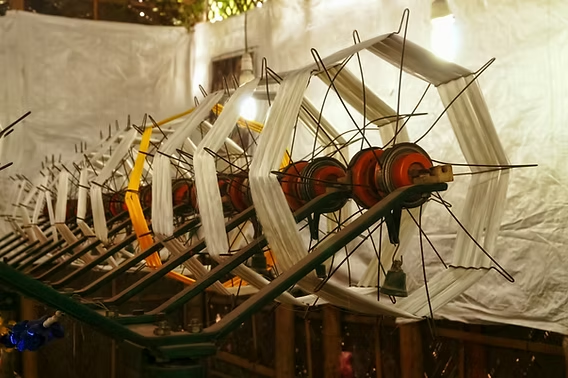
Silk, Sea, or Sand roads?
Paper Money
Significance? Where is it from?
Silk Road
Financial innovation = increase ease of trading/commerce
Important financial innovations of trading:_______, ______, and ____________! * ????????????????
Paper money, bills of exchange, and “flying cash”
Paper money started in China under the Tang and Song.
Flying cash was the Tang system of deposit receipts so merchants didn’t have to haul heavy coins.
Bills of exchange were the later credit notes that let traders deposit money in one city and collect it in another.
Silk, Sea, or Sand roads?
One humbled camel (Arabian Camel)
Sand roads
Silk, Sea, or Sand roads?
Buddhism
Where did Buddhism spread?
Silk Road
spread from India to China
Silk, Sea, or Sand roads?
Porcelain
Where did it originate?
Silk Road
Porcelain is a luxury good
Created in China
Silk, Sea, or Sand roads?
Carivan
Silk or Sand Roads (both correct)
Strength in number
Carivan = strength in numbers
T/F:
Caravans stop at Carivansurai!
True
Silk, Sea, or Sand roads?
two humped camel
Silk roads
Asia
Silk, Sea, or Sand roads?
Salt
Sand Roads
_____,____,______,and_______ can all be found in West Africa trading = ______roads
Gold, salt, ivory, and slaves = west Africa area= sand roads
Silk, Sea, or Sand roads?
rice
Sea Roads
heavy bulks, non-luxury
Silk, Sea, or Sand roads?
Ivory
SNA dRoads
Silk, Sea, or Sand roads?
Dunhuang
Silk Roads
Oasis town
Luxury goods = ________road
Non-luxury/bulk goods = (boat or car or horse) = ______ roads
Luxury goods = silk road
Non-luxury/bulk goods = boat/ships = sea roads
T/F:
When empires conquer other territories, the empires often use things from the conquered peoples.
True
T/F:
When empires conquer other territories, the empires often use things from the conquered peoples.
True
How many lbs can a _______carry?
Horse
Camel
Donkey
Human
Horse with a horse collar (Technology)
Ship
Horse→ 200-300lbs (20% of its body weight)
Camel→ 400 to 500lbs
Donkey→ 100lbs
Human → 50lbs
Horse with a horse collar (Technology)→ 2700lbs, wagons changed the game!
Ship→ 50 tons (around 100,000lbs)
What type of animal would you want on the silk roads?
A camel!
they can carry a lot of weight
they can go a long time without water
Are camels beast of burden?
Yes

As you can clearly tell, ________ __________ did NOT have very many trading routes connecting it to other places. Bad trading location!
Western Europe

All Chinese/ Indian/ Arab goods travel through the strait _ _______
Strait of Melaka (near Srivijaya area)
What types of people live in the steppes?
Pastoralist (nomads)

Where are cities often located!!?
Cities are located on/ near intersections of trade!!
Quick Islam Recap:
Caliphate and Sultanate are both associated with Islam. Define each.
NTP’s, define.
Abasids and Ottomans are apart of ___________leadership
T/F: The Delhi Turks, the Seljuk Turks, and the Ottoman Turks are examples of NTP’s
Imagine the diagram
Caliphate = Muslim empire led by a caliph (religious + political leader, a successor of Muhammad).
Sultanate = Muslim state led by a sultan (mainly a political/military ruler).
Nomadic Turkish Peoples = Islam religion
Caliphate
True

Connections and Interactions: Networks of Exchange 1200 to 1450
What is an essential factor that fostered long distance relationships?
Commerce (AKA the urge to trade)
“The exchange of goods among communities occupying different ecological zones has long been a prominent feature of human history."
![<p>The uneven distribution of goods and resources have long motivated exchange.</p><p>Some societies have been able to monopolize [at least temporarily] certain goods that others find variable. For example,</p><ul><li><p>Silk=______</p></li><li><p>Spices=_______</p></li><li><p>Incense= _______</p></li></ul><p></p>](https://assets.knowt.com/user-attachments/53d91e4c-5b26-452c-8060-57943025c686.jpg)
The uneven distribution of goods and resources have long motivated exchange.
Some societies have been able to monopolize [at least temporarily] certain goods that others find variable. For example,
Silk=______
Spices=_______
Incense= _______
China
Southeast Asia (Srivijaya area)
Southern Arabia

What is the difference between the definitions of social life vs political life?
Social life is how people interact, build relationships, and live together in a community
Political lifeis how people participate in government, make laws, and manage public power
Explain how long-distance trade impacted Social Life (3)
Luxury goods (silk, jade) distinguished elites from commoners.
People started producing for distant markets instead of just their own village.
Merchants became a distinct social group that could get rich without farming or producing things themselves (sometimes people were “sus” of them).
Explain how long-distance trade impacted Political Life (2)
Money collected from controlling and taxing trade helped create and keep states going.
Trade also spread religion, technology, plants/animals, and disease.
- "Such long-distance commerce shaped the daily life of many millions..." through "plants and animals to regions far from their places of origin."
In addition to international commerce (trade), what other processes facilitated interaction between societies?
provide examples for all (6)
Growth of big states (Ottoman Empire, Inca Empire) that mixed different peoples (often violently)
Clashes/rivalry between civilizations (Islamic vs. Christian worlds)
Geographical Proximity: Living next to each other (Chinese farmers vs. steppe pastoralists)
Journeys of missionaries and travelers (Ibn Battuta and Marco Polo promoted awareness of a larger world)
Spread of religions (Buddhism, Christianity, Islam)
Migrations (brought culturally different people into contact with one another, Turks from Central Asia to the Middle East)
What are 2 important dates/ concepts of the following road?
Silk Roads
A. Silk Roads
ca. 200 B.C.E.-200 C.E., initial flourishing of Silk Road commerce
2nd-8th centuries: spread of Buddhism in China
1200-1400: Mongol Empire brings back Silk Road commerce
1347: Black Death enters Europe via transcontinental trade routes

What are 2 important dates/ concepts of the following road?
Sea Roads
1-300: knowledge of monsoons enables Indian Ocean commerce
670-1025: Srivijaya kingdom
ca. 1000-1500: Swahili civilization flourishes along East African coast

What are 2 important dates/ concepts of the following road?
Sea Roads
1-300: knowledge of monsoons enables Indian Ocean commerce
670-1025: Srivijaya kingdom
ca. 1000-1500: Swahili civilization flourishes along East African coast

What are 2 important dates/ concepts of the following road?
Sand Roads
300-400: beginning of trans-Saharan trade
1200-1500: Timbuktu as a major center of learning and commerce
1235-1400: Kingdom of Mali (Mansa Musa's pilgrimage 1324-1325)

What are 2 important dates/ concepts of the following road?
American Networks
ca. 860-1130: Chaco culture trades with Mesoamerican societies
ca. 1100-1350: Cahokia as hub of North American commercial network
1400-1500: Aztec and Inca empires facilitate commercial exchange
What was the most famous product on the silk roads?
Silk!

The Silk Roads
Describing the journeys traders would take along the silk roads:
How would they travel?
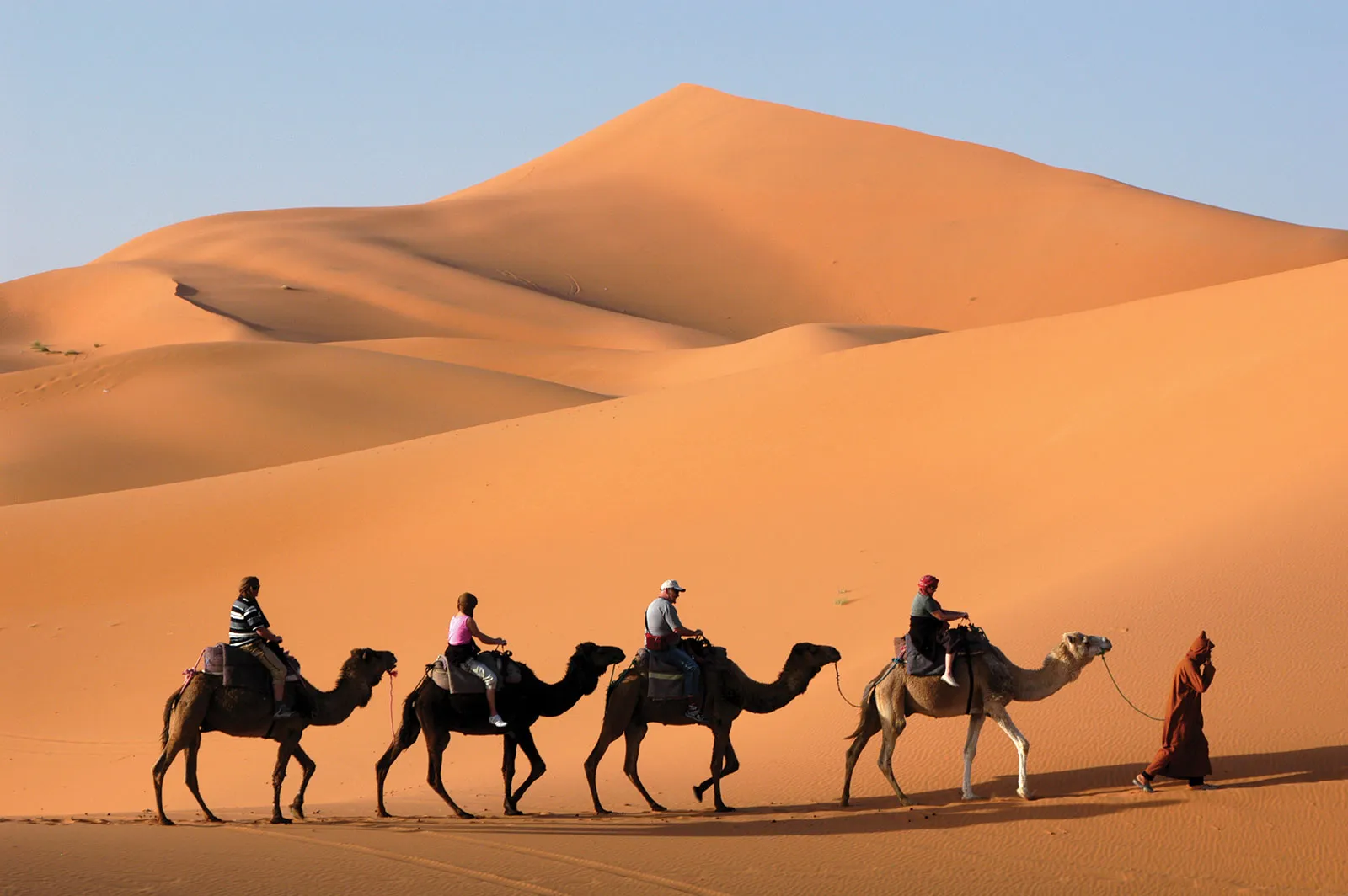
They traveled in large camel caravans across harsh steppes, deserts, and oases of Central Asia.
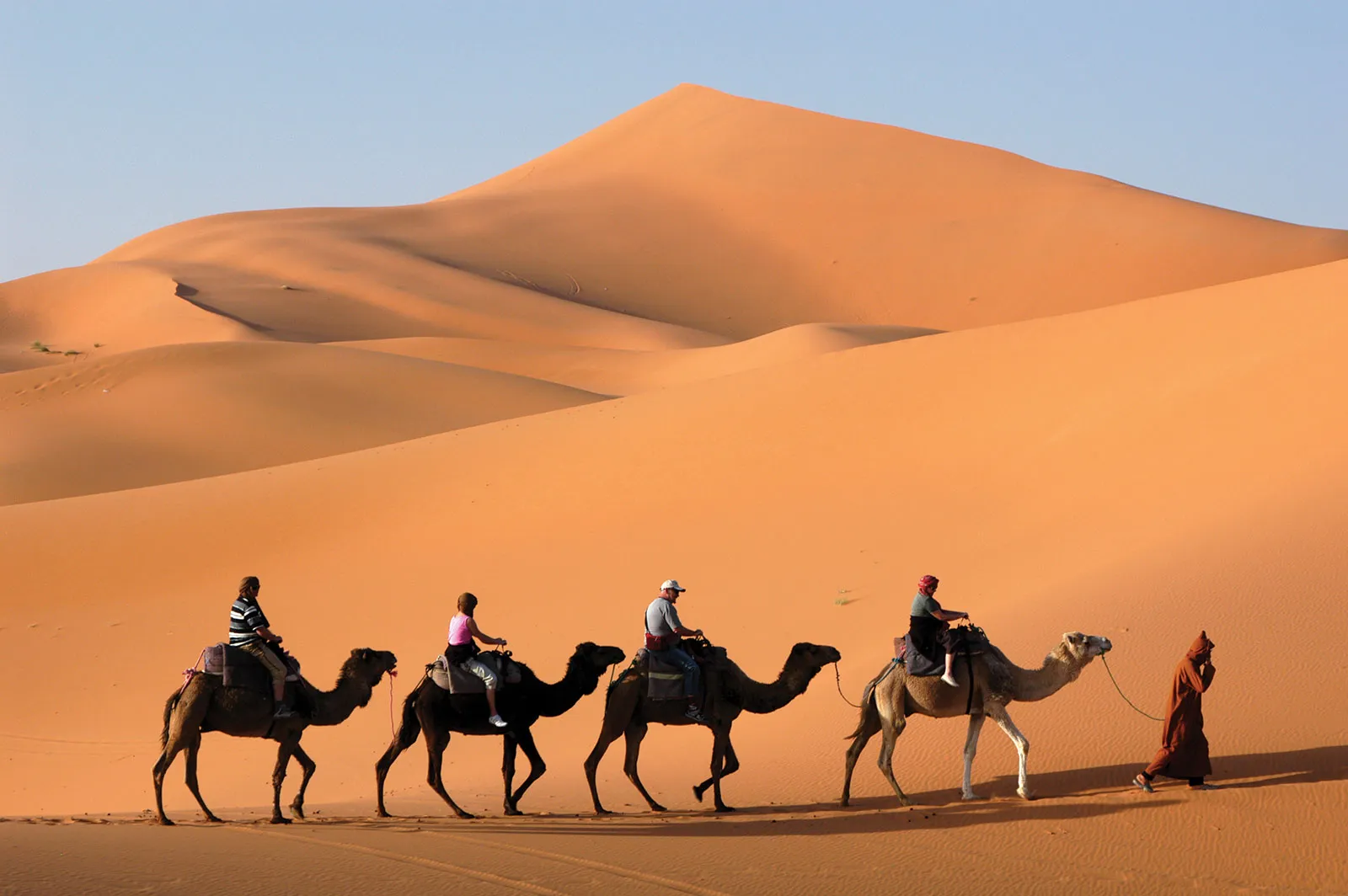
What is a camel caravan?
Camel caravans were large groups of traders and their pack animals (mostly camels) that traveled together along the Silk Roads.
Describing the journeys traders would take along the silk roads:
Where would they stop?
What was mixed at these stops?
Traders stopped at inns/guesthouses called caravanserai to rest, resupply animals, and trade with locals and other merchants.
Those stops also became places where religions and cultures mixed.
Some grew into big cities (Bukhara, Samarkand, Khotan, Kashgar, Dunhuang).

What is a caravanserai?
A caravanserai was a roadside inn along Silk Road trade routes that gave merchants, animals, and goods a safe place to rest, eat, and trade.

What important commercial cities in Central Asia were developed due to the caravanserai? (5)
Bukhara
Samarkand
Khotan
Kashgar
Dunhuang
Describing the journeys traders would take along the silk roads:
Besides goods, what else was exchanged?
Besides goods, people exchanged…
Ideas
Religions
Culture
What’s types of goods were exchanged along the silk roads?
Why?
Luxury products for rich elites (especially silk), not everyday staple foods on silk roads
Only high-value, easy-to-carry items made the long, expensive, dangerous trip worthwhile.
Was the Silk Road the road for regular staple goods?
NO!
Silk Road = silk= luxury goods
FYI: (not a big deal)
China had a long monopoly on silk production, but later on (early 16th century) the knowledge and tech for producing raw silk had spread beyond China to Korea, Japan, India, PErsia, and the Byzantine Empire.
What did silk symbolize?
Give 2 examples of how this symbol is present in society
High status / accumulating wealth… [In both Byzantine and China]
Governments limited who could wear silk.
Silk also became sacred in Buddhism and Christianity (gifts to monasteries, altar cloths, priests' robes as signs of devotion and piety).
piety = means deep religious devotion or showing strong respect and loyalty to God (or the gods).
What Technological and Monetary innovations increased exchange on the Silk Roads? (4)
Monetary = related to money (how people pay, store value, or wealth without carrying heavy coins)
Better animal gear: yokes, saddles, stirrups; the "frame and mattress" saddle let camels carry heavier loads.
Monetary:
2. Paper money so traders didn't have to haul heavy coins
From China
A literal dollar bill
Easier to trade!
Flying Cash
a deposit slip
Ex: you leave $100 at a bank in Chang’an, they give you a note. You walk to another city and turn that note in for $100. The note itself isn’t money you spend at a market.
Bills of exchange and Bank Houses
Bills of Exchange:
Contracts promising later payment
written notes that said “pay this person this amount in another city”
This was issued and cashed in banking houses
Bank Houses:
Bank that held merchant’s money
Same job, different place and form.
Flying cash = China’s version. Deposit coins in one city, get a slip, cash it in another Chinese city.
Bills of exchange = Europe’s version. A written contract: “pay this merchant this amount later / in another city.” Cashed at a banking house.
Both let you move money without hauling coins. Flying cash is the Chinese deposit slip. Bills of exchange are the European’s.
How did the silk roads exchange effect the lives of some farmers in China?
Some peasants stopped growing food and instead made silk, paper, porcelain, lacquerware, or iron tools for Silk Road markets.
Long-distance created luxury trade (silk roads) created a demand for the products above, so a few ordinary farmers changed their jobs to supply that market… “Trickle-Down” effect… Big elite trade eventually touched some regular people’s work
Example: peasants in the Yangzi River delta
“Trickle Down Effect”
big elite trade eventually touched some regular people’s work
Were most farmers effected by the luxurious silk roads trading?
NO!
Most farmers were not affected.
Silk Road trade was mostly luxury goods and stayed smaller compared with today’s global trade.
Religion and the Silk Roads
What main religion spread along the silk roads?
Buddhism

Describe how Buddhism spread along the Silk Roads
Indian traders and Buddhist monks carried it along the trade routes.
Buddhism spread along the silk roads due to Indian traders and Buddhist monks carrying it along the trade routes.
Where did Buddhism originate?
Along the silk roads, where did Buddhism mainly spread to?
Was conversion to Buddhism in the following cities voluntary or mandated? (Merv, Samarkand, Khotan, and Dunhuang)
India
Central and East Asia
Voluntary
How did Buddhism change as it spread along the Silk Roads?
What was the most popular form of Buddhism on the Silk Roads?
It became more worldly (secular) and wealthy:
monasteries got gifts from merchants and rulers
monks' begging bowls became more symbolic (rather than daily activity)
Sculptures and murals in monasteries depicting musicians, women’s makeup, drinking parties, etc… suggested a wealthier and more worldly style of living
Buddhism also mixed with local religions (syncretism)!!
-e.g., Zoroastrian fire rituals in Samarkand, local gods treated as bodhisattvas.
The popular form was Mahayana (Buddha as a deity, bodhisattvas who help people, earning merit) rather than the original austere version.
Monasteries = religious communities where monks or nuns live, pray, study, and (originally) live simply.
Begging bowls = the bowls Buddhist monks used to collect food donations from people each day.
FYI: Buddhism and the Silk Roads.
Early Buddhism tried to stay away from the material world, but monasteries on the Silk Roads got involved in worldly stuff like accepting gifts from rich merchants and rulers, becoming wealthy, and taking part in town life instead of only praying and begging.
T/F:
Buddhism mixing with local religions on the silk roads is an example of syncretism
True!
On the Silk Roads, Buddhism picked up local customs: Zoroastrian fire rituals in Samarkand, and gods of other peoples treated as bodhisattvas.
Syncretism = mixing beliefs from different religions into one practice.

What did the cave in Dunhuang, China represent?
A major center of Buddhist learning, painting, and sculpture at a key Silk Road city in western China.
About 492 caves (roughly 400-1400 C.E.) preserve a huge gallery of Buddhist art showing the Buddha with other enlightened beings.

In what ways did Buddhism come under attack in China?
Why?
THE WAYS:
Confucian scholars attacked Buddhism as foreign/"barbarian"
Han Yu's 819 essay: different language, clothes, no proper prince-subject or father-son relationships.
In 841-845 China ordered ~260,000 monks and nuns back to tax-paying civilian life (they didn’t have to before), destroyed or converted thousands of monasteries, and seized their land, money, and serfs.
Buddhists were banned from using precious metals in images.
WHY THE CHINESE DID THIS:
Reasons China attacked Buddhism:
economic (Nuns/Monks didn’t pay taxes before tax revenue and owned lots of land),
cultural (seen as un-Chinese)
desire for state control (Emperor wanted to be in charge of Buddhism, not just monks doing what they wanted).
Despite persecution, Buddhism did NOT vanish from China!
Name two variations of Buddhism that came to exist in China.
→ FYI, Mahayana was popular on the Silk Roads; however, list the two Chinese forms of Buddhism in China.
1. Pure Land school
Chan school
Give the characteristics of Pure Land school for Buddhism in China
Focused on Faith and Devotion
Salvation by faith [repeating Amitabaha’s name (a Buddha)]!
Rebirth in the “pure land”, samsara
Little meditation
Became popular in china
Salvation (in this context)= Being saved from suffering and the endless cycle of rebirth.
Give the characteristics of Chan school for Buddhism in China
Drew heavily from Daoism
Emphasized strict meditation practice
Dominant during Song Dynasty
Favored by court officials and scholars
Explain the Characteristics of Neo-Confucianism in China.
Song-dynasty reform of Confucianism.
Scholars studied the old Confucian classics, rejected the religious/supernatural parts of Buddhism and Daoism, but liked Buddhism's high moral standards because they seemed to match Confucian values.
Buddhism + Daoism + Confucianism = Neo-Confucianism
T/F: Neo-confucianism is an example of syncratism
True, Buddhism + Daoism + Confucianism = Neo-Confucianism
Unpack the quote: ?????????????????????
"Every black-haired son of Han wears a Confucian thinking cap, a Daoist robe and Buddhist sandals"
Ordinary Chinese people mixed all three traditions instead of choosing only one.
Temples often had statues of Confucius, Laozi, and the Buddha together. Buddhism was absorbed into Chinese culture rather than wiping out the others (unlike Christianity in Europe).
→ this does not necessarily refer to Confucianism. This quote demonstrates street commoners, not the intellectually created neo-Confucianism
Neo-Confucianism context: it was an elite project by scholars who read texts and argued philosophy (Song dynasty)

Confucianism = Continuity!
Describe the interactions between China and its Korean neighbor.
Korea sent tribute missions that gave Korean kings legitimacy and models for court life and government.
Korea copied China's capital (Kumsong modeled on Chang'an).
Korea’s tribute also traded in luxury goods, Confucian and Buddhist texts, and art.
Thousands of Korean students studied Confucianism (and arts/ sciences) in China
Monks brought back Chinese forms of Buddhism to Korea
Korea became part of an expanding Chinese cultural world; its aristocracy grew more "Chinese."
Tribute includes the Kowtow and Bestowal, China uses the tribute system to trade
Chinese culture (like [Neo]Confucianism or writing) mainly spread to _______, _______, and ____________
Japan, Korea, and Vietnam
The Making of the Mongol Empire
Who were the mongols?
(enormous/tiny) empire
The creation of the (enormous/tiny) empire is much owed to a single individual:_________________
Survived by ____________(pastoralists/ settled farmers)
Enormous empire
Enormous empire, Temujin = Chinggis Khan= Genghis Khan= universal ruler
Pastoralists!! Herding!!
Temujin grew up poor, but he was brave and people liked him
He gathered a small group of loyal friends instead of trusting his own family
Temujin became one of many mongol leaders
A rival to other mongol leaders, Chinese rulers helped him because they wanted the Mongol tribes fighting each other, not uniting.
After a bunch of battles and betrayals, in 1206 the Mongol tribes eventually picked him as their supreme leader — Chinggis Khan.
Temujin united all those tribes was a huge deal. (Not what the Chinese wanted, irony!)
Where did the Mongol empire expanded under Chinggis (Ghanghis) Khan and his descendants?
~ Mongols expanded by ___________
China
Central Asia
Russia
Much of the Islamic Middle East
Parts of Eastern Europe
Military conquest expansion!
Chinggis started the campaigns; sons and grandsons (Ögedei, Möngke, Khubilai) finished building

Ghangis Khan:
“I have accomplished a great work, uniting the whole world [Mongol tribes] in one empire.”
→ reality is his kids did most conquering. His descendants later “united” (conquered) all of Eurasia.
What factors led to the success of the Mongol military? (6)
Good “luck” timing
China split: Song had already lost Northern Territory to Jurchens
Islamic World: Abbasid Caliphate was weak and shrank to ¼ size
The Mongol army was better led, organized, and disciplined compared to their enemies.
Chinggis reorganized society into decimal military units (10 / 100 / 1,000 / 10,000) that created UNITY and effective/easy to command.
They used sophisticated tactics (encircle, fake retreat, deceive).
Horse-riding skills from herding life were turned into military advantage.
Mongols were ruthless! (Brutal and destructive)

Mongol military effectiveness was a growing reputation for brutality and destructiveness.
City after city was utterly destroyed.
Due to Chinggis Khan, the mongols were UNITED like never before!!!
(Before they were scattered and fighting eachother).
In 1206, Chinggis Khan united the mongols (mainly by conquering and loyalty), and he later became their supreme leader…!
Once all the Mongol tribes were united (all pastoral), Changghis turned on outsiders: China first, then Central Asia, Persia, Russia, and beyond.
Define “felt-tent”
Mongols and Turks
both pastoral nomadic steppe life
→ cavalry job!
Mongols conquering POV: Pastorals (own king= cavalry) vs Settled Farming (infantry/artillery = on ground soldiers)
At this point Changghis Khan is the supreme law of the mongol nation.
How did the Mongols utilize (use) the people they conquered (both mongols and non-mongols)?
Pastoral "felt-tent" peoples (Mongols and Turks) went into the cavalry.
The conquered non-mongols…
Settled farming peoples (conquered NON- MONGOLS) supplied infantry and artillery (military people on the GROUND, foot soldiers).
Settled farming conquered people built roads/bridges and hauled supplies.
Any skilled person: Skilled artisans were spared of fighting and moved where needed.
Wealth and Chinese siege technology were taken and used.
cavalry = soldiers who fight on horseback
infantry and artillery = foot soldiers
siege = when an army surrounds a city and cuts it off until it surrenders (no food and no help can enter or exit)
