CHEM 121 Final Exam
 Call Kai
 Learn
Learn Practice Test
 Spaced Repetition
 Match
Match Flashcards
 Knowt Play
1/41

Earn XP
Description and Tags
CHEM 121 Foundations of General Chemistry
Name | Mastery | Learn | Test | Matching | Spaced | Call with Kai | Chat |
|---|
No analytics yet
Send a link to your students to track their progress
42 Terms
Identify the following as one of the three domains of chemistry: a diamond ring
macroscopic
Identify the following as one of the three domains of chemistry: a white blood cell
microscopic
Identify the following as one of the three domains of chemistry: Pb(s)
symbolic
True or False: The 3 basic parts of a measurement are a number, a unit, and indication of the uncertainty of the measurement.
True
What is the mass of an iron cylinder, written with correct significant figures, that has a volume of 72.1 cm3 and a density of 7.87 g/cm3?
567 g
A puppy has a mass of 78.2 grams. This is an example of an —.
uncertain measurement
Three different volumes of water (20.57 mL, 9.3994 mL, and 11.286 mL) were added together in a beaker. How should the sum of these volumes be properly reported?
41.26 mL
What is the mass in grams of a baby who weighs 9.32 lb?
Use the following relationship, 1 lb = 453.59 g, and correct significant figures.
4,230 g
Which type of matter has a fixed shape and volume?
solid
Matter: chlorinated pool water
Type:
homogeneous mixture
Matter: carbon
Type:
element
Matter: chocolate chip cookie
Type:
heterogenous mixture
The density of copper is 8.93 g/cm?.This is a
physical property
Gasoline is highly flammable. This is a
chemical property
A car has a mass of 1,302 kg. This is a
physical property
When butter melts, this is a
physical change
When a car fender rusts, this is a
chemical change
When you bake a cake, this is a
chemical change
Which of the following is NOT an example of an extensive property?
The temperature of the water is 60°C.
Which of the following was J.. Thomson's biggest discovery in regards to subatomic particles?
He discovered the electron.
Which of the following was used by J.J. Thomson in his subatomic particle discovery?
cathode ray tube
The following symbols represent examples of
3517Cl 3717Cl
isotopes
Which of the following is the correct chemical symbol for an element that has 33 protons, 42 neutrons, 36 electrons?
7533AS3-
Property Measured: length
Name of Unit: meter
Symbol of Unit:
m
Property Measured: mass
Name of Unit:
Symbol of Unit: kg
kilogram
Property Measured:
Name of Unit: cubic meter
Symbol of Unit: m3
volume
Property Measured: density
Name of Unit: kilogram per cubic meter
Symbol of Unit:
kg/m3
Property Measured:
Name of Unit: second
Symbol of Unit: s
time
Property Measured: temperature
Name of Unit:
Symbol of Unit: K
kelvin
Support or refute the following statement:
The amount of matter involved in a chemical or physical change remains constant.
Support or refute:
Explanation (at least 1 complete sentence):
support.
definition of the law of conservation of matter.
Give an example of a compound and explain your reasoning. Your answer should be at least 2 complete sentences and must be different from an example found on this exam.
An example of a compound is carbon monoxide.
One carbon atom and one oxygen atom come together to make carbon monoxide. pure substances that are comprised of two or more elements.
Define the term atom and give an example.
Definition (must be in a complete sentence):
Example:
smallest part of an element.
a single element He (helium).
Subatomic Particle in a Typical Atom: proton
General Charge:
positive
Subatomic Particle in a Typical Atom:
General Charge: negative
electron
Subatomic Particle in a Typical Atom: neutron
General Charge:
no charge
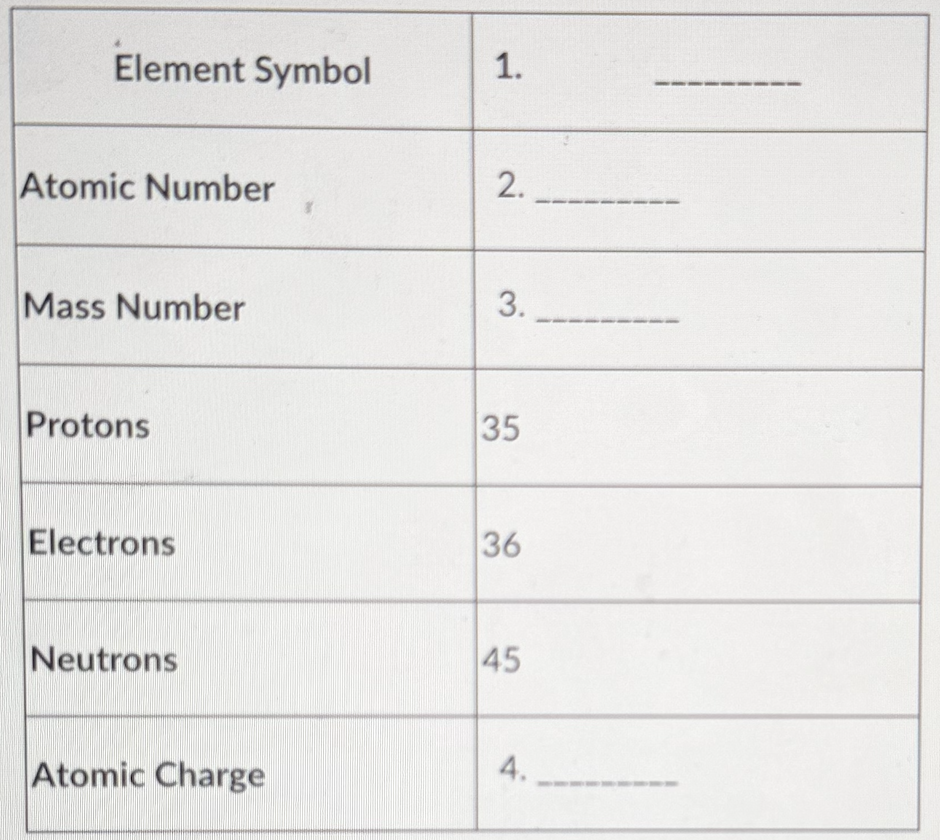
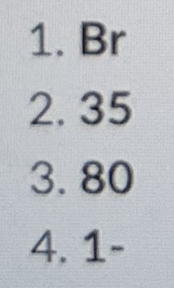
You are performing an experiment in the lab and have two different metal cylinders on your bench, each made of a different metal. You forgot to label which was which and they both look exactly the same. You do not have any extras so you cannot start over.
Based on what you have learned in this module, write out what steps you can take to quantitatively identify which is which. Your answer should contain at least 3 complete sentences to receive full credit.
determine volumes using water displacement or geometric measurement.
determine masses.
calculate densities.
compare densities to known values.
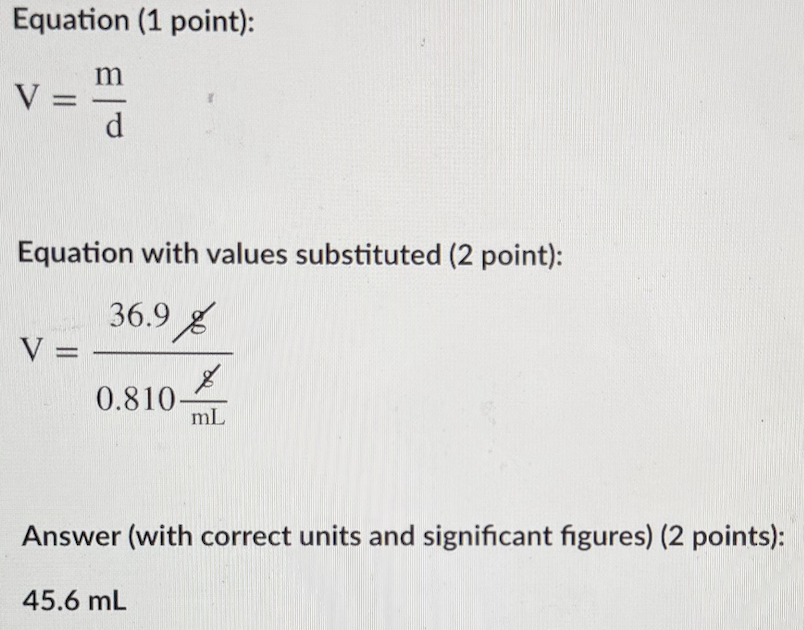
What is the volume of a sample of ethylene glycol if it has a density of 0.810 g/mL and weighs 36.9 grams?
Equation:
Equation with known values substituted:
Answer (with correct units and significant figures):
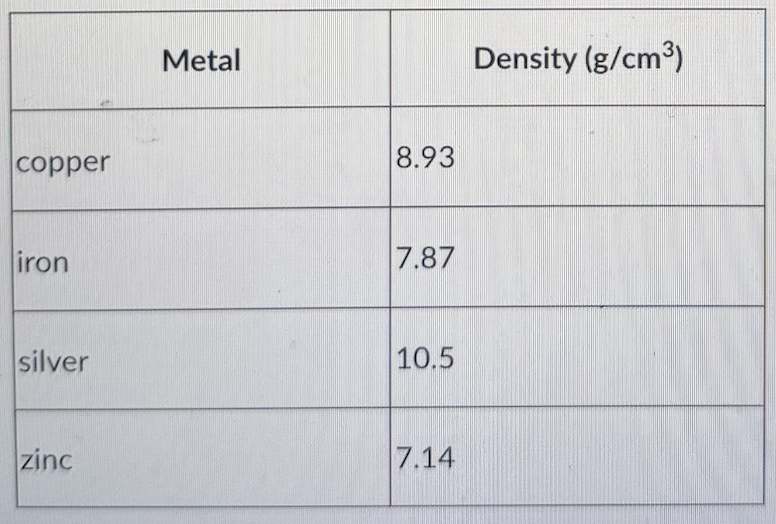
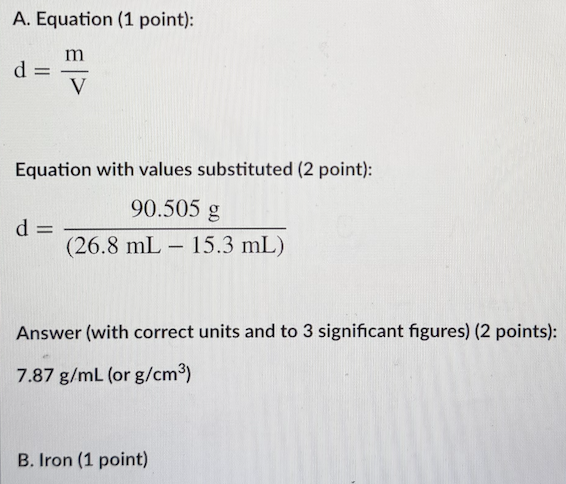
A short metal rod was submerged in a graduated cylinder partially filled with water. The initial volume of water in the graduated cylinder before the rod was added was 15.3 mL. After the metal rod was submerged, the volume in the graduated cylinder was 26.8 mL. The mass of the rod is 90.505 grams.
A. What is the density of the metal rod?
Equation:
Equation with known values substituted:
Answer (with correct units and to 3 significant figures):
B. Given the following information, what is the metal rod made out of?
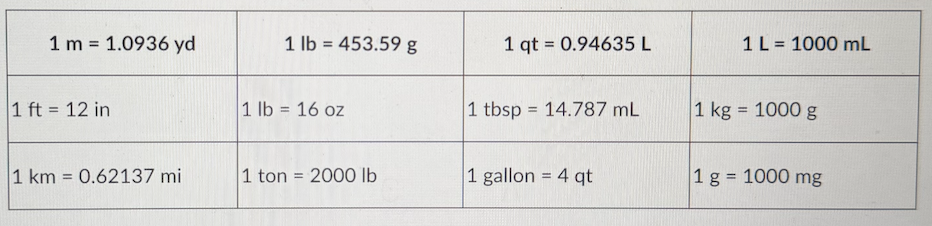
Use dimensional analysis and the conversion factors below to perform the following unit conversion.
You must show the setup of the calculation and the final answer to receive full credit. You do NOT need to show your intermediate work.
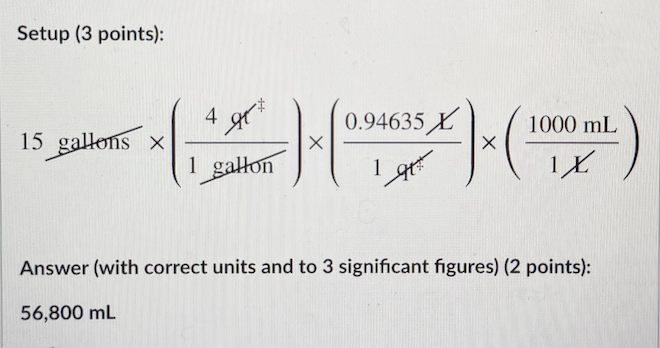
A gasoline tank holds 15.0 gallons of gasoline. How many milliliters (mL) does the tank hold?
Setup:
Answer (with correct units and to 3 significant figures):

Use the following conversion factors to convert between the different temperature scales below.
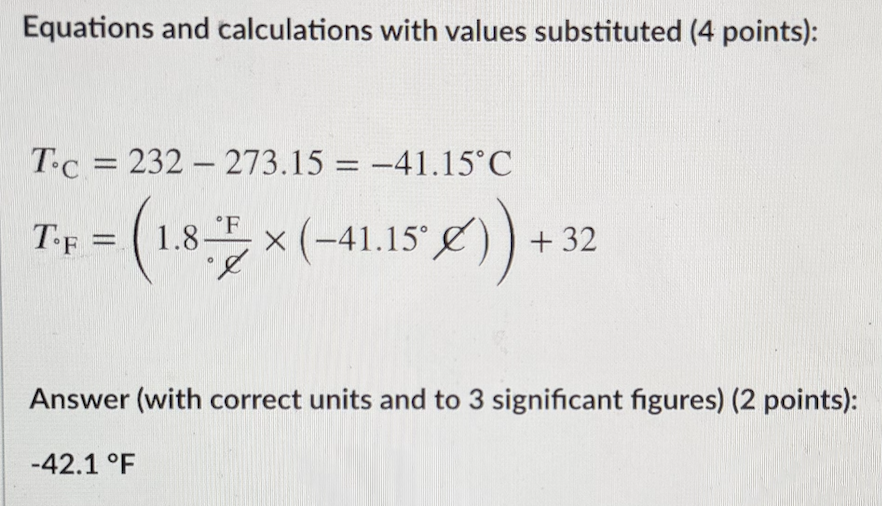
232 K = —°F
Equations and calculations with values substituted:
Answer (with correct units and to 3 significant figures):
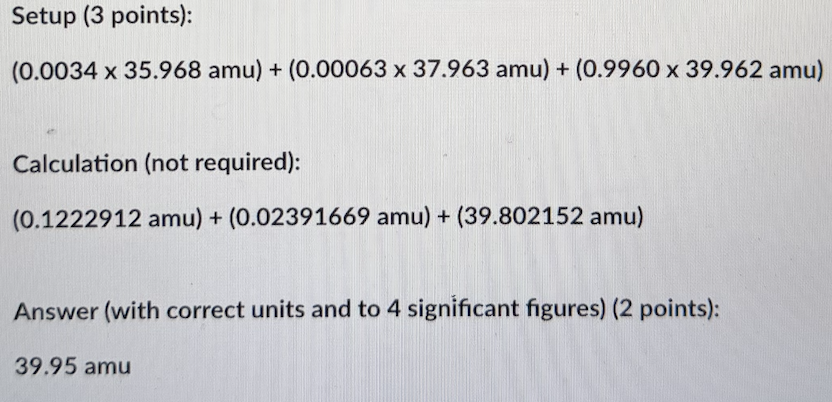
A sample of argon is found to contain 0.34% of 36 Ar atoms (mass 35.968 amu), 0.063% of 38 Ar atoms (mass 37.963 amu), and 99.60% of 40 Ar atoms (mass 39.962 amu. Calculate the average mass of an Ar
atom.
Setup:
Answer (with correct units and to 4 significant figures):