Chapter 2: Introduction to Business Combinations and the Consolidation Process
 Call Kai
 Learn
Learn Practice Test
 Spaced Repetition
 Match
Match Flashcards
 Knowt Play
1/57

There's no tags or description
Looks like no tags are added yet.
Name | Mastery | Learn | Test | Matching | Spaced | Call with Kai | Chat |
|---|
No analytics yet
Send a link to your students to track their progress
58 Terms
Business Combinations and (non-business) asset acquisitions
When obtaining control over a group of net assets qualifies as the acquisition of a business, a specialized set of accounting principles, called the acquisition method applies
—> this method applies only to transactions that qualify as business combinations
-need to know when an acquired group of net assets meets the definition of a business
-a company can do a business combination by one stand alone company purchasing another stand alone operating company, but it can also be a company buying a group of net assets that are not preexisting operating companies
—> a company might acquire from another company one of its preexisting product lines, or intellectual property or unproven R&D of a potential new product
-every acquiring company must preform an evaluation of whether an acquired group of net assets meets the definition of a business
—> a business if an integrated set of activities and assets that is capable of being conducted and managed for the purpose of providing a return in the form of dividends, lower costs, or other economic benefits directly to investors or other owners, members or participants. A business consists of inputs and processes applied to those inputs that have the ability to contribute to the creation of outputs. Although businesses usually have outputs, outputs are not required for an integrated set to qualify as a business
-The evaluation of an acquired group of net assets begins with an initial shortcut test of whether substantial all of the fair value of the gross assets acquired is concentrated in a single identifiable asset or group of similar identifiable assets. If substantially all of the fair value of the gross assets acquired is concentrated in a single identifiable asset or a group of similar identifiable assets, then the acquired set of net assets is not a business and the transaction is automatically accounted for as lump sum acquisition of assets. an acquiring company that qulalifies for this exception foes not need to evaluate the inputs, processes or outputs of the acquired group of net assets
—> even if an acquiring company is obtaining assets and liabilities, this test applies ONLY to assets
if an acquirer does not qualify for the business exemption allowed in the shortcut gross assets test, then the acquirer must evaluate the acquired group of net assets for the inputs, processes, and outputs that are present
-input: any economic resource that creates, or has the ability to contribute to the creation of, outputs when one or more processes are applied to it. Examples= long lived assets, intellectual property, the ability to obtain access to necessary materials or rights, and employees
-Process: any system, standard, protocol, convention, or rule that when applied to an input or inputs creates or has the ability to contribute to the creation of outputs. Examples= strategic management processes, operational processes, and resource management processes. These processes are typically documents, but the intellectual capacity of an organized workforce having the necessary skills and experience following rules and conventions may provide the necessary processes that are capable of being applied to inputs to create outputs
-Output: the result of inputs and processes applied to those inputs that provide goods or services to customers, investment income (such as dividends or interest), or other revenues
integrated set of activities and assets requires only two essential elements
at least one input and at least one SUBSTANSIVE process
-the factors that provide evidence that a process is ‘substantive’ depend on whether the group of net assets had produced outputs.
-If the group of net assets has not yet produced outputs, then a substansive process would include an organized workforce of employees with the knowledge and experiance to perform or apply an acquired process that is critical to the ability to develop or convert an input into outputs
-if it has already produced outputs, then a substansive process would include an organized workforce that can continue to produce that output or a process that significantly contributes to producing outputs, but that cannot be replaced without significant cost
-the business definition of outputs is focused on whether a group of net assets is capable of being conducted and managed for the purpose of providing a retun
—> an output is the result of processes applied to inputs, and is the factor that generates revenues from teh acquired group of net assets
Review of (non-business) asset acquisition
-if more than one net asset is purchased for a single lump sum payment and the group of net assets does NOT qualify as business, the purchaser should proportionately allocate the lump sum payment to the individual acquired net assets on the basis of the relative fair values if the acquired net assets. Amounts paid by the purchaser for transaction costs are also included in the lump sum amount allocated to the acquired net assets
-if the purchaser provides contingent consideration to the seller that amount is excluded until the contingency is resolved
-the investor records the assets purchased and liabilities assumed at their allocated costs on the date of purchase, and cash is credited for the payment
-a basket purchase of net assets that does not qualify as a business transaction is accounted for just like the purchase of any other asset; each asset is recorded at the allocated cost that we compute

Types of Business Combinations
-when the acquisition of net assets qualifies as the purchase of a business a specilized set of accounting principles, called the Acquisition Method applies
-This method applies only to business combinations, which are most commonly executed via two general types of transaction structures: net asset and stock acquisitions
-in a net asset acquisition, the acquirer directly purchases the individual net assets that constitute a business
-in a stock acquisition, the acquirer purchases the business by acquiring the voting shares
Net Asset Acquisition
The acquirer purchases some or all of the assets of the acquiree, and may assume selected liabilities, like a mortgage on a building it is acquiring
-the net assets are recorded on the balance sheet with an offsetting reduction of cash and/or an increase in liabilities or common stock
-in business combinations, the acquiring company must apply acquisition method accounting which requires that the acquired net assetsare recorded on the balance sheet at fair value, regardless of the amount paid by the acquirer. The purchase price for the acquired net assets are not allocated to those net assets, instead the assets are recorded at their respective fair values with any difference between the fair value of those net assets anf the purchase price paid for them recorded at goodwill
-Goodwill is an intangible asset that is only recorded in transactions that qualify as business combinations
-transaction costs related to acquiring a business are not capitalizedd in asset values, instead when a business is acquired all transaction costs are expensed in the period they are incurred
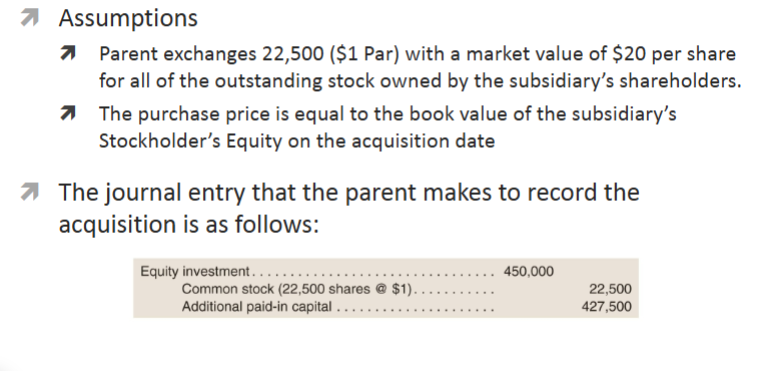
-the investor records the net assets purchased at their fair values on the date of purchase and cash is credited for the payment, In the purchase of net assets the qualify as a business, transation costs are expensed as incurred. The issuence of CS is recorded by a credit to CS for the par value of the share issued, with the remainder as APIC.
-the acquired net acquired assets are recorded at their fair values, not at the allocated cost
Stock acquisition
-an investor purchases all of the investees outstanding common stock from its shareholders rather than the individual net assets in the company
-DR equity investment for the implied stockholders equity of the investee’s business that the investor has acquired
-DR expenses for transaction costs, CR cash, CS, APIC, and Contingent consideration liability
-most transactions are are structured to be like this because:
-most transactions the qualify as business combinations involve an acquiring company obtaining control of an investee company via common stock ownership
—> this is because maintaining the limited liability structure of the acquired company will limit the potential liability on the part of the acquiring company. The potential losses from unknown and potentially large negative outcomes are generally limited to the amount of the investment in the investee companys common stock
-and the purchase of individual net assets will retitling of the acquired company’s assets and renegotiating many of the acquired company’s obligations
-so… companies have lower potential exposure to legal liability and lower transaction costs by simply purchasing the common stock of an investee company
-When a company purchases common stock in an investee, an Equity Investment account is recorded in its internal accounting records. If the equity method is applied, the balance in this asset account on the investor's balance sheet fluctuates in direct proportion to changes in the target company's stockholders' equity.
-If the buyer holds a controlling interest in the acquired entity, it cannot simply disclose this Equity Investment line item on its public financial statements. Instead, accounting regulations mandate that controlled subsidiaries be presented using full consolidation.
When does “control” Exist
-control is an explicit component of the definition of an asset and is implicit in the production of representationally faithful financial statements
-central element in determining the boundaries of every reporting entity
-the actual definition of control within financial reporting rules is intricate.
This difficulty exists because modern U.S. standards recognize two distinct pathways to control: holding a numerical majority of voting shares or having qualitative authority to guide operations while absorbing most economic gains and losses regardless of equity share.
-so we assume consolidation is required because a parent company owns a majority of the voting equity securities of one or more subsidiareis and that control is obtained when a parent company initially acquires a majority interest in the common stock of a sub
Consolidation on the date of acquisition: the intuition underlying the consolidation process
Core Objective of Consolidation: The goal is to report financial statements for a single economic entity under common control, rather than treating the parent and subsidiary as disconnected legal entities.
The Concept of "Replacement": Conceptually, consolidation is a process of substitution. On the parent's balance sheet, the single-line asset account—Equity Investment—serves as a placeholder representing the net assets (assets minus liabilities) of the subsidiary. Consolidating means removing that single placeholder account and replacing it with the subsidiary's actual individual assets and liabilities.
Avoiding Double Counting: Simply adding the two companies' financial statements together line by line would distort the balance sheet. The subsidiary's net assets are already embedded inside the parent's Equity Investment account. Adding the subsidiary's assets and liabilities on top of the parent's investment account counts those underlying net assets twice.
Elimination of Reciprocal Equity Accounts: The subsidiary's Stockholders' Equity represents internal ownership held entirely by the parent, not equity owned by outside shareholders. To ensure consolidated stockholders' equity reflects only the external owners of the combined business entity (the parent's shareholders), the subsidiary's equity accounts must be completely eliminated.
Worksheet-Only Adjustments: Consolidation entry adjustments (debiting subsidiary equity and crediting equity investment) occur solely on a consolidation working paper or spreadsheet. They are never booked to the general ledger of either the parent or the subsidiary company.
What the Numerical Example Was Teaching You
The numerical example walked through a scenario where a parent acquires a subsidiary at book value to demonstrate three key mechanics:
Why Direct Addition Fails: It proved that simply summing the parent and subsidiary balance sheet accounts inflates both total assets and equity. The example showed that adding them directly double-counts the subsidiary's net assets—once in the parent's investment account and once in the subsidiary's asset accounts—and incorrectly inflates total equity by including equity held internally within the entity.
How Elimination Journal Entries Work Mechanically: It demonstrated the basic elimination entry required at acquisition:
Debit: Subsidiary’s Stockholders’ Equity (to remove internal equity)
Credit: Parent’s Equity Investment (to remove the asset placeholder)
The Balance Sheet Transformation: It illustrated how applying this elimination entry successfully substitutes the single-line Equity Investment asset with the detailed underlying assets and liabilities of the subsidiary, leaving the consolidated equity equal to the parent's standalone equity.
Buiness combinations
Obtaining control of a business is the triggering event for
business-combination accounting.
Understanding when an acquired group of net assets meets the
definition of a business is an important first step in accounting
for these transactions.
If the net assets acquired constitute a “business,” a specialized
set of accounting principles, called the Acquisition Method,
applies.
Acquisition Method applies to gaining control of a business.
acqusitions of assets v a businesss
A company might acquire from another company one of its
preexisting product lines, or intellectual property (e.g., patents),
or unproven research and development of a potential new
product.
These assets may or may not be classified as a “business.”
Every acquiring company must evaluate of whether an acquired
group of net assets meets the definition of a business to
determine the accounting treatment
Definition of a buisness
A business is an integrated set of activities and assets that is capable of being conducted and managed for the purpose of providing a return in the form of dividends, lower costs, or other economic benefits directly to investors or other owners, members, or participants.
Short-Cut Test:
If substantially all of the fair value of the gross assets acquired is concentrated in a single identifiable asset or a group of similar identifiable assets, then the acquired set of net assets is not a business and the transaction is automatically accounted for as lump-sum acquisition of assets (i.e., it is not a business combination)
Acquisition of Business
If the acquisition does not qualify as an asset purchase, the following elements are used to evaluate whether a transaction is a business acquisition:
a. Input—Any economic resource that creates, or has the ability to contribute to the creation of, outputs when one or more processes are applied to it.
b. Process—Any system, standard, protocol, convention, or rule that when applied to an input or inputs, creates or has the ability to contribute to the creation of outputs.
c. Output—The result of inputs and processes applied to those inputs that provide goods or services to customers, investment income (such as dividends or interest), or other revenues
Lump-sum Acquisition
-If acquiring company determines its purchase is treated as a lump- sum acquisition of assets, it will not need to evaluate the inputs, processes or outputs as the acquisition does not meet requirements of a business.
-If more than one net asset is purchased for a single lump-sum payment (“basket purchase”), the purchaser should proportionately allocate the lump-sum payment to the individual acquired net assets on the basis of the relative fair values of the acquired net assets
Difference between Asset Acquisitions and Business combinations
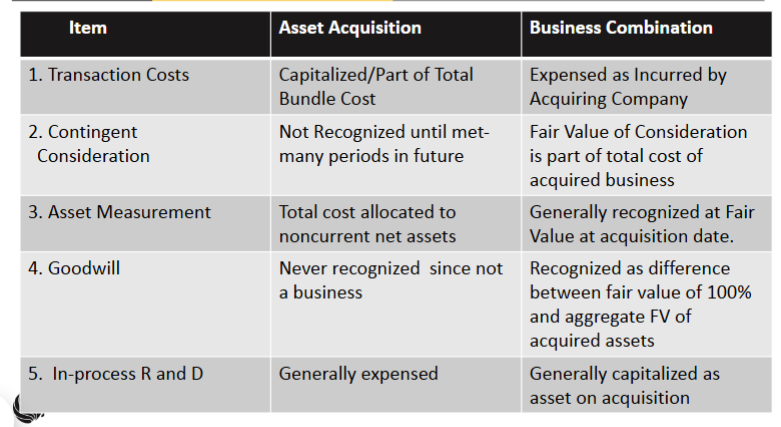
Acquisition Method
The acquisition method applies to business combinations executed via either:
a. Asset Acquisition: Acquirer purchases the individual net assets constituting a business.
b. Stock Acquisition: Acquirer purchases the business by acquiring the voting shares (voting shares are what held by anyone who owns that stock; treasury stock is not voting stock because its held in the treasury and we acquired it back
Net Asset Acquisition
-Net Asset Acquisition. In a net asset acquisition, the acquirer purchases some or all of the assets of the acquiree, and may assume selected liabilities. (might not assume all assets because many shareholders invest in the company and you might not want that on their books. For liabilities it might not have to do with company day to day operations so they dont want that)
-Acquiring company must apply Acquisition Method accounting, which requires that:
—> the acquired net assets are recorded on the balance sheet at fair value, regardless of the amount paid by the acquirer.
—> This means that the purchase price for the acquired net assets is not allocated to those net assets as in our previous example; instead, the assets are recorded at their respective fair values with any difference between the fair value of those net assets and the purchase price paid for them recorded as Goodwill. (i can assign a goodwill value even though i pick and choose my assets and liabilities)
—> Goodwill is an intangible asset that is only recorded in transactions that qualify as business combinations. (write off goodwill through impairment but if it is a private company than we can amortize goodwill)
—> In addition, transaction costs related to acquiring a business are not capitalized in asset values; instead, when a business is acquired, all transaction costs are expensed in the period they are incurred.(those are normal day to day transaction costs. The exception is if i pay someone to issue stock in my company to you those costs reduce APIC, they are not an expense)
Statutory merger
If the acquired company ceases to exist after the acquisition, the assets purchased and liabilities assumed are recorded on the investor’s books. The dissolution following the sale is called a statutory merger
Stock acquisition
The Equity Investment account is an asset that is reported on the investor’s balance sheet just like any other asset, and, our use of the term “investment” in this journal entry implies that the acquired company will remain in existence after the purchase. (equity investment means we invested are ownership; debt investments can be short or long term depending on intent but equity is a long term investment. Our criteria for equity method is 20-50% if we have significant influence but if i loose sig inf then i go back to fair value; 0-20% is fair value with unrealized gains and losses; I can own 15% and still have significant influence depending on who else is owning stock; 51% and higher is the equidity method but required consolidated financials to take the companys to look like one)
-The amount allocated to the Equity Investment account is equal to the fair value of investee’s stockholder’s equity or net identifiable assets (assets - liabilities)
Use of stock aquisition
Investor who acquires controlling interest via stock:
a. Lowers legal liability by leaving investee limited liability structure intact. (owner that does not assume their debt)
b. Lowers transaction costs rather than retitling assets and attempting to renegotiate investee obligations on assets. (i dont want to pay to transfer all the stuff to my name, so by leaving it as a standalone they would be responsible for their own debts)
c. Also easier to dispose of interest in investee if company does not perform well.
When does ‘control’ exist?
U.S. GAAP includes two ways in which control can be achieved:
A quantitative majority of the voting equity interest –primary definition for decades
A qualitatively determined power to direct an entity’s activities and a majority of the entity’s economic risks and rewards (i.e., the primary beneficiary of a variable interest entity), regardless of the level of equity ownership. This concept was introduced in 2023 due to special purpose entities of Enron and other companies. (enron didnt want the world to know how many things they controlled; kept their ownership hidden)
-Determining whether control exists requires considerable judgment.
-For purpose of most of this course, we will assume control exists with ownership > 50% ownership of investee’s voting common stock.
-Further, even if investor owns > 50% control may not exist: if the investee company is a variable interest entity, is in bankruptcy (once you file bankrupcy the govt has control over the business), or has business activities that are controlled by a foreign government.
Consolidation: Why?
-To present the operating results and the financial position of a parent and all its subsidiaries as if they are one economic entity
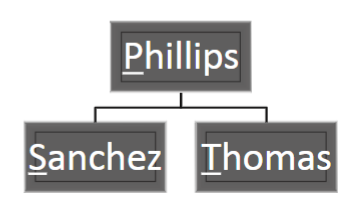
-Example: Phillips owns a controlling interest in Sanchez and Thomas
—>Consolidated financial statements
—> Include operations of all three
—>NCI (noncontrolling interest) for shareholders of S and T
(who are not shareholders of P)

Consolidation: What?

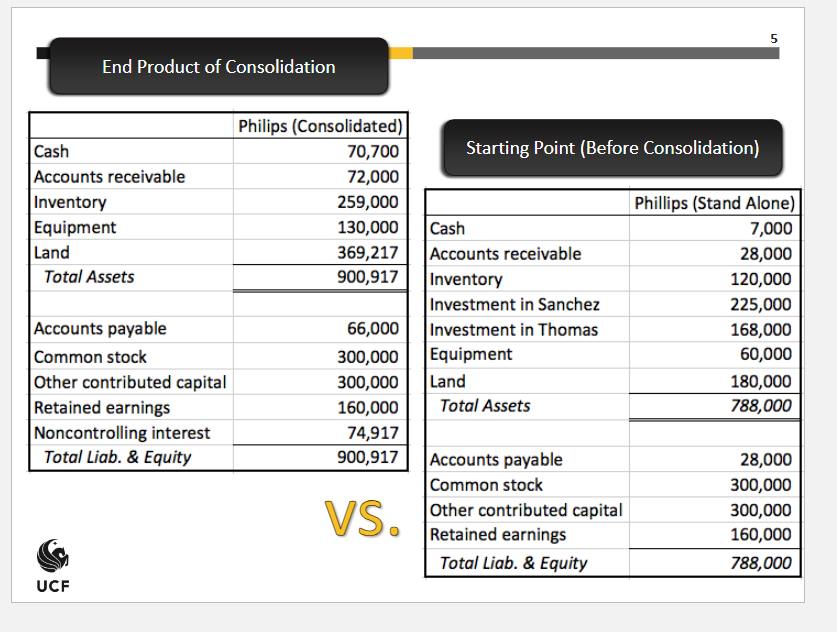
endproduct of consolidation vs starting point
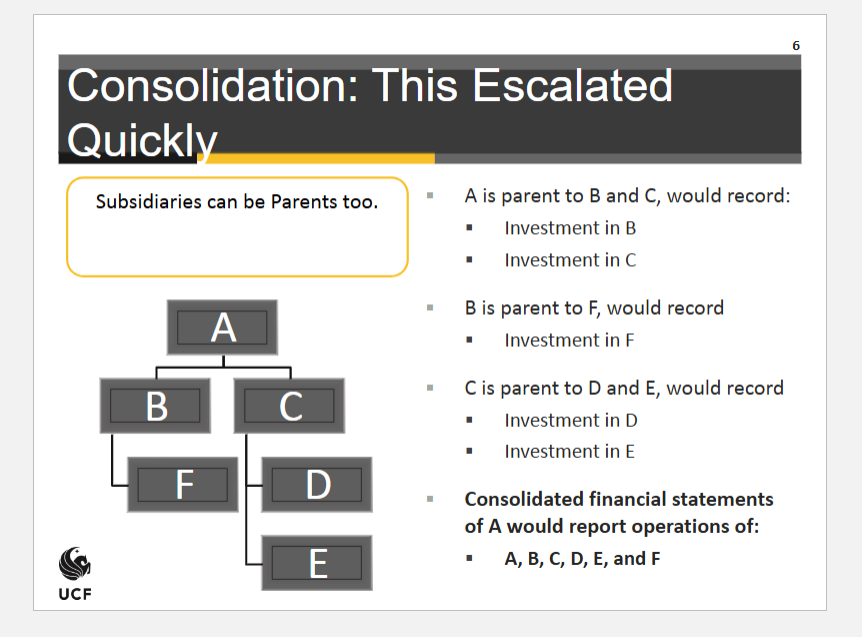
recording equity in S
-recorded on parent general ledger
Parent and subsidiary maintain separate accounting records
Important difference from asset acquisition!
Parent records “Equity Investment” at cost (i.e., cost of making
investment) initially.
Cost measured as more clearly evident of
Fair value of consideration given (i.e., purchase price)
Fair value of consideration received (i.e., items purchased)
Expense direct and indirect costs of stock acquisition
Same as in asset acquisition
consolidating the financial statements
eleminating entry work on worksheet only
Balance sheet accounts are summed in their entirety
Elimination entries remove transactions between the parent and
its subsidiaries (or among subsidiaries) from the consolidated
balance sheet
-These entries exist in workpapers ONLY!!! (not recorded in GL of parent of sub)
Elimination entries
-eliminating on worksheet only

Consolidation process
-The Equity Investment account conveys to the parent the right to control the net assets of the subsidiary.
-Because the parent controls the subsidiary, there is a presumption under GAAP that the parent’s financial statements are more informative if the subsidiary’s individual net assets are reported by the parent instead of the single-line Equity Investment account.
-This process of replacing the parent’s Equity Investment account with the subsidiary’s assets and liabilities is called “consolidation.”
-The consolidation of the balance sheets of the parent and its subsidiary is accomplished by replacing the Equity Investment account with the assets and liabilities to which it relates.
-By replacing the Equity Investment account with the assets/liabilities to which it relates eliminates double counting if the financial statements were merely added together.
-The Equity Investment account, therefore, is not reported on the consolidated balance sheet and the amounts that are reported for consolidated assets and liabilities include those of both the parent and its subsidiary.
most important point
Here is the most important point and one students struggle
with:
-The consolidation entries are not actually recorded by either company in their respective general ledgers
-The entries are made only in our spreadsheet, and the consolidated balance sheet exists only in our spreadsheet.
-Thus, we have not changed the accounting records or the balance sheets of either the parent or the subsidiary.
acquisition-date consolidation (purch price = bv)
E entry: stockholders equity
-elimination entry you are making of EQUITY

Effects of the E consolidation entry
-The Equity Investment account is eliminated as a credit. Debit eliminates the Stockholders’ Equity of Investee.
—> Consolidated Stockholders’ Equity equals the parent company’s pre-consolidation Stockholders Equity.
-This will always be the case so long as the parent uses the equity method to account for its Equity Investment in the subsidiary.
-After the consolidation entry, the “Consolidated” column reports the balance sheet that we will issue to shareholders and other external parties.
Acquisition-date consolidation (purch price > than book value)
the 25000 to account for will go to goodwill

Acquisition Accounting Premium (aap) A entry
AAP aka differential because its the difference in what we have to pay
undervalues PPE; depreciation
patent; amortization
goodwill; impairment
AAP can be evolving over time because of depreciation, impairment and amortization

Composition of equity investment account
-The Equity Investment Account is composed of:
—> Book Value of Subsidiary’s Net Identifiable Assets(AKA as Equity per Books plus
—>Amount Assigned to Acquisition Accounting Premium
-To consolidate the financials, we will use the above information record the elimination entries on the consolidation workpaper
consolidation entries
E and A
-date of acquisition determines what we acquired, what we paid for, and what kind of issues it raises as we move forward year after year

Consolidated balance sheet (when purchase price exceeds subs BVSE)

Consolidated balance sheet
Three important points:
The book value of Stockholders’ Equity on the consolidated balance sheet is equal to the book value of Stockholders’ Equity of the parent, just like before.
—>This will always be the case so long as the parent uses the equity method to account for its Equity Investment.
Total consolidated assets are $250,000 more than in the balance sheet in our previous consolidation example. (extra we are paying to gain control)
Our approach to the consolidation process involves elimination of two components of the Equity Investment account sequentially:
—>[E] entry to eliminate Stockholders’ Equity of the subsidiary, and
—>[A] entry to eliminate the AAP.
-Equity Investment account has been reduced to a zero balance on the consolidated balance sheet
Recognition principle
“As of the acquisition date, the acquirer shall recognize, separately from goodwill, the identifiable assets acquired, the liabilities assumed, and any noncontrolling interest in the acquiree” (FASB ASC 805-20-25-1)
-The recognition principle is comprised of two central requirements related to recognition of assets acquired and liabilities assumed:
-As of the acquisition date, they must meet the definition of assets or liabilities, and
-They must be part of the business combination and not the results of a separate transaction.
measurement principle
“The acquirer shall measure the identifiable assets acquired, the
liabilities assumed, and any noncontrolling interest in the acquiree at
their acquisition-date fair values” (FASB ASC 805-20-30-1)
-The measurement and reporting of identifiable net assets will often include assets and liabilities that are not reported in the preacquisition balance sheet of the subsidiary.
-This is to be expected because current GAAP generally requires that companies expense (i.e., not capitalize) costs incurred to internally develop intangible assets.
Preacquisition contingencies
-If the contingency can be determined during the measurement
period, that asset or liability is recognized at the acquisition
date.
-An example is the liability relating to warranty obligations.
-These warranty liabilities must be recognized on the date of
acquisition.
Consolidation process
-These previously unrecognized assets and liabilities are
identified by the purchasing company and implicitly included in
the price it is willing to pay for the acquired subsidiary (and,
thus, in the Equity investment account).
-In the consolidation process, we remove the Equity Investment
account from the consolidated balance sheet and replace it with
both the recorded and unrecorded assets and liabilities to
which it relates.
Intangibles
intangible assets should be separately recognized if they can be
identified.
Intangible assets are considered to be separately identifiable if
they meet either of the following criteria:
The intangible asset arises from contractual or other legal rights,
or
The intangible is separable, that is, it can be separated or divided
from the acquired entity and sold, rented, licensed, or otherwise
transferred
contingency
-if there is a contingency i may have agreed to pay shareholdes an additional amount, but if i have control, i control the future so i will probably not pay it
-impact income statement if you change Fair value of the liability
-if the estimate is reduced, i would record a gian. If i need to increase the liability than i take a loss i my incomestatement
-contigency related to sto
acquisition related costs
Acquisition-related costs
Services provided by attorneys, accountants, and investment
bankers
Indirect costs, such as office expenses of the investor company
Expense in the income statement of the investor company in
the period of the acquisition